


MPC lets you measure results across partners without exchanging raw customer records. I’d start with one question, then set matching rules, data permissions, and report limits before running any calculation.
Here’s where it fits:
- Ad attribution: Match ad events with conversions and assign campaign credit.
- Cross-partner counts: Remove duplicate conversions without sharing matched identities.
- Lift studies: Compare treatment and control outcomes to estimate what a campaign caused.
- Shared reporting: Give brands and vendors approved aggregate results – not a shared customer dataset.
The distinction matters: counting sales isn’t assigning credit, and assigning credit isn’t proving lift.
I’d also treat <u>output privacy as a separate requirement</u>. A cutoff of 100 matched users, for example, is a reporting rule – not a privacy guarantee. Small groups, overlapping reports, and repeated queries can still expose data. MPC needs access controls, output checks, and a study design that fits the question.
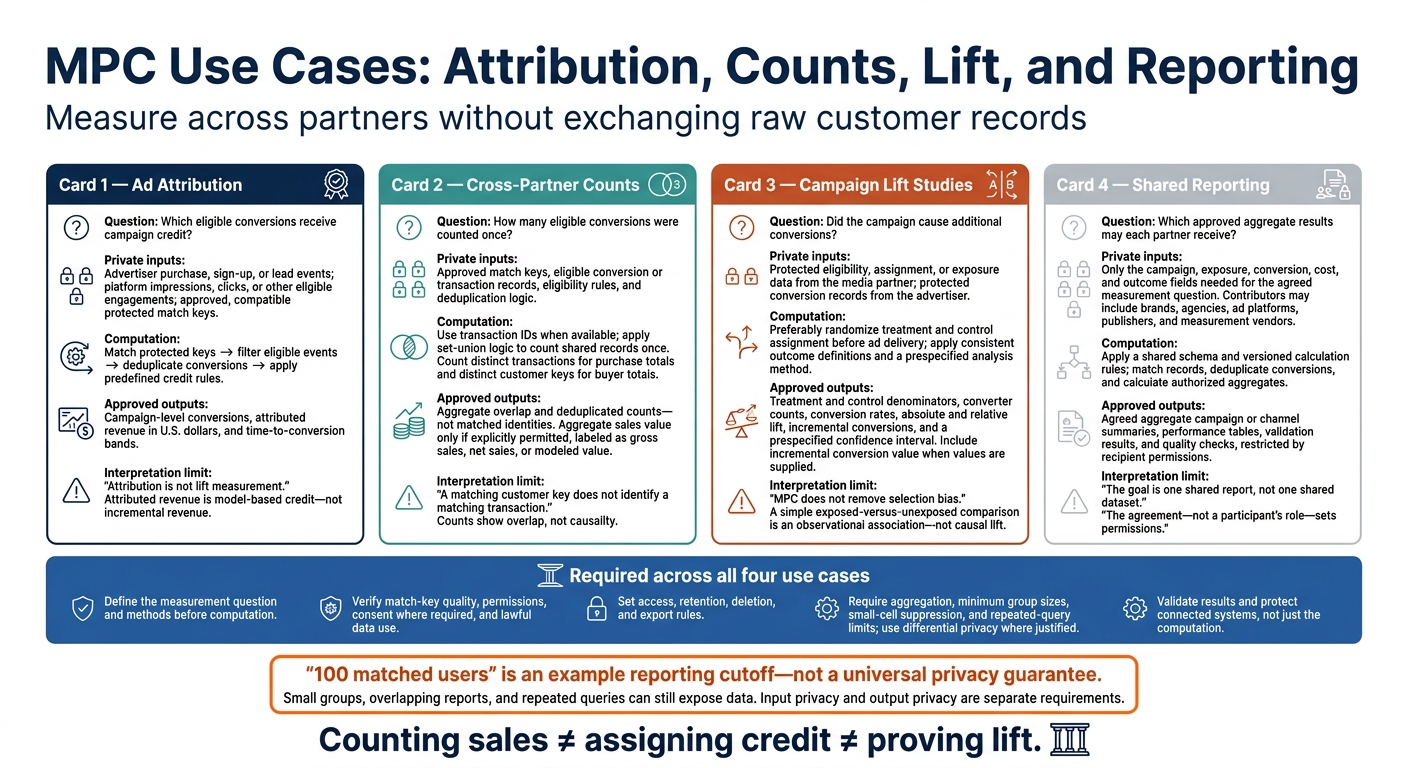
MPC Use Cases: Attribution, Counts, Lift, and Reporting
1. Ad Platform Matching and Attribution
Match Ad Events With Conversions
Attribution is not lift measurement. For attribution, the advertiser provides purchase, sign-up, or lead events. The ad platform provides impressions, clicks, or other eligible engagements. An MPC operator coordinates the joint computation.
Both parties need approved, compatible match keys. Before matching, check identifier normalization, token handling, consent, and expiration as part of your customer journey mapping. IAB Tech Lab’s ADMaP guidance calls for authenticated, deterministic first-party data and the user consent needed for measurement.[7]
Set credit rules before matching. Define eligible impressions and clicks, conversion-time boundaries, click-through and view-through windows, cross-device handling, and credit allocation. Specify which transaction ID removes duplicate orders. Also decide how refunds, cancellations, repeat purchases, and multiple conversions from one user affect totals.
The protocol then matches protected keys, filters eligible events, deduplicates conversions, and applies those credit rules.[4]
Report Aggregate Attribution Results
After matching, publish only campaign-level aggregates. Use a shared event schema, stable campaign IDs, and UTC timestamps. Agree on revenue fields and currency conversion rules before reporting amounts in U.S. dollars. State the denominator for every conversion rate, and identify each report’s period, model, and attribution window.[5]
One shared schema makes clear what each party contributes and what it may receive.
| Participant | Private inputs | Role in the joint computation | Approved outputs | Records not disclosed to other participants |
|---|---|---|---|---|
| Ad platform | Protected match keys, event types, campaign IDs, exposure and click timestamps | Enables ad-event matching and credit allocation | Campaign-level conversions and time-to-conversion bands | Raw exposure logs, click histories, identifiers |
| Advertiser | Protected match keys, conversion timestamps, transaction IDs, conversion types, values | Enables conversion deduplication and revenue calculations | Campaign-level conversions and attributed revenue in U.S. dollars | Customer lists, individual orders, raw conversion records |
| MPC operator | Protected inputs under the chosen protocol | Coordinates matching, window checks, deduplication, and aggregation | Only outputs authorized for its role | No entitlement to either party’s unprotected inputs or a user-level match file |
Set output protections before enabling exports.
A policy could suppress cells under 100 matched users, but that is a configurable threshold – not a universal privacy guarantee.
Limit overlapping queries and granular breakdowns. Use differential privacy where needed.[8] Before production, test duplicate and unmatched records, then reconcile aggregate results against approved source totals. Label attributed revenue as model-based credit – not incremental revenue.[6]
2. Cross-Partner Conversion Counts
Count Conversions Without Double-Counting
Brands, publishers, marketing agencies, and vendors can use MPC to compare approved match keys against eligible conversion records. The output contains aggregate counts, not matched identities. IAB Tech Lab’s ADMaP separates identity mapping, attribution computation, and reporting in its privacy-oriented measurement workflow.[13][14] Counting overlap and assigning credit are different tasks.
A matching customer key does not identify a matching transaction. Use transaction IDs when available, plus conversion type, campaign ID, event date, and a defined reporting window to decide which records qualify. Count distinct transactions for purchase totals and distinct customer keys for buyer totals. When multiple participants contribute records, use set-union logic to count shared records once.
Before computation, resolve conflicting records. Specify which source determines transaction status and how late-arriving events affect published totals. Release only approved overlap and deduplicated counts. Include aggregate sales value only if the agreement explicitly allows it, and state whether it represents gross sales, net sales, or modeled value.[10][12] Never export individual match details or customer-level spend.
Separate Conversion Counts From Attribution
Keep deduplicated totals separate from campaign credit:
| Metric | Question answered | Required data | Interpretation limits |
|---|---|---|---|
| Deduplicated conversions | How many eligible records were counted once? | Approved match key, conversion or transaction record, eligibility rules, and deduplication logic | Shows overlap, not causality. |
| Attributed conversions | How many eligible conversions received campaign credit? | Conversion records, campaign or exposure identifiers, timestamps, attribution window, and model or priority rules | Model-based credit is not causality. |
| Conversion value | What aggregate conversion value was reported? | Approved transaction values, currency rules, refund treatment, and aggregation permissions | Reported value does not prove profit or incrementality. |
Shared counts measure overlap. Incrementality requires a causal design, so use a lift study when you need to measure whether a campaign caused additional conversions.
Each participant still needs permission to use the data, deletion deadlines for inputs and logs, and query limits that prevent small-segment leakage.[9][11]
3. Campaign Lift Studies
Measure Treatment and Control Outcomes
When attribution isn’t enough, use MPC to measure incremental lift. The media partner supplies protected eligibility, assignment, or exposure data, while the advertiser supplies protected conversion records. Before launch, define the eligible population, assignment, dates, time zone, conversion window, events, deduplication, exclusions, primary outcome, and analysis method. Once those details are fixed, MPC can calculate group-level outcomes without exposing user-level records.[4][15]
Randomize assignment before ad delivery and keep it fixed after launch. State whether the estimand is intent-to-treat lift or lift among exposed users. Set sample-size requirements based on the baseline conversion rate, minimum detectable lift, treatment-control allocation, and desired statistical power. Apply the same outcome definitions to both groups, document missing data, and check whether control users saw ads elsewhere.[17]
Compare Attribution With Incremental Lift
Attribution and incrementality answer different questions:
| Dimension | Attribution | Incrementality |
|---|---|---|
| Study design | Rules-based or model-based analysis of observed journeys | Preferably randomized treatment and control groups |
| Typical output | Attributed conversions, attributed revenue, or credit share | Absolute and relative lift, incremental conversions or value, and confidence interval |
| Main uncertainty | Missing touchpoints, conversion-window choices, cross-device gaps, and attribution assumptions | Sampling error, insufficient power, noncompliance, contamination, and selection bias without randomization |
MPC does not remove selection bias. Users who receive ads may differ from control users in intent, geography, device, or purchasing behavior. Label a simple exposed-versus-unexposed comparison as an observational association – not causal lift. An imprecise result does not establish that there was no effect.[17]
Report MPC-derived treatment and control denominators, converter counts, conversion rates, absolute and relative lift, incremental conversions, and a prespecified confidence interval. Include incremental conversion value when values are supplied.[5][15]
Set minimum cell sizes before analysis. Suppress or combine small groups, and make sure related totals cannot reveal suppressed values. Predefine reporting dimensions and limit repeated queries: overlapping cuts can leak information and encourage selective reporting. Disclose rounding or privacy noise, and control repeated testing.[16][18]
4. Shared Reporting Across Brands and Vendors
Agree on Matching and Reporting Rules
In shared reporting, MPC controls access as tightly as it controls computation. The goal is one shared report, not one shared dataset. Brands, agencies, ad platforms, publishers, and measurement vendors can supply private inputs to a single MPC process. Start with the measurement question, then request only the campaign, exposure, conversion, cost, and outcome fields needed to answer it. The computation can match records, remove duplicate conversions, and calculate approved aggregates using the agreed attribution rules.[6][19]
Use a shared schema with stable campaign IDs, consistent event definitions, and standardized timestamps so everyone works from the same report definition. Document matching keys, how to handle late-arriving events, the cost basis, and schema versioning. Version the calculation rules and code, too. Log submissions, corrections, and report downloads so participants can reproduce a result.[20]
Define Each Participant’s Report Access
The agreement – not a participant’s role – sets permissions. Document each recipient’s allowed metrics, dimensions, date ranges, exports, and retention period. The table below outlines possible contributions and approved aggregate outputs; it does not grant access automatically. A measurement vendor may run the computation without permission to inspect source records or use the data for unrelated analysis.[21]
| Participant | Possible private contribution | Approved aggregate outputs | Raw data not disclosed to other participants |
|---|---|---|---|
| Brand | First-party conversion events, order values, customer or account keys, product category, outcome labels | Aggregated conversions, revenue, attributed return on ad spend, campaign or channel summaries | Customer identities, transaction-level records, unapproved product or customer segments |
| Ad platform | Impressions, clicks, campaign IDs, placement, spend, exposure timestamps, platform-side conversion signals | Campaign reach, frequency, attributed conversions, cost, performance totals | User-level delivery logs, platform identifiers, publisher-level confidential data, unapproved audience attributes |
| Publisher | Exposure events, inventory, placement, page or app context, publisher-side events | Aggregated exposure, reach, conversion, or campaign performance results | Subscriber or visitor identities, browsing histories, transaction-level events |
| Agency | Media plans, campaign taxonomy, budgets, optimization inputs, client data | Cross-campaign summaries, pacing, cost, and performance reports | Client raw customer data, partner-level logs, confidential platform data |
| Measurement vendor | Protocol execution, matching and aggregation logic, audit records, report delivery | Agreed tables, validation results, and quality checks | Participant source records, unrestricted identifiers, undisclosed partner-specific results |
Enforce these permissions within the computation. Permit campaign, channel, date, geography, or device breakdowns only when approved and when the groups are large enough. Review requests across brands and partners together: subtracting client-specific results from portfolio totals can expose confidential results, even if each report looks acceptable on its own.[21]
Build access controls into the reporting pipeline, not just the dashboard. Log queries, approvals, and downloads, and test for ways to bypass controls or expose data through intermediate values. Prevent shared reports from enabling reidentification or inference. Assign an owner and approval authority to every report, including later analyses.[20][21]
What is Secure Multiparty Computation (MPC)?
MPC Requirements and Privacy Limits
Before production, lock down the data contract, access rules, and privacy controls. Each workflow needs a fixed measurement question and clear release limits for campaign aggregates, deduplicated counts, lift results, and performance marketing report access.
Define Data, Methods, and Access
Verify match-key quality and the legal basis for using the data. Check coverage, missing values, key collisions or duplicates, and the expected match rate. Confirm that each party can lawfully contribute its data. Then fix conversion definitions, windows, time zones, cross-device rules, deduplication, and credit allocation before any pilot or production run.
Document permitted use, access, retention, and deletion rules for source files, shares, intermediate files, and reports. Set audit rights and a process for disputes. Run a limited pilot with predefined requirements for match quality, processing time, and accuracy. Use synthetic or authorized benchmark data to confirm that results can be reproduced across two runs.
Protect Outputs and Connected Systems
Once inputs are defined, control what the outputs can reveal. Input controls alone aren’t enough. Require aggregation, minimum group sizes, small-cell suppression, and repeated-query limits to block difference attacks. Add differential privacy only when the release plan justifies the loss of accuracy. Document its privacy parameters, cumulative privacy budget, and accuracy tradeoffs across releases.[21][24][26]
Choose a protocol that fits the threat model, including malicious participants, possible collusion, and compromised endpoints. A protocol built for honest-but-curious participants may not stop deliberate manipulation. Review secret-share handling, key management, rejection of malformed inputs, and checks that the approved computation ran as intended. Protect ingestion endpoints, credentials, logs, storage, and downstream dashboards – not just the computation itself.[21][23][25]
The FTC warns that hashing does not automatically make identifiers anonymous.[22] Before running the measurement workflow or releasing results, require privacy, security, and legal approval covering notices, consent, consumer rights, contracts, retention, incident handling, and a named owner.
Conclusion: Choose MPC for a Defined Measurement Question
MPC fits four measurement jobs across these use cases: ad-event matching, cross-partner deduplication, lift studies, and shared aggregate reporting. Attribution assigns credit; lift estimates incrementality.
Start each use case with one measurable business question and the decision it will guide. Before launch, define the methods, permissions, and output limits. Before shifting budget, check aggregates against independent totals or experiment holdouts. Use MPC when answering the question requires multiple parties’ data and strict control over outputs – not as a default privacy layer.[27]
FAQs
How do I know if MPC fits my measurement needs?
MPC works well for cross-partner or cross-channel marketing attribution – including ad platform matching, conversion counts, and shared reporting – when organizations can’t or won’t share raw user-level data. It lets them analyze data together without exposing it, so they can collaborate while meeting privacy constraints [1].
MPC also supports privacy-first approaches that rely on aggregated, noise-protected signals instead of tracking individuals [1][2].
What if partners use different customer identifiers?
Secure multi-party computation (MPC) lets partners analyze data together without sharing raw information or needing a common customer identifier [1]. It processes encrypted data through a trusted aggregation service to produce results, such as conversion counts or campaign lift, while keeping the raw data private [1][2]. Instead of matching identifiers directly, MPC focuses on aggregate statistics rather than individual customer records [2].
How do privacy controls affect measurement accuracy?
Privacy controls move measurement away from individual tracking and toward aggregated data with added noise [1][2][3]. Differential privacy adds noise to prevent re-identification, but it also makes results less precise for smaller campaigns. Privacy budgets, such as epsilon, limit how much a browser can contribute, balancing useful data with anonymity [1][2].
Compared with cookie-based methods, these controls leave data gaps and offer less detail. They also provide a more reliable, compliant basis for performance measurement as the digital landscape changes [2][3][4].