


Attribution tools help marketers understand which campaigns drive sales. But tracking user behavior comes with privacy challenges. With regulations like GDPR and CCPA, and the phase-out of third-party cookies, businesses must balance marketing insights with user privacy. Here’s how:
- Privacy Risks: Traditional methods use cross-site tracking, risking user data exposure.
- Regulations: GDPR and CCPA demand explicit consent and data transparency.
- Solutions: Use privacy-friendly APIs, differential privacy, and first-party data.
- Steps to Improve Privacy:
- Conduct privacy audits to identify risks.
- Minimize data collection and set clear retention policies.
- Implement server-side tracking and browser-mediated systems.
- Use consent management platforms (CMPs) to automate compliance.
- Leverage tools like the Attribution Reporting API for aggregate insights.
GDPR Proof Attribution. Is Online Media Mix Modeling the Answer? – EP020
Auditing Attribution Practices for Privacy Risks
Before tackling privacy issues in your attribution setup, you need a clear understanding of the current landscape. A privacy audit helps identify where your tracking methods might breach regulations or expose customer data. The stakes are high – the average cost of a data breach is $4.35 million, and companies with weak privacy measures are nearly twice as likely to experience breaches compared to those with stronger data governance.
Running a Privacy Risk Assessment
Start by compiling a Record of Processing Activities (RoPA) – a detailed inventory that outlines the personal data you collect for attribution, the reasons for collecting it, where it’s stored, and who has access. This document helps map out data flows across your marketing tools and platforms.
Next, conduct a Data Protection Impact Assessment (DPIA) to pinpoint specific privacy risks in your attribution workflows. Pay close attention to tracking identifiers and scripts to ensure they don’t inadvertently enable cross-context recognition. As the W3C Working Draft explains:
"The goal of this document is to define a means of performing attribution for advertising that does not enable tracking".
Scrutinize cookies, tracking codes, and third-party scripts for any connections that might facilitate cross-site tracking.
Don’t forget to audit your vendors. Evaluate how ad platforms, analytics providers, and other partners handle the data you share with them. Ensure you have Data Processing Addendums (DPAs) in place – these legally binding agreements outline how vendors must safeguard customer information. If you’ve adopted modern privacy-preserving APIs like the Attribution Reporting API, you’ll also need to monitor "privacy budgets." These budgets restrict how much information a single browser can contribute to prevent re-identification.
| Assessment Component | Focus Area | Privacy Requirement |
|---|---|---|
| Data Inventory | Data Flow Mapping | GDPR/RoPA Compliance |
| DPIA | Risk Identification | Risk Mitigation & Governance |
| Vendor Audit | Third-party Contracts | Data Processing Addendums (DPA) |
| Retention Review | Data Lifecycle | Purpose Limitation & Minimization |
| Technical Audit | Tracking Identifiers | Prevention of Cross-Context Tracking |
Once you’ve completed these steps, it’s time to refine your data collection and retention policies.
Reviewing Data Collection and Retention Policies
After identifying privacy risks, you need to adjust your data practices. Start by implementing data minimization – only gather the information necessary for measuring each conversion event.
Set clear retention periods for attribution data. Use parameters like lifetimeDays in modern APIs to define how long data should be stored. For instance, if your typical customer journey spans 30 days from first click to purchase, there’s no reason to retain impression data for 90 days.
"Privacy by design ensures privacy factors are considered early in the development process".
Revisit your purpose limitation policies as well. Be explicit about why you’re collecting each piece of data before the attribution event occurs, and ensure it’s deleted or anonymized once that purpose is fulfilled. For example, if you collect email addresses to measure campaign performance, don’t reuse that data for unrelated marketing without obtaining fresh consent. Businesses must respect user preferences and delete data once its original purpose has been met.
Building Privacy-Focused Attribution Practices
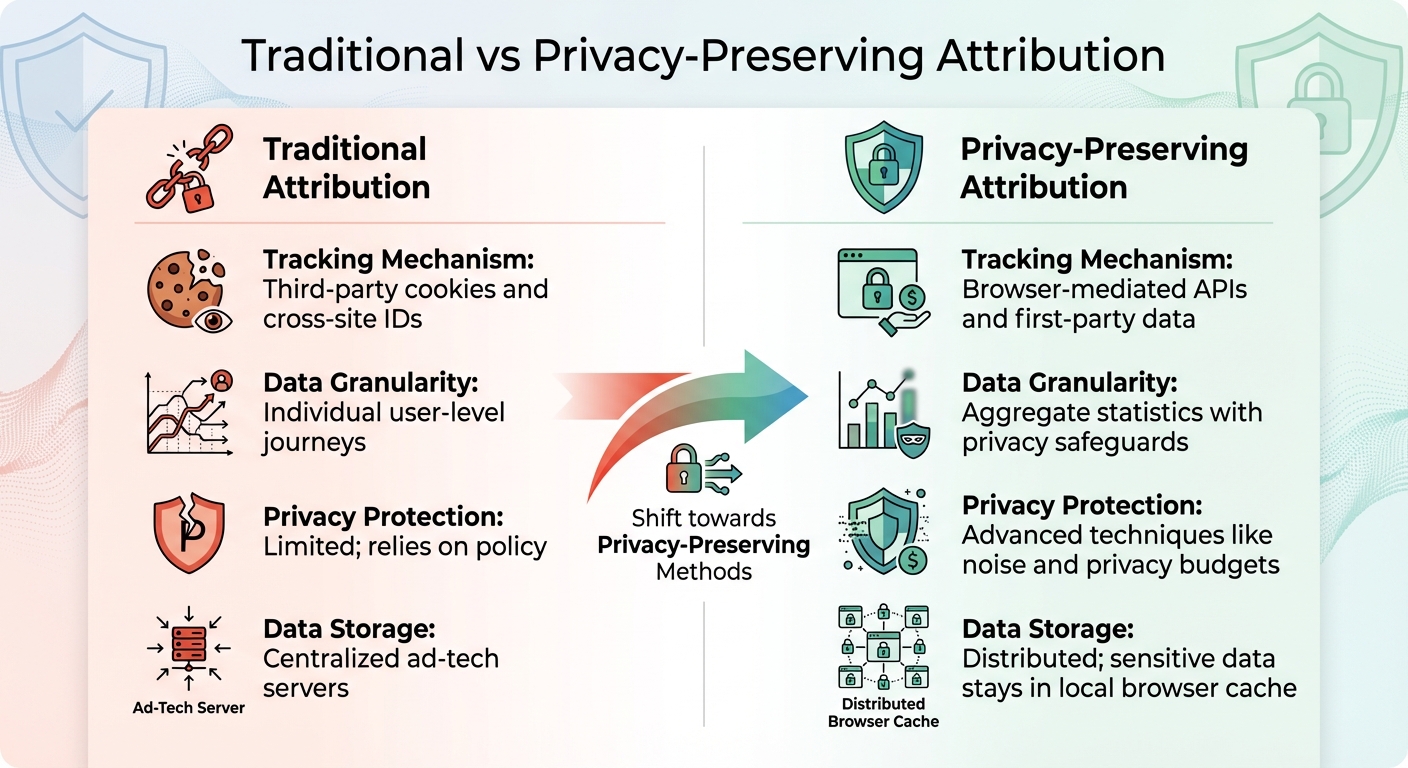
Traditional vs Privacy-Preserving Attribution: Key Differences
Once you’ve addressed privacy risks and refined your data policies, the next step is implementing technical solutions that balance user privacy with accurate attribution. Privacy-first approaches now favor browser-mediated systems over invasive tracking, offering aggregate insights without exposing individual user behavior.
Setting Up Granular Consent Management
Modern attribution APIs shift the responsibility for data reporting from advertisers to browsers. These APIs provide aggregate, differentially private statistics, ensuring user privacy while maintaining functionality. This approach redefines how consent operates – users can participate in attribution without revealing their privacy preferences to websites.
"The proposed design allows people the option of appearing to participate in attribution without revealing that choice to sites." – W3C Working Draft
Privacy budgets play a key role in these systems. They limit how much information a browser can contribute to aggregate reports, reducing the risk of re-identification. The epsilon parameter acts as a privacy budget, decreasing each time the browser shares data. When using the Attribution API with methods like saveImpression() (to log ad views) and measureConversion() (to generate reports), it’s crucial to fine-tune these parameters. This ensures a balance between accurate data collection and respecting user privacy.
Differential privacy further enhances security by introducing mathematical noise into aggregate data. Trusted aggregation services process this data, ensuring no single user’s information stands out. This shift focuses on group behavior rather than individual tracking – something the W3C refers to as "collective decision-making".
To complement granular consent, server-side tracking adds another layer of protection by centralizing data processing into aggregate formats.
Moving to Server-Side Tracking
Server-side tracking employs a trusted aggregation service to compute aggregate statistics while safeguarding individual data. In this system, browsers send encrypted reports to the aggregation service, which processes the data without exposing any single user’s contributions.
"The goal is to produce aggregate statistics about how advertising leads to conversions, without creating a risk to the privacy of individual web users." – W3C Working Draft
To transition smoothly, start by adopting the Attribution Reporting API. Use the Save-Impression HTTP header to securely log ad events. Choose an aggregation service that supports privacy protocols, such as dap-15-histogram, for collecting data across multiple web sources. During impression registration, configure parameters like histogramIndex and matchValue to maintain accurate attribution while protecting user privacy.
Run A/A testing to compare the Attribution Reporting API with your current methods. This helps evaluate reporting accuracy and coverage before fully switching over. You can also experiment with different batching frequencies – hourly, daily, or weekly – to reduce report loss and control how noise impacts your data summaries.
Using First-Party Data for Attribution
First-party data offers a privacy-conscious alternative to traditional tracking methods. Unlike third-party cookies, which follow users across websites and raise privacy concerns, first-party data keeps tracking confined to your controlled environment. This reduces the need for cross-site tracking and individual user profiling.
Privacy-preserving APIs use first-party interactions to produce aggregate statistics rather than individual-level data. You can customize attribution windows (e.g., 14-day or 30-day) to align with your customer journey by adjusting parameters like lookbackDays or expiry. Browsers typically send navigation-based attribution reports 2, 7, or 30 days after initial registration, while event-level reports are dispatched about an hour after the event expires, preventing real-time tracking.
To securely handle backend registration, use HTTP headers like Attribution-Reporting-Register-Source and Attribution-Reporting-Register-Trigger. Additionally, define metadata with parameters such as matchValue and histogramIndex during impression registration. This allows you to categorize data for analysis without storing personal identifiers. Finally, submit encrypted histogram contributions to a trusted aggregation service that uses multi-party computation, ensuring no single entity has access to raw data.
| Feature | Traditional Attribution | Privacy-Preserving Attribution |
|---|---|---|
| Tracking Mechanism | Third-party cookies and cross-site IDs | Browser-mediated APIs and first-party data |
| Data Granularity | Individual user-level journeys | Aggregate statistics with privacy safeguards |
| Privacy Protection | Limited; relies on policy | Advanced techniques like noise and privacy budgets |
| Data Storage | Centralized ad-tech servers | Distributed; sensitive data stays in local browser cache |
sbb-itb-2ec70df
Adding Privacy Tools and Platforms
Integrating privacy tools that automate compliance processes can strengthen user trust and ensure adherence to privacy regulations. Building on earlier discussions about privacy risk assessments and server-side tracking, these tools and methods are essential for a well-rounded privacy strategy.
Consent Management Platforms (CMPs)
A Consent Management Platform (CMP) acts as a gatekeeper between your attribution tools and user data. The best CMPs automatically scan your website for cookies and tracking technologies, categorizing them based on privacy laws. This automation is crucial since manual tracking can easily miss scripts, which could lead to regulatory penalties.
With regulatory enforcement becoming stricter, businesses using automated privacy tools report an 80% drop in privacy-related incidents and a 35% cut in compliance costs.
When selecting a CMP, prioritize platforms with strong geo-targeting capabilities. For example, your CMP should display opt-in banners for visitors from the EU to comply with GDPR, while offering opt-out options for users in California to meet CCPA requirements. Another critical feature is consent logging, which provides timestamped, downloadable records of user privacy choices – essential for passing regulatory audits. Look for platforms that support Global Privacy Control (GPC) and "Do Not Track" browser signals, as these will be mandatory in eight U.S. states starting in 2025 (Delaware, Iowa, Nebraska, New Hampshire, New Jersey, Tennessee, Minnesota, and Maryland).
"We switched to TrustArc from OneTrust because of poor support and an inability to get their cookie tool working on our site." – Sean McInnis, Data Protection Officer, NEJM Group
Avoid dark patterns like pre-checked consent boxes or confusing language. These practices violate GDPR rules, which require consent to be "freely given, specific, informed, and unambiguous". Instead, use clear, straightforward language to explain what data is collected and why. Integrate the CMP with your analytics tools to ensure user preferences are respected across platforms, from attribution systems to CRMs.
CMP solutions vary in cost, ranging from free open-source options to enterprise-grade platforms with monthly subscription plans.
Once a robust CMP is in place, the next step is implementing privacy-focused attribution methods that balance detailed insights with user privacy.
Privacy-Preserving Attribution Methods
To protect user privacy while gaining valuable insights, switch to attribution methods that use aggregated data. These models replace individual tracking with summaries that include mathematical noise to prevent re-identification. For instance, instead of tracking "User A clicked Ad X and bought Product Y", you might receive a histogram showing that 1,000 users from a specific campaign segment converted. The Attribution Reporting API supports dual reporting: event-level data (limited to 3 bits for ad views) for real-time bid optimization, and summary reports for more detailed ROI analysis.
This API uses a 128-bit aggregation key (referred to as a "bucket") to organize data by factors like campaign ID, location, or creative type – all without storing personal identifiers.
In this privacy-first environment, multi-touch attribution takes on a new form. Tools like "Shared Storage" and "Private Aggregation APIs" allow you to distribute credit across touchpoints. For example, you might assign 50% of the credit to the last click and 25% to earlier ad views. You can choose between path-based keys, which encode the entire user journey, or node-based keys, which track individual touchpoints. While path-based keys offer more detail, they also introduce more noise due to the complexity of possible user journeys.
Before rolling out these methods, use simulation tools like Noise Lab or the Measurement Simulation Library (SimLib) to test your setup. These tools help you understand how privacy budgets (epsilon values) and batching frequencies affect the accuracy of your historical data. Be mindful of your L1 contribution budget – the maximum value a single conversion can add to aggregate reports – to ensure that critical events are captured without breaching privacy limits.
"The AI capabilities are particularly impressive and feel like they’re ahead of the curve in the industry." – Kevin Alvero, Chief Compliance Officer, Integral Ad Science
Batching strategies also play a significant role in data quality. Grouping reports hourly, daily, or weekly can help reduce noise and prevent data loss. For example, navigation-based conversion reports typically arrive 2, 7, or 30 days after registration, while aggregatable reports are sent within an hour of the trigger event. Both types of reports include random delays to prevent cross-site identity linking.
Maintaining Compliance and Governance
Privacy regulations are constantly changing, so it’s crucial to stay informed. Keep an eye on updates from organizations like the Network Advertising Initiative (NAI), W3C’s Private Advertising Technology Working Group, and platform status pages. These resources serve as the backbone for tracking regulatory developments and ensuring internal governance aligns with the latest standards.
Tracking Privacy Regulation Changes
National regulatory bodies often introduce frameworks that directly influence attribution strategies. For example, the UK’s Competition and Markets Authority (CMA) has issued specific guidelines for testing new attribution reporting tools. To stay ahead, subscribe to official announcements for timely updates and engage with industry groups such as the NAI and W3C. These collaborations can help you adapt your practices to meet evolving regulatory requirements.
Running Regular Privacy Audits and Training
Regular privacy audits are essential for assessing the impact of updated privacy APIs. Tools like Noise Lab and the Measurement Simulation Library (SimLib) can help you test historical data under different configurations, experimenting with epsilon values and aggregation keys to strike a balance between data utility and privacy. Debug reports are invaluable for comparing the performance of privacy-preserving APIs against traditional cookie-based methods. Additionally, conducting A/A experiments can help isolate the effects of new APIs on conversion measurement.
Beyond technical evaluations, it’s equally important to educate your team on privacy-related topics. Simplify complex regulatory and technical concepts using resources like Technology Explainers and primers provided by the NAI on privacy-enhancing technologies (PETs). Real-world examples highlight the benefits of these practices: in May 2023, Air France implemented Google’s Consent Mode across its European markets, achieving a 9% average increase in conversions while respecting user privacy. Similarly, Kia saw a 4X boost in its conversion rate by transitioning to first-party data strategies and fostering direct customer relationships.
"Making your business resilient in the face of change requires prioritizing investments in data and insights. Making these investments will ensure that your ads stay relevant and your measurement accurate, even as people’s expectations for data privacy continue to rise." – Cameron Grace, Marketing Lead, Ads Privacy at Google
To further strengthen compliance, establish a privacy review program with regular internal audits. This ensures your marketing efforts remain aligned with self-regulatory frameworks and legal standards. Experiment with batching frequencies – hourly, daily, or weekly – to minimize data loss and maintain compliance, tailoring the approach to your advertiser size or conversion volume. Additionally, verify that treatment and control splits in bidding models are randomized and unbiased to ensure accurate results during compliance checks. By integrating these practices, you can maintain compliance while preserving reliable attribution insights.
Conclusion: Balancing Privacy and Performance
Striking the right balance between privacy and performance is possible by transitioning from individual tracking to aggregate, browser-mediated measurement. Businesses can gain accurate attribution insights and respect user privacy by adopting modern methods that prioritize anonymity. The focus should shift toward aggregate measurement and browser-level APIs, which deliver meaningful statistics without compromising user identities.
To navigate this balance effectively, combine event-level reports for real-time optimization with summary reports for overall ROI analysis. This hybrid strategy provides the detailed insights needed for performance optimization while incorporating the safeguards of differential privacy. It’s a practical way to maintain both granular data and user privacy.
Real-world examples highlight the success of this approach. For instance, MandM Direct achieved a 120% increase in return on ad spend by using privacy-respecting tools to reconnect with high-value customers. This demonstrates that prioritizing privacy can enhance performance by aligning measurement techniques with regulatory standards and consumer expectations.
As the marketing world continues to evolve, consider experimenting with batching frequencies, reporting windows, and aggregation key structures to find what works best for your specific needs. Utilize trusted simulation tools to assess how differential privacy might affect data accuracy before fully implementing new strategies. This ensures you’re prepared for any potential trade-offs in reporting precision.
With privacy regulations becoming stricter and consumer expectations growing, adopting strategies like granular consent, server-side tracking, and privacy-preserving APIs is essential. These tools not only ensure compliance but also help maintain strong performance metrics. At Growth-onomics, we’re committed to leveraging these privacy-focused solutions to drive marketing success while safeguarding consumer trust.
FAQs
How can businesses stay compliant with GDPR and CCPA when using attribution tools?
To stay compliant with GDPR and CCPA while using attribution tools, businesses need to prioritize user privacy. Start by selecting tools that incorporate privacy-friendly methods like on-device measurement, data aggregation, or differential privacy. These approaches help ensure personal data is either anonymized or minimized, making it harder to trace back to individuals.
It’s also important to treat your attribution tool provider as a data processor. Establish a clear Data Processing Agreement (DPA) that outlines how data will be used, how long it will be retained, and the security measures in place. To further protect privacy, conduct a Data Protection Impact Assessment (DPIA) to identify and address any potential risks, ensuring accountability is well-documented.
Securing explicit consent from users is another critical step for any tracking that goes beyond essential service operations. Use clear, straightforward cookie banners to explain why attribution tracking is being used and provide simple opt-out options. Additionally, set up systems to handle user rights requests, such as accessing, deleting, or transferring their data.
By combining privacy-conscious tools with robust data management practices, businesses can analyze campaign performance while respecting user privacy and adhering to regulatory standards.
What are privacy-preserving APIs, and how do they protect user data in ad attribution?
Privacy-preserving APIs, such as the Attribution Reporting API, offer a way for advertisers to measure ad performance without compromising individual user data. Unlike traditional methods that rely on third-party cookies or cross-site tracking, these APIs operate directly within the user’s browser to track ad interactions and conversions. The result? Aggregated, encrypted reports that deliver only the essential data needed for analysis – nothing more.
These APIs prioritize privacy by ensuring all measurement processes happen on the user’s device. Raw data never leaves the browser. Instead, the reports are aggregated, encrypted, and include intentional noise to safeguard against identifying individual users. A trusted aggregation service then processes the final summaries, ensuring that only anonymized, statistical data is shared.
For performance-driven agencies like Growth-onomics, adopting these tools provides actionable insights – such as pinpointing top-performing campaigns – while staying compliant with U.S. privacy regulations like CCPA and GDPR. This approach not only protects user privacy but also builds trust and supports effective ad optimization.
Why is server-side tracking a better option for privacy and accuracy?
Server-side tracking offers a dependable and privacy-focused alternative to traditional tracking methods. Instead of using third-party cookies or client-side pixels, data is processed on secure servers. This approach minimizes privacy concerns and aligns with current data protection regulations.
Another advantage? It bypasses ad blockers, ensuring more reliable conversion data. This accuracy empowers businesses to make informed decisions while prioritizing user privacy. It’s a modern approach that strikes a balance between maintaining trust and achieving accurate attribution in the ever-evolving digital world.
