

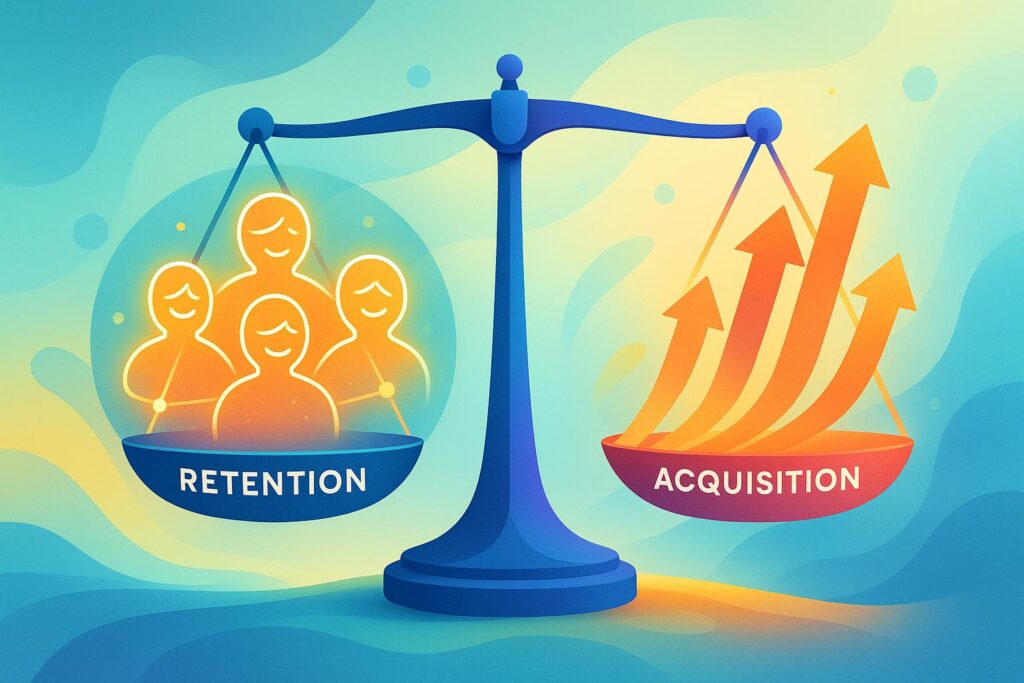
Balancing customer retention and acquisition is key to growing your business effectively. Retention focuses on keeping existing customers loyal, while acquisition brings in new ones. Here’s what you need to know:
- Retention is cheaper and more profitable: Selling to existing customers has a 60–70% chance of success, while acquiring new ones has only a 5–20% chance. A 5% boost in retention can increase profits by 25–95%.
- Acquisition drives growth: It’s essential for expanding your customer base but costs 5–25x more than retention.
- Both are important: Over-focusing on one can hurt your business. Retention maximizes value from current customers, while acquisition ensures long-term growth.
Quick Comparison
| Aspect | Retention | Acquisition |
|---|---|---|
| Goal | Keep existing customers loyal | Attract new customers |
| Cost | Lower | Higher (5–25x more expensive) |
| Success Rate | 60–70% probability of repeat purchase | 5–20% probability of first purchase |
| Impact | Higher ROI, boosts profits | Expands market reach, drives growth |
Retention and acquisition should work together. For example, loyalty programs can retain customers while also attracting new ones through referrals. Both strategies are critical for sustainable business growth.
Acquisition v/s Retention – What Matters and When
How Retention and Acquisition Affect CLV and ROI
Getting a handle on how retention and acquisition strategies influence your business’s financial performance is key to smart budgeting. These two approaches affect profitability in different ways, showing where your marketing investments are likely to pay off the most.
Retention vs. Acquisition: Costs and Returns
The cost difference between retaining existing customers and acquiring new ones is striking. Acquiring a new customer can be 5 to 25 times more expensive than keeping an existing one, depending on the industry. Over the past five years, customer acquisition costs have surged by 60%, making retention strategies increasingly appealing from a cost perspective.
Paid advertising, a common acquisition tool, has become less effective and more expensive. 68% of retailers report a drop in performance on paid social platforms. On the flip side, retention strategies offer better returns for less money.
Here’s why retention wins: The likelihood of selling to an existing customer is 60-70%, compared to just 5-20% for a new prospect. This stark difference in conversion rates makes retention-focused marketing a more efficient way to boost ROI.
"Retaining a customer is much cheaper than acquiring a new customer…acquiring a new customer can cost five to seven times more than retaining an old one."
– Saravana Kumar, Founder & CEO, Kovai.co
Retention also drives revenue growth. A 5% increase in customer retention can increase profits by up to 75%, and loyal customers tend to spend 67% more than new ones. For subscription-based companies, 79% of revenue comes from the top 30% of loyal subscribers.
Real-world examples back this up. REN Skincare implemented a loyalty program that led to a 68% jump in spending among members and 63% higher repeat purchase rates compared to non-members. Similarly, Waterdrop saw customer spending rise by 90%, with repeat purchases increasing by 70% after introducing a long-term loyalty program.
These numbers highlight why retention strategies are a smarter investment in the customer lifecycle.
Customer Lifecycle Stages and Strategy Impact
The customer lifecycle – spanning reach, acquisition, conversion, retention, and loyalty – shapes how businesses allocate resources. Early stages require more spending and yield lower returns, while later stages offer higher ROI as customers become familiar with and loyal to your brand.
The retention and loyalty stages deliver the best ROI. Customers at these stages already trust your brand and are more likely to respond to personalized offers and rewards. For example, Tata StarQuik used automated segmentation to re-engage inactive users, leading to a 64% increase in repeat purchases, a 20% rise in retention rates, and a 30% boost in overall customer lifetime value (CLV).
Retention strategies also evolve as customers move through the lifecycle. Early-stage customers need education and trust-building, while loyal customers respond better to exclusive perks and personalized outreach. Dropbox capitalized on this by creating a referral program that rewarded users with extra storage for inviting friends. This approach turned loyal customers into advocates, driving growth through existing relationships rather than costly cold acquisition.
"CleverTap helps us in visualizing the user journey at an individual or segment level, enabling us to understand, communicate, and engage with users in a better fashion."
– Gaurav Juneja, Co-founder, StarQuik
Knowing how customers move through these stages is essential for calculating and improving CLV.
Calculating CLV in Dollars
Customer Lifetime Value (CLV) estimates the total revenue a business can expect from a customer over their entire relationship. It’s a critical metric for determining how much to invest in acquisition while staying profitable.
The formula is straightforward: average purchase value × purchase frequency × customer lifespan. For instance, if a customer spends $50 per purchase, buys 4 times a year, and stays for 3 years, their CLV is $50×4×3 = $600.
Subtract the $100 Customer Acquisition Cost (CAC), and the net CLV becomes $500. Ideally, businesses aim for a 3:1 CLV to CAC ratio, meaning every $1 spent on acquisition should generate $3 in lifetime value.
Retention strategies directly enhance CLV by increasing purchase frequency, extending customer lifespan, and boosting average order values through upselling and cross-selling. Personalization alone can drive a 10-15% revenue increase.
Several companies have successfully improved CLV through strategic efforts:
- MOVii, a Colombian fintech, reduced onboarding churn by 36% by analyzing user behavior and launching targeted campaigns. 63% of inactive users returned to complete onboarding, extending customer lifespan.
- Boost, a Malaysian e-wallet, achieved a 5x increase in 90-day retention rates and doubled monthly active users through personalized campaigns.
- PayMaya in the Philippines saw a 10x spike in monthly app launches and an 18% month-over-month rise in user reactivation using automated, personalized strategies.
The beauty of CLV-focused strategies is how small improvements can snowball. For example, increasing retention rates by just 5% can boost profits by 25% to 95%.
"Improving customers makes them more valuable."
– Michael Schrage
Proven Methods for Retention and Acquisition
In today’s competitive market, successful businesses rely on strategies grounded in data to retain existing customers and bring in new ones. By blending time-tested techniques with continuous refinement, companies can maximize their return on investment and strengthen customer lifetime value.
Customer Retention Methods
Retaining customers is often more cost-effective than acquiring new ones. Here are some effective ways to keep your customers engaged and loyal:
- Personalized loyalty programs: These programs work best when tailored to your customers’ preferences. Instead of using generic reward systems, focus on what motivates your audience. Thoughtfully designed programs can significantly boost profitability.
- Early churn detection: By monitoring user behavior, businesses can identify warning signs before customers leave. Metrics like engagement patterns, support ticket activity, and product usage can help pinpoint at-risk customers, allowing for timely intervention.
- Self-service options: Offering resources like knowledge bases, video tutorials, and automated tools empowers customers to resolve issues independently. This not only enhances satisfaction but also lowers support costs.
- Omnichannel engagement: Meeting customers where they are – whether through email, SMS, or push notifications – ensures more meaningful interactions. By mapping out preferences and behaviors, businesses can create more effective communication strategies.
- Customer feedback: Listening to your customers and acting on their suggestions can turn potential complaints into opportunities. Feedback from surveys, reviews, and support interactions can highlight areas for improvement, showing customers that their opinions matter.
Customer Acquisition Methods
While retention focuses on maximizing the value of current customers, acquisition is about expanding your customer base. Here’s how businesses are successfully attracting new customers:
- Data-driven targeting: Using predictive models based on existing customer data helps identify potential prospects who are more likely to convert. This precision is crucial as acquisition costs continue to rise.
- First-party data collection: With the decline of third-party cookies, gathering data directly from customers has become essential. Interactive campaigns, like Vineyard Vines’ scan-to-win initiative during the Head of the Charles Regatta, showcase how effective this can be. Their campaign achieved a 92% conversion rate, collecting 4,000 emails at just $0.42 per customer.
- Search engine optimization (SEO): SEO offers a sustainable way to attract customers actively searching for solutions. Unlike paid ads, well-optimized content continues to drive traffic long after it’s published.
- Performance marketing: This approach prioritizes measurable outcomes like sign-ups, purchases, or trial starts. Strategies include pay-per-click ads, affiliate marketing, and conversion-focused campaigns.
- A/B testing: Experimenting with different headlines, visuals, offers, and landing page designs can reveal what resonates most with your audience. This helps optimize campaigns and reduce acquisition costs.
- Social commerce and shoppable content: These methods simplify the buying process by allowing customers to purchase directly through social media platforms, eliminating unnecessary steps.
How Growth-onomics Helps Optimize Both Strategies
Balancing retention and acquisition efforts requires a holistic approach, and Growth-onomics provides just that. By integrating various services, they help businesses achieve long-term growth.
- Customer journey mapping: This process identifies where potential customers drop off and where existing ones disengage. For instance, Growth-onomics helped a SaaS company boost free trial conversions by 45% and reduce onboarding time by 30% by addressing friction points in the trial process.
- UX design and conversion rate optimization: Improving user interfaces enhances the experience for both new and existing customers. For example, Growth-onomics worked with an online fashion retailer to revamp their post-purchase experience, leading to a 32% increase in repeat purchases and a 15% rise in average order value.
- Performance marketing: By focusing on metrics that drive results, Growth-onomics helps businesses allocate ad spend effectively. They assisted a B2B consulting firm in shortening their sales cycle by 40% and increasing high-quality inbound leads by 20% through targeted campaigns.
- Data analytics and reporting: Insightful data enables businesses to allocate budgets wisely, focusing on what works best for retention and acquisition. Understanding customer value and rising acquisition costs ensures smarter decision-making.
- SEO strategies: By creating valuable content, businesses can attract new customers while keeping existing ones engaged. This dual-purpose approach maximizes the impact of content investments.
Growth-onomics uses its Sustainable Growth Model to integrate these services, offering a comprehensive strategy that prioritizes long-term success over quick fixes. Their methodology ensures that retention and acquisition efforts work together seamlessly, delivering measurable results.
"Teams get so far with these first-gen tools, and then they hit walls." – Yali Sassoon, Snowplow
This quote underscores the need for integrated solutions rather than relying on isolated tools to address retention and acquisition challenges.
Budget Allocation Framework for Retention and Acquisition
Effectively dividing your marketing budget between retention and acquisition is essential for driving growth and maximizing ROI. To do this well, you need a clear understanding of your current performance, your business’s growth stage, and how to make data-driven decisions that ensure every dollar is well spent.
Assessing Your Current Performance Metrics
Start by evaluating where you stand. Metrics like Customer Acquisition Cost (CAC) and Customer Lifetime Value (CLV) are your foundation. Calculate these in dollars to determine if your spending is efficient. Ideally, your CAC should be less than one-third of your CLV. For example, if you’re spending $300 to acquire a customer with a $600 CLV, that’s not sustainable. A healthier target would be acquiring customers with a CLV of $900 or more to maintain a 3:1 ratio.
Retention and churn rates are equally important. A retention rate of 80–90% is generally strong, though this varies by industry. SaaS companies often aim for retention rates above 90%, while retail businesses typically target 60–70%. If your retention rate is lower than these benchmarks, it might be time to allocate more resources toward keeping your current customers satisfied.
Also, keep an eye on your repeat purchase rate, which averages around 28.2%. Existing customers are 50% more likely to try new products and spend 31% more. If your rate lags behind industry standards, focusing on retention could yield better returns than pouring resources into acquiring new customers.
"Beyond CAC and ROMI, it’s vital to dissect underlying factors such as customer lifetime value and brand equity to truly understand the long-term impact of your marketing investment."
– Stephen McClelland, Digital Strategist, ProfileTree
Finally, leverage your Net Promoter Score (NPS) as an early warning system. A score of 60 or higher is a good sign and can help you identify potential churn risks before they materialize.
Setting Priorities Based on Business Growth Stage
Your business’s growth stage plays a huge role in how you should allocate your marketing budget. For startups, marketing budgets often range from 15–25% of revenue, while established companies typically spend 5–15%. Within that budget, the split between acquisition and retention evolves as your business matures.
- Early-stage companies focus heavily on acquisition to build a customer base quickly. These businesses might allocate 60–70% of their marketing budget to acquisition, with the remaining 30–40% supporting basic retention efforts like onboarding and customer support. Proving product-market fit is the top priority in this phase.
- Growth-stage companies start to balance their efforts. A 50-50 split between acquisition and retention often works well, but the exact ratio depends on your industry and competition. At this stage, you have enough customers to make retention worthwhile, yet acquisition remains essential for continued growth.
- Mature companies typically benefit from prioritizing retention. Allocating 60–70% of the budget to retention and 30–40% to acquisition often delivers better results. With a larger customer base, keeping those customers engaged becomes more valuable.
Market conditions also influence your strategy. In highly competitive industries, acquisition may require a larger share of your budget, even for mature businesses. Conversely, in less competitive markets, focusing on retention can be more effective since customers aren’t constantly bombarded by alternatives.
"Companies that reallocated more resources earned, on average, 30 percent higher total returns to shareholders annually."
– McKinsey
Retention vs. Acquisition Comparison Table
Understanding when to emphasize retention or acquisition can help you make smarter budget decisions. Here’s a side-by-side look:
| Aspect | Retention Focus | Acquisition Focus |
|---|---|---|
| Best for Business Stage | Mature companies with an established base | Startups and early-growth companies |
| Cost Efficiency | 5–25x less expensive than acquisition | Generally higher costs due to competition |
| Revenue Impact | 25–95% profit increase with a 5% retention boost | Drives initial sales and expands market reach |
| Customer Behavior | 60–70% likelihood of repeat purchases | 5–20% likelihood of a first-time purchase |
| Budget Allocation | Typically 60–70% for mature businesses | Often 60–70% of the marketing budget for startups |
| ROI Timeline | Faster returns from existing relationships | Longer payback periods |
| Market Conditions | Works best in stable, less competitive environments | Crucial in highly competitive markets |
| Cash Flow Requirements | Lower upfront investment | Requires higher upfront investment |
Interestingly, 54% of B2C marketing executives allocate more than half their budgets to acquisition, while only 13% dedicate the same to retention. This suggests many businesses may be missing opportunities to boost ROI by focusing more on retention.
To determine your optimal mix, consider your market and business model. For instance, a SaaS company in a competitive market might need to maintain a 60% focus on acquisition even as a mature business. On the other hand, a local service provider could thrive with a 70% retention focus after just a few years.
Keep a close eye on your Customer Retention Rate (CRR). If you’re losing customers faster than you’re gaining them, it’s a clear signal to adjust your budget toward retention. The ultimate goal is sustainable growth – not growth at any cost.
"By leveraging CLV, we’re not just shooting in the dark with our marketing budget; we’re making every penny count towards sustained growth."
– Stephen McClelland, Digital Strategist, ProfileTree
Integrating acquisition and retention strategies can amplify your results. For example, acquisition campaigns can promote loyalty programs, while retention initiatives can include referral incentives to attract new customers. This interconnected approach ensures that every marketing dollar contributes to long-term growth and stability.
Measuring and Improving ROI: Best Practices
To get the best results from your retention and acquisition efforts, it’s crucial to track the right metrics and use your data to make informed decisions.
Key Performance Indicators (KPIs) to Track
One of the most important metrics is Customer Acquisition Cost (CAC), which calculates how much it costs to gain a new customer. Breaking down CAC by channel can reveal which platforms or strategies are delivering the best value.
Another critical ratio to watch is the CLV to CAC ratio. A ratio of 3:1 is often seen as a healthy benchmark for profitability.
Conversion rates are also essential, as they show how well your marketing efforts are turning potential customers into actual buyers. By analyzing conversion rates at every stage of your funnel, you can spot weak points and focus on improving them.
Your Customer Retention Rate (CRR) indicates how effectively you’re keeping your customers engaged. For SaaS businesses, a monthly retention rate of around 95% is considered strong. Alongside this, monitoring your churn rate can help you identify and address issues that may be driving customers away.
The Repeat Purchase Rate (RPR) is another key metric that measures customer loyalty. The average RPR across industries is 28.2%, though this can vary depending on the type of business and time of year.
Net Promoter Score (NPS) is a widely used tool for gauging customer satisfaction. Fred Reichheld, the creator of NPS, suggests that a score of 60 or higher is a good indicator of customer loyalty. Customers who rate you 9 or 10 are your strongest advocates, while lower scores may signal dissatisfaction or risk of churn.
Additional metrics like Customer Satisfaction Score (CSAT) and Customer Effort Score (CES) offer deeper insights into the customer experience, helping you predict future behavior and uncover areas for improvement.
"If you have a good retention rate, then you don’t have to work as hard to acquire customers over and over again. Positive brand interactions create a flywheel – when you give your customers a great experience, they’ll come back for more and you’ll get to understand them better. This customer data then allows you to build more relevant experiences." – Veronica Saha, Head of Analytics @ Zoopla
By focusing on these KPIs and analyzing them thoroughly, you can continuously refine your ROI strategy.
Using Data Analysis for Ongoing Improvement
Once you’ve identified the KPIs that matter most, data analysis becomes your secret weapon for sustained growth. Organizations that prioritize data-driven strategies are 23 times more likely to gain new customers and 19 times more likely to achieve profitability.
Start by setting clear objectives and measurable KPIs for every campaign. Vague goals won’t cut it – specific targets are the key to effective optimization.
Feedback loops are invaluable for continuous improvement. Take Hussle, a gym pass platform, as an example. When their team surveyed users who had canceled subscriptions, they discovered that 26% had switched to local gym memberships. Acting on this insight, they introduced a feature allowing users to buy gym memberships directly through their platform. This change helped reduce churn and boosted retention.
Companies that use feedback loops often see an 85% improvement in customer satisfaction. Collect input from various sources – surveys, social media, and website analytics – and use tools like text analytics to spot trends before they become problems.
Predictive analytics takes things a step further by using historical data to forecast customer behavior. This can help you identify high-value leads and spot potential churn risks early, enabling proactive strategies that are particularly useful for subscription-based businesses.
Centralizing data from all customer interactions is critical for gaining a complete view of the customer journey. Tools like Google Analytics, HubSpot, and Tableau can help combine these insights into a single, actionable dashboard.
"Your most unhappy customers are your greatest source of learning." – Bill Gates
Consistent testing and fine-tuning should be a regular part of your process. Use customer segmentation to create targeted campaigns and measure their impact against control groups. Even small adjustments can lead to big improvements over time.
Staying Current with U.S. Market Changes
As you measure and refine your performance, staying adaptable in the U.S. market is essential. The landscape changes quickly, and your strategies need to keep up. For example, 87% of marketers admit that data is their most underused asset, which highlights a significant opportunity for those willing to dig deeper.
Privacy regulations are also reshaping how businesses collect and use data. First-party data, such as email lists and loyalty programs, is becoming more important than ever.
Personalization is another area where businesses can stand out. Research shows that 80% of customers are more likely to buy from brands that offer tailored experiences, and personalized email campaigns can deliver six times higher transaction rates .
AI and automation are no longer optional – they’re essential. With 93% of marketers investing in AI this year, tools like chatbots and predictive analytics are helping businesses streamline operations and improve ROI. For instance, Banner Health used analytics to track marketing-driven appointment calls. By segmenting their audience into loyal, intermittent, and new patients, they reduced patient acquisition costs by 74% across all departments.
Providing a seamless omnichannel experience is also critical. Seventy-three percent of shoppers use multiple channels during their buying journey, and they expect a consistent experience whether they’re online or in-store. Tracking engagement across all touchpoints ensures that you’re meeting these expectations.
Ethical branding and customer service are increasingly important, too. Sixty-seven percent of customers say they’ve switched brands due to poor service.
Economic factors like inflation, employment rates, and consumer confidence also play a role in customer behavior. Keeping an eye on these indicators can help you adjust your strategy during uncertain times.
Subscription models are gaining traction as a retention strategy. Repeat customers often spend up to 70% more than new ones, making memberships and exclusive perks a smart investment.
Finally, staying ahead of industry trends and competitor moves requires ongoing market research. The most successful businesses treat adaptation as a continuous process, testing new ideas and pivoting when necessary. This flexibility can give you a real edge in today’s fast-changing market.
Achieving Balance for Long-Term Growth
Balancing customer retention and acquisition is key to building a business that thrives over time. Retention often costs less than acquisition, and even small gains in retention can lead to noticeable profit increases. In fact, 86% of businesses agree that retention is just as important – if not more – than bringing in new customers.
Success over the long haul comes from combining these two efforts into a unified strategy. While acquisition brings in new customers, retention ensures they stay loyal. A data-driven approach, such as maintaining a CLV (Customer Lifetime Value) to CAC (Customer Acquisition Cost) ratio of 3:1 or better, lays the foundation for sustainable growth. Personalization plays a big role here: 78% of shoppers say they only respond to offers that reflect their previous interactions with a brand. This kind of insight can guide how companies allocate their budgets across different growth stages.
At different stages of growth, companies need to adjust their focus. Early-stage businesses often prioritize acquisition, while more established organizations lean into retention.
Retention and acquisition should work hand in hand. Acquisition efforts can highlight customer success stories, while retention strategies transform happy customers into enthusiastic advocates for the brand. This approach aligns with the idea that loyal customers drive organic growth. After all, 83% of consumers trust recommendations from friends and family more than any other form of advertising.
Listening to customer feedback is another way to fine-tune strategies, build loyalty, and reduce churn. Teams across marketing, sales, and customer success must collaborate to monitor key metrics like CLV, churn rate, NPS (Net Promoter Score), and CAC. This ensures no single area is optimized at the expense of another. For companies looking to move faster, working with experts can make a big difference. Growth-onomics, a performance marketing agency, specializes in services like Customer Journey Mapping, Performance Marketing, and Data Analytics, helping businesses align their retention and acquisition strategies to drive maximum ROI.
Staying successful requires constant measurement and adjustment. As markets shift and customer preferences change, businesses must adapt their balance between retention and acquisition. By adopting an integrated, flexible approach grounded in data, companies can stay competitive and set themselves up for long-term success.
FAQs
How can businesses allocate their budget between customer retention and acquisition to achieve the best ROI?
To get the most out of your investment, businesses need to find the right balance between keeping current customers happy and bringing in new ones. Why? Because retaining customers is often cheaper and more profitable in the long run – loyal customers tend to spend more as time goes on. That said, bringing in new customers is still vital to keep the business growing.
A smart approach is to dedicate a good chunk of your budget to retention efforts like loyalty programs and personalized customer experiences. At the same time, make sure to invest enough in acquisition strategies to continue expanding your customer base. Keep an eye on your past ROI data, set clear objectives, and adjust your spending to focus on what delivers the best results for your business.
What are the best strategies to boost Customer Lifetime Value (CLV) through customer retention?
Improving Customer Lifetime Value (CLV) starts with nurturing strong relationships. This means actively engaging with your customers and taking the time to understand what they truly need. When you provide prompt and thoughtful customer service, you build trust and encourage loyalty.
Another effective approach is introducing loyalty programs. These reward repeat purchases and motivate customers to stick around for the long haul. Pair this with personalized marketing – using customer data to craft messages that feel tailored to their preferences – and you’ll create a more meaningful experience for them.
Finally, leverage data-driven insights to fine-tune the entire customer journey. By identifying areas where satisfaction can be improved, you’ll not only keep customers coming back but also maximize the value they bring to your business over time.
How do market changes and shifting customer preferences affect retention and acquisition strategies?
Market shifts and changing customer preferences heavily influence how businesses juggle retention and acquisition efforts. For example, during economic slumps or when competition heats up, focusing on retention often proves to be more cost-efficient. Loyal customers not only save businesses on acquisition costs but also contribute more over time through a higher customer lifetime value (CLV).
Meanwhile, evolving customer demands – like the need for personalized experiences, quicker service, or better value – push companies to adjust rapidly. This often means leaning into engagement strategies, such as loyalty programs or customized communication, to deepen connections with current customers. On the flip side, when market conditions open up new possibilities, businesses may shift gears to emphasize acquisition, aiming to grow their customer base and fuel expansion.
Finding the right balance between these two approaches is crucial for ensuring both stability and sustainable growth.
