


Seasonal adjustment removes recurring patterns in data, like holiday sales spikes or summer slumps, to highlight actual trends. Python simplifies this process with libraries like pandas, statsmodels, and matplotlib. Here’s what you need to know:
- Why It Matters: Seasonal adjustment helps businesses make better decisions by clarifying trends, improving forecasts, and evaluating campaigns more accurately.
- How It Works: Decompose time series data into trend, seasonal, and irregular components. Remove seasonal effects to focus on meaningful changes.
- Key Tools:
pandasfor data preparationstatsmodelsfor decomposition (classical or STL methods)matplotlibfor visualizing results
- Preparation Steps:
- Clean data: Handle missing values, outliers, and date formatting.
- Organize data: Ensure consistent time intervals and proper indexing.
Using Python, businesses can adjust their data to better plan budgets, measure performance, and detect trends effectively.
Preparing Data for Seasonal Adjustment
Getting your data ready for seasonal adjustment starts with making sure it’s clean and well-organized. Raw business data often has its fair share of problems – missing values, inconsistent formatting, or structural quirks – that can throw off your analysis. Taking the time to tidy things up ensures your seasonal adjustments are accurate and reliable.
Cleaning and Formatting Data
The first step is to address common data quality issues. One major hurdle is missing values, which might show up as blank cells, "N/A" entries, or even zeros where actual data should be. For seasonal adjustments to work properly, your time series data needs to be complete, with no gaps.
To handle missing data, Python’s pandas library offers helpful tools. You can use fillna() with options like 'ffill' or 'bfill' to carry forward or backward nearby values. For a more advanced fix, try interpolate(), which estimates missing values based on surrounding data points.
Outliers can also mess with seasonal patterns. Use methods like interquartile range (IQR) or box plots to identify them. Once spotted, decide whether to remove, cap, or transform these outliers. Techniques like logarithmic scaling can help minimize their impact.
Date formatting is another key step, especially in U.S. datasets where dates follow the mm/dd/yyyy format. Python’s pandas library makes this straightforward. Convert your date column into datetime objects with the following code:
df['Date'] = pd.to_datetime(df['Date'], format='%m/%d/%Y') This ensures dates like 03/04/2023 are correctly interpreted as March 4th, not April 3rd. After converting, set the date column as the DataFrame’s index:
df = df.set_index('Date') Having a datetime index is crucial for libraries like statsmodels, which rely on it to infer time series frequency and perform decomposition tasks. Without this setup, seasonal adjustment functions might throw errors.
Organizing Data for Analysis
Once your data is clean, the next step is to structure it for analysis. A well-prepared time series should have a datetime index and at least one numeric column representing the metric you’re analyzing. Each row should correspond to a single time period – daily, weekly, monthly, or quarterly.
For U.S. business datasets, numeric columns often include currency values like revenue or sales. If these values come formatted with dollar signs or commas (e.g., "$1,234.56"), you’ll need to clean them up. Strip these characters and convert the values to floats with this code:
df['Revenue'] = df['Revenue'].str.replace('[$,]', '', regex=True).astype(float) Consistency in the time series frequency is also critical. For daily data, every day should be accounted for; for monthly data, you need one entry per month. If there are gaps, you may need to create the missing time periods and fill them with appropriate values. Alternatively, you can use resampling techniques to aggregate data into a consistent frequency.
If your dataset includes multiple metrics, make sure each one has its own column. This setup allows you to perform seasonal adjustments on different metrics simultaneously – say, comparing trends in website traffic and conversion rates, or analyzing sales revenue alongside marketing spend.
Finally, ensure your datetime index is sorted in chronological order using df.sort_index(). Verify that your dataset spans at least two full seasonal cycles and check that numeric columns have the correct data types and ranges.
With your data cleaned and structured, you’re ready to dive into Python libraries for effective seasonal adjustment.
Python Libraries for Seasonal Adjustment
Python offers a range of tools to help you transform raw data into meaningful insights, especially when dealing with seasonal patterns in time series data.
Key Libraries: pandas, statsmodels, and matplotlib
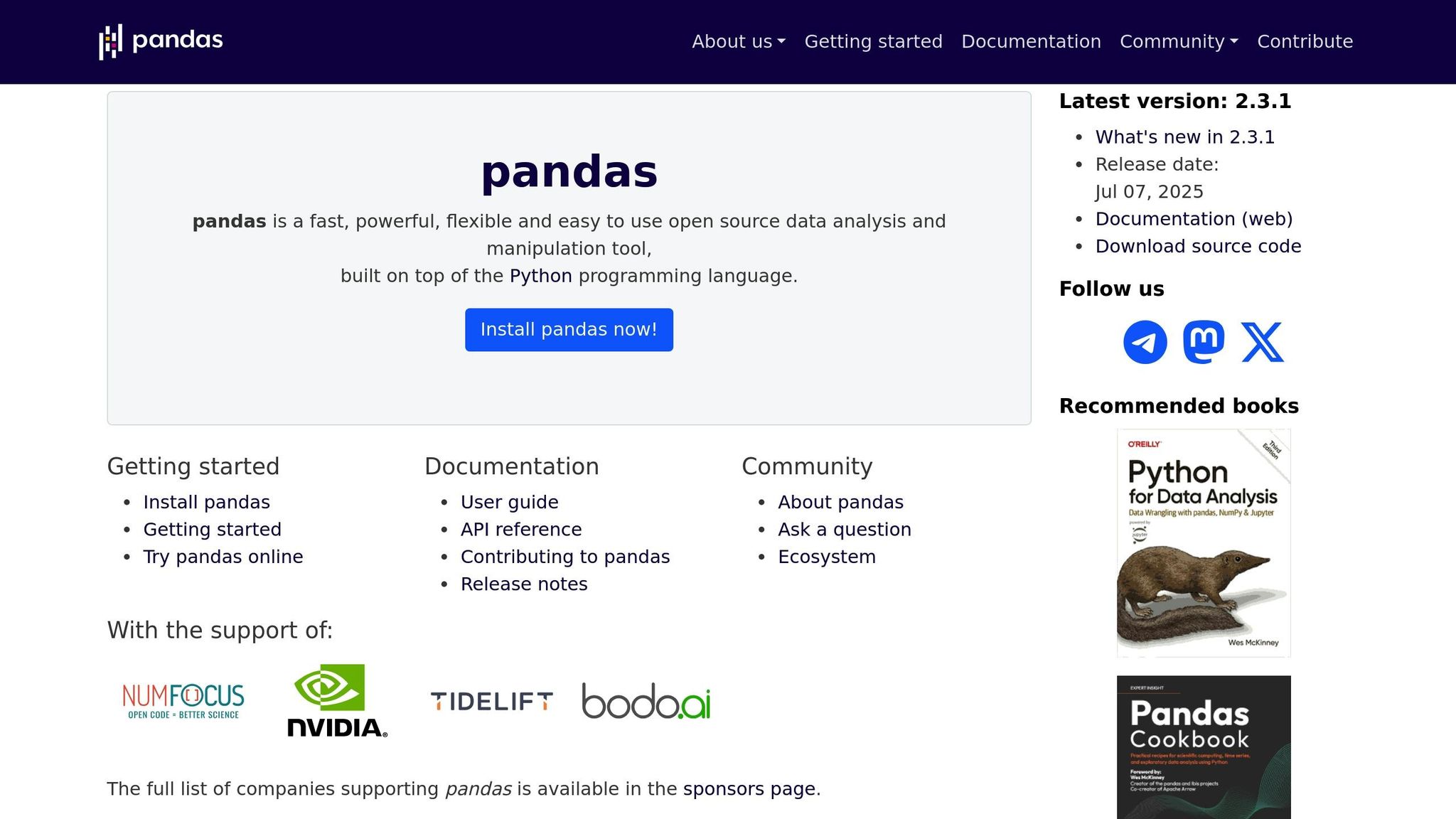
Pandas is a cornerstone for data manipulation in Python. Built on top of NumPy, it provides efficient tools for handling and organizing data. Its ability to create DataFrame structures and manage datetime indexing makes it invaluable for recognizing time-based patterns and preparing data for analysis.
Statsmodels is where the real magic of seasonal adjustment happens. This library specializes in breaking down time series data into its core components: trend, seasonality, and residuals. It supports a variety of methods, from traditional techniques to more adaptive approaches, and integrates seamlessly with pandas, ensuring a smooth workflow from data preparation to analysis.
Matplotlib brings the results to life. With its visualization capabilities, you can create clear, detailed charts that showcase the original time series alongside its decomposed components – trend, seasonal patterns, and residuals. These visualizations make it easier to spot patterns and evaluate the effectiveness of your adjustments.
With these tools in hand, let’s dive into the seasonal decomposition methods available in statsmodels.
Decomposition Methods Overview
Statsmodels offers two main methods for seasonal decomposition, each tailored to different types of data and business needs.
Classical Decomposition (seasonal_decompose) represents the traditional approach. This method assumes that seasonal patterns remain consistent over time, such as retail sales peaking every December. It supports both additive models, where seasonal effects add a fixed value to the baseline (e.g., an additional $10,000 in revenue during the holidays), and multiplicative models, where seasonal effects scale proportionally with the baseline (e.g., a 15% sales increase in summer). Multiplicative models are particularly useful for datasets where seasonal effects grow alongside the business.
STL Decomposition (STL) is a more modern and flexible method, designed to handle evolving seasonal patterns. STL stands for Seasonal-Trend decomposition using Loess, and it’s ideal for situations where seasonal behavior changes over time – like when peak sales shift from December to November, or when seasonal intensity grows as a business expands. Its advanced smoothing techniques make it especially valuable for businesses operating in fast-changing markets.
Comparing Decomposition Methods
Choosing the right decomposition method can make a significant difference in your analysis. Here’s a quick comparison of the two approaches:
| Method | Flexibility | Computational Speed | Best For | Limitations |
|---|---|---|---|---|
Classical (seasonal_decompose) |
Assumes fixed seasonal cycles | Very fast | Businesses with stable, predictable cycles | Struggles with changing seasonal trends |
| STL Decomposition | Adapts to evolving patterns | Moderate | Growing businesses or dynamic markets | Requires more computational resources |
Classical decomposition works well for businesses with steady, predictable seasonal trends. It’s simple, fast, and easy to explain to stakeholders. However, its assumption of fixed seasonality can lead to inaccuracies when patterns shift over time.
On the other hand, STL decomposition shines in dynamic environments. It can handle gradual changes in seasonal behavior and is more resilient to outliers. While it requires more processing power, its ability to adapt makes it a strong choice for businesses experiencing growth or operating in rapidly changing markets.
Step-by-Step Guide to Seasonal Adjustment in Python
Building on the decomposition methods overview, this guide walks you through the process of seasonal adjustment using Python. By the end, you’ll know how to turn raw time series data into meaningful insights.
Loading and Formatting Data
Every solid seasonal adjustment begins with data that’s clean and properly formatted. Python’s pandas library is a go-to tool for this. A well-prepared dataset ensures smoother analysis and minimizes errors down the line.
Start by loading your libraries and importing the dataset. Whether you’re working with a CSV file, an Excel sheet, or a database, pandas can handle it. Make sure the date column is converted into a datetime object so time-based operations work as expected.
import pandas as pd import numpy as np from statsmodels.tsa.seasonal import seasonal_decompose, STL import matplotlib.pyplot as plt # Load your data df = pd.read_csv('monthly_sales.csv') df['date'] = pd.to_datetime(df['date']) df.set_index('date', inplace=True) Double-check that your dates are interpreted correctly (e.g., MM/DD/YYYY format). You can verify this by inspecting a few rows of your dataset.
Next, ensure the time series has consistent intervals – whether daily, monthly, or quarterly. Irregular gaps or missing dates can disrupt decomposition methods. Use the asfreq() method in pandas to set regular intervals and address any missing data.
Once your data is formatted and indexed properly, you’re ready to apply decomposition techniques.
Applying Seasonal Decomposition
Now that your dataset is prepared, it’s time to apply seasonal decomposition. The method you choose – classical decomposition or STL – depends on the nature of your data and analysis goals.
Classical decomposition works well for stable and predictable seasonal patterns, such as monthly utility bills or quarterly sales figures.
# Classical decomposition - additive model decomposition_add = seasonal_decompose(df['revenue'], model='additive', period=12) # Classical decomposition - multiplicative model decomposition_mult = seasonal_decompose(df['revenue'], model='multiplicative', period=12) For data with evolving seasonal patterns or outliers, STL decomposition is a more flexible option. It uses LOESS (locally estimated scatterplot smoothing) to extract trend, seasonal, and residual components.
# STL decomposition with customization stl = STL(df['revenue'], seasonal=13, # Adjust seasonal smoothing trend=None, # Automatically determine trend smoothing robust=True) # Reduce the impact of outliers result = stl.fit() The robust fitting option is especially useful for minimizing disruptions caused by anomalies, ensuring cleaner seasonal and trend components.
Once decomposition is complete, the next step is to validate and visualize the results.
Validating and Visualizing Results
Visual inspection is a key part of validating your decomposition. Plot the original time series alongside its components – trend, seasonal, and residual – to assess the results. Here’s how you can create a four-panel chart:
# Create comprehensive visualization fig, axes = plt.subplots(4, 1, figsize=(12, 10)) # Original data df['revenue'].plot(ax=axes[0], title='Original Revenue Data') axes[0].set_ylabel('Revenue ($)') # Trend component result.trend.plot(ax=axes[1], title='Trend Component') axes[1].set_ylabel('Revenue ($)') # Seasonal component result.seasonal.plot(ax=axes[2], title='Seasonal Component') axes[2].set_ylabel('Seasonal Effect ($)') # Residuals result.resid.plot(ax=axes[3], title='Residuals') axes[3].set_ylabel('Residual ($)') plt.tight_layout() plt.show() Check that the decomposed components (trend, seasonal, and residual) align with the original series. For additive models, the components should sum back to the original data, while for multiplicative models, they should multiply back.
To obtain seasonally adjusted data, subtract the seasonal component from the original series. This adjustment removes recurring seasonal patterns, helping you uncover underlying trends and cyclical movements. The result is invaluable for evaluating growth, measuring campaign effectiveness, and making precise forecasts for business planning.
sbb-itb-2ec70df
Using Seasonal Adjustment to Improve Growth-onomics Analytics

Building on the Python techniques discussed earlier, this section delves into how Growth-onomics applies seasonally adjusted data to refine forecasts and sharpen marketing strategies. By filtering out seasonal fluctuations, raw data becomes more actionable. This process, paired with Growth-onomics’ data-driven methods, empowers U.S. businesses to fine-tune their marketing efforts and achieve consistent growth.
Impact of Seasonally Adjusted Data on Marketing Strategies
Seasonal adjustment plays a key role in improving forecasting, campaign planning, and performance evaluation. By stripping away calendar-related fluctuations from time series data, Growth-onomics uncovers trends and patterns that would otherwise be obscured.
This has a direct impact on campaign timing and budget management. For instance, without seasonal adjustment, a retailer might wrongly attribute December’s high sales to a successful marketing campaign, when in reality, it reflects the holiday shopping boom. By accounting for these predictable seasonal effects, Growth-onomics helps businesses allocate their marketing budgets more effectively across the year. Additionally, understanding these seasonal variations allows for better planning around inventory, staffing, and promotional strategies.
Performance measurement also becomes more precise when seasonal noise is removed. With seasonally adjusted data, Growth-onomics can make meaningful comparisons between different time periods, like January versus July, without the distortion of recurring seasonal effects. This approach enhances trend analysis and provides deeper insights into campaign performance and customer behavior.
By embedding seasonal adjustment into its analytics services, Growth-onomics ensures that businesses can make data-driven decisions with greater confidence and clarity.
Benefits of Combining Seasonal Adjustment with Growth-onomics Services
Growth-onomics integrates seasonal adjustment into its analytics framework to deliver tailored, impactful solutions for U.S. businesses.
The process begins with data preparation, including interpolating missing values and addressing outliers. Growth-onomics carefully selects between additive or multiplicative models and determines optimal parameters, such as using 12-month moving averages for monthly data. This level of customization ensures that seasonal adjustments align with each client’s unique business cycles and data patterns.
Seasonally adjusted data is then incorporated into advanced forecasting models. For example, ARIMA models use adjusted data for residual predictions, while machine learning models like Random Forests and Gradient Boosting include decomposed components as features. Growth-onomics automates these processes through scheduled batch jobs and integrates seasonal adjustments into ETL pipelines. Techniques like grid search and Bayesian optimization are used to fine-tune parameters, ensuring that seasonal patterns are accurately captured.
The impact of these adjustments is rigorously measured. Metrics such as Mean Absolute Error (MAE), Root Mean Squared Error (RMSE), and Mean Absolute Percentage Error (MAPE) quantify improvements. A/B testing compares historical forecasts with seasonally adjusted ones, offering empirical evidence of better accuracy.
To ensure transparency, Growth-onomics provides detailed documentation, including visual aids like decomposition plots and step-by-step explanations. This reporting framework not only builds trust but also helps stakeholders understand the methodology behind the results.
Statistical reliability is confirmed through stationarity testing, using methods like the Augmented Dickey-Fuller (ADF) test. Combined with Growth-onomics’ expertise in areas like SEO, UX, customer journey mapping, performance marketing, and data analytics, this technical precision creates a balanced approach that is both statistically sound and business-focused.
Conclusion
This guide has explored essential Python techniques for seasonal adjustment, highlighting their practical applications and benefits. By removing seasonal effects, these methods help uncover genuine trends in data, enabling more accurate analysis. Using libraries like statsmodels, businesses can eliminate recurring patterns, leading to better predictions and streamlined financial analytics workflows.
Seasonal adjustment reduces data noise, making it easier to identify trends and compare performance across different periods by accounting for repetitive seasonal influences. For U.S. businesses, it’s particularly useful in addressing factors like varying monthly day counts, holiday schedules, and predictable seasonal fluctuations. This approach also provides a clearer perspective on cyclical and nonseasonal movements within time series data.
Growth-onomics applies these techniques to enhance decision-making across areas like SEO, user experience, customer journey mapping, performance marketing, and data analytics. By leveraging seasonal adjustment, businesses can make sharper strategic choices, improve budget planning, measure campaigns more effectively, and allocate resources with greater precision – all while focusing on meaningful trends instead of seasonal distractions.
Whether analyzing website traffic, sales figures, or customer acquisition data, the decomposition methods discussed here serve as a solid foundation for data-driven decisions and achieving steady growth in a competitive market.
FAQs
What’s the difference between classical decomposition and STL decomposition in Python, and how do I decide which to use?
Classical decomposition is a solid choice when working with data that has steady and unchanging seasonal patterns, making it suitable for trends that remain stable and predictable over time. On the other hand, STL decomposition (Seasonal-Trend decomposition using LOESS) offers more flexibility. It allows the seasonal component to adjust as needed, which makes it a better option for datasets with shifting or irregular seasonality.
When deciding between the two, take a closer look at your data. If the seasonal patterns are consistent, classical decomposition should work well. However, if those patterns evolve or gradually change, STL decomposition is likely to deliver more accurate results.
What steps should I take to prepare my time series data for seasonal adjustment, and what common problems might arise?
To get your time series data ready for seasonal adjustment, it’s crucial to start with at least three years of monthly data. This timeline helps you identify and capture clear seasonal patterns. Make sure your data is consistently sampled and clean it thoroughly by addressing outliers, irregularities, or structural breaks that might interfere with the analysis.
Some common hurdles you might face include having too short a dataset, irregular sampling intervals, or unexpected structural changes. These issues can throw off the accuracy of your seasonal adjustments. Tackling them early on ensures your analysis is both reliable and precise.
What are the key advantages of using seasonally adjusted data for business and marketing decisions?
Seasonally adjusted data eliminates the recurring ups and downs caused by seasonal patterns, making it easier to compare performance across various time periods. This approach helps businesses zero in on the underlying trends and patterns, providing a clearer picture of what’s really happening.
When companies use seasonally adjusted data, they can make smarter decisions about where to allocate resources, fine-tune their marketing strategies, and spot opportunities for growth. By relying on consistent and dependable data instead of temporary seasonal shifts, businesses can enhance their strategic planning and achieve better results.