

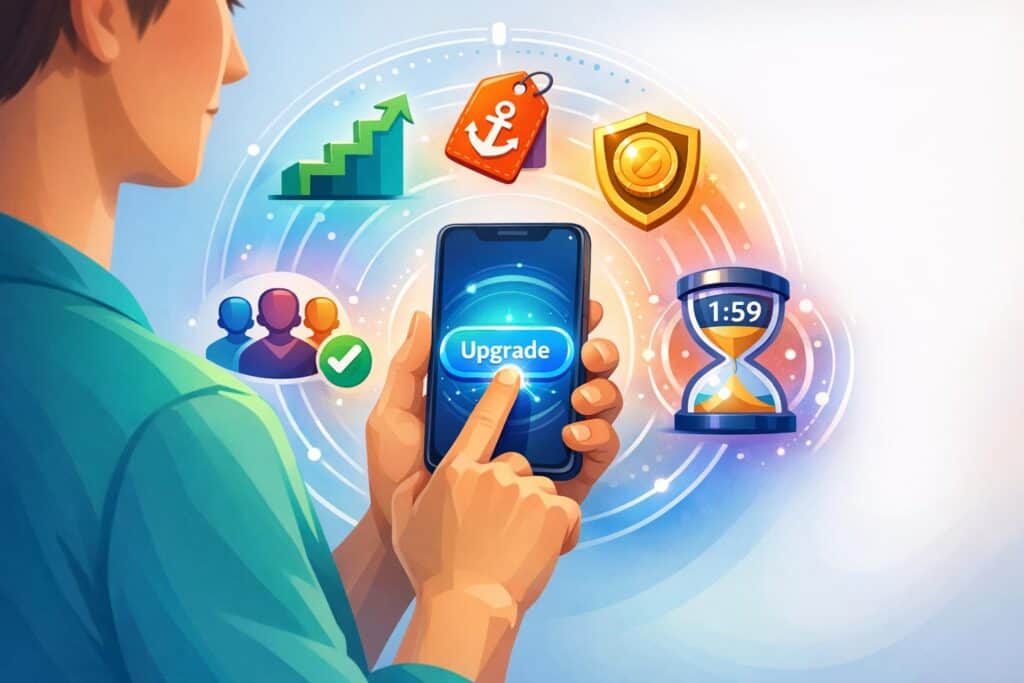
Upselling works because it taps into how people think and make decisions. Research shows that 95% of buying decisions are subconscious, influenced by psychological triggers like momentum, anchoring, and loss aversion. This isn’t about pushing "more stuff" – it’s about creating offers that feel natural, relevant, and valuable to the customer.
Here’s what you need to know:
- Buying Momentum: Customers are more open to upsells right after making a purchase. Use one-click offers or add-ons during checkout or on the "Thank You" page.
- Anchoring Effect: The first price customers see sets their expectations. Showing premium options first can make mid-tier choices feel more reasonable.
- Loss Aversion: People fear losing what they already have. Free trials and urgency messaging (e.g., "Don’t lose access") work well here.
- Social Proof: Highlighting what others buy builds trust. For example, "Frequently Bought Together" suggestions can increase conversions.
- FOMO (Fear of Missing Out): Limited-time offers or countdown timers create urgency and drive action.
Combining psychology with data analytics can improve upsell timing and relevance. For example, tracking customer behavior (like hitting usage limits) helps identify when they’re ready for an upgrade. Businesses using these strategies have seen upsell conversion rates jump from 8%-12% to 35%-45%.
Key takeaway: Upselling isn’t just about increasing revenue – it’s about helping customers get more value from their purchase while strengthening their connection to your brand.
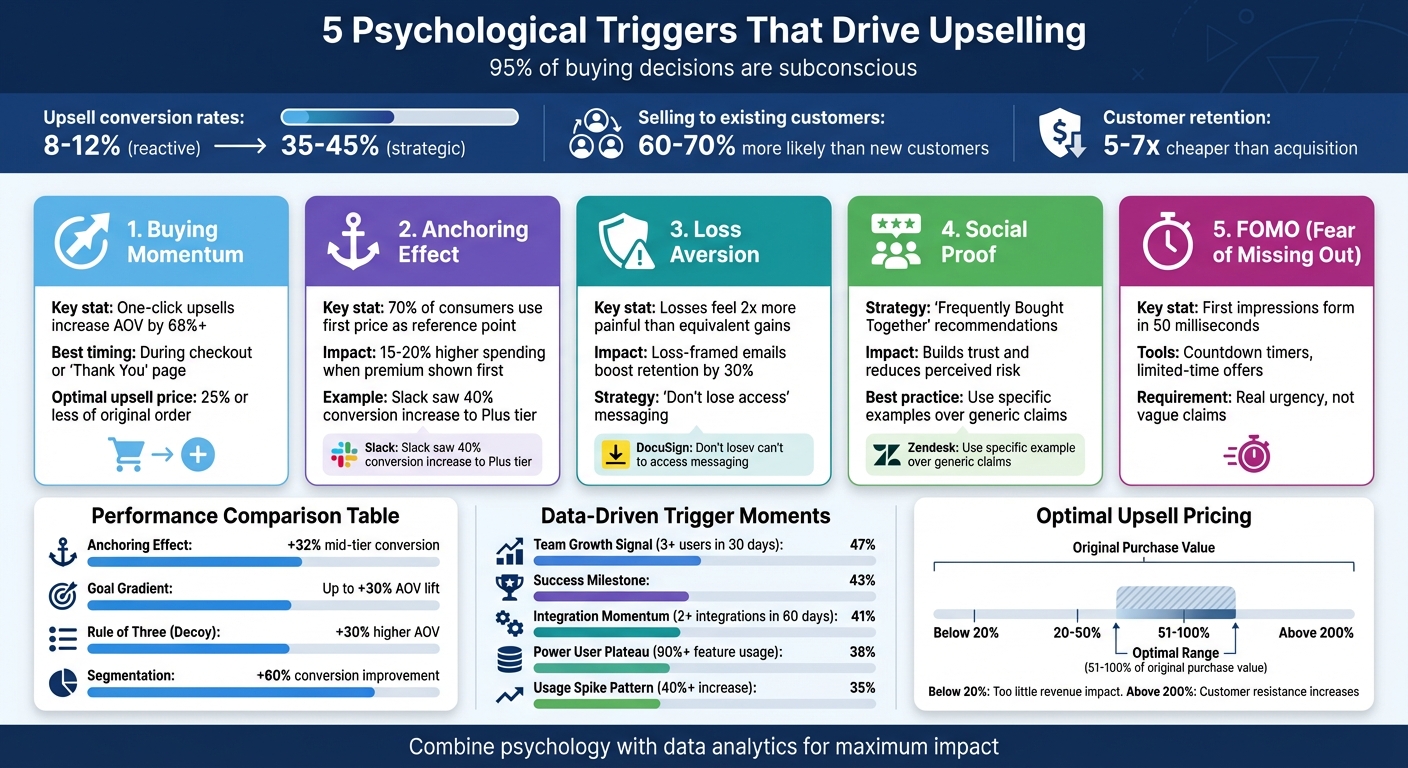
5 Psychological Triggers That Drive Upselling Success Rates
Use These Marketing Psychological Triggers to Make People Buy
sbb-itb-2ec70df
5 Psychological Triggers That Drive Upsells
Understanding why customers make decisions can help you craft upsells that feel natural instead of pushy. These five psychological triggers tap into how people think and make purchases.
Buying Momentum
Once a customer clicks "Buy Now", their resistance to spending drops. This moment, often called the "yes state", is the perfect time to introduce relevant upsells. They’ve already agreed to buy something, and their brain is wired to stick with that decision.
"The most profitable moment in your business isn’t when someone clicks ‘Buy Now’. It’s the moment after." – Zipify
This state of heightened trust and dopamine makes customers more open to additional offers. One-click upsells work especially well here because they keep the process smooth and convenient. Timing is key – present these offers during checkout or immediately on the "Thank You" page.
If the customer declines your primary upsell, a downsell (a simpler or lower-priced option) can still capture their interest while the buying momentum is strong. The key is relevance. For example, if someone buys a phone, offering a protective case feels helpful, but unrelated items can disrupt the flow and come off as a hard sell.
| Momentum Stage | Psychological State | Recommended Strategy |
|---|---|---|
| Checkout | High intent; focused on completion. | Add-ons that complement the main product (e.g., warranties). |
| Post-Purchase | "Yes State"; high dopamine and trust. | One-click upgrades or complementary discounts. |
| Thank You Page | Satisfaction; anxiety has subsided. | Low-risk bundles or curated next steps. |
Building on this momentum, introducing a high-price anchor can further influence how customers perceive value.
Anchoring Effect
The first price a customer sees often shapes how they view all subsequent options – this is called the anchoring effect. Studies show that about 70% of consumers rely on this first price as a reference point for their decisions.
Take Slack, for example. In early 2017, they launched "Enterprise Grid", a high-cost premium plan with custom pricing that could reach thousands of dollars per month. This made their "Plus" plan, priced at $12.50 per user per month, seem far more reasonable for medium-sized businesses. As a result, Slack saw a 40% jump in conversions to the Plus tier within just one quarter.
"The first number your customers see isn’t random – it’s a strategic choice. Anchoring shapes perceptions, influences decisions, and drives growth." – Growth Method
The anchoring effect works even better when combined with the decoy effect. For instance, offering a basic, less appealing plan alongside a premium option can steer customers toward a mid-tier choice. Visual cues like strikethroughs on original prices (e.g., "Was $199, Now $149") also highlight savings and reinforce the anchor. Showing premium options first can lead to customers spending 15% to 20% more compared to when lower-priced options are presented first.
Loss Aversion
People hate losing something more than they enjoy gaining something of equal value. In fact, losses feel about twice as painful as similar gains feel rewarding. This instinct is rooted in survival – avoiding threats was more critical than chasing rewards.
"Your prospects are making decisions with their amygdala, not their prefrontal cortex. And if you don’t understand that, you’re losing deals to reps who do." – Mamta Tainwala, AI & Automation, Sybill
This is why free trials are so effective for upselling. Once customers experience a product, they assign it more value, and the idea of losing access feels personal. For example, emails framed around loss (e.g., "Don’t lose access") have been shown to boost retention rates by 30% compared to gain-focused messages.
Instead of highlighting what customers stand to gain, show them what they’re losing. For instance, rather than promising a "30% increase in productivity", explain how much time or money they’re wasting without the upgrade. Real deadlines and clear constraints (not vague urgency) make this approach even more effective.
Social Proof
When customers see others making the same choice, it validates their decision and reduces their sense of risk. Features like "Frequently Bought Together" highlight actual customer behavior, making the upsell feel like a trustworthy recommendation.
Specific examples work better than generic claims. For instance, "10 people purchased this in the last hour" feels more credible than saying "thousands of happy customers." Personalized scarcity messages, like noting limited stock, can also add urgency while reinforcing the value of the recommendation.
Fear of Missing Out (FOMO)
FOMO taps into the anxiety of missing out on an opportunity others are enjoying. Real urgency and scarcity – like limited-time offers – are incredibly effective here. However, vague or exaggerated claims can feel manipulative and backfire.
Countdown timers are a great tool when used honestly. For instance, if a discount is only available for the next 24 hours, showing the time remaining builds credibility. Research shows that website visitors form their first impression in just 50 milliseconds, so these visual cues can make a big impact.
The best FOMO strategies combine clear deadlines, real-time social signals, and scarcity to motivate customers to act quickly. By creating a sense of urgency, you encourage immediate decisions without overwhelming the customer.
Using Data Analytics to Improve Upsell Strategies
Pairing psychological insights with precise timing based on analytics can make upsell efforts far more effective. Data helps identify the perfect moment to present an upsell, boosting conversion rates from a modest 8%–12% with reactive efforts to an impressive 35%–45% when timed strategically. This approach aligns with the psychological triggers discussed earlier, creating a powerful combination of timing and relevance.
Spotting "Trigger Moments"
"Trigger Moments" are specific behaviors or milestones that signal a customer might be ready for an upsell. For instance, if a customer is approaching 80% of their plan limits or adds a third team member within 30 days, analytics can predict upsell readiness 2–6 weeks in advance.
"The companies winning at expansion think differently. They’ve identified behavioral triggers that predict upsell readiness 2-6 weeks before customers realize they need more. They strike when customers are experiencing peak value, not peak frustration." – Jon Farah, Author
Take VoiceDrop as an example. In August 2025, they boosted their trial-to-paid conversion rate from 12% to 57% by leveraging behavioral triggers. They set up achievement triggers after the first voice drop, investment triggers after team invitations, and limit triggers at five free voice drops. This strategy increased conversions by 375% and added $47,000 in monthly revenue.
Customer Journey Mapping
Mapping the customer journey helps pinpoint natural upsell opportunities. The focus is on "Peak Value Moments" – those times when customers experience success with your product and are more likely to expand their engagement. Behavioral triggers are 2–3 times more effective than timing-based approaches like generic six-month check-ins.
For example, a Team Growth Signal – when three or more users are added within 30 days – has a 47% success rate. Other effective triggers include reaching measurable success milestones (43% success rate) and activating two or more integrations within 60 days (41% success rate).
Readiness Scoring is another useful tool. It evaluates accounts based on five factors: Activation (35%), Engagement (25%), Investment (20%), Collaboration (15%), and Recency (5%). When a score exceeds 65, the account is primed for an upsell conversation. Timing is critical, too. Reaching out 7–10 days after a key event, like a third user activation, or within two weeks of a milestone maximizes success. For high-engagement accounts, starting expansion discussions 90–120 days before renewal gives enough time to show ROI without rushing.
Amazon provides a great example of leveraging behavioral insights. In September 2025, their "Frequently Bought Together" feature paired items like camera bags and batteries with camera purchases, increasing average transaction values through smart upsell strategies.
| Trigger Type | Success Rate | Key Indicator |
|---|---|---|
| Team Growth Signal | 47% | 3+ new users added within 30 days |
| Success Milestone | 43% | Achievement of measurable business outcomes |
| Integration Momentum | 41% | 2+ new integrations activated within 60 days |
| Power User Plateau | 38% | Using 90%+ of available features in current plan |
| Usage Spike Pattern | 35% | 40%+ increase in monthly usage for 2+ months |
The best results – conversion rates as high as 65% – occur when multiple triggers align. Combining triggers like a Team Growth Signal and a Success Milestone creates a "Perfect Storm" of upsell readiness.
Working with Performance Marketing Agencies
Specialized agencies can take data-driven upsell strategies to the next level. Agencies like Growth-onomics excel at turning raw data into actionable insights. By analyzing behavioral data – such as clicks, time spent on site, and cart activity – they deliver highly personalized messaging at just the right moment.
For example, if a customer repeatedly hits API rate limits, the agency can send a targeted message about upgrading to a higher-tier plan with expanded capacity. Automated systems can also flag accounts for outreach when customers reach 90% of their seat or storage quota for two consecutive weeks, positioning the upsell as a proactive solution rather than a reactive fix.
In March 2026, SamCart demonstrated the power of structured "upsell-only" offers, increasing Customer Lifetime Value (CLV) by 35% by focusing on strategic upgrades.
"Behavioral marketing allows brands to meet customers exactly where they are in the buying journey, with the right message at the right moment." – Upsellit
Agencies like Growth-onomics also monitor metrics like the Daily-to-Monthly Active User (DAU/MAU) ratio. A ratio exceeding 0.6 over a full month signals deep product engagement and readiness for expansion. Additionally, tracking support tickets for intent signals – such as feature requests for SSO/SAML or complaints about capacity limits – often precedes upgrade decisions.
How to Measure Upsell Performance
Once you’ve identified trigger moments, the next step is to measure how well your upsell strategies are working. This process helps confirm whether your psychology-driven approaches are hitting the mark and provides direction for fine-tuning your methods.
Start by focusing on metrics like customer-segment AOV (Average Order Value). Another essential metric is the Upsell Conversion Rate, which measures the percentage of customers who accept an upsell offer. Successful upsell strategies generally see conversion rates between 15% and 25%, much higher than the 2% to 3% typical for acquiring new customers. If your acceptance rate falls below 15%, it could point to issues with timing, the relevance of the offer, or perceived value. Establish a baseline by tracking performance for two weeks before introducing new triggers.
"Selling to an existing customer is 60-70% more likely than selling to a new one. This is mathematical certainty, not opinion." – Benny
Another critical metric is Customer Lifetime Value (CLV), which indicates whether upselling is contributing to long-term revenue growth. When done effectively, upselling can increase CLV by 20% to 40%. Pair this with Net Promoter Score (NPS) to ensure your upselling efforts are not negatively impacting customer satisfaction.
Key Metrics to Track
Conversion Lift measures how well specific psychological triggers perform. For example, using the anchoring effect can increase mid-tier conversions by 32%, while segmented offers can outperform generic ones by up to 60%.
Revenue per Impression is another useful metric. This is calculated by dividing total upsell revenue by the total number of offers shown. For instance, if you display 1,000 upsell offers in a month and generate $5,000 in revenue, your revenue per impression is $5.00. To maintain high acceptance rates for post-purchase upsells, keep the upsell price at 25% or less of the original order value.
One-click upsells are another game-changer, often increasing AOV by over 68%. These small improvements in upsell acceptance can have a big impact on overall revenue.
Performance Comparison Table
The table below highlights how different psychological triggers influence upsell performance:
| Psychological Trigger | Performance Impact | Best Use Case |
|---|---|---|
| Anchoring Effect | +32% mid-tier conversion | Display premium options first to set a high price anchor |
| Goal Gradient | Up to +30% AOV lift | Use progress indicators like "amount to next tier" messaging |
| Rule of Three (Decoy) | +30% higher AOV | Offer a "Good-Better-Best" pricing structure to guide choices |
| Segmentation | +60% conversion improvement | Personalize offers based on purchase history or intent |
| Social Proof | Builds trust | Add "Most Popular" labels or customer ratings to premium options |
Studies suggest that the sweet spot for upsell pricing is between 51% and 100% of the original purchase value. Pricing below 20% adds little revenue, while pricing above 200% can scare off customers. Systematic A/B testing is another powerful tool – businesses that test regularly can improve upsell conversion rates by 20% to 40% within six months. To stay on top of shifting customer behaviors, review performance data at least once a month and adjust your strategies accordingly.
Conclusion
Len Markidan from Groove puts it perfectly: "Upselling isn’t just a sales tactic; it’s a customer happiness tactic that can help you build deeper relationships with customers by delivering more value." This idea aligns with the numbers – retaining a customer is 5 to 7 times cheaper than acquiring a new one, and loyal customers tend to spend 10 times more than first-time buyers.
Interestingly, around 95% of purchase decisions happen subconsciously. This is where psychological triggers like anchoring, loss aversion, and social proof come into play. When used effectively, they can nudge customers toward making decisions that benefit both them and your business. For instance, DocuSign saw a 35% boost in conversion rates by incorporating loss aversion messaging in their trial expiration emails. Similarly, Zendesk increased trial conversions by 15% simply by reducing their pricing options from five to three.
Data analytics and psychology work hand in hand here. Browsing habits and purchase histories reveal what customers do, while psychological insights explain why they do it. To keep upselling strategies effective, it’s crucial to track key metrics like upsell conversion rates and customer lifetime value. Regular A/B testing and adapting to shifting customer behaviors ensure your approach stays relevant and impactful over time.
FAQs
How do I pick the best upsell trigger for my product?
To find the most effective upsell trigger, tap into psychological factors that shape customer choices. Match your strategy to your audience’s habits and preferences. For example, highlight potential savings, create a sense of urgency, or leverage social proof by showcasing what others are buying. You can also use techniques like loss aversion (the fear of missing out) or present higher-priced options as the better deal through smart framing. Experiment with different methods, but always keep the focus on personalization and offering clear value – this will help you connect with what your customers value most.
What data should I track to find upsell “trigger moments”?
To pinpoint upsell opportunities, keeping an eye on behavioral and transactional data is key. Metrics like transaction history, product usage, and engagement patterns can reveal when a customer might be ready for an upgrade or an add-on.
For example, browsing habits or specific actions within an app can provide clues about the best timing for presenting an offer. Beyond that, tapping into psychological triggers – such as creating urgency or using social proof at moments like the checkout process – can help align offers with what customers are already considering.
By combining these insights, you can craft well-timed, relevant upsell strategies that resonate with your audience.
How can I upsell without sounding pushy or manipulative?
To upsell successfully without coming across as pushy, prioritize offering real value and addressing your customer’s specific needs. Frame your upsell as a way to enhance their experience rather than merely a higher-priced option. Timing matters – introduce the upsell at a point where it naturally fits into the conversation or their purchase process. By keeping the offer personalized and relevant, customers are more likely to view it as beneficial. Avoiding high-pressure tactics is equally important, as it helps build trust and encourages lasting customer relationships.