


Behavior data can transform how businesses approach cross-selling. By analyzing customer actions – like browsing patterns, purchase history, and cart behavior – you can predict what they’ll need next and offer relevant products at the right time. For example, Amazon generates 35% of its revenue from behavior-driven recommendations, showing how effective this strategy can be.
Key takeaways:
- Purchase history helps identify related product needs (e.g., printers → ink cartridges).
- Browsing behavior reveals intent before purchase (e.g., viewing laptops → accessories).
- Cart activity signals strong interest and opportunities for complementary items.
Behavioral signals highlight customer intent in real-time, helping businesses create targeted cross-sell strategies that boost revenue and retention. The key? Use this data to make personalized, timely offers that solve customer needs without being intrusive.
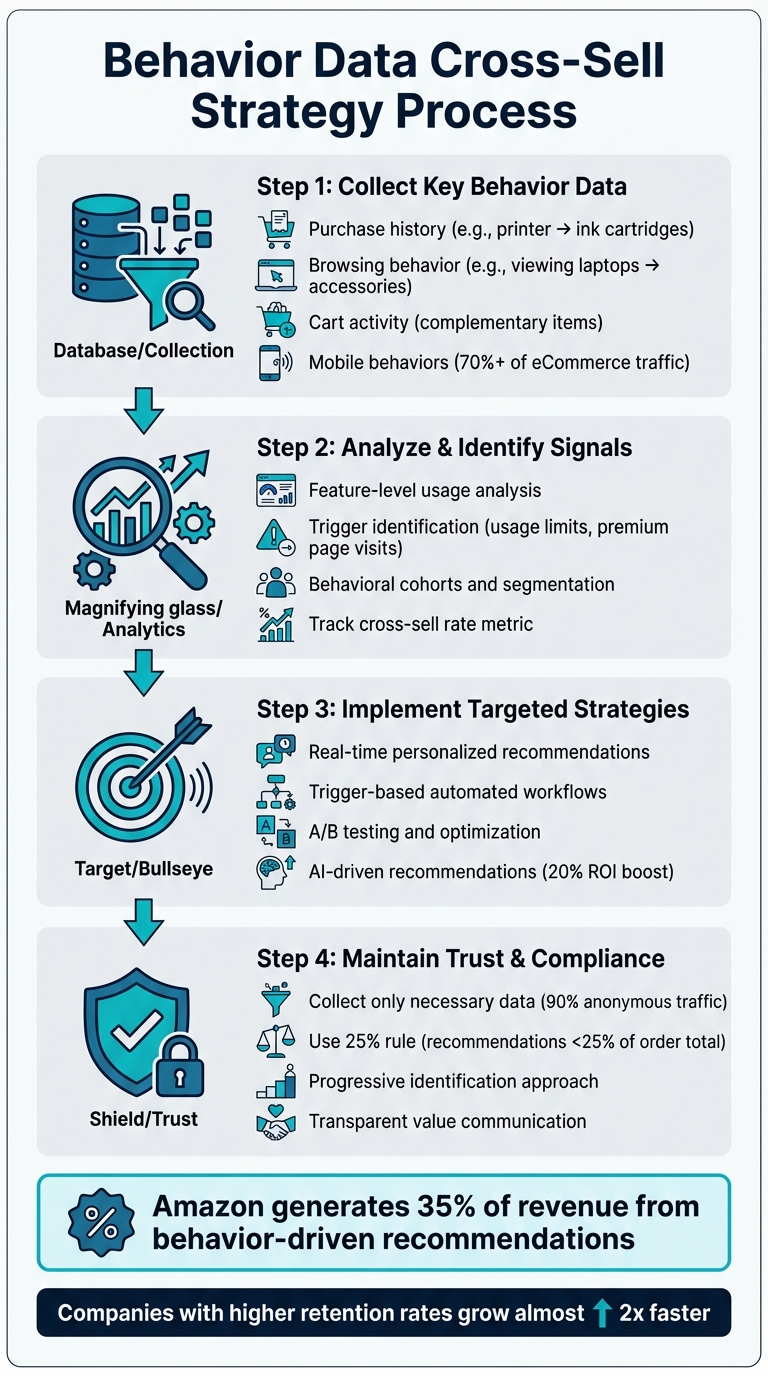
4-Step Process for Using Behavior Data to Identify Cross-Sell Opportunities
Using Data Science techniques to promote cross selling opportunities and understand client needs
sbb-itb-2ec70df
Collecting and Understanding Key Behavior Data
When you have accurate behavior data, you can stop guessing and start making informed decisions. By focusing on three main types of data – purchase history, browsing behavior, and near-purchase signals – you can uncover valuable cross-sell opportunities. This data lays the groundwork for identifying clear patterns and triggers in customer behavior.
Purchase History and Patterns
A customer’s purchase history tells you a lot about their preferences and when they might need related items. For example, someone who recently bought a printer will likely need ink cartridges soon. By analyzing purchase patterns over time, you can pinpoint the best moments to offer cross-sell suggestions that feel helpful instead of intrusive.
Browsing Behavior and Site Engagement
Browsing behavior often reveals a shopper’s intent long before they add anything to their cart. The order in which someone views product pages can help you understand whether they’re comparing options or assembling a complete solution. For instance:
- If a shopper looks at multiple laptop models, they’re likely comparing specs and prices.
- If they move from a laptop page to accessories like a mouse or a laptop bag, they’re probably building a setup – perfect for bundling recommendations.
Browsing filters can also reveal anonymous visitors’ preferences, like a focus on "professional-grade" products or "sustainable materials".
Using tools like smart URL parameters and campaign tags, you can segment visitors right when they arrive on your site. For example, someone coming from an influencer’s page might be searching for items that fit a specific style or routine. In many cases, the sequence of pages a visitor views offers more insight into their intent than the time they spend on a single page. Combining these browsing insights with purchase data gives you a fuller picture of their behavior.
Cart Abandonment and Product Interactions
When a shopper adds something to their cart, it’s a strong signal of intent. That’s the perfect time to suggest complementary items – like performance socks or a running belt for someone who just added running shoes. On the flip side, understanding when and why customers abandon their carts can reveal obstacles like price sensitivity, helping you craft value-based cross-sell strategies.
Paying attention to product interactions – like zooming in on images or checking size guides – helps you distinguish casual browsers from serious buyers. And with mobile devices making up over 70% of eCommerce traffic, it’s crucial to track mobile-specific behaviors, such as scrolling patterns and tap actions.
"Behavioral targeting combined with strategic segmentation provides the bridge between anonymous visitors and relevant recommendations." – Brian V Anderson, Founder & CEO, Nacelle
Analyzing Behavior Data to Identify Cross-Sell Signals
Turning raw behavior data into actionable insights is the key to identifying cross-sell opportunities. Instead of focusing solely on numbers, look for patterns that signal which customers might be ready for additional products or services.
Start by examining how customers interact with your platform. A feature-level analysis can reveal which actions or tools deliver the most value to specific customer segments. This approach helps uncover immediate opportunities for cross-selling.
Keep an eye out for specific triggers that indicate a customer’s readiness to expand. These might include hitting usage limits, frequently visiting premium feature pages, or accessing advanced settings multiple times. Customers trying to integrate third-party tools could signal a need for enhanced integration options or higher-tier plans. Similarly, repeated support inquiries about premium features often highlight unmet needs that could be addressed with an upsell.
Once you’ve identified these triggers, group customers with similar behaviors to create more focused and effective cross-sell campaigns.
Segmenting Customers Based on Behavior
Behavioral cohorts allow you to group customers by their actions – like usage patterns or feature preferences – rather than relying solely on demographics. This method leads to more precise targeting. For instance, marketing teams might gravitate toward analytics add-ons, while development teams may prioritize collaboration tools.
To spot customers primed for expansion, use tools like usage-based scoring and engagement tracking. These methods help you differentiate thriving customers from those who might need more support. Data shows that companies with higher retention rates often grow nearly twice as fast as their peers with lower retention rates.
Instead of static usage metrics, focus on engagement momentum. Customers who are increasing their activity or inviting more team members are likely in a growth phase, making them ideal candidates for cross-sell opportunities. Historical data can also be a goldmine – analyzing past behaviors that led to successful cross-sells helps you create predictive customer segments. Sequence tracking is another powerful tool, as it highlights natural progression paths. For example, users exploring certain features may frequently upgrade to higher-tier plans.
With these segments in place, dive deeper into purchase behavior to identify trends and correlations.
Spotting Purchase Correlations and Trends
To uncover which products or services are frequently purchased together, analyze your data from multiple perspectives. Revenue attribution can help pinpoint customer behaviors that drive the most value. A useful metric to track is your cross-sell rate, which measures the percentage of existing customers making additional purchases. This can give you a clear picture of how effective your cross-sell strategies are.
Look for peaks in engagement to introduce complementary solutions. For example, if you notice that companies of a certain size often use a specific combination of features, use that insight as social proof to recommend similar solutions to other customers in the same category.
Visualization tools can be particularly helpful in identifying real-time trends. They allow you to quickly spot highly engaged customers and those who might be slipping away. The goal is to connect seemingly unrelated behaviors that, when analyzed together, consistently lead to successful cross-sell scenarios. By linking these behaviors, you can refine your strategies and make more impactful recommendations.
Implementing Cross-Sell Strategies Using Behavior Data
Once you’ve pinpointed cross-sell signals and segmented your audience, the next step is turning those insights into action. The key lies in blending automation with a personal touch to deliver timely, relevant offers. By using behavioral data effectively, you can craft strategies that turn insights into real sales. Let’s break down how real-time recommendations, automated workflows, and continuous testing can help you execute these strategies.
Real-Time Personalized Recommendations
Automated recommendation tools analyze real-time behavior to suggest complementary products right when customers are most receptive. Instead of relying on generic suggestions, these tools use specific behavioral cues – like what the customer has viewed, added to their cart, or purchased before.
The timing of these recommendations is crucial. For instance, if someone just purchased project management software, offering collaboration tools during checkout or shortly after can make the process feel seamless. But don’t wait too long – conversion rates drop significantly after just ten minutes of delay.
This approach goes beyond just making suggestions. It’s about integrating automation in a way that feels natural and enhances the customer experience.
Trigger-Based Automated Workflows
Behavioral triggers let you automate outreach through email, SMS, or push notifications. By identifying key signals – like recent purchases, specific product views, or even downloads of a resource – you can send tailored cross-sell offers to the right audience.
For example, you might set up triggers such as "Placed Order" or "Viewed Product" to automatically recommend related items. To avoid overwhelming customers, include exit conditions that stop the workflow once the recommended product is purchased. As Nexuscale points out:
"A lead sitting in a CRM queue for more than four minutes is a wasting asset".
You can also automate follow-ups at intervals like 30, 90, or 180 days to identify new cross-sell opportunities. Adding frequency caps ensures customers don’t feel over-targeted. This is especially important in mid-market sales, where 60% to 70% of a representative’s time is often spent on tasks like searching for contact details or manually entering data. Automating these tasks frees up time for more meaningful interactions.
A/B Testing and Optimization
Testing different cross-sell strategies is essential to figure out what resonates most with your audience. Try experimenting with variables like message timing, preferred communication channels, product pairings, and the way offers are presented. Start small, monitor metrics like open rates and sales, and use the insights to refine your approach.
McKinsey highlights that integrating AI-driven recommendations can boost B2B sales ROI by up to 20%. As PhantomBuster advises:
"Automate admin, not relationships. Keep manual steps for negotiation and complex questions".
Best Practices for Using Behavior Data Responsibly
When using behavior-driven cross-sell tactics, it’s essential to prioritize ethical practices to maintain both customer trust and data privacy. While 81% of customers expect personalized experiences, they also want assurance that their data is being handled responsibly. The challenge lies in offering relevant recommendations without crossing the line into intrusive tracking.
Maintaining Data Privacy and Compliance
Start by collecting only the data you truly need. Instead of tracking individual users during every session, focus on segment-based recommendations. This method groups visitors by observable patterns – like page views or navigation habits – rather than identifying them personally. It’s a smart move, especially since anonymous visitors make up at least 90% of typical ecommerce traffic.
You can also use Smart URL parameters to assign customers to segments based on their arrival context. For example, consider what marketing campaign or influencer link brought them to your site. This approach allows for meaningful personalization while respecting privacy, catering to today’s privacy-conscious shoppers.
For more detailed customer profiles, try progressive identification. Offer something valuable, like a preference quiz for personalized recommendations, in exchange for voluntary data sharing. This builds trust while providing insights for more targeted cross-sell opportunities. Save one-to-one personalization for customers who have already shared their consent and have a history of purchases.
Once privacy concerns are addressed, focus on balancing personalization with building authentic trust.
Balancing Personalization and Customer Trust
The key is to solve customer problems rather than simply pushing products. Natalie Hogg, President and Head of Marketing at Method Q, explains it well:
"If the cross-sell products/services bring additional value and enrich the customer outcomes, then it is less ‘selling’ and more ‘solving’".
When your recommendations genuinely help customers, they feel like thoughtful suggestions rather than hard sales pitches.
A helpful guideline is the 25% rule: keep cross-sell recommendations under 25% of the original order total unless the added value is clear. Position these suggestions below the main product information so they feel like natural additions, not aggressive upsells. Transparency is also critical – Yaz Hanley, Business Development Manager, emphasizes:
"Being transparent about the value and costs of additional products builds trust and helps establish a long-term relationship with the customer, which is far more valuable than a one-time sale".
Consistency matters too. Stay engaged throughout the year with useful content, not just during sales periods. As Sienna Quirk, CMO at Invisory, warns:
"If your customer only hears from you during renewal season, you’ll come off as shallow and money-driven".
Regular, value-focused communication shows customers you’re invested in the relationship – not just the transaction.
Conclusion
This guide has explored how behavioral insights can reveal timely opportunities for cross-selling. By analyzing behavior data, businesses can map out the customer journey – identifying what customers engage with, when they do it, and how they interact with different touchpoints. Tracking purchase trends, browsing activity, and engagement signals enables you to pinpoint the ideal moments to introduce cross-sell offers. These moments might include a customer reaching a usage limit, exploring premium feature pages, or attempting to integrate third-party tools.
It’s worth noting that companies with higher retention rates grow almost twice as fast as those with lower retention rates. Despite this, 68% of decision-makers globally collect customer engagement data but often struggle to turn that data into actionable insights. Predictive analytics can bridge this gap by scoring factors like purchase intent, churn risk, and product preferences.
As Hai Ta, Co-Founder of Userlens, puts it, effective cross-sell strategies combine personalization with genuine care to enhance customer satisfaction, retention, and overall growth:
"The best cross-sell programs create a win-win scenario: additional products enhance customer satisfaction and loyalty, which leads to higher retention and more opportunities for future growth".
Trust and transparency play a crucial role in successful cross-selling. Shalini Vijayakumar emphasizes the value of understanding customer behavior to refine marketing approaches:
"Behavioral data is the key to unlocking these insights. It helps you understand customer actions and predict their future behaviors, making it invaluable for optimizing every aspect of your marketing strategy".
FAQs
What behavior data should I track first for cross-sells?
To get started, focus on tracking customer behaviors such as website clicks, browsing patterns, cart abandonment, and purchase history. These actions reveal valuable insights into what your customers prefer and how they engage with your platform. By analyzing these patterns, you can fine-tune your cross-sell offers to match their interests. Plus, it helps you pinpoint the right moment and context for making recommendations, which can lead to higher conversions and increased revenue.
How do I identify the best moment to show a cross-sell offer?
The ideal moment to present a cross-sell offer is when it adds value to the customer’s experience without feeling intrusive. Leverage behavioral data – such as browsing patterns, past purchases, or engagement indicators – to understand their intent. For instance, you could recommend related products right after a purchase or while they’re viewing complementary items. Aligning offers with real-time customer actions ensures they feel relevant, increasing the chances of a successful conversion.
How can I personalize cross-sells without hurting customer trust?
To make cross-sells feel personal without losing customer trust, tap into behavioral data like browsing patterns and past purchases. Use this information to craft recommendations that are both relevant and well-timed. Instead of generic suggestions, segment your audience based on their actions and demographics to ensure your offers resonate.
Be transparent about how you use customer data and stay compliant with privacy regulations. The key is to focus on delivering value – whether it’s suggesting complementary products or upgrades that genuinely enhance the customer’s experience. Striking the right balance between personalization and respecting privacy can help foster trust and long-term loyalty.