
March–August 2026 vs March–August 2025
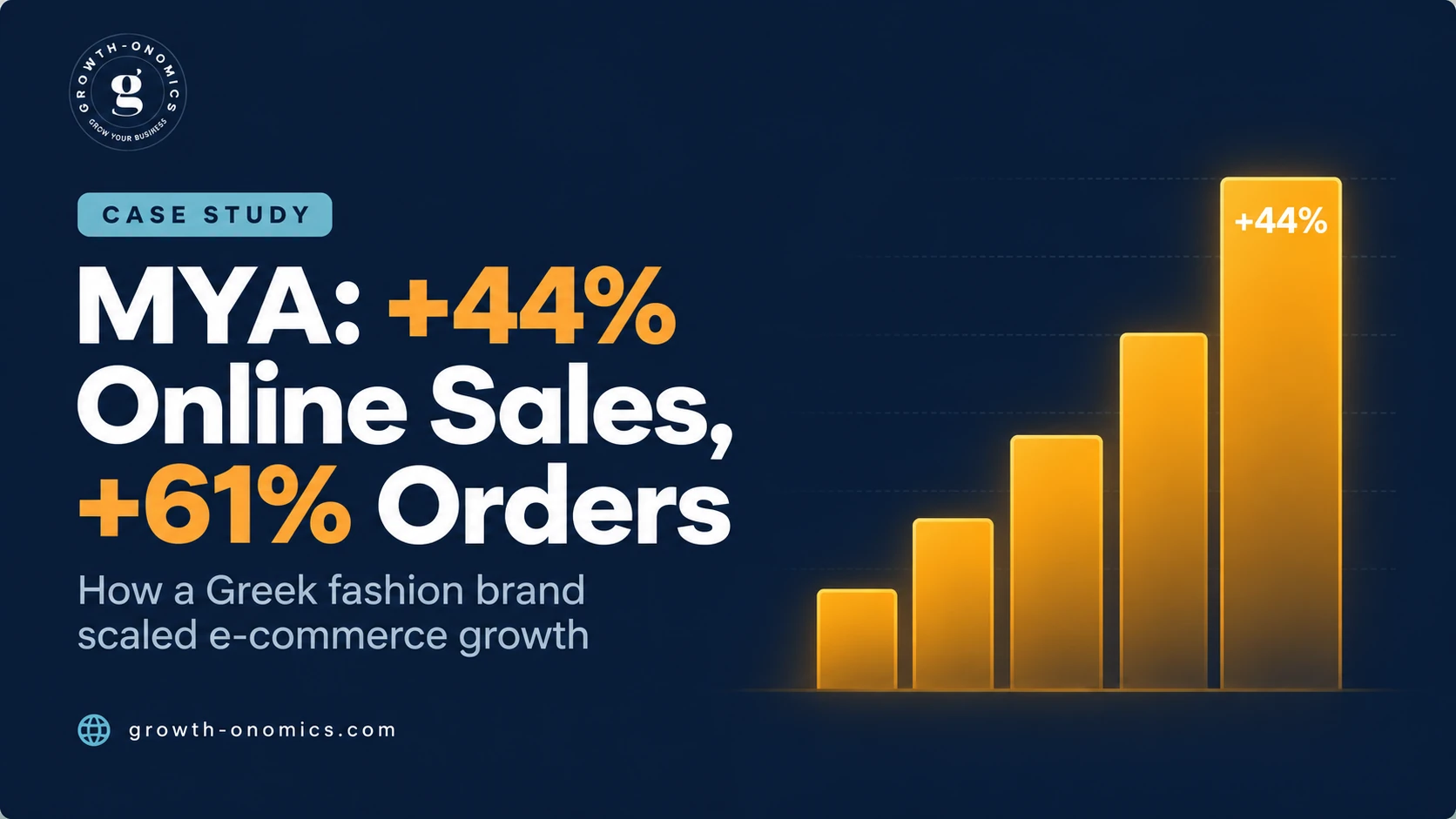
+44% Online Sales YoY · +61% Orders YoY · +111% Website Sessions YoY · +135% Google Ads Conversions YoY · +295% Meta Reach YoY
Introduction
Fashion e-commerce is one of the most demanding environments for performance marketing. Products change continuously, customer preferences shift quickly, seasonality affects demand, and creative fatigue can reduce campaign performance within weeks.
For MYA, sustainable growth required more than increasing advertising budgets. It required a structured acquisition system capable of introducing new collections, testing individual products, creating demand through Meta, capturing that demand through Google, and continuously adapting to real customer behaviour.
Between March and August 2026, Growth-onomics implemented an integrated Google Ads and Meta Ads strategy focused on scalable customer acquisition, continuous creative testing, product-led campaign development and data-driven budget allocation.
Over this six-month period, compared with the same months in 2025, the strategy contributed to:
- 44% year-over-year growth in online sales
- 61% year-over-year growth in total orders
- 111% year-over-year growth in website sessions
- 135% year-over-year growth in Google Ads conversions
- 55% year-over-year growth in Meta-attributed purchases
- 295% year-over-year growth in Meta reach
These results were measured by comparing March–August 2026 with March–August 2025, ensuring that performance was evaluated across the same six-month seasonal window.
The growth was not driven by a single campaign, promotion or creative. It came from a connected performance marketing system that evolved alongside MYA’s collections, products and customers.
The Challenge
MYA already had a recognisable brand, a strong product range and an established online audience. The challenge was turning these foundations into consistent, scalable e-commerce growth.
Four main factors shaped our strategy.
A Constantly Changing Product Catalogue
Fashion campaigns cannot rely on the same products or messages throughout the year. New collections, seasonal demand, best sellers, product availability and promotional periods continuously change what customers are interested in.
The advertising structure needed to react quickly whenever MYA launched new dresses, collections, offers or product categories.
Scaling Without Losing Commercial Relevance
Increasing reach and traffic is relatively straightforward. Increasing them while continuing to attract customers with genuine purchase intent is significantly more difficult.
As investment increased, we needed to monitor not only clicks and platform conversions but also landing-page behaviour, add-to-cart activity, checkout progression, Shopify orders and total online sales.
Connecting Demand Generation With Demand Capture
Meta and Google play different roles in the customer journey.
Meta introduces collections and products to new audiences, creates interest and brings previous visitors back into the funnel. Google captures users who are already searching for MYA, specific product categories or products they discovered through other channels.
Managing the platforms separately would have provided only a partial view of performance. Our strategy therefore treated them as connected parts of the same acquisition system.
Creative Fatigue and Seasonal Buying Behaviour
Fashion performance depends heavily on creative relevance. A successful advertisement can lose momentum as audiences repeatedly see it, while a new product or collection can create a completely different response.
This required continuous communication with the MYA team and a consistent flow of new product images, videos, collection assets, promotional messages and creative variations.
The Approach
Rather than building one static campaign structure and leaving it unchanged, we developed a flexible system around the way customers discover, consider and purchase fashion products online.
The strategy operated across five connected areas:
- Full-funnel advertising across Google and Meta
- Continuous creative and product testing
- Search demand capture and query optimisation
- Product-category and catalogue management
- Performance-based budget allocation
Each area supported the others. Meta generated product awareness and website traffic. Google captured brand and category demand. Remarketing re-engaged users who had already shown interest. Shopify data showed whether this activity translated into genuine business growth.
Continuous Collaboration With the Client
A major part of the strategy was the continuous communication between Growth-onomics and MYA.
We did not treat creative production as an occasional request made only when performance declined. It became part of the regular campaign workflow.
We worked closely with the client to identify:
- New collections ready to launch
- Products with strong commercial potential
- Best sellers that could support further scaling
- Products that needed additional visibility
- Seasonal opportunities
- Promotional periods and offers
- New images and videos available for testing
- Messaging that reflected the current direction of the brand
This collaboration allowed advertising activity to remain connected to what was actually happening inside the business.
When a new collection launched, campaigns and creatives were built around it. When new products became available, they were introduced through dedicated tests. When an offer was activated, the messaging and campaign structure were adjusted accordingly.
The account therefore developed continuously instead of depending on one creative concept or one fixed campaign.
Meta Ads Strategy
Meta was used as the main demand-generation and product-discovery channel.
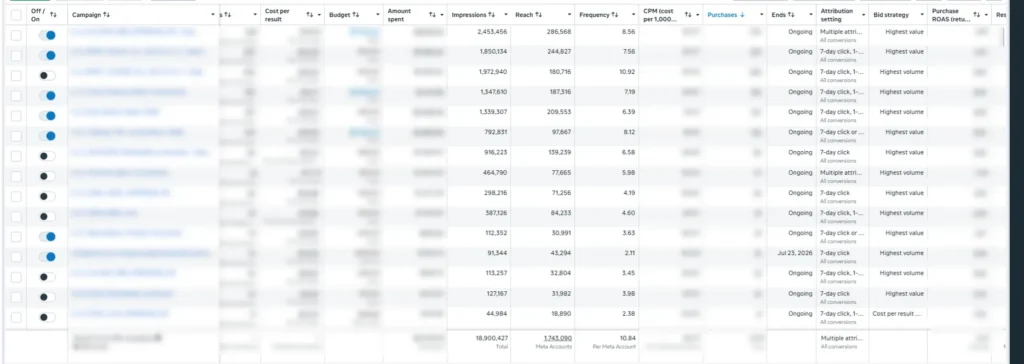
The campaign structure covered multiple stages of the customer journey, including broad prospecting, lookalike audiences, product-focused campaigns, collection launches, catalogue advertising and remarketing.
Prospecting and Audience Expansion
Broad and lookalike targeting allowed MYA to reach significantly more potential customers beyond its existing audience.
Across March–August 2026, compared with March–August 2025:
- Reach increased by 295% YoY
- Impressions increased by 209% YoY
- Link clicks increased by 208% YoY
- Landing-page views increased by 202% YoY
Despite the substantial increase in delivery, link CTR remained almost unchanged YoY. This indicated that the campaigns preserved their ability to generate engagement while reaching a much larger and colder audience.
Collection and Product-Led Campaigns
Campaigns were not built only around generic brand messages.
Dedicated activity was created for:
- New seasonal collections
- New product releases
- Best-selling products
- Individual product tests
- Summer offers
- Catalogue and dynamic product advertising
- Brand and lifestyle creatives
This gave the team the ability to identify which products and creative angles could support further investment.
Products were not selected only because they were new. Their performance was evaluated through click behaviour, landing-page engagement, add-to-cart activity, purchases and overall Shopify results.
Remarketing and Catalogue Advertising
Warm audiences were re-engaged through campaigns built around website behaviour, including product viewers, add-to-cart users and customers who had initiated checkout.
Catalogue and dynamic product formats allowed Meta to reconnect users with relevant products and collections based on their previous interactions.
This created a more complete journey:
Product discovery → Website visit → Product consideration → Remarketing → Purchase
Catalogue and dynamic product ads became an important part of the account, especially for converting users who had already demonstrated product interest.
Continuous Creative Testing
Creative testing was one of the most active parts of the strategy.
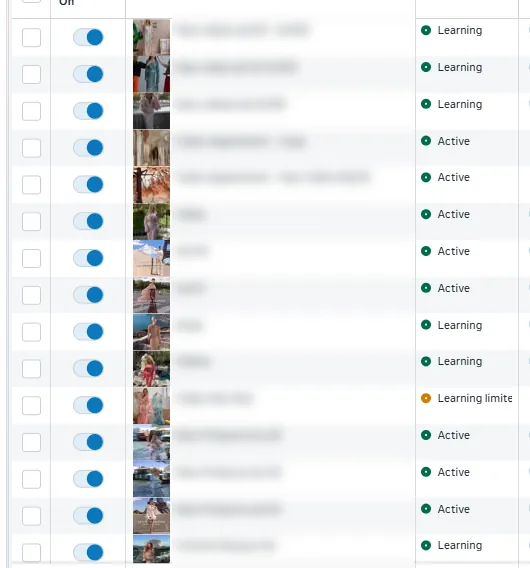
During the six-month period, the account recorded:
- 176 ads with delivery
- 174 new ads created
- 172 creative edits
- Multiple image, carousel, video and catalogue formats
- Continuous tests across collections, products, offers and messaging
Image and carousel formats delivered the strongest direct-response performance overall, while dynamic catalogue creatives supported both prospecting and remarketing.
Video and existing Instagram content played a broader role in product discovery, collection awareness and audience development.
Instead of expecting every creative to generate purchases immediately, we evaluated each format according to its role in the funnel.
Meta Budget Allocation
Budgets were not distributed evenly across every campaign.
Investment was increased when campaigns, products or creatives showed the ability to absorb additional spend. At the same time, campaigns were reduced, paused or replaced when performance weakened, creative fatigue appeared or a stronger product opportunity emerged.
During the six-month period, the account history recorded:
- 109 budget changes
- 100 targeting adjustments
- 342 campaign-status changes
- Continuous creation, pausing and replacement of ads
This was not uncontrolled activity. It was a structured testing process designed to keep investment focused on the strongest available opportunities at each stage of the season.
Google Ads Strategy
Google Ads was responsible for capturing the demand generated across Meta, organic activity, brand exposure and existing customer awareness.
The structure combined Brand Search, Performance Max, Shopping, remarketing activity, product-category segmentation and controlled product-search tests.
Protecting and Capturing Brand Demand
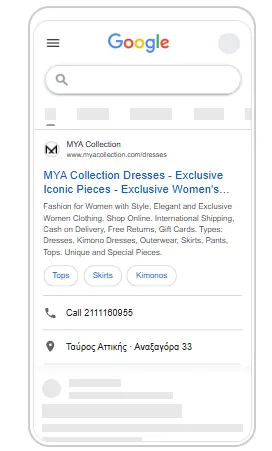
Brand Search campaigns ensured that users actively searching for MYA, MYA dresses, MYA clothing and related brand variations could reach the most relevant website experience.
Brand traffic represented a substantial part of Google Ads performance, demonstrating that customers were not only discovering individual products but actively searching for the MYA brand.
This was particularly important because a portion of branded demand was likely influenced by Meta campaigns, collection launches, social activity and repeat customer behaviour.
Rather than treating Brand Search as an isolated campaign, we viewed it as the final demand-capture layer of the broader marketing funnel.
Performance Max and Brand Separation
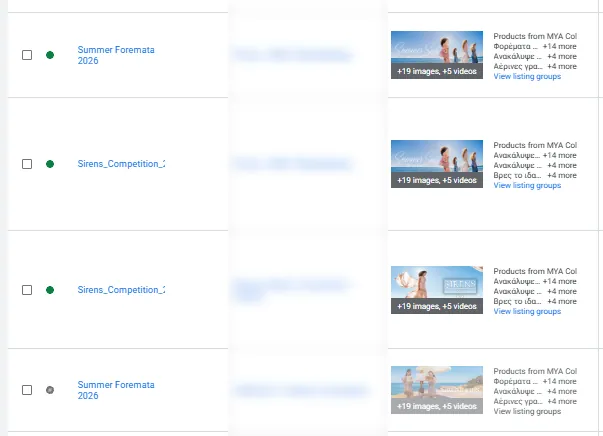
Performance Max supported non-brand product discovery and sales across Google’s inventory.
As the account developed, brand exclusions were introduced to the main Performance Max activity. This helped create a clearer separation between:
- Existing brand demand captured through Search
- Incremental product and category discovery generated through Performance Max
This separation improved the quality of the analysis and reduced the risk of Performance Max reporting results that were primarily driven by customers already searching for MYA.
Search-Term and Keyword Optimisation
Search campaigns were continuously reviewed at query level.
The optimisation process included:
- Reviewing actual search terms
- Adding irrelevant searches as negative keywords
- Refining keyword match types
- Separating brand variations
- Identifying new product and category opportunities
- Monitoring search intent
- Improving the relevance between keywords, ads and landing pages
This work protected the budget from irrelevant traffic and helped the campaigns focus on searches with genuine commercial relevance.
Search-term optimisation was not treated as a one-time clean-up. It remained part of the ongoing account-management process as new searches and seasonal patterns appeared.
Product Categories and Shopping Structure
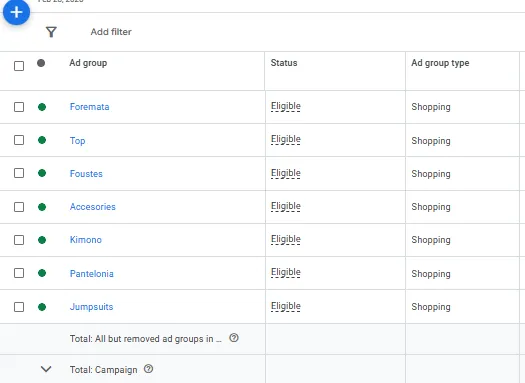
Shopping activity was segmented by product category, including dresses, skirts, trousers, tops, jumpsuits, kimonos and accessories.
This structure provided greater visibility into which categories were generating demand and allowed budget decisions to be made at product-group level.
Product performance was reviewed using:
- Click volume
- Cost per click
- Purchase activity
- Cost per purchase
- Conversion value
- Return on ad spend
- Shopify sales patterns
- Product availability
The team could then increase exposure for stronger categories while limiting products or groups that were consuming budget without producing sufficient commercial value.
Scaling a Broad Product Catalogue
Rather than relying on a small number of hero products, MYA generated demand across a broad product range.
The largest individual product represented just 4.75% of total sales, while the top 10 products accounted for only 23.97%. This demonstrated a healthy spread of demand across dresses, kimonos and skirts — allowing the account to scale collections, categories and new product launches without depending on a single bestseller.
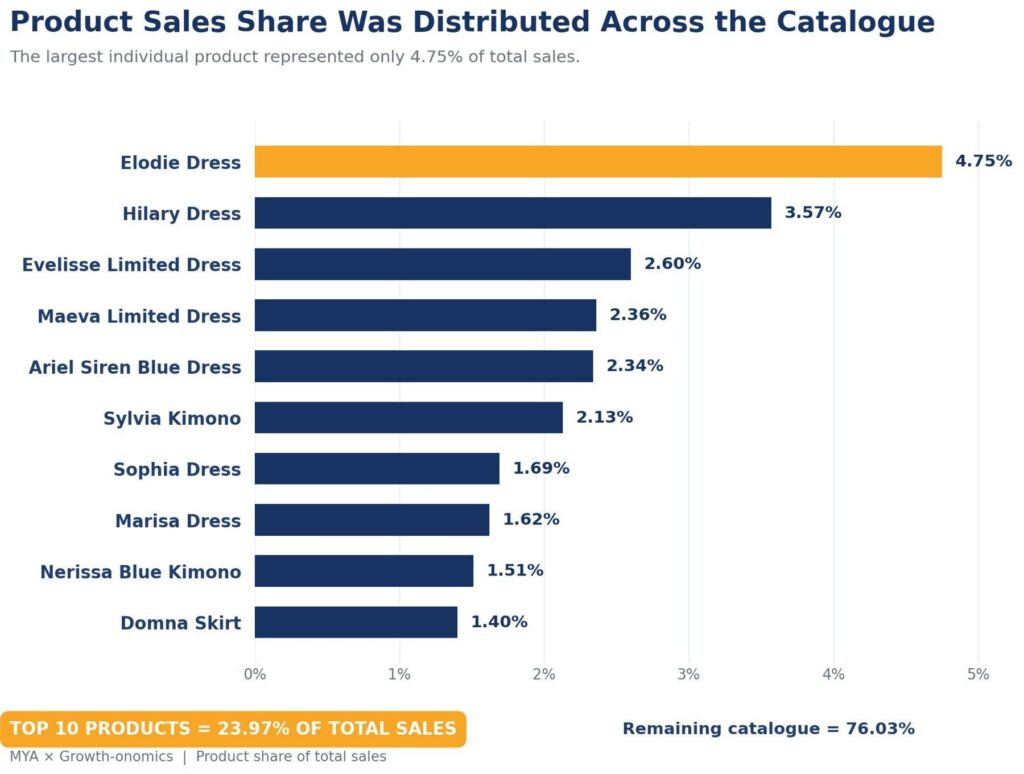
Examples of products contributing to a broad and diversified catalogue demand.
Bidding Strategies and Budget Allocation
Bidding strategies were reviewed according to campaign objective, available conversion data and the maturity of each campaign.
The account used a combination of conversion-focused and value-focused strategies across Search, Shopping and Performance Max.
Budgets were allocated according to:
- Search demand
- Campaign efficiency
- Product availability
- Seasonal priorities
- Collection launches
- Conversion volume
- The ability of each campaign to scale
Budget changes were made gradually and evaluated using performance trends rather than isolated daily results.
This allowed Google Ads to expand significantly while continuing to capture high-intent demand.
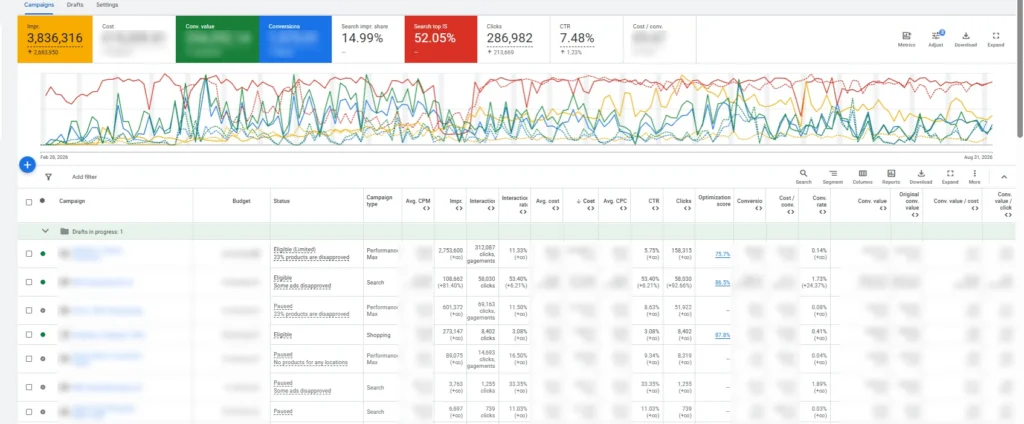
A Connected Full-Funnel System
The strongest growth did not come from Meta or Google operating independently.
Meta introduced the brand, products and collections to new audiences. Visitors engaged with product pages, explored collections and entered remarketing audiences.
Google then captured users searching for:
- The MYA brand
- MYA product variations
- Dresses and other fashion categories
- Products they had previously discovered
- High-intent shopping terms
Remarketing and catalogue campaigns re-engaged users who were not ready to purchase during their first visit.
This created a connected acquisition journey:
Meta awareness and product discovery → Website engagement → Google demand capture → Remarketing → Purchase and repeat demand
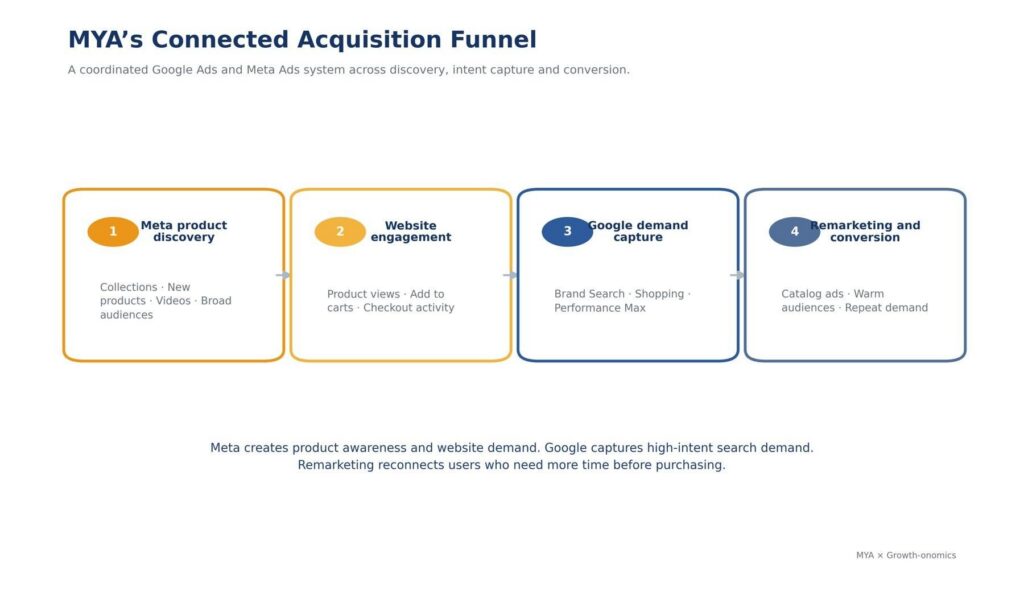
The Results
Across the six-month period from March to August 2026, compared with the same period in 2025, MYA achieved substantial year-over-year growth across both store-level and advertising metrics.
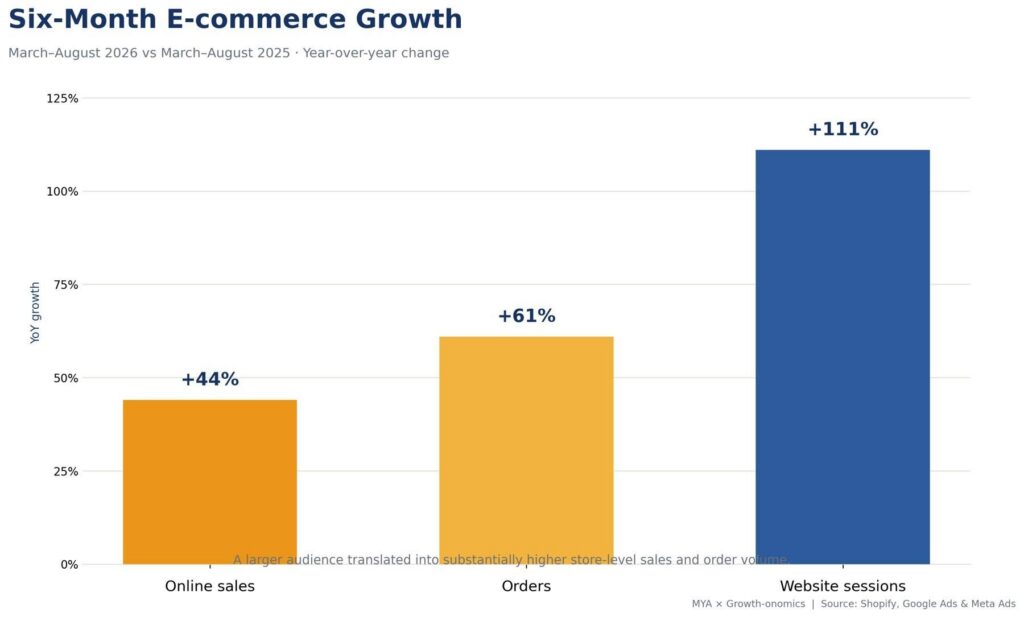
Shopify Performance – Six-Month YoY Comparison
March–August 2026 vs March–August 2025
- Online sales increased by 44% YoY
- Total orders increased by 61% YoY
- Website sessions increased by 111% YoY
- Order growth outpaced sales growth, demonstrating a significant increase in purchase volume and customer acquisition
The account did not simply generate additional platform conversions. It produced measurable growth at store level across an equivalent six-month seasonal period.
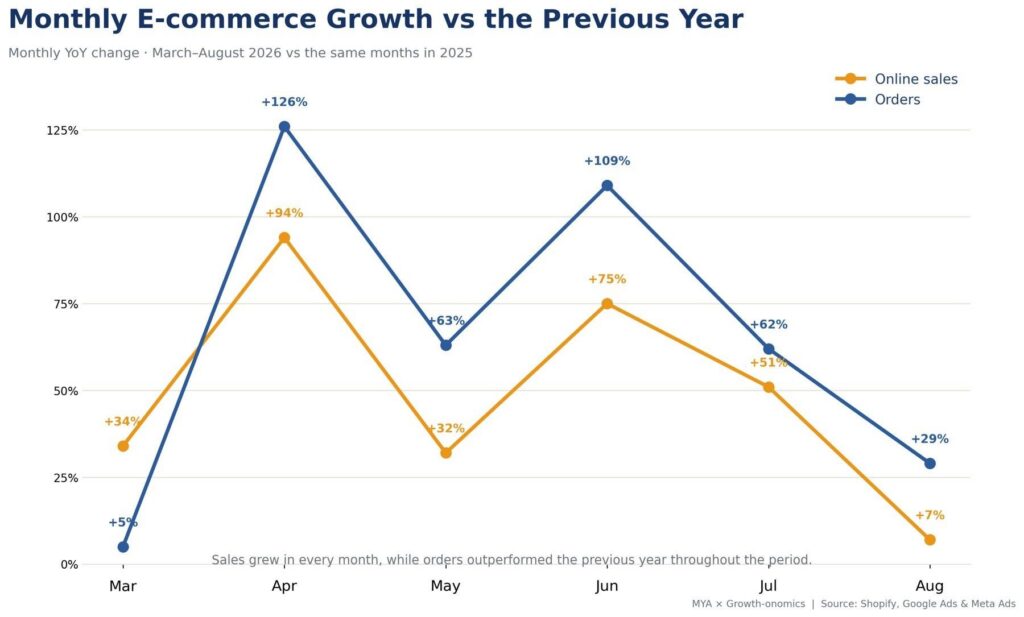
Google Ads Performance — Six-Month YoY Comparison
March–August 2026 vs March–August 2025
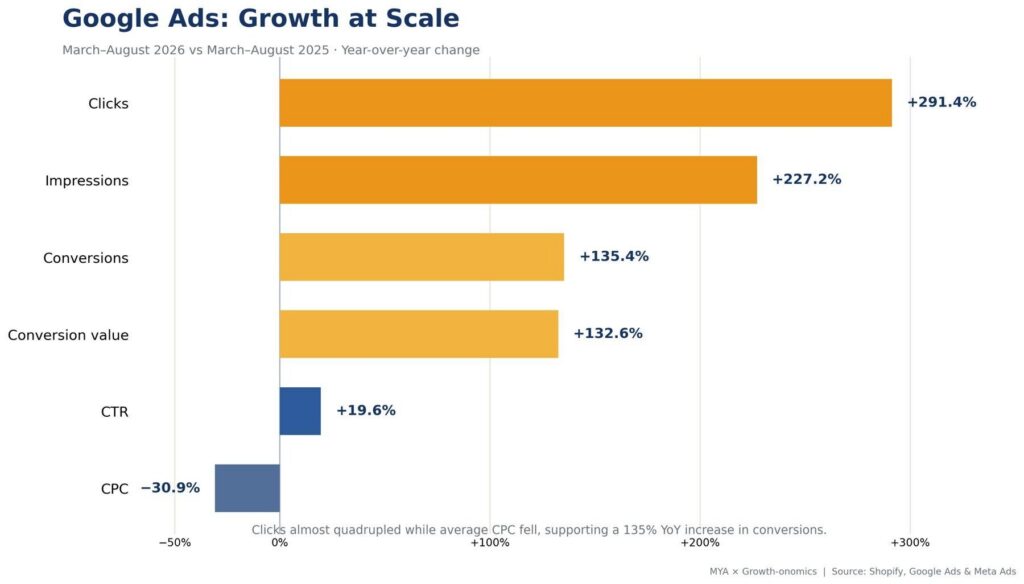
- Impressions increased by 227% YoY
- Clicks increased by 291% YoY
- CTR improved by 19.6% YoY
- Average CPC decreased by 30.9% YoY
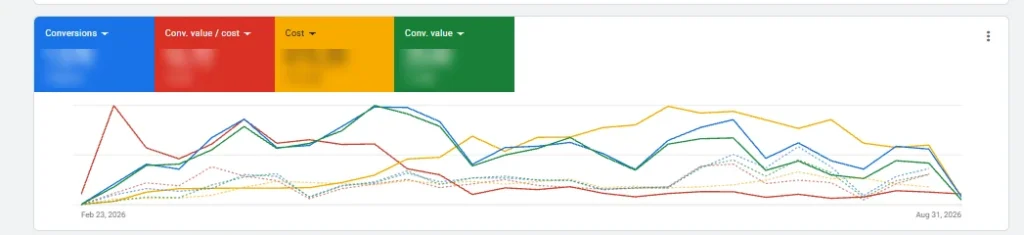
- Conversions increased by 135% YoY
- Reported conversion value increased by 133% YoY
- Cost per conversion increased by only 14.8%, despite the substantial expansion in traffic and conversion volume
Google Ads delivered almost four times as many clicks YoY while reducing the average cost of each click.
The combination of higher CTR and lower CPC showed that the account did not rely only on larger budgets. Campaign relevance, search coverage and traffic acquisition also improved.
Meta Ads Performance — Six-Month YoY Comparison
March–August 2026 vs March–August 2025
- Reach increased by 295% YoY
- Impressions increased by 209% YoY
- Link clicks increased by 208% YoY
- Landing-page views increased by 202% YoY
- Add-to-cart events increased by 61% YoY
- Initiated checkouts increased by 56% YoY
- Purchases increased by 55% YoY
- Attributed purchase value increased by 51% YoY
Meta delivered the scale required to expose MYA’s products and collections to a substantially larger audience.
As the campaigns expanded into colder audiences, platform-level efficiency declined. However, this was evaluated alongside Shopify’s 44% YoY sales growth and Google’s significant increase in brand and conversion activity.
This wider view prevented the team from making decisions based only on the last-click ROAS of an individual platform.
Continued Momentum in September
The positive trajectory continued beyond the initial six-month analysis.
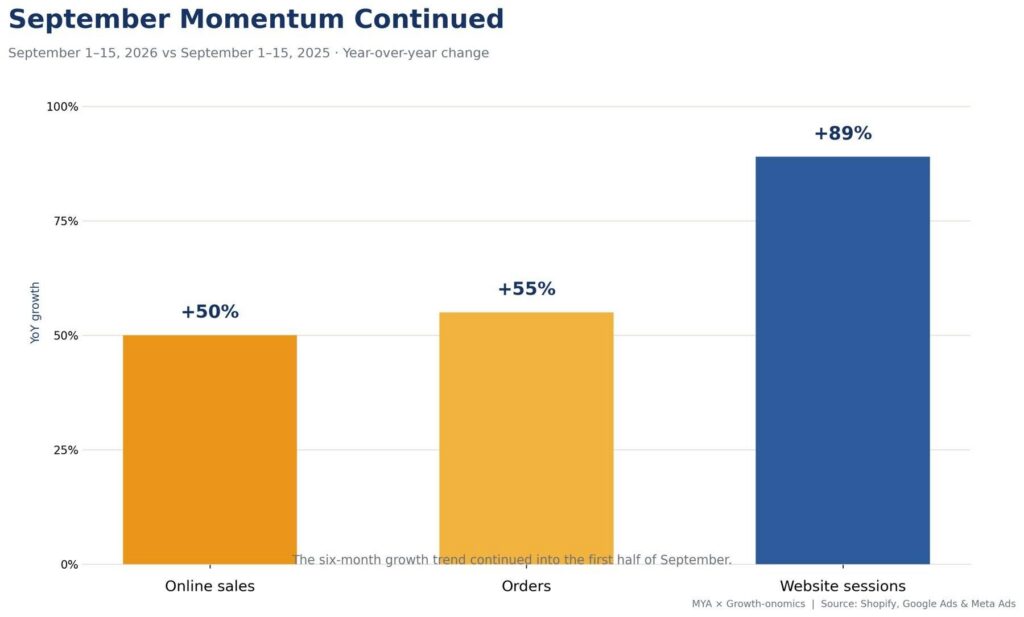
During September 1–15, 2026, compared with September 1–15, 2025:
- Online sales increased by 50% YoY
- Orders increased by 55% YoY
- Website sessions increased by 89% YoY
- Average order value remained broadly stable, decreasing by only 1.6% YoY
The early September results indicated that the growth recorded between March and August was continuing into the following month rather than being driven by one isolated campaign or short-term seasonal spike.
Strategic Value
Several principles drove the results.
The Strategy Followed the Business
Campaign decisions were connected to product availability, new collections, best sellers, promotional periods and the client’s commercial priorities.
The advertising account did not operate separately from the brand.
Creative Production Became Continuous
MYA’s growth was supported by an ongoing flow of new images, videos, products, collections and promotional messages.
This reduced dependence on a small number of ads and allowed the account to respond faster when performance shifted.
Every Channel Had a Defined Role
Meta created demand and product discovery. Google captured existing intent and branded demand. Remarketing re-engaged consideration-stage audiences. Shopify measured the combined commercial result.
Testing Was Systematic
New audiences, products, creatives and campaign structures were introduced with a clear purpose.
Performance was monitored, stronger tests received additional investment and weaker tests were paused or replaced.
Budgets Followed Performance
Budgets were increased when campaigns demonstrated the ability to scale, but investment was not raised uniformly across the account.
Allocation followed actual performance, search demand, product priorities and customer behaviour.
Optimisation Never Stopped
Search terms, keywords, negative keywords, product categories, audiences, creatives, bidding strategies and budgets were reviewed continuously.
The growth came from hundreds of individual improvements working together, not from a single large change.
Conclusion
Over six months, from March through August 2026, MYA achieved 44% year-over-year growth in online sales compared with the same six-month period in 2025.
During the same YoY comparison period:
- Orders increased by 61%
- Website sessions increased by 111%
- Google Ads conversions increased by 135%
- Google Ads clicks increased by 291%
- Meta-attributed purchases increased by 55%
- Meta reach increased by 295%
The account scaled because creative production, product strategy, paid media and client communication worked as one connected system.
New collections created new advertising opportunities. Continuous creative testing kept the brand relevant. Meta expanded product discovery. Google captured high-intent and branded demand. Remarketing brought interested users back. Shopify data kept the strategy connected to actual business performance.
For fashion e-commerce brands, growth rarely comes from finding one perfect campaign.
It comes from building a system that can continuously test, learn, reallocate investment and evolve alongside the products and the customer.
Ready to Scale Your E-commerce Brand?
Successful e-commerce growth requires more than increasing advertising spend.
It requires the right campaign structure, continuous creative development, accurate measurement and a team capable of turning performance data into clear actions.
Growth-onomics helps e-commerce brands build connected Google and Meta Ads strategies designed to generate demand, capture purchase intent and create sustainable growth.
Book a strategy call with Growth-onomics to discover the next growth opportunities for your brand.
