


Cross-channel engagement connects customer interactions across multiple platforms for better results. Campaigns using three or more channels achieve 287% higher purchase rates and boost retention by 90%. Yet, only 15% of businesses have a unified customer view.
Here’s what matters most:
- Engagement Rate by Channel: Measure how users interact (e.g., clicks, likes, session depth). Compare performance to optimize strategies.
- Multi-Touch Attribution: Understand how all touchpoints contribute to conversions. Models like time decay and position-based provide better insights than single-touch methods.
- Customer Satisfaction (CSAT): Track satisfaction by channel to identify strengths and weaknesses. A 1-point CSAT increase can drive 3% revenue growth.
- Customer Lifetime Value (CLV): Calculate total revenue per customer to focus on high-value segments. Aim for a 1:3 ratio with acquisition costs.
- Churn and Retention Rates: Retaining customers is 5-25x cheaper than acquiring new ones. Cross-channel strategies improve retention by 90%.
- Conversion Path Analysis: Analyze customer journeys to find the most effective channel combinations.
Challenges include fragmented data, identity resolution, and accurate attribution. To succeed, centralize data, adopt multi-touch attribution, and refine tracking systems for better insights.
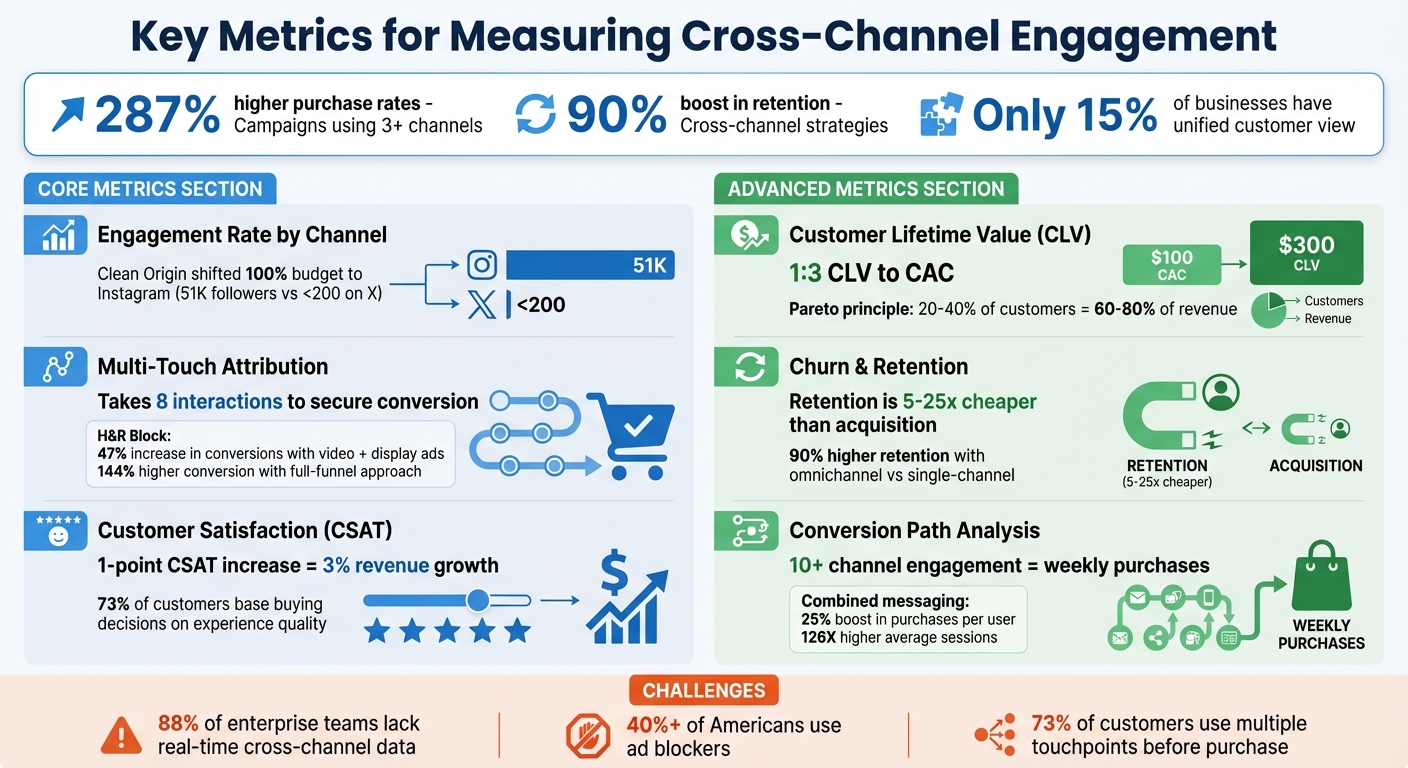
Cross-Channel Engagement: Key Metrics and Performance Statistics
Mastering Multi-Channel Mentions and Engagement Analysis
Core Metrics for Cross-Channel Engagement
Core metrics help businesses understand how customers interact with their brand and identify the most impactful touchpoints across various channels.
Engagement Rate by Channel
Engagement rate reflects how actively people interact with your content on different platforms. For email, this involves tracking clicks and opens. On social media, it’s measured through likes, shares, and comments. For websites, metrics like session depth and time spent on a page matter. In apps, it’s about how often users engage and which features they use most.
By comparing engagement rates across channels, you can spot performance gaps. For example, in 2024, jewelry brand Clean Origin analyzed their social media metrics and found that Instagram, with 51,000 followers, far outperformed X (formerly Twitter), which had fewer than 200 followers. This led them to shift their marketing budget entirely to Instagram. Similarly, in 2023, B2B software company Nlyte discovered that email campaigns delivered the highest-quality leads at the lowest cost. By focusing on email and cutting underperforming campaigns, email became their top revenue generator.
To calculate website engagement rate in Google Analytics, use this formula: (engaged sessions ÷ total sessions) × 100%. For social media, divide total interactions by total impressions, then multiply by 100%. If engagement is low or bounce rates are high, it could signal issues like poor navigation or slow load times.
These insights are crucial for understanding how different channels contribute to overall performance, especially when combined with multi-touch attribution analysis.
Multi-Touch Attribution Metrics
Single-touch attribution assigns all credit to either the first or last interaction a customer has with your brand. Multi-touch attribution, on the other hand, distributes credit across all touchpoints, offering a more complete picture. This is key because it typically takes 8 interactions with a prospect to secure a conversion.
For instance, H&R Block used Amazon Marketing Cloud in 2024-2025 to track customer journeys across Prime Video, Twitch, and Alexa. They found that adding online video to their display ads increased conversion rates by 47%, and their full-funnel approach resulted in a 144% higher conversion rate compared to display ads alone. Similarly, Hanes discovered that customers exposed to both display and search ads were twice as likely to convert, leading to $7.75 million in attributed sales.
Here’s a breakdown of common attribution models:
| Model Type | Description | Best Use Case | Limitation |
|---|---|---|---|
| First-Touch | Credits the first interaction entirely. | Ideal for brand awareness campaigns. | Ignores later touchpoints. |
| Last-Touch | Credits the final interaction before conversion. | Useful for bottom-of-funnel activities. | Overlooks earlier efforts. |
| Linear (MTA) | Splits credit equally across all touchpoints. | Helps map the full customer journey. | Doesn’t account for varying touchpoint impact. |
| Time Decay (MTA) | Gives more credit to touchpoints closer to conversion. | Works well for short sales cycles. | Undervalues early interactions. |
| Position-Based (MTA) | Allocates 40% credit to the first and last interactions, and 20% to those in between. | Balances acquisition and conversion focus. | Complex to configure. |
Currently, 75% of companies rely on multi-touch attribution to measure marketing performance. To implement it effectively, set up custom channel groupings in analytics tools, integrate data from your CRM and email platforms, and regularly audit tracking systems for accuracy.
These metrics provide a deeper understanding of how touchpoints work together, paving the way to evaluate customer satisfaction by channel.
Customer Satisfaction Score (CSAT) by Channel
CSAT gauges how satisfied customers are with specific interactions, usually on a 1-10 scale. This metric matters: a 1-point increase in CSAT can lead to a 3% revenue boost. Additionally, 73% of customers say their buying decisions depend on the quality of their experience.
To gather actionable data, send CSAT surveys right after key moments like purchases, onboarding, or customer support resolutions. This ensures feedback is tied to the specific interaction. Segmenting CSAT scores by channel can reveal strengths and weaknesses. For example, email support might score high, while mobile app interactions might lag behind.
Combine CSAT scores with qualitative feedback to uncover the full picture. While scores show what is happening, open-ended survey responses explain why customers feel the way they do. This approach helps identify and address issues before they lead to customer churn.
Advanced Metrics for Cross-Channel Analysis
When basic engagement metrics aren’t enough, advanced metrics step in to provide a richer understanding of customer behavior, value, and the paths that lead to conversions. By integrating data from multiple channels, these metrics help uncover the real worth of customer relationships and pinpoint the most effective ways to drive profitability.
Customer Lifetime Value (CLV)
Customer Lifetime Value (CLV) represents the total revenue a customer generates throughout their relationship with your brand. The formula is straightforward: CLV = (Average Revenue Per Customer × Customer Lifespan) − Total Costs to Serve. To get an accurate picture, you need to account for acquisition, onboarding, and support costs, subtracting them from gross revenue to determine true profitability.
To calculate CLV effectively, you’ll need unified, cross-channel data. Tools like a CDP or an integrated CRM can help track customer interactions across email, websites, physical stores, and mobile platforms. Here’s where the Pareto Principle comes into play: typically, the top 20–40% of your customers contribute 60–80% of your revenue. Identifying and nurturing these high-value segments is key to maximizing returns.
"Customer lifetime value is a shared lens into customer success for sales, service, marketing, and product." – Candice Gervase, Salesforce Team Manager, JMP Statistical Discovery
A good benchmark for CLV is maintaining a 1:3 ratio with Customer Acquisition Cost (CAC). For instance, if acquiring a customer costs $100, their lifetime value should ideally be at least $300. Instead of tracking CLV daily, review it quarterly or annually to guide your long-term strategies. Segment your customers by LTV to identify which products or channels yield the highest value, and refine your acquisition efforts accordingly.
Churn Rate and Retention Rate
While CLV offers a long-term view of profitability, churn and retention rates provide real-time insights into customer loyalty. Churn rate measures the percentage of customers who stop engaging with your brand, while retention rate tracks the percentage you retain over a specific time period. These metrics are crucial because retaining a customer is significantly cheaper – 5 to 25 times less expensive – than acquiring a new one.
Omnichannel strategies can dramatically improve retention rates. In fact, retention rates are 90% higher for brands that provide seamless cross-channel experiences compared to those using a single-channel approach. This is because smoother interactions reduce the friction that often drives customers away.
Defining churn depends on your business model. For example, an app might define churn as 30 days of inactivity, while a retail brand might use a 12-month timeframe. Unified data is critical to avoid "false churn" scenarios, such as a customer appearing inactive online while actively shopping in-store. Understanding the last channel a customer converted on can help you time cross-sell and upsell opportunities more effectively.
Conversion Path Analysis
Conversion path analysis digs into the sequence of customer interactions to uncover which channel combinations work best. Unlike single-touch attribution, this approach highlights "assisted conversions", where channels play a supporting role even if they aren’t the final step before purchase.
For instance, customers engaging through 10 or more channels often make weekly purchases, significantly increasing their lifetime value. Combining in-product and out-of-product messaging, such as email, in-app messages, and push notifications, can boost purchases by 25% per user and drive 126X higher average sessions per user compared to those who receive no messages.
The accuracy of conversion path analysis hinges on identity resolution. This process, often referred to as "stitching", links various device records – like laptops, mobile apps, and in-store interactions – to a single customer profile. Without it, duplicate records can skew your analysis. To streamline this, establish a common ID system across your data sources and use ETL tools to consolidate information into a centralized warehouse. Automating these processes can save teams 14.5 to 20 hours per week that would otherwise be spent on manual data management.
"Cross-channel analytics isn’t just about tracking – it’s about understanding the dynamics of your customer interactions." – Ram Prabhakar, Head of Solutions and Content, Xerago
Tracking metrics like "Time to Conversion" can help you understand how long it takes different customer segments to complete their purchase journey. This insight can guide you in optimizing channel sequences to speed up conversions. Real-time dashboards can further enhance your efforts by enabling quick budget adjustments and campaign optimizations.
Common Challenges in Cross-Channel Measurement
Even with a wealth of metrics at their disposal, measuring cross-channel engagement is no easy feat. For example, while 73% of customers engage with multiple touchpoints before making a purchase, a staggering 88% of enterprise marketing teams lack real-time access to cross-channel performance data to guide their strategies. This disconnect between how customers behave and how marketers can measure that behavior leaves gaps that can undermine even the most advanced marketing plans. These challenges pave the way for discussions on identity resolution and data integration strategies later in this article.
Cross-Device Fragmentation
One of the biggest hurdles in accurate measurement is identity fragmentation. This happens when the same customer is logged as separate users across different devices. For instance, someone browsing on their laptop might appear as "user123", but when they switch to their smartphone, they’re recorded as "userabc". Without effective identity resolution, attribution models end up relying on incomplete data, which leads to broad assumptions instead of precise insights.
"If identities don’t resolve cleanly, timestamps don’t align, channels aren’t normalized, or events aren’t consistent, you’re not running attribution, you’re running assumptions at scale."
- Jamie Isabel, MetricMaven
The problem doesn’t stop there. Privacy restrictions and technical roadblocks add to the complexity. Over 40% of Americans use ad blockers, and browser privacy updates, along with the phasing out of third-party cookies, create further tracking issues. This often results in over-crediting bottom-of-funnel channels like branded search, while the earlier, awareness-driven touchpoints that kickstart the customer journey go unnoticed.
Take ASUS, for example. They faced significant challenges in standardizing global data. By adopting Improvado to integrate their data into a BigQuery instance, they automated processes that previously required extensive manual effort. Tasks that once consumed 90 hours a week were reduced to mere minutes. Jeff Lee, Head of Community and Digital Strategy at ASUS, explained:
"Improvado helped us gain full control over our marketing data globally. Previously, we couldn’t get reports from different locations on time and in the same format, so it took days to standardize them"
To tackle cross-device fragmentation, businesses should focus on identity resolution strategies that merge login-based IDs, CRM identifiers (like email or phone numbers), and hashed identifiers. This approach combines anonymous and known behaviors into a cohesive customer journey. Server-side tagging tools, such as GTM Server, can also help by reducing dependency on client-side scripts, making data more resilient against ad blockers and browser restrictions. When deterministic identifiers aren’t available, businesses can use probabilistic signals – like device type, behavioral patterns, and geographic data – to fill in the gaps. These fragmentation challenges naturally lead to broader issues with maintaining data accuracy across platforms.
Attribution and Data Accuracy
Beyond device fragmentation, another critical challenge lies in ensuring data accuracy across multiple platforms. Marketing data often lives in silos – Google Ads, Meta, CRM systems, email platforms – each using its own formats and naming conventions. This lack of consistency creates a major roadblock for multi-touch attribution.
"The true limiter of MTA performance is data integrity. No attribution model can compensate for incomplete data ingestion or cross-platform identity fragmentation."
- MetricMaven
As previously discussed, effective attribution relies on robust data integration. Single-touch attribution models only make matters worse. First-touch models ignore all the nurturing steps that follow the initial interaction, while last-touch models give too much credit to closing channels, overlooking the complexity of the entire customer journey. On average, customers interact with more than six touchpoints before making a purchase, yet many businesses still rely on models that give credit to just one interaction.
To improve data accuracy, start with strict UTM governance by standardizing naming conventions across all platforms. Use API-based data ingestion to pull information directly from ad platforms and CRMs, reducing the risk of manual errors. Shift away from last-click models and adopt multi-touch attribution frameworks like U-shaped, W-shaped, or data-driven models, which allocate credit more fairly across the customer journey. Finally, centralize all data in a warehouse like BigQuery or Snowflake to create a single source of truth that is both reproducible and auditable.
Conclusion
To overcome the challenges of measurement, a well-thought-out strategy is essential. Effective cross-channel measurement thrives on making the most of your existing data. Relying on single-channel metrics or last-click attribution alone can leave significant gaps in understanding customer behavior.
The execution makes all the difference. Start by consolidating siloed data, addressing identity fragmentation, and employing accurate attribution models with the right tools. For example, unified analytics platforms can significantly streamline operations – one team reported saving around 90 hours per week while generating complex reports in minutes instead of days.
The impact of cross-channel strategies is undeniable. Brands that engage customers on three or more channels experience a 287% higher purchase rate, see retention rates improve by 90%, and observe customers becoming 3.5 times more likely to make a purchase when recognized across channels.
For businesses ready to move past guesswork and embrace a data-driven approach, collaborating with experts in Customer Journey Mapping, Performance Marketing, and Data Analytics – like Growth-onomics – can make the transition smoother. Unified analytics can turn disjointed data into actionable strategies that drive meaningful growth.
FAQs
What’s the best way for businesses to centralize data from multiple marketing channels?
To bring data together from different marketing channels, businesses often turn to a Customer Data Platform (CDP). A CDP gathers and organizes data from sources like social media, email campaigns, websites, and mobile apps into a single system. This creates a unified view of the customer journey, making it simpler to track engagement across platforms and deliver consistent messaging.
To make the most of a CDP, businesses should prioritize standardizing data formats, automating data collection, and ensuring real-time synchronization. These steps help maintain data accuracy, break down silos, and improve team collaboration. Regularly updating and fine-tuning data processes is essential for keeping up with evolving customer behavior and new technology.
What are the benefits of using multi-touch attribution instead of single-touch models?
Multi-touch attribution offers a more detailed view of how every customer interaction plays a role in driving a conversion. Unlike single-touch models that give all the credit to just one interaction – like the first or last touchpoint – multi-touch attribution spreads the credit across all the touchpoints in the customer journey. This method allows businesses to better understand the influence of each channel and campaign, helping them refine their marketing efforts to boost engagement and drive more conversions.
What is Customer Lifetime Value (CLV) and how does it shape marketing strategies?
Customer Lifetime Value (CLV) is a metric that estimates the total revenue a business can expect from a customer throughout their relationship. It’s a vital tool for shaping marketing strategies, as it emphasizes the importance of keeping customers loyal and driving long-term profitability.
When CLV is higher, it signals the need to focus on retaining loyal customers, tailoring interactions to their needs, and minimizing churn. By analyzing CLV, marketers can make smarter budget decisions, zero in on high-value customer groups, and create campaigns that build lasting connections. Real-time tracking of CLV also allows businesses to quickly adapt strategies, improving retention rates and increasing overall revenue.
In essence, CLV acts as a roadmap for sustainable growth, helping businesses prioritize the customers who contribute the most value over time.