


Block randomization ensures fairness and accuracy in marketing tests by balancing participant groups based on key traits like demographics, behavior, or device type. Unlike simple randomization, which can lead to uneven groups, this method reduces bias and improves the reliability of results, especially in smaller sample sizes or diverse audiences.
Key Takeaways:
- What It Is: A process of dividing participants into smaller, similar groups (blocks) before randomizing them into test or control groups.
- Why It Matters: It minimizes imbalances, reduces noise, and ensures results reflect the true impact of your marketing strategy.
- When to Use It: Ideal for tests with small sample sizes, uneven customer segments, or high-impact variables like customer value or purchase intent.
- How It Works: Identify key traits, group participants into blocks, and randomize within each block for balanced results.
Block randomization is especially useful when testing across diverse customer segments, running small experiments, or controlling for variables that could heavily influence outcomes. While it requires more setup, the method provides cleaner insights and avoids misleading conclusions.
What Is Block Randomization? – The Friendly Statistician
What is Block Randomization?
Block randomization, sometimes called stratified randomization, organizes participants into smaller, uniform groups (or blocks) based on specific traits before randomizing them within these blocks. Instead of treating your audience as one large group, you first categorize them by characteristics that could influence your results – like age, gender, customer type, or location. This method creates controlled "mini-experiments" within your larger test, keeping outside variables (known as nuisance factors) consistent while allowing your main variable of interest to change. For example, if you’re testing an email campaign, you might separate high-value and low-value customers into distinct groups before randomizing.
By controlling for known variables and leaving unknown ones to chance, block randomization reduces experimental noise and delivers clearer insights into how effective your marketing efforts truly are.
How Block Randomization Works
The process starts by identifying key traits that could affect your results, even if they aren’t the focus of your test. In marketing, these traits often include demographics (like age or gender), customer behavior (such as purchase patterns or engagement levels), device type (mobile versus desktop), or geographic location. Once you’ve pinpointed these variables, you group participants with similar characteristics into blocks. For example, you might group customers by their demographic and geographic similarities.
After creating these blocks, you randomly assign participants within each one to different treatments. In an A/B test, for instance, each block would be split evenly between your two variations. This ensures that the treatment and control groups are balanced in terms of the traits that matter most, while still maintaining the randomness needed for reliable statistical analysis. This structured approach simplifies comparisons between groups and highlights why block randomization is so effective in marketing.
Why Block Randomization Matters in Marketing
One of the biggest benefits of block randomization is its ability to reduce bias caused by confounding variables. With simple randomization, especially in smaller sample sizes, groups can end up unbalanced. For instance, one test group might accidentally include more mobile users or a larger share of high-value customers. These imbalances make it harder to tell whether your results are due to your marketing efforts or just differences in the groups themselves. By ensuring balanced groups, block randomization provides more accurate and meaningful insights.
When to Use Block Randomization in Marketing
Block randomization can be a game-changer when dealing with uneven customer segments, small sample sizes, or variables that have a big impact on your results. Knowing when to use this method can help you avoid misleading outcomes and make the most of your marketing budget. Below, we’ll explore the key scenarios where block randomization can provide clarity and accuracy.
Testing Across Uneven Customer Segments
If your audience includes clearly defined customer segments, relying on simple randomization can lead to imbalanced groups, which might distort your results. For instance, if one test group ends up with a disproportionate number of users from a specific demographic, the results might reflect the traits of that segment rather than the effectiveness of your campaign. Block randomization ensures that customer segments are evenly distributed across test groups, maintaining balance even when targeting different age groups, geographic regions, or profiles like B2B versus B2C.
This method is especially useful in B2B marketing, where factors such as company size, industry, or the seniority level of decision-makers can significantly influence outcomes.
Block randomization also helps avoid statistical pitfalls like Simpson’s Paradox, where overall trends can mask what’s happening within specific segments. A great example comes from a simulation conducted by CVS Health in August 2023. They tested a campaign with 400,000 customers, dividing them into four blocks based on segments and personas. Traditional analysis methods either overestimated the treatment effect by 2.58 percentage points or underestimated it by 1.7 percentage points. In contrast, using a Weighted Average Treatment Effect with block randomization provided a much more accurate estimate: 2.13 percentage points (95% CI: 1.88–2.38).
Another challenge marketers often face is dealing with tests that involve smaller sample sizes.
Small Sample Size Experiments
When working with small sample sizes, simple randomization can lead to uneven group distributions, which weakens the statistical reliability of your test. Block randomization solves this by ensuring equal group sizes, which enhances the test’s statistical power.
"Statistical power is maximized for equal sample sizes." – Jimmy Efird, Center for Health Disparities Research
Dealing with High-Impact Variables
Certain variables, like customer lifetime value or purchase intent, can heavily influence test results if they aren’t evenly distributed. Uneven distribution of these high-impact variables can skew outcomes, making it harder to identify the true effects of your marketing efforts.
Block randomization allows you to account for these variables from the start. For example, when testing two pricing strategies, you’ll want both groups to include a balanced mix of high-value and low-value customers. Otherwise, any observed differences might simply reflect imbalances in customer profiles rather than the pricing strategies themselves. This approach is equally important when considering factors like the time of day or which marketing representative interacts with a lead.
sbb-itb-2ec70df
Pros and Cons of Block Randomization
Let’s dive deeper into the advantages and challenges of block randomization. Knowing both sides will help you decide if it’s the right fit for your marketing experiments.
Benefits of Block Randomization
Block randomization ensures equal group sizes, which is critical for maintaining statistical accuracy. This is especially useful when your resources are limited, or your audience size is small – every data point counts.
It also helps control external factors that could distort your results. For instance, if you’re testing across multiple channels, blocking by channel type ensures both your test and control groups get equal exposure to high- and low-performing channels. This reduces unnecessary noise and makes it easier to pinpoint the real impact of your marketing changes.
Additionally, by evenly distributing specific customer segments across groups, you can analyze how different demographics respond to your campaigns without worrying about skewed results from an imbalance in high-value customers.
Challenges and Limitations
While block randomization offers clear benefits, it’s not without its hurdles.
One issue is predictability when using fixed block sizes. If your team knows the block size, they might anticipate the next assignment. For example, in a block of four, if two participants are already in Group A, the next two must go to Group B. This predictability can lead to selection bias unless your team is properly blinded.
Stopping a test early or conducting interim analyses can also disrupt the balance, leading to unequal group sizes.
Another challenge is the extra effort involved in setting it up. You’ll need to analyze historical data and identify which variables matter most to block for. This step requires a solid understanding of your audience, and for large datasets or multi-site campaigns, manual randomization can quickly become overwhelming and prone to errors.
To mitigate these challenges, consider using randomly mixed block sizes (like alternating between blocks of 2, 4, and 6) and ensure your team is unaware of block sizes or upcoming sequences.
"Block what you can, randomize what you cannot".
Understanding these trade-offs can help you decide when this method is the best choice – or when another approach might work better.
Comparison with Other Techniques
| Method | Use Case | Pros | Cons |
|---|---|---|---|
| Simple Randomization | Large samples (over 100 participants) | Easy to implement; completely unpredictable | Can lead to unequal group sizes and imbalances in small samples |
| Block Randomization | Small samples or when equal group sizes are needed | Ensures balanced groups; reduces noise in estimates | Risk of selection bias if block sizes are fixed and known |
| Stratified Randomization | When specific variables (e.g., customer lifetime value) are key | Balances key factors; improves subgroup analysis | Requires complex planning and prior knowledge of participant characteristics |
For large-scale tests with more than 100 participants, simple randomization is often sufficient because balance naturally occurs with larger numbers. However, when working with smaller samples – like in targeted marketing experiments – simple randomization can lead to imbalances that skew your results. Stratified randomization offers even more precision by balancing multiple variables, but it demands more preparation and a deeper understanding of your audience.
How to Implement Block Randomization in Marketing Experiments
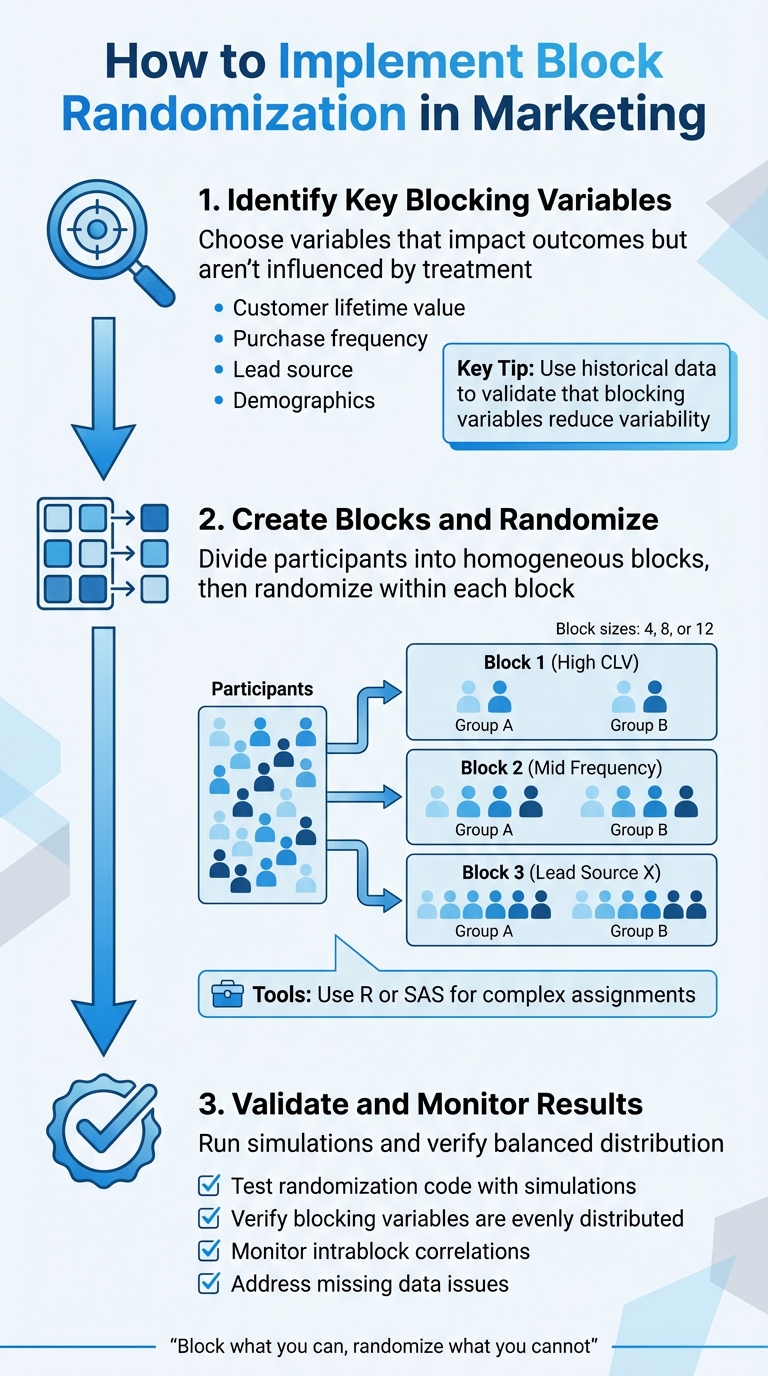
How Block Randomization Works in Marketing Tests: 3-Step Implementation Process
Breaking the process into clear steps helps ensure your test groups stay balanced throughout the experiment. Here’s how to approach it methodically to maintain consistency in your test design.
Step 1: Identify Key Blocking Variables
Start by choosing variables that significantly impact your outcomes but aren’t influenced by the marketing treatment you’re testing. For instance, if you’re experimenting with different email subject lines, factors like customer lifetime value or purchase frequency could work as blocking variables. These factors affect conversion rates but remain unrelated to the subject lines themselves.
The goal is to focus on nuisance factors that might obscure your treatment’s actual effect. However, avoid overcomplicating things by blocking too many variables at once – this can make it harder to create truly similar groups.
Use historical data to confirm that your selected blocking variables create more consistent groups compared to the overall sample. If the variability within your blocks is just as high as your entire sample, blocking could actually weaken your statistical power compared to simple randomization. Accurate blocking is critical to ensure your results reflect the true effects of your marketing efforts, avoiding biased estimates.
Step 2: Create Blocks and Randomize
Once you’ve identified your blocking variables, divide participants into homogeneous blocks – like grouping by gender – and then randomize participants equally into each group.
To keep things unpredictable, use varying block sizes. Choose block sizes that are multiples of the number of study groups. For example, if you’re running a two-group test, mix block sizes like 4, 8, or 12. For sequential participant entries, algorithms can help maintain balance. Tools like R or SAS can handle the complexity of these assignments and ensure your process is repeatable.
After randomization, double-check the integrity of your block formation and assignments to confirm everything is set up correctly.
Step 3: Validate and Monitor Results
Before rolling out your test, run simulations of your randomization code. These simulations can help you spot problems – like participants being excluded from treatment groups – before they affect your actual experiment.
Once randomization is complete, verify that the blocking variables are evenly distributed across groups. For example, if you’re blocking by lead source, both groups should have the same proportions of organic, paid, and referral traffic.
Keep an eye on intrablock correlations by checking whether participant characteristics or responses shift based on when they entered the study. If you notice patterns, adjust your variance estimates during the analysis phase. Missing data can also pose a challenge; if blocks are affected, you might need to exclude them, though this could reduce your statistical power. These steps help maintain the rigor of your methodology, ensuring reliable and unbiased results.
Conclusion
Block randomization offers a practical way to reduce noise and improve precision in marketing tests. By addressing known impactful variables through blocking and relying on randomization for the rest, this method enhances the reliability of your results. It’s especially helpful when working with small sample sizes, uneven customer segments, or variables with a significant influence.
To make the most of block randomization, focus on situations where between-group variability is greater than within-group variability. If your chosen blocking variables don’t explain much of the variation in outcomes, you risk losing statistical efficiency rather than gaining it. Use historical data to carefully select blocking variables, and avoid overcomplicating your test design by including too many factors.
One of the key benefits of block randomization is achieving equal group sizes, which boosts statistical power. This allows you to detect meaningful differences more quickly, helping you make confident decisions about which marketing strategies are truly effective.
Whether you’re testing email campaigns across customer tiers or running ads in different regions, block randomization can help you get cleaner estimates and more actionable insights. Use this approach in your next test to cut through the noise and make smarter, data-backed decisions.
FAQs
What is block randomization, and how is it different from simple randomization in marketing tests?
Block randomization is a technique often used in marketing experiments to create balanced group sizes and minimize the impact of external factors. Unlike simple randomization, which assigns participants randomly without regard to group balance, block randomization organizes participants into smaller, predefined blocks based on specific criteria such as location, demographics, or time. Within each block, participants are then randomly assigned, ensuring equal representation across the test groups.
This method is especially helpful when experiments span different time periods or target various segments. By evenly distributing external factors like seasonal trends or regional variations, block randomization helps produce results that are more consistent and reliable.
What are the main advantages of using block randomization in small marketing experiments?
Block randomization brings several advantages when conducting marketing experiments with small sample sizes. It ensures that both treatment and control groups are evenly distributed across key variables, reducing bias and boosting the reliability of your findings. By accounting for external factors that could skew results, this approach helps cut down variability, leading to more dependable outcomes.
Another perk of block randomization is that it increases statistical power, making it easier to spot meaningful differences or effects in your experiment. This is especially valuable when working with smaller sample sizes, as it provides clearer insights and more practical data to guide your decisions.
How do I choose the right variables for block randomization in marketing tests?
To choose the right variables for block randomization, focus on pre-treatment factors – those that can be observed before assigning users to test groups. These variables should have a meaningful impact on your key metric (like conversion rates or revenue) but shouldn’t interact with the treatment itself.
Start by digging into historical data to find variables that strongly predict your desired outcome. Common examples include things like device type, geographic location, or past purchase behavior. If you’re working with a smaller sample size, keep the number of blocks manageable by combining similar categories or grouping continuous variables into quantiles. The key is to ensure that units within each block are more alike compared to units in other blocks, which helps minimize unwanted variation.
Not sure which variables to pick? Growth-onomics can analyze your data and help design a block randomization framework that aligns with your marketing objectives.