


Want to maximize your marketing ROI? Understanding attribution is key. Here’s the deal: when a customer buys, it’s rarely due to one interaction. Proper attribution helps you figure out which marketing touchpoints (like ads, emails, or social media) deserve credit for driving sales. Without it, you’re left guessing – and likely wasting budget.
Key Takeaways:
- Single-touch models (like first-touch or last-touch) are simple but often miss the full picture.
- Multi-touch models (linear, time-decay, or W-shaped) offer a more balanced view of how channels work together.
- Data-driven attribution uses machine learning for deeper insights but requires a lot of data.
- Choosing the right model depends on your sales cycle, data availability, and marketing complexity.
Steps to Get Started:
- Pick a model that matches your sales process (e.g., last-touch for quick sales, multi-touch for longer cycles).
- Collect clean, detailed data from all customer interactions.
- Apply weights to touchpoints based on your chosen model, then calculate ROI for each channel.
Hyros Review: Best Ad Tracking Software for Scaling Profitably?

Common Attribution Models Explained
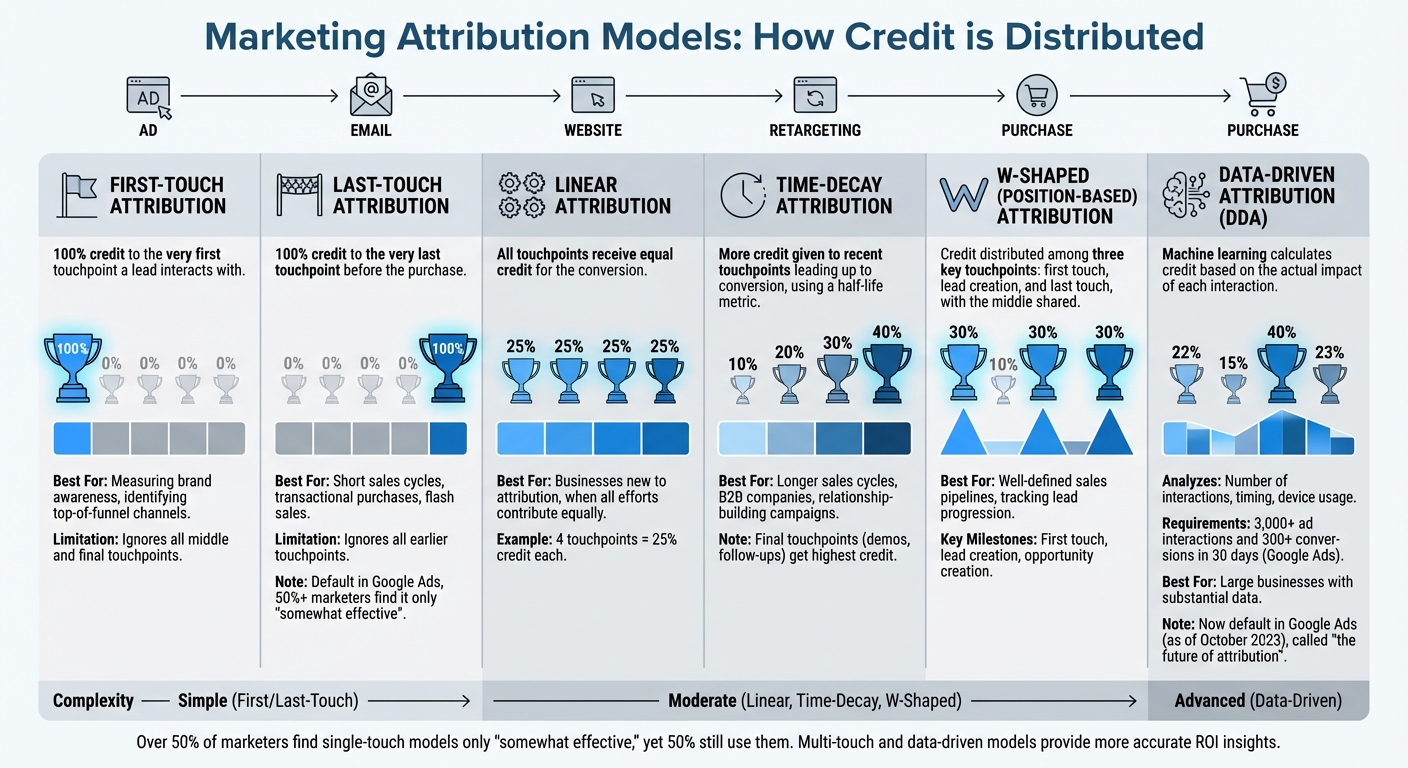
Marketing Attribution Models Comparison: Credit Distribution and Use Cases
First-Touch and Last-Touch Models
First-touch attribution assigns all the credit to the very first interaction a customer has with your brand. For instance, if someone discovers your brand through a Facebook ad and later makes a purchase after engaging with emails and Google searches, that initial Facebook ad gets 100% of the credit. This model is particularly useful when your goal is to measure brand awareness or identify which channels are bringing new prospects into your funnel.
Last-touch attribution, on the other hand, gives full credit to the final interaction before a conversion. This approach is the default in platforms like Google Ads and works best for short sales cycles or quick, transactional purchases. For example, if you’re running a flash sale or selling impulse-buy products, last-touch attribution can help pinpoint the channel that closed the deal.
The downside to both models is their simplicity – they ignore all the touchpoints in between. Surveys indicate that over 50% of marketers find last-touch attribution only "somewhat effective", yet nearly half still rely on these single-touch approaches. This narrow focus can limit insights for more complex customer journeys.
Linear, Time-Decay, and W-Shaped Models
Linear attribution takes a more balanced approach, distributing credit equally across every touchpoint in the customer journey. For example, if a customer interacts with your brand four times before converting, each touchpoint gets 25% of the credit. This model is a good starting point for businesses new to attribution or for those where all marketing efforts contribute equally to conversions.
Time-decay attribution prioritizes touchpoints that happen closer to the conversion, gradually reducing the value of older interactions. It uses a "half-life" metric to calculate how quickly earlier touchpoints lose weight. This model is particularly effective for businesses with longer sales cycles, such as B2B companies, where the final touchpoints – like follow-ups or product demos – often play a critical role in closing the deal.
W-shaped attribution focuses on three pivotal milestones in the customer journey: first touch, lead creation, and opportunity creation (or last touch). Each of these receives 30% of the credit, while the remaining 10% is shared among other interactions. This model is ideal for businesses with well-defined sales pipelines, offering a clearer view of how leads progress from initial awareness to becoming qualified opportunities.
Each of these models provides a unique lens for analyzing your marketing efforts, setting the stage for more sophisticated methods.
Data-Driven Attribution
Data-driven attribution (DDA) takes attribution to the next level by leveraging machine learning. It analyzes factors like the number of interactions, timing of touchpoints, and even device usage to determine the contribution of each channel. Neil Patel, Co-Founder of NP Digital, describes it as "the future of attribution".
However, DDA isn’t for everyone. It requires a significant amount of data to be effective. For example, Google Ads needs at least 3,000 ad interactions and 300 conversions within 30 days to generate meaningful insights. In October 2023, Google retired first-click, linear, time-decay, and position-based models from Google Ads and GA4, citing that these models accounted for less than 3% of conversions. As a result, DDA is now the default.
If your business generates enough data to support it, DDA provides the most accurate view of channel performance. For smaller businesses with limited data, sticking with rule-based models like linear or position-based may be more practical until you scale up.
How to Weight Attribution for Accurate ROI
Step 1: Choose Your Attribution Model
Start by selecting an attribution model that aligns with your sales process. For an e-commerce store with quick purchase decisions, last-click attribution can work well since it pinpoints the final step that led to the sale. On the other hand, if you’re managing a B2B company with a lengthy 90-day sales cycle, relying on first-touch attribution might overlook key campaigns that engage customers earlier in the funnel.
If you’re running campaigns across multiple channels – say, five or more – single-touch models might not cut it. In that case, a multi-touch attribution model is better suited to capture the impact of all your channels. And if you have substantial traffic, algorithmic models can provide the most precise insights, though they require a significant amount of data to be effective.
"Attribution is both a science and an art – it’s not perfect, but the right model should help you clarify your data into usable insights." – AttributionApp
To make sure you’re on the right track, test different attribution models using comparison tools to see how well they align with your actual sales data. Remember to revisit your model every quarter. If you add new marketing channels or adjust your strategy, your attribution approach should evolve as well.
Step 2: Gather and Prepare Your Marketing Data
Once you’ve chosen your model, the next step is consolidating all your marketing data. Use tools like a CRM or Customer Data Platform to centralize information and avoid fragmented datasets. Make sure you capture every customer interaction, including ad impressions, clicks, email opens, site visits, and even offline events like phone calls or in-person meetings.
For digital campaigns, UTM parameters are your best friend. Use them consistently across all channels to create a timestamped record of customer interactions. Tie everything back to a unique identifier, such as an email address or CRM ID, to track the buyer’s journey from start to finish. For offline interactions, ensure they’re logged properly – sales teams can record calls and meetings in the CRM, or you can use tools like QR code scanners at events to automate data collection.
To keep your data clean and organized, standardize your tagging system with clear labels like "offline_event", "sales_call", or "webinar". Set a lookback window that aligns with your sales cycle, and audit your data periodically – quarterly reviews can help you catch issues like missing UTM tags or broken tracking pixels before they distort your results.
Step 3: Assign Weights and Calculate ROI
With your model and data ready, it’s time to assign weights and calculate ROI. Apply the weighting rules of your chosen model. For instance, in a position-based model, you might allocate 40% of the credit to both the first and last touchpoints, and 20% to all the interactions in between. If you’re using a time-decay model, give more weight to recent touchpoints – this is especially effective for campaigns with a short promotional window or for B2B sales that involve building relationships over time.
Next, calculate the revenue attributed to each touchpoint. For example, in a $10,000 deal with four touchpoints using linear attribution, each touchpoint would get $2,500 in credit. To determine ROI for each channel, subtract the channel’s cost from its attributed revenue, divide the result by the cost, and then multiply by 100 to get the percentage return. For sales involving multiple stakeholders, aggregate your attribution data at the account level to get a more accurate ROI picture.
Finally, compare ROI results across different models before finalizing your reporting framework. A channel that seems highly profitable under a last-click model might show very different results under a time-decay approach. This comparison ensures you’re basing decisions on the most accurate picture of performance.
sbb-itb-2ec70df
How to Improve Attribution Weighting Over Time
Once you’ve established your weighted attribution model, the work doesn’t stop there. You’ll need to refine it regularly to keep pace with how customer behavior evolves.
Test and Adjust Your Models
Attribution models aren’t one-size-fits-all, and they require regular testing to stay effective. Comparing different models – like Linear and J-Shaped – can help you figure out which one best captures your customers’ actual journey. This process ensures your model reflects the unique touchpoints and buying cycle of your audience.
When switching between models, it’s smart to evaluate the impact on key metrics like cost per conversion. For example, if a "Brand" campaign sees a 25% drop in conversion credit under a new model, you’ll want to lower your Target CPA by the same percentage. This prevents overspending and keeps your bidding strategy aligned with the updated credit distribution.
Don’t forget about time lag when analyzing these changes. Google Ads suggests excluding the most recent 14 days of data when making bid adjustments, as there’s often a delay between clicks and conversions. Use reports like "Avg. days to conversion" to pinpoint an appropriate evaluation period.
For a more advanced approach, consider data-driven models that use counterfactual analysis. This method compares what actually happened to what might have happened if a specific touchpoint were removed. It’s a machine learning technique that calculates the likelihood of a touchpoint driving a conversion, rather than just being part of the journey. Keep in mind that in these models, conversions can be reattributed for up to seven days after the initial event.
Once your model is fine-tuned, the next step is to align your attribution windows with your sales cycle.
Adjust Attribution Windows to Match Your Sales Cycle
Your attribution window should reflect how long it takes your customers to make a purchase. For instance, research shows that B2B technology buyers often take between 1–3 months (38% of buyers) or 3–6 months (34% of buyers) to complete their purchase. If you’re using a 7-day attribution window for a product with a 90-day sales cycle, you’re likely missing critical parts of the customer journey.
To get it right, consider the TIME Framework: Time to conversion, Intent level, Marketing mix, and Evaluation type. High-intent channels like search and retargeting benefit from shorter windows (1–7 days), while top-of-funnel efforts like content marketing need longer windows (30–90+ days) to capture the full consideration period.
It’s also essential to standardize attribution windows across platforms to avoid double-counting. For example, Facebook defaults to a 7-day click and 1-day view window, Google Ads uses 30 days, and LinkedIn applies a 30-day click and 7-day view window. Keeping these settings consistent ensures accurate ROI comparisons. Without standardization, you risk skewed data that could lead to poor decision-making. Make it a habit to audit your window settings quarterly or after any major changes.
"Attribution windows are the lens through which we view campaign impact. If your window is too narrow, you’ll miss key touchpoints. If it’s too wide, you risk over-crediting irrelevant ones." – AttributionApp
Work with Attribution Experts
Attribution can be complex, and sometimes it’s best to bring in experts. Partnering with a performance marketing agency, such as Growth-onomics, can give you access to skilled data analysts who specialize in advanced models and tracking setups. These experts can fine-tune your attribution weights, ensuring they align with your sales cycle and customer journey patterns.
Agencies also help you avoid common mistakes, like changing attribution windows mid-campaign. Such changes can disrupt reporting consistency and reset platform algorithms, particularly in tools like Meta. They’ll also make sure your bid targets are recalculated properly when models or windows are adjusted, preventing costly errors like overbidding or underbidding.
Conclusion: Key Points for Attribution Weighting
Attribution is a process that never stands still. As your data evolves, your team grows, and customer behaviors shift, your attribution model needs to adapt alongside them. The best model for your business will depend on factors like your sales cycle, the complexity of your marketing channels, and how much conversion data you have on hand. It’s all about finding a model that fits your unique sales process.
Conversions rarely happen after just one interaction. They’re often the result of multiple touchpoints working together. If your attribution model overlooks this reality, you risk undervaluing key channels and mismanaging your marketing budget.
Regular testing and adjustments are non-negotiable. Plan to review your attribution models every quarter. Make sure your lookback windows align with your sales cycle, and try out new methods on specific product lines before rolling them out more broadly. As AttributionApp explains:
"Attribution is both a science and an art – it’s not perfect, but the right model should help you clarify your data into usable insights that help you scale smarter and faster".
By staying flexible and fine-tuning your approach, your attribution strategy can keep pace with your marketing goals.
For more intricate strategies, consider partnering with professionals like Growth-onomics to build advanced models that mirror your customer journey. Accurately measuring ROI starts with selecting the right model, testing it thoroughly, and continuously improving it over time.
FAQs
How can I select the best attribution model for my business?
Choosing the right attribution model hinges on your business goals and how your customers engage with your marketing efforts. For businesses with short purchase cycles – think low-cost items – single-touch models like first-click or last-click attribution often work just fine. But if your sales process involves multiple touchpoints, such as ads, email campaigns, and social media interactions, a multi-touch model is better suited to distribute credit across the entire customer journey.
The quality of your data plays a big role here. If you have robust tracking systems and unified analytics in place, data-driven attribution can automatically assign credit based on observed performance trends. On the other hand, if your data is fragmented or less comprehensive, starting with rule-based models might be the smarter move. Options like linear attribution (equal credit to all touchpoints), time-decay (more credit to recent interactions), or position-based (e.g., 40% credit to the first and last touchpoints, 20% to everything in between) are straightforward and effective.
Attribution isn’t a set-it-and-forget-it process. As your marketing strategy evolves, regularly testing and fine-tuning your model is crucial. Looking at your ROI through different lenses – whether it’s first-touch, time-decay, or linear – offers a broader understanding of performance and helps you avoid common attribution pitfalls. By aligning your choice of model with your business objectives and the capabilities of your data, you can ensure a more accurate distribution of ROI across all your marketing channels.
What challenges do businesses face when implementing data-driven attribution?
Implementing data-driven attribution isn’t without its hurdles. One of the biggest challenges businesses face is fragmented data. Customers interact with brands across various channels – social media, search engines, email, and even offline ads – and these interactions are often stored in separate systems. This lack of integration makes it tough to piece together a clear picture of the customer journey.
On top of that, today’s buyer journeys are increasingly complex. This is especially true in B2B settings, where sales cycles tend to be longer and involve multiple touchpoints. Traditional attribution models often fall short, misrepresenting how credit should be assigned across these touchpoints. And let’s not forget the headaches caused by data quality issues. When teams manually pull and reconcile data from different sources, errors can creep in, or worse, projects can stall entirely.
To tackle these challenges, businesses should consider adopting unified analytics platforms, leveraging cross-device tracking, and experimenting with multi-model attribution. These strategies can help ensure more accurate ROI measurement and drive smarter decision-making.
How often should I update my attribution model to ensure accurate ROI?
To keep your ROI measurements on point, make it a habit to review and tweak your attribution model every quarter. It’s also a good idea to revisit it whenever you roll out major campaigns, add new marketing channels, or spot noticeable shifts in performance trends. Regular updates ensure your model reflects your current strategies and adapts to changing market dynamics.