


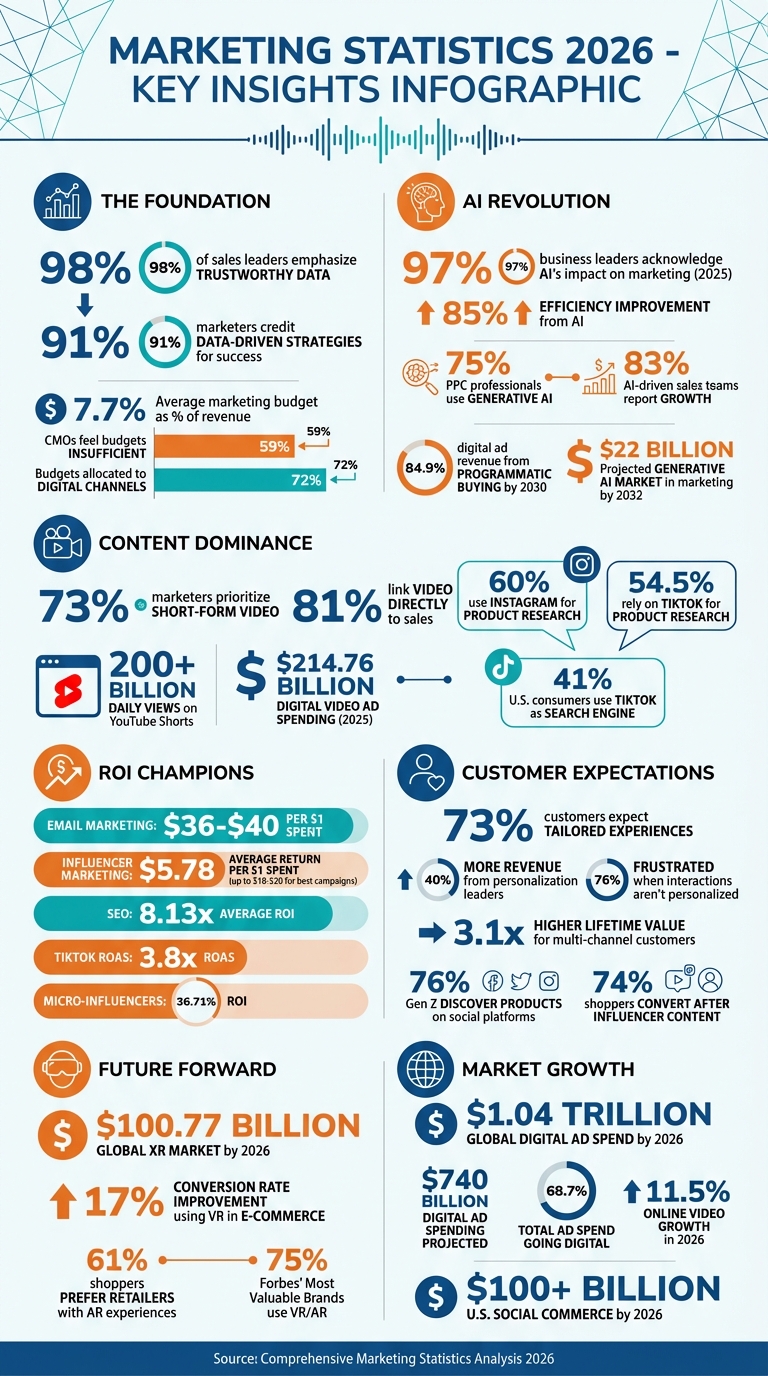
Marketing in 2026 is all about data-backed decisions. Here’s what you need to know:
- Data is king: 98% of sales leaders emphasize trustworthy data, and 91% of marketers credit data-driven strategies for success.
- Budgets under pressure: Marketing budgets average 7.7% of revenue, but 59% of CMOs feel their budgets are insufficient.
- Digital-first focus: 72% of budgets go to digital channels, with AI improving efficiency by 85%.
- AI and automation: 75% of PPC pros use generative AI, and 83% of AI-driven sales teams report growth.
- Short-form video dominance: 73% of marketers prioritize short videos, with platforms like TikTok and YouTube Shorts leading.
- Email marketing ROI: Generates $36–$40 for every $1 spent, making it a top-performing channel.
- Personalization matters: 73% of customers expect tailored experiences, boosting revenue by up to 40%.
- Immersive tech grows: AR and VR are reshaping e-commerce, with conversion rates up 17%.
The takeaway? Data, AI, and personalization are non-negotiable for staying competitive in today’s fragmented, digital-first landscape.
Marketing Statistics 2026: Key Data-Driven Insights for Digital Success
5 Marketing Statistics That You NEED To Know
Digital Marketing Trends for 2026
The digital marketing landscape is transforming rapidly, with global digital ad spending projected to hit a staggering $740 billion by 2026. Of this, 68.7% will be funneled into digital channels, signaling a major shift in how brands engage with consumers.
Three major forces are reshaping the industry: AI is no longer experimental but essential, short-form video dominates as the go-to creative format, and traditional search behaviors are fragmenting across social platforms and conversational AI. By 2025, 97% of business leaders acknowledged AI’s direct impact on their marketing performance, while Instagram Reels now account for half of all time spent on the platform. These aren’t just trends – they’re the new normal.
Consumer habits are also evolving. For example, 41% of U.S. consumers now use TikTok as a search engine, and AI-driven answers appeared in 15–20% of informational queries by mid-2025. To stay relevant, content must function seamlessly across a variety of discovery platforms – from traditional search engines to social media feeds and AI assistants. These shifts set the stage for a deeper dive into how AI, video, and emerging content formats are shaping the future of marketing.
AI and Automation in Marketing
AI has evolved from a tool for efficiency to a critical driver of competitive advantage. By 2030, programmatic buying is expected to account for 84.9% of digital ad revenue. Additionally, 83% of sales teams leveraging AI reported revenue growth, compared to just 66% of teams without it. Today, 75% of PPC professionals use generative AI for crafting ad copy, and nearly 40% of video ads are expected to feature AI integration by 2026. SEO itself is transforming into "Generative Engine Optimization" (GEO), which focuses on creating concise, authoritative content tailored for AI summaries.
Brands are already using AI to innovate. IKEA’s "Kreativ AI" tool allows users to scan their rooms and digitally experiment with IKEA furniture, turning browsing into a hands-on experience. Similarly, British Airways revamped its Avios loyalty program by using AI to identify smaller, frequent milestones, offering incremental rewards that boost customer satisfaction.
"The goal is no longer to bid on specific keywords for a single, narrow ad campaign, but to supply AI-powered search campaigns with a library of high-quality assets."
- Phil Wilson, Vice President of Ads Marketing, Google
However, the rise of AI also brings challenges, particularly around trust. Confidence in businesses using AI ethically has dropped to 42%, down from 58% in 2023. This highlights the importance of balancing automation with human oversight. Despite these concerns, the generative AI market in marketing is projected to grow to $22 billion by 2032. As AI becomes more integrated into marketing strategies, its role in shaping video and social media engagement is only set to expand.
Short-Form Video and Social Media Growth
Video has become the go-to format for showcasing products, building trust, and driving sales. By 2026, 73% of marketers predict short-form video will dominate their strategies, with 81% linking it directly to sales and 21% identifying it as delivering the highest ROI.
Platforms like YouTube Shorts, which receive over 200 billion daily views, and TikTok are leading the charge. Digital video ad spending is expected to reach $214.76 billion in 2025, with short-form video accounting for a hefty $115.75 billion. Online video is projected to grow by 11.5% in 2026, outpacing other digital channels.
Social platforms are now integral to consumer decision-making. For example, 60% of consumers use Instagram and 54.5% rely on TikTok for product research. Among Gen Z, 76% discover products on social platforms, and 74% of shoppers convert after engaging with influencer-led content.
The shift toward active consumer participation is reshaping how content is created. Composer Jorge Rivera-Herrans tapped into community engagement for "EPIC: The Musical", generating over 50,000 user-uploaded videos on YouTube through social media-driven campaigns. Nintendo also successfully bridged generational gaps by featuring actor Paul Rudd in a nostalgic campaign that referenced a 1991 commercial.
Consumers increasingly expect brands to engage directly with them. Seventy-six percent say they feel more loyal to brands that interact with them in comment sections. Meanwhile, tools like Google’s Veo 3 are making it easier for brands, even smaller ones, to produce high-quality video content at scale. As short-form video continues to dominate, the rise of zero-click content is further redefining digital engagement.
Zero-Click Content and Interactive Formats
The traditional click-through model is being replaced. AI-driven summaries and social feeds now provide instant answers, pushing brands to rethink how they deliver value. In this "zero-click" world, content must perform effectively within search results and social platforms.
Social commerce in the U.S. is projected to exceed $100 billion by 2026, driven by platforms that enable users to research, evaluate, and purchase without ever leaving the app. For instance, Vinted partnered with YouTuber Emma Winder to create videos highlighting practical benefits like saving money and improving style, attracting hundreds of thousands of views.
"In 2026, media buying skill alone will not create advantage. Creative systems will."
- CoolNerdsMarketing
To thrive in this environment, marketers are encouraged to include executive summaries at the top of web pages and implement FAQ schema to increase the likelihood of appearing in AI-generated search results. Building a strong content framework that addresses high-intent questions is essential for visibility across search engines, social platforms, and AI assistants. As privacy regulations tighten, limiting tracking and targeting capabilities, creative quality will play an even bigger role in campaign success.
Performance Marketing Benchmarks for 2026
Marketing budgets are stabilizing, with companies allocating about 7.7% of their revenue to marketing efforts. Of that, paid media accounts for 30.6% of the spend. By 2026, programmatic advertising is expected to dominate, driving over 80% of digital ad investments. To stay competitive, businesses need to move beyond basic attribution models and focus on measuring incrementality and decision-making quality to identify which channels truly influence customer behavior.
Digital Ad Spend and Growth Trends
Digital ad spending is increasingly shaped by AI-powered campaigns that align assets with user intent, improving how bids are placed and campaigns are managed. These AI-driven processes not only streamline bidding but also enhance the overall performance of campaigns across platforms.
In addition to leveraging AI, brands are investing in influencer-driven content to maximize their return on investment (ROI) from digital campaigns.
Influencer Marketing and ROI Insights
Influencer marketing has transitioned from being just a tool for brand awareness to becoming a key performance channel. On average, brands earn $5.78 for every $1 spent on influencer marketing, with the best campaigns delivering returns as high as $18 to $20 per $1 invested. This translates to an ROI that is 11 times higher than traditional digital advertising.
The numbers tell the story: 74% of brands now track direct sales from influencer campaigns, and 82% of marketers believe customers acquired through influencers are of higher quality. TikTok stands out, with 78% of users reporting they’ve purchased a product after seeing creator content on the platform. TikTok also boasts a leading Return on Ad Spend (ROAS) of 3.8x.
Nano and micro-influencers are gaining traction, with 73% of brands choosing them for their higher engagement rates. Nano-influencers, who have between 1,000 and 10,000 followers, achieve an average engagement rate of 8.8%, far surpassing the 1.6% seen with mega-influencers. They also charge significantly less – typically $10 to $100 per post, compared to the $10,000+ fees of mega-influencers.
"The organizations that will thrive in this new era are those that measure what matters, optimize with precision, and evolve with confidence."
AI continues to be a game-changer in this space. 66.4% of marketers report better campaign outcomes after using AI to identify and optimize influencer partnerships. Meanwhile, 46% of brands now track conversions like sign-ups or downloads as a success metric – an 11.6-point increase from the previous year – and 44% focus on direct sales, up 13.7 points year-over-year.
Email Marketing and Customer Retention
While paid media and influencer campaigns grab headlines, email marketing remains a cornerstone for customer retention and revenue generation.
Email marketing delivers an impressive return, with $36–$40 earned for every $1 spent. It’s no wonder 78% of marketers consider email critical to their company’s success. For nonprofits, having a donor’s email address can boost offline donor retention by 29%.
The effectiveness of email is clear in the numbers: welcome emails see open rates of 80–82%, general emails achieve click-through rates of 2–5%, and transactional emails lead with over 30% click-to-open rates.
Automation has taken email campaigns to the next level. Abandoned cart emails, for instance, generate up to 30 times more revenue per recipient than standard campaigns, with an average revenue per recipient of $3.07, compared to just $0.10 for traditional emails.
Subject lines are key to engagement. Nearly 47% of recipients open emails based solely on the subject line. Subject lines with 6 to 10 words perform best, achieving open rates of around 21%, while those posing a question can increase open rates by 50%. Personalized calls to action also perform exceptionally well, converting 202% better than generic ones.
Mobile optimization is no longer optional – 53% of all emails are opened on mobile devices. Emails that aren’t mobile-friendly are often deleted within three seconds. Adding videos can boost click-through rates by 65%, and countdown timers in emails have been shown to increase event registrations by 30%. With privacy updates like Apple’s Mail Privacy Protection shifting the focus away from open rates, marketers are now prioritizing click-through rates (CTR) and click-to-open rates (CTOR) as more reliable performance indicators.
sbb-itb-2ec70df
Consumer Behavior and Personalization in 2026
By 2026, 73% of customers will feel that brands treat them as unique individuals, a significant jump from just 39% in 2023. Personalization has become a necessity, with 76% of consumers expressing frustration when interactions aren’t tailored to their preferences. Companies that excel in personalization see tangible rewards, generating 40% more revenue from these efforts compared to their competitors. On average, personalization can boost revenue by 10–15%, with top-performing companies achieving increases of 25% or more.
Despite this, there’s a tension between personalization and privacy. While 64% of consumers prefer personalized experiences, only 39% feel the benefits outweigh the privacy trade-offs. Compounding this issue, trust in companies is eroding – 71% of customers report trusting businesses less than they did a year ago. This highlights the importance of building personalization strategies that are transparent and prioritize privacy. These trends are also reshaping how consumers interact across mobile, social, and immersive platforms.
Mobile-First and Social-Driven Engagement
Social media has become a powerful tool for product discovery. In 2026, 53% of shoppers find products through social platforms, up from 46% in 2023. For Gen Z, this number jumps to 76%, with 40% specifically turning to TikTok for discovering new products. Even Baby Boomers are joining in, with 36% now using social media for product discovery.
This shift has also fueled the rise of "micro-moments" – those quick, intent-driven decisions made on mobile devices. For instance, 88% of mobile users who search for local businesses visit a store within 24 hours. Brands that fail to engage during these moments risk losing out. In fact, 52% of consumers are less likely to purchase from brands that ignore social media comments, while 76% express loyalty to brands that promptly respond to messages.
Generational preferences also play a role. While 81% of Gen Z and 57% of Millennials appreciate personalized ads, 63% of Gen Z shoppers specifically favor product recommendations from AI agents. These behaviors underscore how mobile engagement and personalization go hand in hand, shaping consumer loyalty and purchase decisions.
Personalization as a Driver for Engagement
Personalized, multi-channel engagement delivers clear benefits. Customers who interact with brands across multiple channels have 3.1 times higher lifetime value and are retained at 3.2 times the rate of others. The impact of personalization can be seen in real-world examples:
- A subscription coffee company increased conversion rates from 2.1% to 2.6% using taste profile quizzes and personalized welcome emails.
- An apparel retailer generated 38% of its total email revenue through automated, personalized email flows, even though these accounted for less than 3% of total email volume.
- A food delivery app achieved a 9% same-day order increase and boosted 30-day retention by 4 percentage points by integrating real-time events with personalized messaging.
These examples highlight how personalization can directly enhance engagement and drive measurable results.
VR, AR, and Immersive Experiences in Marketing
As personalization and mobile strategies evolve, brands are increasingly leveraging immersive technologies to captivate their audiences. The global extended reality (XR) market – which includes AR, VR, and mixed reality – is projected to surpass $100.77 billion by 2026. In the U.S., the metaverse market is expected to reach $253.77 billion by 2030, growing at an impressive 37.4% annual rate.
The impact on e-commerce is striking. Using VR in online shopping can improve conversion rates by 17%. Meanwhile, 61% of shoppers prefer retailers that offer AR experiences, and 72% of luxury fashion consumers consider AR essential to their shopping journey. Additionally, 44% of consumers value immersive shopping experiences through AR or VR, while 37% appreciate interactions with voice assistants.
Major brands are already diving into immersive tech. For example, 75% of Forbes’ World’s Most Valuable Brands utilize VR or AR in their marketing or operations. In June 2022, Samsung’s U.S. division expanded its metaverse presence by launching a Discord server and creating virtual experiences in Decentraland and Roblox, such as "Samsung 837X" and "Samsung Superstar Galaxy". Similarly, Reebok International Limited partnered with Futureverse in December 2023 to offer virtual experiences with AI and digital wearables, aiming to gather customer insights through cutting-edge digital tools.
Younger audiences are particularly drawn to immersive experiences. Sixty-one percent of young consumers are more likely to purchase from brands that actively engage in the virtual worlds they frequent. This aligns with a growing trend where younger generations expect to participate in shaping brand narratives, rather than being passive consumers.
Improving ROI with Data Analytics
Marketing in 2026 isn’t about taking chances – it’s about making informed decisions. The stats speak for themselves: 81% of top-performing marketing teams now use advanced analytics platforms to get ahead of their competition. These tools don’t just help with budget allocation and campaign fine-tuning; they make businesses 2.4 times more likely to outperform their rivals. This aligns with the growing reliance on AI-driven optimization we’ve touched on earlier.
Customer Journey Mapping and UX Optimization
Analytics have become the glue connecting every customer interaction – whether through websites, apps, CRM systems, or call centers – into a seamless, unified view. This matters because today’s B2B buyers engage with 27+ touchpoints before committing to a purchase. Pinpointing where users drop off can reveal whether poor targeting or a flawed user experience is holding back a campaign.
Companies that adopt comprehensive marketing attribution models report 37% higher marketing ROI, while those leveraging real-time analytics enjoy 34% faster decision-making and 28% better campaign performance. A website plays a key role in this process – if it’s not converting well, teams often overspend on bringing in traffic to make up for weak performance. And here’s the kicker: 74% of shoppers will ditch a brand after just three or fewer bad experiences.
"Email automation makes it possible, for a small team like ours, to show customers that we care about building a connection."
– James Le Compte, CEO, To’ak Chocolate
Automated emails triggered by specific customer behaviors outperform traditional scheduled campaigns by a staggering 2,361% in conversion rates. This proves how understanding customer journeys and delivering personalized touchpoints can directly boost revenue.
Using Data Analytics for Campaign Performance
By 2026, the best analytics tools will offer data latency of under five minutes. This means marketers can tweak campaigns in real time – pausing underperformers and doubling down on winners – without waiting days or weeks for results. Predictive models are already driving a 15-20% improvement in marketing efficiency and 10-15% revenue growth.
To measure success effectively, it’s time to move beyond vanity metrics like total traffic or follower counts. Instead, focus on actionable KPIs such as Pipeline Velocity and Customer Acquisition Cost (CAC) Payback Period. Multi-touch attribution models, which credit all touchpoints in a customer’s journey, are replacing outdated last-click metrics, revealing undervalued channels.
Email marketing continues to deliver impressive results, with an average ROI of $36 to $42 for every $1 spent. SEO also shines, offering an average ROI of 8.13x, well above the 4.04x average for PPC ads. Micro-influencers, with follower counts between 10,000 and 99,000, generate the highest ROI at 36.71%. Meanwhile, tracking software saves brands around 100 hours per month by automating data collection and reporting.
Mid-sized companies typically allocate $15,000 to $75,000 annually for analytics, attribution, and business intelligence tools. Larger enterprises, on the other hand, often spend over $200,000 annually, including salaries for dedicated analytics teams.
Growth Marketing Projections for 2026
With real-time insights and advanced attribution models in hand, marketers are primed to tap into emerging growth opportunities. Global digital ad spend is projected to hit $1.04 trillion by 2026, capturing 68.7% of total ad spend. By 2030, programmatic ad buying is expected to account for 84.9% of all digital ad revenue. This shift toward automation and AI-driven strategies is reshaping how campaigns are optimized.
"Marketing analytics once meant counting clicks and tracking pageviews. Today, it’s about connecting every customer signal – across every channel, device, and moment – into a single, actionable source of truth."
– Adobe for Business Team
As third-party cookies phase out, privacy-first measurement is becoming the norm. 38% of B2B marketing teams have already moved away from third-party data, focusing instead on first-party analytics. While 88% of marketers use analytics tools as part of their tech stack, only 31% feel confident in their ability to unify data. This gap presents a major opportunity for businesses that can consolidate data from various sources – like CRM systems, websites, and offline channels – into a single, actionable platform.
Generative Engine Optimization (GEO) is also gaining traction, with marketers tracking how often their brands appear in AI-generated answers from tools like ChatGPT and Google’s AI Overviews. As 98% of sales leaders emphasize the importance of trustworthy data during times of change, the ability to analyze and act on accurate insights will set leading companies apart from the rest.
Conclusion
The numbers don’t lie: global ad spend is projected to hit $1.04 trillion by 2026, with a hefty 68.7% of that funneled into digital channels. But throwing more money into advertising without focusing on conversions and tracking the right metrics won’t get you the results you need. To thrive in 2026, businesses must put data at the heart of their decision-making processes, as emphasized throughout this guide.
Start by fine-tuning your top five landing pages. Make sure they include clear calls-to-action – whether it’s booking a demo, completing a purchase, or subscribing. From there, track 5–8 key metrics on a weekly basis and establish consistent routines for improving these metrics. The goal isn’t to chase every shiny new trend; it’s about making smarter, data-driven decisions with the tools and resources you already have. These insights highlight the importance of focusing on metric-driven optimizations across all digital interactions.
The landscape is shifting fast, with AI-powered analytics, short-form video, and first-party data leading the charge. Consider this: 97% of consumers research a business online before visiting, and 74% walk away from brands after just three bad experiences. Meanwhile, email marketing continues to deliver strong results, SEO remains a reliable performer, and personalization can boost conversions by a staggering 188%. These aren’t optional tactics – they’re essential for staying competitive.
As Susie Marino, Senior Content Marketing Specialist at WordStream, explains:
"Data reveals patterns and digital marketing trends that can help you to identify strategies and platforms where it might make sense to be an early adopter."
– Susie Marino
Let these statistics guide your spending decisions, helping you pinpoint winning strategies and cut out what doesn’t work. In a world where every dollar matters, taking swift, data-informed actions will set the leaders apart from the rest. By 2026, success will belong to those who act decisively on the insights that truly count.
FAQs
How will AI and automation transform marketing strategies in 2026?
AI and automation are transforming how marketing strategies will operate by 2026, making workflows faster and campaigns more tailored and data-focused. With 88% of marketers already using AI daily, tasks like crafting ad copy, writing video scripts, and generating campaign variations now take just minutes. This efficiency slashes production times by as much as 93%, freeing up teams to concentrate on strategy and creative innovation rather than repetitive work.
AI tools also excel at analyzing massive datasets to predict audience behavior, enabling real-time adjustments such as automated bidding and highly personalized offers. These capabilities not only enhance efficiency but also reduce costs and drive higher conversion rates. On top of that, automation integrates every customer interaction into unified ROI dashboards, making it easier to measure and refine marketing impact.
By tapping into AI-powered segmentation, natural language processing, and advanced performance optimization, marketers can build campaigns that genuinely connect with U.S. consumers, offering timely and relevant interactions at scale.
How important is short-form video in achieving digital marketing success?
Short-form video has become a powerful force in digital marketing, grabbing attention in seconds, driving high engagement, and delivering trackable results. In 2026, platforms like Instagram Reels and TikTok are showcasing the massive potential of these snackable videos, racking up millions of views every minute and achieving impressive conversion rates. With mobile-first habits dominating, these videos seamlessly fit into how people consume content, making it easier than ever for brands to share bold, impactful messages and boost their visibility.
Marketers are increasingly allocating budgets toward short-form video because it’s both versatile and effective. These quick clips are perfect for building brand awareness, telling captivating stories, and even driving conversions. By focusing on brief, shareable content, brands can stretch their marketing dollars further while staying connected to their audience at every stage of the customer journey. Short-form video isn’t just a passing phase – it’s a must-have strategy for thriving in today’s fast-moving digital world.
Why is personalization so important for boosting customer engagement and driving revenue?
Personalization plays a crucial role in forming deeper connections with customers by offering content and experiences that align with their preferences. When done right, it fosters meaningful interactions that make customers feel appreciated, boosting both their satisfaction and loyalty.
Catering to individual needs doesn’t just improve engagement – it also directly impacts a company’s bottom line. Brands that focus on personalized strategies often experience higher conversion rates, stronger customer retention, and a noticeable improvement in ROI. In today’s marketing landscape, personalization is not just an option – it’s a necessity for success.