

Scaling partner incentive programs can drive revenue growth, improve partner engagement, and streamline operations. The key is creating systems that reward the right behaviors while remaining efficient as your business expands. Here’s how:
- Reward Structures: Tailor incentives like SPIFs, rebates, and MDFs to encourage specific actions. Non-cash rewards often outperform cash in cost-effectiveness and loyalty-building.
- Partner Segmentation: Group partners by type (e.g., affiliates, resellers) and maturity to deliver targeted strategies. Focus efforts on the middle 60% of partners for the most growth potential.
- Performance Metrics: Track metrics like activation rates, ROI, and incrementality to measure program success and avoid overpaying for non-impactful sales.
- Technology: Use Partner Relationship Management (PRM) tools to automate processes, integrate with CRM systems, and provide real-time dashboards for transparency and trust.
- Scalable Models: Combine tiered commissions, activity-based rewards, and dynamic payouts to engage diverse partner types without adding complexity.
Growth with Purpose: Aligning Performance Management, Incentives and Strategic Growth
sbb-itb-2ec70df
Core Components of Effective Partner Incentive Programs
Creating a scalable partner incentive program hinges on three key elements: well-structured rewards that align with partner goals, effective segmentation to address diverse partner needs, and reliable performance metrics to track progress. Without these, managing the program becomes a challenge. Let’s dive deeper into how rewards can drive partner behavior.
Setting Up Reward Structures
To scale effectively, your reward structures need to evolve with your growing network. The type of reward you choose should align with the specific behavior you’re trying to encourage. For example:
- SPIFs (Sales Performance Incentive Funds): Great for driving short-term actions, like promoting a new product or clearing inventory.
- Rebates: These backend payments are tied to revenue milestones, making them ideal for encouraging sustained growth.
- MDF (Market Development Funds): Provide partners with flexible budgets for marketing initiatives.
- Co-op Funds: Accrual-based rewards earned by partners based on their revenue performance.
Interestingly, cash isn’t always the most effective motivator. Studies show that non-cash rewards – like travel, merchandise, or exclusive training – can achieve the same results as cash rewards at just one-third of the cost. These rewards carry what’s often called “daydream value”, creating memorable experiences that build loyalty. In fact, U.S. businesses spend about $90 billion annually on incentive travel, gift cards, and merchandise.
Budget allocation plays a crucial role in successful programs. A common guideline is the “Budget Pie” approach: allocate 70% to rewards, 10% to communications, 10% to technology, and 10% to administration. Most programs also dedicate 0.5% to 2% of total sales or 1% to 3% of gross profit to their incentive budgets.
Partner Segmentation Methods
Not all partners are the same, and tailoring your approach is key. Different types of partners respond to different incentives:
- Affiliates and influencers: Thrive on high-volume, performance-based commissions and pre-made marketing tools.
- Agencies: Value revenue-sharing models and benefit from client success-focused support.
- Resellers and VARs (Value-Added Resellers): Prioritize margin and volume, responding well to tiered commissions and technical training.
- Strategic alliances: Focus on long-term collaboration, often through co-branded solutions or input on product development.
Segmentation also considers partner maturity. Newer partners often need extra support, while established ones may operate more independently. Geographic differences can also impact payout structures. For instance, Brevo segmented its partners into groups – startups, mid-market, and enterprise – allowing the company to scale quickly by offering tailored strategies for each.
Most programs follow the 20-60-20 rule: the top 20% of partners perform well with or without incentives, the bottom 20% are unlikely to change, and the middle 60% offer the most growth potential through targeted efforts. Smart segmentation ensures resources are focused where they can make the biggest difference.
Performance Metrics and Tracking
Tracking performance is essential for managing and improving your program. The most important metrics fall into four categories:
- Recruitment: Number of new partners added monthly and their sources.
- Activation: Metrics like activation rate and time to first sale.
- Engagement: Monthly sales volume and lead-to-deal conversion rates.
- Efficiency: ROI and cost-to-incentive ratio.
Interestingly, data shows that a partner is considered “truly active” only after their second sale, as this milestone significantly boosts long-term engagement.
Real-time tracking is a game changer. Partners benefit from dashboards that provide immediate updates on their progress, eliminating the need for outdated spreadsheets. This transparency not only reduces admin work but also builds trust by clearly showing partners what they’ve achieved and what’s next.
“A program will never be perfect in its first iteration, so it’s crucial to keep improving as you learn more about your partners – but you can’t improve what you can’t measure.” – Laurella Jose, Contributing Editor, PartnerStack
Another important factor is tracking incrementality – determining whether a sale happened solely because of a partner’s efforts. This helps avoid overpaying for sales that might have occurred through other channels. Monitoring metrics like payout accuracy and fraud rates becomes increasingly vital as programs grow. Even simplifying program communications can lead to a 40% boost in partner engagement. Clear, measurable goals and accurate tracking lay the groundwork for scalable, data-driven improvements in your partner incentive program.
How to Design Incentive Programs That Scale
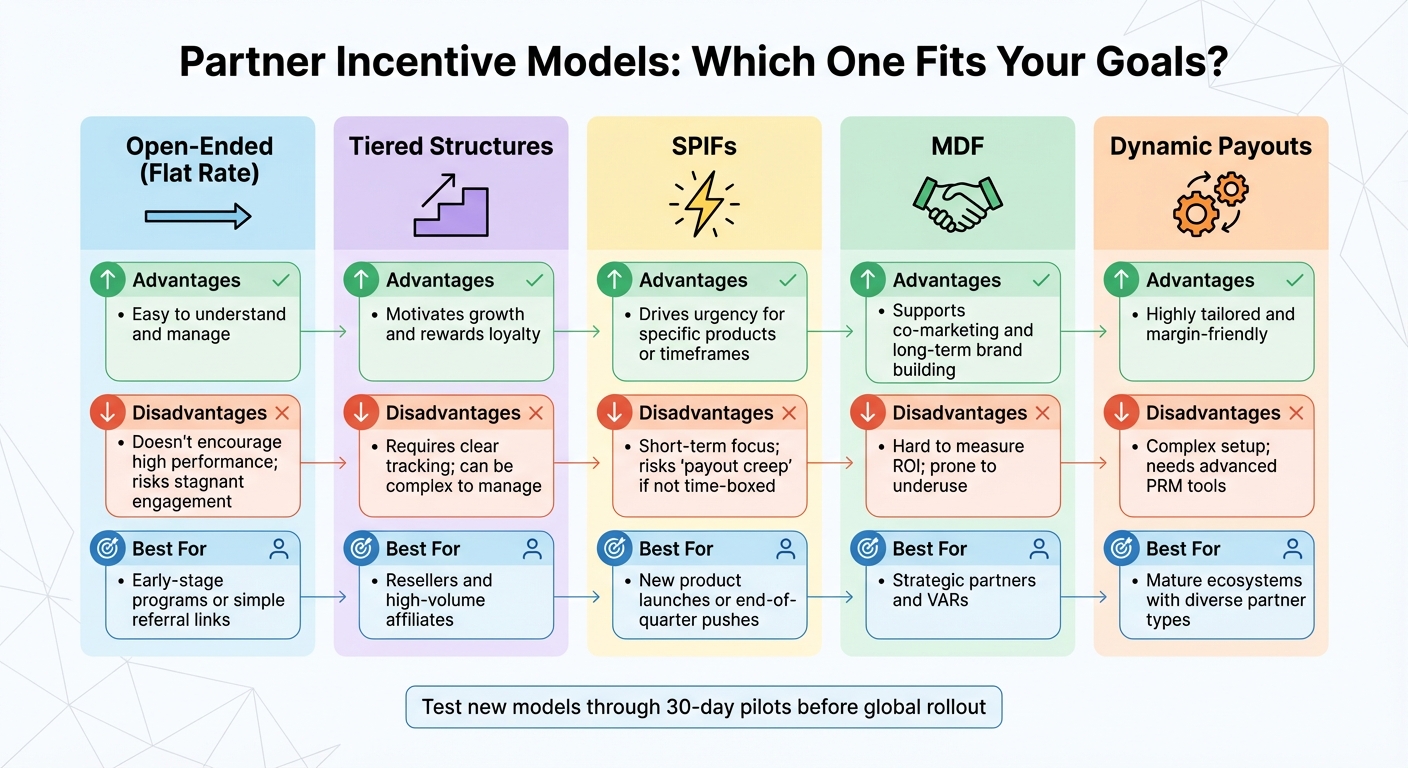
Partner Incentive Models Comparison: Advantages, Disadvantages, and Best Use Cases
Creating a scalable incentive program means keeping the rules straightforward yet flexible enough to engage a variety of partner types.
Flexible Incentive Models
To make your program scalable, use incentive models that adapt to the different stages and needs of your partners. A portfolio approach works well – combining tiered commissions, SPIFFs, Market Development Funds (MDF), and activity-based rewards to drive performance.
- Tiered commissions motivate partners to exceed milestones by offering progressively higher rates as they achieve more. This system encourages consistent overperformance without the need for constant manual adjustments.
- SPIFFs (Sales Performance Incentive Funds) create urgency for short-term goals, such as promoting new product launches.
- MDF provides flexible support for partners focused on marketing efforts.
- Activity-based incentives reward actions like completing training or generating leads, ensuring that partners stay engaged and proactive.
“A diverse incentive mix ensures engagement across roles and partner types. While SPIFs drive urgency, rebates sustain long-term growth, and MDF strengthens collaboration.” – Ansira
Flexibility doesn’t mean confusion – it’s about having the right tools to align rewards with specific contributions.
Standardization vs. Personalization
You can balance efficiency and customization by using a mix of segmentation and smart technology. For example, the 90/10 contract rule allows you to standardize 90% of your legal terms while tailoring the remaining 10% with addendums for specific program types. This approach avoids the need to notify your entire partner base every time a change occurs.
Tiered frameworks, like Bronze, Silver, and Gold levels, provide an automated, clear path for partners to progress. Higher tiers can include perks like exclusive event access or dedicated support, giving partners an extra incentive to aim higher. Dynamic payouts can further personalize rewards by adjusting based on customer type, geography, or product SKU.
Cory Snyder from Maropost demonstrated the power of this approach by launching a partner program in just four weeks. The program generated $1.3 million in revenue within its first year, thanks to a standardized tech stack integrated with CRM tools that identified customer overlaps and boosted partner engagement.
“If partners aren’t giving you feedback, you have a problem. It means they’re giving it to somebody else.” – Cory Snyder, VP of Partnerships, Sendoso
The key is simple: standardize your rules and frameworks but personalize the experience and rewards. Partner Relationship Management (PRM) tools can automate tracking, giving partners real-time insights into their progress. This transparency keeps engagement high while reducing administrative overhead.
Incentive Types Compared
Different incentive models serve different purposes. Here’s a quick comparison to help you decide which fits your goals:
| Incentive Model | Advantages | Disadvantages | Best For |
|---|---|---|---|
| Open-Ended (Flat Rate) | Easy to understand and manage. | Doesn’t encourage high performance; risks stagnant engagement. | Early-stage programs or simple referral links. |
| Tiered Structures | Motivates growth and rewards loyalty. | Requires clear tracking; can be complex to manage. | Resellers and high-volume affiliates. |
| SPIFs | Drives urgency for specific products or timeframes. | Short-term focus; risks “payout creep” if not time-boxed. | New product launches or end-of-quarter pushes. |
| MDF | Supports co-marketing and long-term brand building. | Hard to measure ROI; prone to underuse. | Strategic partners and VARs. |
| Dynamic Payouts | Highly tailored and margin-friendly. | Complex setup; needs advanced PRM tools. | Mature ecosystems with diverse partner types. |
Before rolling out a new model globally, test it through short-term pilots. For example, use 30-day bonus windows to create urgency without driving up long-term costs. You could also allow partners to “lock in” a higher commission tier for a set period (like a quarter) if they maintain strong performance for three consecutive months. Automated communication triggers can notify partners when they’re close to reaching the next reward level, keeping them motivated without requiring constant manual follow-ups.
Using Technology to Automate and Scale
Relying on manual spreadsheets or systems that don’t talk to each other just doesn’t cut it when your partner network starts to expand. That’s where Partner Relationship Management (PRM) platforms come into play. These platforms streamline the entire incentive process – from setting up rules and approving claims to processing payouts and reconciling accounts. The result? Fewer calculation errors and faster payouts, which are crucial for maintaining partner trust and loyalty.
The real game-changer, though, is integration. When your PRM system connects seamlessly with tools like CRM, ERP, and billing software, you get a unified view of partner performance. This means rewards are based on verified actions – like deal registrations or training completions – instead of relying on guesswork. Plus, real-time dashboards give your partners instant updates on their progress, keeping their motivation levels high. This integrated setup also supports more flexible and responsive payout models.
Dynamic payouts take things a step further by adjusting commissions based on factors like customer type, regional differences, or product margins. Advanced AI tools now make it easier to identify fraudulent claims, predict which incentives will yield the best return, and even simulate different scenarios before rolling out programs globally.
“Technology doesn’t just simplify administration – it transforms incentive management into a strategic growth engine.” – Ansira
But automation alone isn’t enough to scale partner incentive programs effectively. Success also depends on making decisions rooted in data. That’s where data analytics services come in. When integrated with PRM tools, solutions like Growth-onomics provide deeper insights into program performance. Growth-onomics helps businesses connect the dots between partner activities – such as training completion, engagement rates, and deal velocity – and actual revenue impact. This level of visibility makes it clear which partners are driving growth and which incentive programs are delivering measurable ROI.
The ability to measure incrementality – actions that occur only because of a partner’s involvement – marks a turning point. Instead of rewarding demand that would have happened anyway, you can focus on compensating partners for creating real, added value.
Monitoring Performance and Solving Problems
Tracking and Measuring Results
Good reporting systems take the guesswork out of understanding your program’s success. Metrics like Activation Rate and Time to First Sale offer a clear picture of how quickly your incentives are encouraging new partners to take action. But don’t stop at the first sale. For example, Looka analyzed their partner data and found that significant activity only started after a partner’s second sale. To address this, they revamped their engagement strategy into a three-tier system: Tier A (15+ sales), Tier B (4-15 sales), and Tier C (<2 sales). They then focused their onboarding efforts on helping partners hit that critical second-sale milestone.
When it comes to revenue, tracking both Partner-Sourced Revenue (direct deals) and Partner-Influenced Revenue (indirect support) is essential to gauge the true financial impact of your program. Incrementality – measuring outcomes that result directly from a partner’s contribution – is the key metric here. This ensures you reward partners for driving growth, rather than paying for sales that would’ve happened anyway. For example, aligning rewards with each partner’s incremental value, instead of using flat commission rates, has been shown to drive better results.
Operational KPIs like Onboarding Completion Rates and training feedback can also reveal friction points before they become major issues. B&Q, for instance, used custom reporting to analyze first-party versus third-party sales data, which led to a 30% increase in sales. Similarly, PUMA reduced fraudulent activities by over 90% through automated audits and protective clauses.
These insights lay the groundwork for addressing operational challenges, which we’ll explore next.
Common Scaling Problems and Solutions
Once you’ve established solid tracking, the next step is tackling common scaling challenges in partner incentive programs. One major hurdle is manual administration. ActionIQ, for example, integrated WorkSpan’s Co-Sell Management Platform with AWS ACE and Salesforce in 2023. This eliminated 90% of manual tasks and boosted opportunities shared with AWS by 10-25%. Mindtickle saw equally impressive gains, cutting manual data entry by 50% and increasing shared opportunities by 60% with a similar approach.
Another issue is overly complex rules, which can discourage partner participation. If your reward structure isn’t easy to understand at a glance, partners may turn to simpler programs offered by competitors. Simplification is key – limit the number of rules and offer real-time dashboards instead of monthly email updates. Rosetta Stone, for example, used Tracking Detail Reporting to validate sales data, saving $120,000 while streamlining their partner operations.
Delayed payouts are another common problem that can erode trust. Automated systems can solve this by moving from quarterly payouts to real-time or instant payments, keeping partners motivated and engaged. However, as you scale, be cautious of “tier chasing”, where partners push low-quality leads just to hit higher reward tiers. To combat this, implement fraud scoring, KYC attribution, and chargeback clawbacks to ensure payouts are tied to verified results. With attribution and measurement now top investment priorities for 2025 among US brand and agency marketers, getting these systems right is no longer optional – it’s essential for long-term success.
Conclusion
Scaling a partner incentive program isn’t just about spending more – it’s about creating a system that rewards the right actions, simplifies processes, and evolves as your business grows. The foundation of any successful program lies in three key elements: simplicity (clear rules that encourage participation), technology (automation to reduce manual effort), and ongoing improvement (using data to fine-tune strategies over time). Overcomplicated rules can discourage partners, while automation can turn previously time-consuming tasks into opportunities for growth.
“The differentiator isn’t just product quality – it’s motivation. A well-designed incentive program can be the lever that turns partner engagement into measurable revenue impact.” – Ansira
Take Rugs Direct as an example: their 600% year-over-year revenue growth showcases the impact of aligning rewards with incremental value. Similarly, in 2022, Microsoft restructured its partner program to address frustrations with rigid tiers, proving the importance of flexible frameworks.
To build on these lessons, your program needs to remain dynamic. Use tiered structures that inspire upward movement, real-time dashboards to foster trust, and fast payouts to keep partners engaged. Growth-onomics’ Data Analytics services can help pinpoint which partners deliver real value by tracking the customer journey and analyzing key performance metrics. This approach takes the guesswork out of decision-making, ensuring your program drives scalable profit while keeping your partners invested in your success.
FAQs
Why are non-cash rewards often more effective than cash in partner incentive programs?
Non-cash rewards often outperform cash when it comes to building emotional connections and leaving lasting impressions. Think about it – receiving something tangible like a luxury trip, exclusive event tickets, or branded merchandise feels personal and memorable. These kinds of rewards go beyond monetary value, tapping into unique experiences or desires that cash simply can’t replicate. They make people feel genuinely appreciated and motivated.
From a business angle, non-cash incentives are also a smart choice financially. They offer a high perceived value while costing less than their cash equivalent, which means companies can stay profitable while keeping their partners engaged. In fact, research shows that non-cash reward programs can deliver a 31% higher ROI compared to cash-based ones. By including rewards that focus on experiences or status, businesses can maintain excitement, strengthen loyalty, and keep driving steady growth.
What does the 20-60-20 rule mean in partner segmentation, and why is it important?
The 20-60-20 rule is a popular method for segmenting partners, designed to help businesses allocate their efforts and resources more effectively. According to this framework, 20% of your partners are high achievers, 60% fall into the average performance category, and the remaining 20% are those who underperform.
This approach allows companies to pinpoint where their attention is most needed. By focusing on the top 20% and providing targeted support to the middle 60%, businesses can drive growth while finding strategic ways to address challenges with the lower-performing 20%. It’s a practical way to scale partner incentive programs and create long-term success.
How can Partner Relationship Management (PRM) tools help scale partner incentive programs?
Partner Relationship Management (PRM) tools simplify and centralize the way partner incentive programs are managed, making them easier to scale and more efficient. By bringing together partner profiles, deal registrations, and performance data on one platform, PRM tools offer real-time access to details like rewards eligibility, earnings, and program performance. This removes the need for manual tracking and significantly reduces errors.
A major advantage of PRM tools is their automation features, which play a critical role in managing growth. These tools can handle tasks such as calculating payouts, applying tiered bonuses, and directly processing payments to partners. This means you can oversee a large network of partners without adding extra administrative work. Additionally, self-service portals give partners the ability to access dashboards, submit claims, and find resources on their own, speeding up onboarding and cutting down on manual processes.
PRM platforms are built to handle more complex needs, like multi-currency payments, tiered commission structures, and compliance checks. This ensures your program runs smoothly and consistently, even as you expand into new markets or take on more partners. With built-in analytics, businesses can continuously improve their incentive strategies, keeping programs effective and aligned with growth objectives.