


Local SEO competitor analysis is all about understanding the strategies of businesses ranking higher in local search results. It focuses on the Local Pack, Google Maps, and localized organic rankings. Why does this matter? 46% of Google searches are location-based, and 80% of local searches lead to conversions, making top rankings critical for driving business growth.
Here’s how competitor analysis can help you:
- Identify competitors: Use manual searches and tools like BrightLocal or SEMRush to find businesses ranking for your target keywords.
- Analyze on-page SEO: Study how competitors use local keywords, optimize content, and implement schema markup.
- Optimize Google Business Profiles: Focus on categories, reviews, photos, and engagement strategies to improve your visibility.
- Find content and keyword gaps: Discover opportunities where competitors rank higher and refine your strategy.
Businesses that invest in competitor analysis improve local rankings by over 40% and gain 35–50% more leads. Start by auditing your top competitors, focusing on their strengths, and addressing your gaps. With just a few hours of monthly analysis, you can significantly boost your local SEO performance.
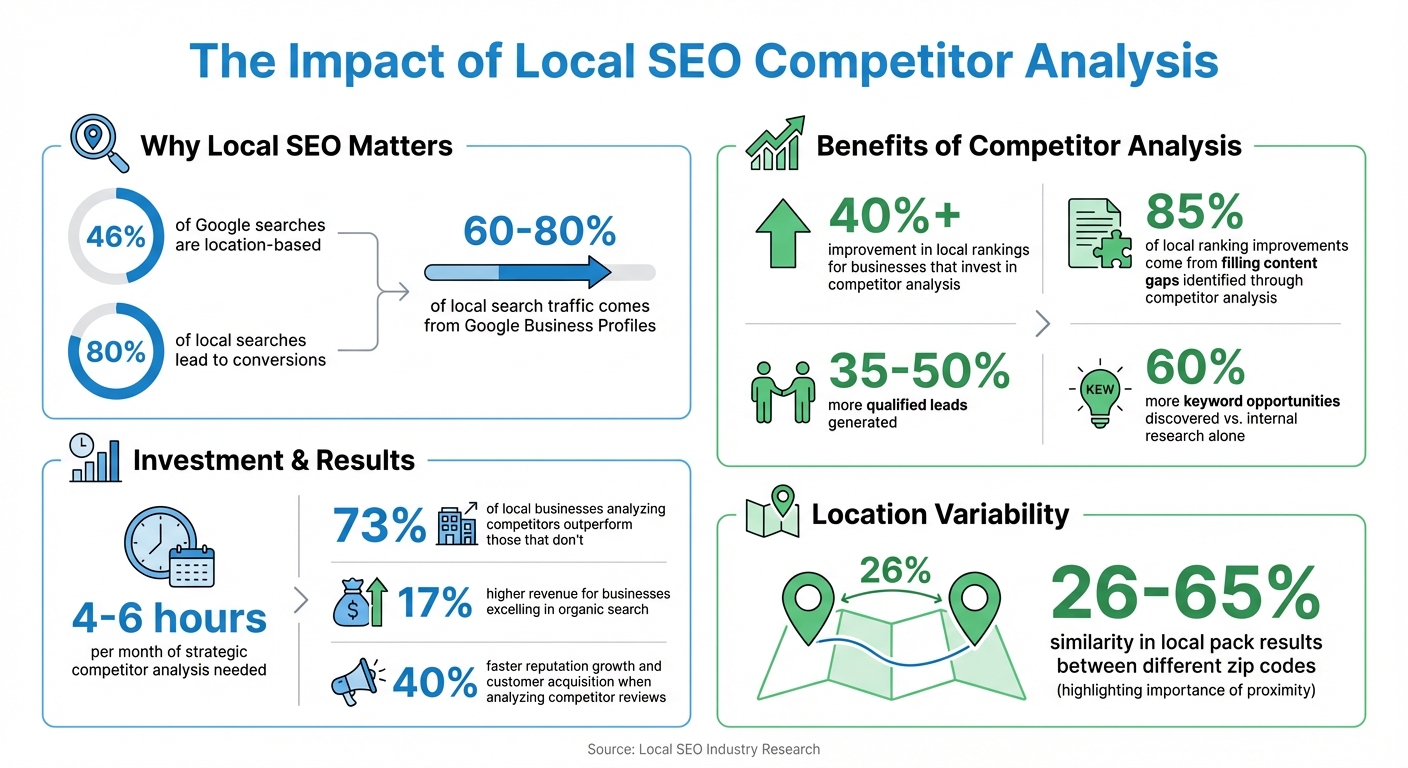
Local SEO Competitor Analysis: Key Statistics and Impact Metrics
How to Identify Local Competitors
Finding Competitors Through Search Engines
You can uncover local SEO competitors by conducting manual searches. Start by opening a private browsing window and searching for your target keywords along with your location – for example, "plumbers in Dallas" or "organic Mexican restaurant."
Pay close attention to three key areas in the search results: Google Maps, the Local 3-Pack (the top three map listings), and the localized organic results that appear below them. The businesses that consistently show up across these sections are your real SEO competitors, even if they’re not your traditional business rivals. Sometimes, smaller businesses with better SEO strategies can outrank larger, more established competitors.
Keep in mind that local rankings can vary significantly depending on the searcher’s precise location. For example, identical searches from different zip codes may produce local packs with only 26% to 65% similarity. This variability underscores the importance of proximity as a key ranking factor.
"The key ranking local ranking factor is location, i.e. proximity to a business."
– Ann Smarty, Brand and Community Manager, InternetMarketingNinjas
If you’re working remotely or outside your target area, you can use location spoofing tools like BrightLocal’s Local Search Results Checker or the GS Location Changer to simulate searches from specific locations. To stay organized, track how often competitors appear across various keyword searches using a spreadsheet. It’s also worth noting that directories like Yelp, TripAdvisor, or Yellow Pages aren’t direct competitors – view them as citation opportunities instead.
Once you’ve identified competitors manually, you can use SEO tools to dive deeper into their strategies.
Using SEO Tools for Competitor Discovery
While manual searches give you a customer-facing view, SEO tools provide behind-the-scenes insights. Tools like SEMRush and SpyFu can reveal which domains are targeting the same keywords as you. SpyFu even highlights your top five competitors in both organic and paid search.
For a more localized perspective, BrightLocal offers features tailored to local SEO. Its Local Search Grid, for example, maps out rankings across multiple points in your service area, giving you a detailed view of competitor performance. The Citation Tracker tool can also pinpoint where competitors are listed online, helping you identify citation gaps that you can fill.
To analyze backlink profiles and domain authority, platforms like Ahrefs, SEMRush, and Moz Link Explorer are invaluable. These tools can show you which partnerships and link-building strategies your competitors rely on to strengthen their rankings. Additionally, the GBP Spy Chrome extension can uncover hidden details from competitor Google Business Profiles, such as their primary and secondary categories, review counts, and the number of photos they’ve uploaded.
Analyzing Competitor On-Page SEO
Reviewing Local Keyword Usage and Content
Take a close look at how competitors use local keywords in their title tags, H1 headers, and meta descriptions. Including geographic terms can signal local relevance to search engines like Google, which can significantly boost rankings. For instance, a title tag such as "Emergency Plumber in Austin, TX | 24/7 Service" is likely to outperform a generic one like "Emergency Plumber Services."
Another key area to examine is the depth and quality of their content. Strong local landing pages typically feature over 400 words of original content that incorporate mentions of specific neighborhoods, landmarks, or even community activities. If a competitor has multiple location pages, check whether each one offers unique content or simply swaps out city names in a template. Thin or duplicate content presents an opportunity to create better, more engaging pages.
You should also use tools like the Schema Validator to see if competitors include LocalBusiness schema markup on their pages. This structured data provides Google with essential business details – such as address, phone number, and service areas – which can lead to enhanced search result features like rich snippets. Additionally, inspect the URL structures for geographic modifiers; for example, "domain.com/dallas/plumbing-services" can reinforce local relevance for both users and search engines.
Make sure competitors display their NAP (Name, Address, Phone) as plain, crawlable text instead of embedding it in images – Google needs to read this information directly. Also, check for features like embedded Google Maps, online scheduling tools, and clear calls-to-action, all of which improve user engagement. Research shows that businesses excelling in organic search can see up to 17% higher revenue.
"Keep your friends close, and your competitors closer when it comes to local SEO – observing their strategies helps keep your tactics ahead of the curve."
– Connor Wilkins, CMO, Direction.com
Once you’ve gathered this data, compile it into a side-by-side comparison of your top competitors to identify strengths and weaknesses.
Comparing On-Page Optimization Elements
A direct comparison of on-page elements across competitors can reveal valuable insights. By organizing this data visually, you can quickly identify patterns and spot areas where you have room to improve.
Key elements to evaluate include:
- Whether the primary local keyword is included in the title tag.
- Whether the city or state is mentioned in the H1 header.
- The use of LocalBusiness schema markup.
- Whether NAP information is displayed as crawlable text.
- The presence of an embedded Google Map on contact or location pages.
- Mobile-friendliness and page load speed.
Here’s an example of how to benchmark these elements:
| On-Page Element | Competitor A | Competitor B | Your Business |
|---|---|---|---|
| Primary Keyword in Title | Yes (City + Service) | Yes (Service only) | ? |
| City/State in H1 Tag | Yes | No | ? |
| LocalBusiness Schema | Comprehensive | Basic | ? |
| NAP Crawlable Text | Yes (Footer) | No (Image only) | ? |
| Embedded Google Map | Yes | No | ? |
| Mobile Friendly | Yes | Yes | ? |
| Page Load Speed | Fast | Slow | ? |
Tools like the MozBar browser extension can make it easier to review title tags, meta descriptions, and header tags without needing to dive into the source code. You can also analyze Google’s search results for "justifications" (the snippets Google uses in the Local Pack) to understand which on-page elements are prioritized.
Google Business Profile Competitor Analysis
Reviewing Google Business Profile Optimization
Start by running searches like "service near me" or "service in [city]" to identify Local Pack profiles worth analyzing. This step helps you spot competitors who are excelling in your area.
Pay close attention to their category choices. A simple tweak to your primary category can lead to noticeable ranking improvements. Browser tools like GMB Everywhere can also reveal secondary categories competitors are using, which might be influencing their visibility.
Next, evaluate their photo strategy. Count the total number of photos, and note the balance between owner-uploaded and customer-uploaded images. Also, check for video content or 360° virtual tours. Businesses that perform well typically update their photo content weekly.
Engagement is another key area to examine. Look at how often competitors use Google Posts and respond to Q&A inquiries. Top profiles post regularly, include clear calls-to-action, and actively address customer questions. The types of questions asked on their profiles can also help you identify gaps to fill – use these insights to enhance your own FAQ section or prepopulate your Google Business Profile Q&A.
Another critical step is reviewing listing snippets for phrases like "Their website mentions…" to see which website content supports their rankings. Click through to analyze their landing pages. Watch for keyword stuffing in business names (e.g., "Best Plumber") and report any violations through Google’s Redressal Complaint Form.
"The point of learning to perform a competitive local business audit does not have to be to analyze and destroy the livelihood of your esteemed neighbor… it can be a study of how they have succeeded in the SERPs so that you can create an informed strategy for finding your own strong niche."
– Miriam Ellis, Local SEO Subject Matter Expert, Moz
Armed with these observations, you’ll be better prepared to refine your strategy and track the performance of your optimization efforts.
Monitoring Google Business Profile Metrics
Once your profile is optimized, tracking key metrics will help you identify which competitors are leading in local search results.
Start by examining reviews. Look at the total number of reviews, the average star rating, how recent the reviews are, and the percentage of reviews that receive responses from the business owner. Businesses that reply to all reviews – positive and negative – send a strong message of excellent customer service to both Google and potential customers.
Engagement metrics such as direction requests, website clicks, and photo views provide a window into how well a profile converts searchers into customers. Tools like BrightLocal’s Local Search Grid or GTrack can help you map rankings across neighborhoods, revealing which competitors dominate specific areas.
It’s also important to track content activity. Note the date of the last Google Post, how frequently updates are made, and the total number of Q&A entries. Research shows that 73% of local businesses analyzing competitors outperform those that don’t by over 40% in local rankings. Given that Google Business Profiles drive 60–80% of local search traffic and conversions, these metrics are critical for staying ahead.
| Metric Category | Key Data Points | Why It Matters |
|---|---|---|
| Reviews | Total count, average rating, recency, response rate | Directly impacts rankings and builds trust with customers |
| Content | Post frequency, photo count, media quality | Signals activity and builds credibility |
| Optimization | Primary/secondary categories, attributes, justifications | Helps with keyword relevance and visibility |
| Engagement | Q&A response rate, website clicks, direction requests | Indicates user intent and profile effectiveness |
| Visibility | Local Finder rank, proximity to city center, map grid share | Measures reach within the local market |
Lastly, check if competitors share an address with other businesses in the same category. Google often filters out duplicate listings, which could explain unexpected ranking disparities. Additionally, review their "Popular Times" data to see how their foot traffic compares to your business hours.
Finding Content and Keyword Gaps
Conducting Keyword Gap Analysis
Once you’ve identified competitors and analyzed on-page elements, it’s time to dig into content and keyword gaps. This step refines your local SEO strategy by examining your domain, subfolders, and individual pages. A deeper analysis like this uncovers opportunities that might go unnoticed with a surface-level review.
Pay close attention to "striking distance" keywords – terms where your site ranks in the top 20 but competitors are ahead. Using the Traffic Lift metric, prioritize these gaps based on their potential to boost traffic. These keywords represent low-hanging fruit. Small tweaks, like optimizing content or improving metadata, can help nudge your page higher in search results.
Local pack snippets (e.g., "Their website mentions…") also provide clues about the content Google values for specific searches. If competitors are featured in these snippets and you’re not, consider revising your content to include similar query language, local details, or other elements Google seems to favor.
Don’t stop at keywords. Look at the "People Also Asked" sections in search results to find questions your competitors are addressing but you’re not. Additionally, Google Search Console can be a goldmine – filter your data for queries with over 100 impressions but few clicks. These highlight clear content gaps that are ripe for improvement.
Once you’ve outlined keyword gaps, shift your focus to identifying content areas where competitors are excelling.
Identifying Content Gaps
Go beyond the basics of service pages. Look into location-specific pages that target nearby neighborhoods or ZIP codes. These pages often don’t appear in a competitor’s main navigation but can significantly impact local rankings. When analyzing top-ranking landing pages, compare key details like:
- Inclusion of city and state names in H1 and title tags
- Overall content length and depth
- Use of Local Business Schema
- References to local landmarks or community involvement
- Conversion-focused elements like chat features, instant booking, or detailed FAQs
These factors often explain why certain pages rank higher for local searches.
Studies show that 85% of local ranking improvements stem from filling content gaps identified through competitor analysis. Businesses that regularly analyze competitors uncover 60% more keyword opportunities compared to those relying only on internal research. Once you spot a gap, use the competitor’s ranking URL as a guide to create a more thorough content brief that aligns with user intent.
For example, in 2017, the local kitchen manufacturer KuchyneValent leveraged competitor analysis to refine its SEO strategy, resulting in over $400,000 in annual revenue.
To help prioritize your efforts, the table below organizes gaps by their potential traffic lift and ease of winning.
Keyword Gap Benchmarking Table
A structured comparison can help you decide which gaps to tackle first. Here’s a quick breakdown:
| Gap Type | What to Track | Why It Matters |
|---|---|---|
| Traffic Lift | Expected traffic gain from surpassing competitor rankings | Focuses on keywords with the highest ROI potential |
| Striking Distance | Keywords where you rank 11–20 but competitors rank higher | Offers quick wins with minimal effort |
| Justifications | Content featured in "Their website mentions…" snippets | Highlights content that drives visibility |
| Location Pages | Landing pages targeting specific neighborhoods or ZIP codes | Shows hyper-local strategies competitors use |
| Content Depth | Word count, local references, and schema markup | Identifies if thin content is holding you back |
When analyzing large national competitors, filter out branded keywords to focus on generic, high-intent local terms that you can realistically rank for. Addressing these content and keyword gaps can significantly boost your organic performance.
sbb-itb-2ec70df
Using Competitor Analysis for Local SEO Success
Prioritizing Actions Based on Data
Harnessing insights from competitor analysis can make a big difference in your local SEO performance. At the top of your to-do list should be Google Business Profile (GBP) optimization – this directly impacts your Local Pack rankings. One effective method to organize your efforts is the "wins" column approach: audit over 50 factors, figure out where competitors are ahead, and focus on closing those gaps.
Concentrate on the 20% of actions that deliver 80% of the results. Typically, this breaks down into three key areas: Visibility (improving GBP and citations), Traffic (addressing keyword gaps), and Conversions (enhancing reviews and user experience). When it comes to citations, quality trumps quantity. Instead of chasing hundreds of low-value listings, aim to match the high-authority citations your top competitors use, such as local chambers of commerce or niche industry directories.
"I have seen a listing jump 7 spots just from a simple change of the primary category, and I have seen a listing completely disappear when an unrelated category was accidentally set." – Darren Shaw, Founder, Whitespark
Spending 4-6 hours a month on strategic competitor analysis can boost qualified leads by 35-50%. This data-driven focus paves the way for Growth-onomics’ structured methodology, which is outlined in the next section.
Growth-onomics‘ Data-Driven Approach
Growth-onomics employs its VTC Framework to turn competitor insights into high-impact actions. The framework focuses on Visibility (optimizing GBP and citations), Traffic (bridging keyword gaps), and Conversions (turning visitors into paying customers). The emphasis is on impactful tasks rather than generic optimization.
Their process involves benchmarking 5-10 high-performing competitors to uncover patterns in areas like category selection, review management, and content depth. By using this data-led approach, they ensure resources are funneled into strategies that deliver the best ROI – whether it’s refining GBP categories, creating targeted location pages, or launching review generation campaigns. Beyond optimization, the aim is to carve out a distinct identity, as explored in the next section.
Creating Differentiators
Competitor analysis isn’t about copying – it’s about spotting opportunities your rivals have overlooked. For example, you can analyze competitors’ operating hours to identify gaps and position your business as the go-to option during off-hours. Similarly, comb through their reviews to find common complaints, then tailor your services and responses to emphasize your strengths.
Develop hyper-local content that goes beyond generic city-wide pages. Create neighborhood-specific landing pages that highlight local landmarks or events. If your competitors have weak visuals, step up with professional photography, video testimonials, or immersive 360-degree virtual tours.
"A good audit shouldn’t generate a mere carbon copy – it should point the way to creating a uniquely powerful local identity." – Miriam Ellis, Local SEO Subject Matter Expert, Moz
Keep an eye on the Local Finder for "name spam", where competitors stuff keywords into their business titles. Reporting these violations to Google can level the playing field while reinforcing your position through fair practices. Businesses that actively analyze competitor reviews often see reputation growth and customer acquisition 40% faster.
Conclusion
Key Takeaways
Local SEO competitor analysis plays a crucial role in helping businesses stand out in a crowded market. With nearly 46% of Google searches tied to location and 80% of those leading to conversions, staying on top of your competition can make a significant difference. Regular competitor analysis has been shown to improve local rankings by over 40%.
Your fiercest online competitors are the ones consistently ranking in the top 5 organic results and the Local Pack for your key search terms. By analyzing their strategies – like how they’ve optimized their Google Business Profile (GBP), their keyword choices, citation practices, and review management – you can identify areas where your business might be falling short. Addressing these gaps can lead to 85% of local ranking improvements.
The best results come from focusing on what matters most. Start by optimizing your Google Business Profile, paying close attention to category selection and managing reviews effectively. Use keyword gap analysis to find opportunities you might be missing. With just 4–6 hours of competitor analysis each month, you can see a 35–50% boost in qualified leads. Monitoring tools like weekly Local Pack checks, monthly brand mention tracking, and quarterly in-depth reviews help you stay ahead of shifting algorithms and new competitors.
Armed with this knowledge, you’ll be well-equipped to develop strategies that give you a competitive edge.
Next Steps
To put these insights into action, start with a detailed audit of your top 5–10 local competitors. Dive into their Google Business Profiles, keyword strategies, and citation practices to pinpoint where they’re excelling. Focus on closing gaps in areas like GBP optimization, keyword rankings, and citation consistency. Set measurable goals, such as acquiring 10 local backlinks or increasing GBP interactions by 25% within 90 days. Concentrate on the 20% of actions that will deliver 80% of your results – like fixing NAP (Name, Address, Phone) inconsistencies, targeting high-value keywords, and refining your primary GBP categories.
For expert support, Growth-onomics offers data-driven local SEO strategies tailored to your needs. Their VTC Framework (Visibility, Traffic, Conversions) helps prioritize impactful actions through competitive benchmarking. Whether you’re aiming to dominate the Local Pack or attract hyper-local search traffic, a well-structured, data-focused approach can help turn insights into measurable growth.
How To Do A Competitive Analysis For Local SEO – Expert Tutorial
FAQs
What’s the best way to identify local SEO competitors?
To figure out who your local SEO competitors are, start by searching for keywords and locations that match your business. For example, try "near me" searches like "plumber in Seattle, WA" and look at the businesses that show up in the Google Local Pack, the map sidebar, and the organic search results. Take note of key details such as the names, addresses, and URLs from their Google Business Profiles (GBP). These businesses are your actual local competitors, and they may not always align with who you typically consider your rivals.
If you want to dig deeper, tools like keyword research platforms can help you identify local domains ranking for your target keywords. Pay close attention to factors like domain authority, backlink profiles, review counts, and how well their GBP is optimized. Organizing this information in a spreadsheet can make it easier to spot gaps in your strategy and uncover opportunities. Using these insights, you can fine-tune your local SEO efforts and stay ahead of the competition.
What are the key on-page SEO factors for improving local search rankings?
When it comes to improving your local search rankings, a few on-page SEO essentials can make a big difference. Start with optimized title tags, compelling meta descriptions, and the thoughtful inclusion of locally-relevant keywords throughout your content. These elements work together to signal to search engines that your page is highly relevant to local searches.
Don’t overlook the importance of consistently displaying your business’s name, address, and phone number (NAP) across your website. Pair this with structured data (schema markup) to give search engines a clearer understanding of your business details. By nailing these basics, you’ll improve your chances of standing out in local search results.
How does optimizing my Google Business Profile help improve local SEO?
Fine-tuning your Google Business Profile is a key step to boosting your local SEO. It helps your business stand out on Google Maps and in local search results (often called the local pack). The payoff? Better rankings, more clicks, and increased customer interaction.
To make the most of your profile, ensure all your information is accurate and complete. Include essentials like your address, phone number, business hours, and upload high-quality photos that showcase your business. This not only helps potential customers find you but also builds trust.
Another important tip: Engage with customer reviews. Responding to reviews – both positive and negative – shows you’re active and committed to your customers. Plus, it signals to Google that your business is reliable and worth recommending.
