

Influencer marketing works best when you focus on engagement, not just follower counts. Today, platforms like Instagram and TikTok prioritize actions like saves, shares, and comments over likes. Micro-influencers (10K–100K followers) consistently outperform larger creators in engagement and cost-effectiveness. Here’s what you’ll learn in this guide:
- Key Metrics: Engagement rate = (Total Engagements ÷ Followers) × 100. TikTok averages higher engagement than Instagram, with video completion rates of 52% vs. 38% for Reels.
- Platform Insights: Short-form videos drive more engagement than static posts. Instagram favors saves, TikTok values watch time, and LinkedIn rewards thoughtful comments.
- Improvement Tactics: Work with influencers who have active, real audiences. Use clear creative briefs, track performance with UTM links, and repurpose top-performing content.
- Advanced Tools: Monitor real-time metrics, run A/B tests, and use predictive analytics to maximize ROI.
The key takeaway? Engagement reflects influence, not just reach. Small, engaged audiences often deliver better results than massive but inactive followings. Let’s dive into the strategies that drive meaningful results.
Engagement Rate Formula – Everything you NEED to Know
How Influencer Engagement Rates Work
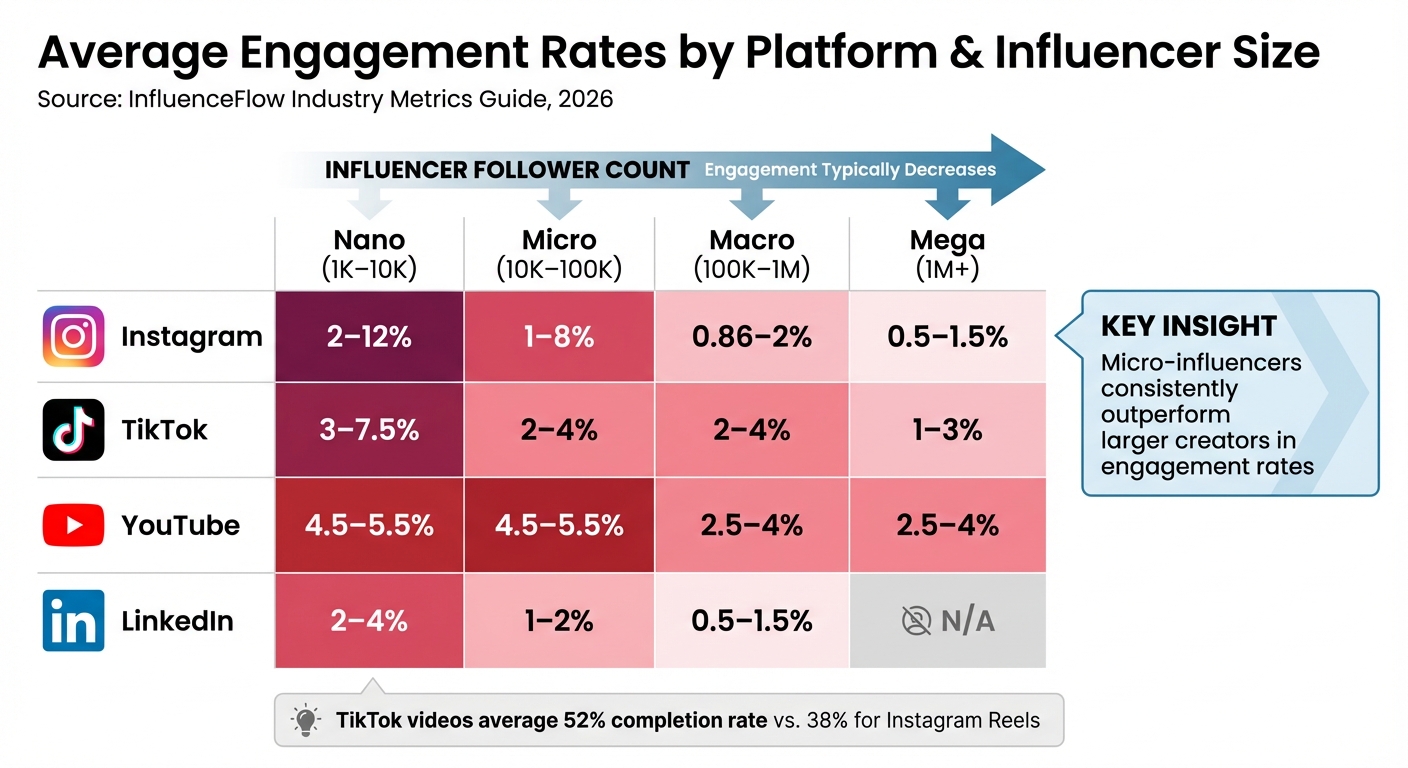
Average Influencer Engagement Rates by Platform and Audience Size
What Is an Engagement Rate?
An engagement rate measures how much of an audience interacts with a creator’s content. This includes actions like likes, comments, shares, saves, and video views, and it’s typically calculated as a percentage of total followers, reach, or impressions. It’s a key metric that separates influencers with truly engaged audiences from those who may have a large but less active following.
The most common formula is:
(Total Engagements ÷ Total Followers) × 100.
However, some brands prefer formulas like (Total Engagements ÷ Reach) × 100 or (Total Engagements ÷ Impressions) × 100, especially for platforms focused on video content.
"Engagement rate is your first filter, not follower count." – Ali Afshar, SocialMedia Tutor
Different platforms weigh engagement differently. For example:
- Instagram factors in likes, comments, shares, and saves. Reels often see 15–30% more engagement than static posts.
- TikTok prioritizes video views and completion rates.
- YouTube calculates engagement as the total likes, comments, and shares divided by subscriber count.
Next, we’ll dive into how these metrics compare across platforms and what they reveal about influencer performance.
Average Engagement Rates by Platform
Engagement rates can vary widely depending on the platform and the size of the influencer’s audience. For instance, TikTok often boasts double the engagement rates of Instagram for creators in similar tiers. On average, TikTok videos have a 52% completion rate, compared to 38% for Instagram Reels.
| Platform | Nano (1K–10K) | Micro (10K–100K) | Macro (100K–1M) | Mega (1M+) |
|---|---|---|---|---|
| 2–12% | 1–8% | 0.86–2% | 0.5–1.5% | |
| TikTok | 3–7.5% | 2–4% | 2–4% | 1–3% |
| YouTube | 4.5–5.5% | 4.5–5.5% | 2.5–4% | 2.5–4% |
| 2–4% | 1–2% | 0.5–1.5% | N/A |
Source: InfluenceFlow Industry Metrics Guide, 2026
A noticeable trend is that engagement rates tend to drop as follower counts increase. Additionally, industry context plays a big role. For example, brands in food or beauty often see engagement rates between 5–12%, while industries like finance or healthcare average around 0.5–1.5%. Even a 3% engagement rate on LinkedIn can be incredibly impactful when targeting decision-makers.
What Affects Engagement Rates
The type of content is one of the biggest factors influencing engagement. Short-form vertical videos – like Reels, TikToks, and YouTube Shorts – consistently outperform static images. For example, Instagram Reels can achieve 39% to as much as 300–400% more reach than static posts, while carousels often generate 114% more engagement.
Timing also matters. Posting during peak periods – Tuesday through Thursday in the morning, at lunch, or in the early evening – and responding quickly to comments can boost engagement by up to 25%.
Audience alignment plays a critical role as well. One sustainable apparel brand shifted from working with two macro-influencers to 12 micro-influencers, leading to 340% more total engagement and a 2.8x higher conversion rate.
Lastly, content quality and authenticity are essential. Audiences are increasingly drawn to unfiltered, genuine content over polished, ad-like posts. Instagram, for example, now places significant weight on "saves" as an indicator of long-term value. Content like tutorials, guides, or recipes that encourage users to save posts can improve both engagement and visibility in the algorithm.
Metrics to Track for Influencer Engagement
Core Engagement Metrics
When analyzing influencer engagement, certain metrics stand out. Likes and reactions are quick indicators of approval, but comments carry more weight – on Instagram, they’re considered three times more valuable as they indicate deeper interest and spark conversations. Shares expand your reach by spreading content to new audiences, while saves highlight content that users find worth revisiting, such as tutorials or product recommendations. For videos, completion rates reveal how much of the content viewers actually watch – TikTok averages 52%, while Instagram Reels lag behind at 38%. Additionally, direct messages (DMs) track engagement with temporary content like Stories, and click-through rates (CTR) help measure how well calls-to-action drive users toward further steps.
"A creator with 50,000 followers but 200 likes per post has a very different story than a creator with 5,000 followers and 800 likes per post. One has reach. The other has influence." – InfluenceFlow
However, engagement metrics can be misleading. With 73% of marketers struggling to measure campaigns accurately, it’s crucial to consider that 38% of engagement may come from bots. To ensure authenticity, evaluate comment sentiment rather than just volume. High engagement could mask negative feedback, which might harm your brand perception.
Platform Differences in Engagement
Each platform calculates engagement differently, and comparing metrics without context can lead to skewed conclusions. For example, Instagram uses (Likes + Comments + Shares + Saves) ÷ Followers to measure engagement. TikTok, on the other hand, focuses on video views with (Likes + Comments + Shares) ÷ Video Views. LinkedIn measures engagement as (Reactions + Comments + Shares) ÷ Impressions.
Algorithms also prioritize different actions. Instagram’s 2026 algorithm emphasizes saves and shares for content distribution, while TikTok values video completion rates and watch time over total views. Engagement benchmarks vary too: a 2% engagement rate on Instagram is average, but the same rate on TikTok – where typical rates range from 3% to 10% – would be considered low.
| Platform | Primary Formula | 2026 Avg. ER | Algorithm Focus |
|---|---|---|---|
| (Likes+Comments+Shares+Saves) / Followers | 1.2% | Shares, Saves, Reels | |
| TikTok | (Likes+Comments+Shares) / Views | 3-10% | Completion Rate, Watch Time |
| (Reactions+Comments+Shares) / Impressions | 0.5-1.5% | Comment Quality, Thought Leadership | |
| YouTube | (Likes+Comments+Shares) / Subscribers | 2-5% | Watch Time, CTR, Retention |
Content format also plays a role. On Instagram, Reels generate 67% more engagement than standard feed posts, while user-generated content outperforms brand-created content by 30–50%. For a clearer picture, track video and static content separately instead of averaging their performance.
Understanding these platform-specific nuances helps align your metrics with the goals of your campaign.
Awareness Metrics vs. Conversion Metrics
To gauge the full impact of an influencer campaign, it’s essential to connect awareness metrics with conversion metrics. Awareness metrics capture top-of-funnel visibility, such as reach (unique viewers), impressions (total views), audience growth, and brand mentions. Conversion metrics, on the other hand, measure bottom-of-funnel results like sales, lead generation, app downloads, and cost-per-acquisition (CPA).
The choice of metrics should match your campaign objectives. For instance, if you’re launching a new product, metrics like reach and impressions are key. But if your focus is sales, prioritize figures like ROAS and CPA. On average, B2B influencer campaigns deliver an 8:1 ROAS, B2C campaigns achieve 5:1, and ecommerce campaigns reach 12:1.
Traditional "last-click" attribution often undervalues influencers who drive early-stage awareness. For example, The Body Shop’s Middle East campaign achieved 30 million impressions and 17 million in reach over 18 months, leading to a 17% increase in sales. Similarly, Adobe’s B2B LinkedIn influencer campaign doubled engagement compared to standard efforts and boosted form completion rates by 150%.
To track sales more effectively, use unique promo codes (e.g., "CREATORNAME2026") and UTM parameters for each influencer. Linear attribution models can also credit influencers for raising awareness, not just closing sales. Setting clear KPIs – like achieving a 5% engagement rate or $50,000 in revenue – before launching a campaign prevents any post-campaign guesswork.
How to Improve Influencer Engagement
Turning data into actionable strategies is key to boosting influencer engagement. By focusing on informed decisions, you can encourage authentic connections and achieve meaningful business results.
Choose Influencers with Engaged Audiences
A large follower count doesn’t always equate to influence. Micro-influencers (10,000–100,000 followers) often see four times higher engagement rates compared to macro-influencers, while nano-influencers (under 10,000 followers) offer 40% lower cost-per-acquisition in campaigns projected for 2025–2026. The real value lies in creators whose audiences actively engage with their content instead of passively scrolling by.
"There is no correlation between follower count and actual influence. What truly determines an influencer is their connection level with their audience." – GRIN
When evaluating influencers, focus on the quality of comments over sheer numbers. Thoughtful, relevant comments and ongoing conversations are better indicators of engagement than generic praise or emojis. A healthy audience tends to generate one comment for every 50–100 likes. Also, pay attention to the follower-to-following ratio – authentic influencers usually have at least three followers for every account they follow.
To find the right influencer, start by defining your Ideal Creator Profile. Consider factors like demographics (age, gender, location), niche expertise, visual style, and shared values. Look to your existing customers – those who already have influence on social media can become genuine brand advocates. Use location tags to discover creators in specific areas, like local coffee shops, rather than tourist-heavy spots. Once you identify a strong influencer, tools like Instagram’s "Suggested for You" can help you find similar creators.
Be cautious of red flags such as sudden follower spikes (1,000+ overnight), mismatched audience locations (e.g., a UK-based influencer with a predominantly Middle Eastern audience), or influencers following more than 1,500 accounts, which can hurt post visibility.
Write Effective Creative Briefs
A well-crafted creative brief strikes a balance between clear instructions and creative freedom. Overly rigid guidelines can result in content that feels forced, so share your brand’s vision while allowing influencers to connect with their audience in their own way.
"Creators know their audience and which buttons to push to get them excited about a product or service." – Quinn Schwartz, Writer, GRIN
Set clear SMART goals, like "increase website traffic by 25%" or "achieve a 5% engagement rate", to give influencers a clear target. Outline deliverables, including the number of posts, preferred formats (e.g., Reels vs. Stories), and platforms. Limit the review process to two rounds of feedback to maintain creative autonomy while ensuring brand consistency.
Include technical details like required hashtags, UTM tracking links, and specific calls-to-action (CTAs). For example, "Which strategy are you testing?" performs three times better than generic prompts like "Like this". Since video content generates 3.7 times more engagement than static images, encourage influencers to make the first three seconds of their videos stand out with surprising elements or questions. Informative or myth-busting content can also drive 2.3 times more saves than purely entertaining posts. On Instagram, suggest placing hashtags in the first comment to keep captions clean while maintaining reach. Also, ensure influencers comply with FTC disclosure rules (e.g., #ad or #sponsored).
Match Content to Campaign Goals
Your campaign goals should dictate the type of content you create. For awareness campaigns, opt for relatable storytelling, such as lifestyle content, behind-the-scenes glimpses, or "day-in-the-life" posts that introduce your brand to new audiences. For conversion-focused campaigns, prioritize product demos, personalized promo codes (e.g., "CREATORNAME2026"), and strong CTAs that guide users toward purchases or sign-ups.
Content format plays a big role, too. Different platforms and objectives call for different formats. In 2026, audiences are leaning toward unfiltered, natural content over overly polished posts. This shift toward "realness" emphasizes authenticity and relatability. Additionally, edutainment – content that blends education with entertainment – has proven highly effective for engaging viewers with short attention spans. Tailor your content to the campaign phase: use educational material to build trust early on, then transition to product-focused content during the conversion stage.
Time Posts for Maximum Visibility
Timing matters. Posting when your audience is most active can significantly boost engagement. Peak activity generally falls between late morning and early evening (11 a.m. to 6 p.m.) on weekdays, with Tuesday, Wednesday, and Thursday consistently seeing the highest engagement.
"Instagram’s algorithm favors recency and engagement. A captivating post could get lost if it’s published when your followers aren’t around to see it." – William Gasner, CMO, Stack Influence
Certain types of content perform better at specific times. Reels and videos often gain more traction in the evening when people have time to watch, while Stories work well during commutes and lunch breaks. Customize your schedule to fit your audience’s routines – fitness content in the early morning, food posts around lunchtime, and B2B content during midweek mornings.
Encourage influencers to check their "Most Active Times" in Instagram Insights to pinpoint when their audience is online. For global campaigns, aim for overlapping time zones, such as late morning EST, to capture both U.S. and European audiences. Early engagement is crucial; posts that get likes and comments within the first hour are more likely to gain algorithmic boosts.
Build Conversations with Followers
True engagement goes beyond likes and shares – it’s about creating meaningful conversations. Influencers who actively respond to comments and engage with their audience see higher sustained interaction than those who simply post and move on. Even responding to the first 10 comments within 30 minutes can help boost visibility through algorithm prioritization.
Encourage influencers to ask open-ended questions in their captions to spark discussions. This approach not only deepens connections but also sustains engagement over time, building stronger relationships that translate into tangible results for your brand.
Advanced Methods and Tools for Optimization
Once you’ve nailed the basics, it’s time to dive into advanced techniques that can take your influencer ROI to the next level. These strategies focus on smart data analysis and making the most of your content to get the highest returns on your campaigns. Below, we’ll explore three key methods to refine your approach.
Reuse Top-Performing Content
Why let your best influencer content fade away after just 24 hours? User-generated content (UGC) consistently outperforms brand-created content by 30–50% in engagement metrics, making it a goldmine for extending your campaign’s reach. Start by reviewing your top 10 posts to identify what worked – what formats, topics, or tones resonated most? For example, did carousel posts generate more interaction than single images? Did educational posts lead to more saves compared to entertainment-focused ones?
Once you’ve pinpointed the winners, repurpose them across other channels. Post influencer-created Reels on your brand’s Instagram page, include testimonials in email campaigns, or feature product demos in paid ads. This strategy stretches the value of your initial investment without requiring new content creation. Just make sure to secure usage rights and properly credit the creators as outlined in your contracts.
Track Data and Test Different Approaches
Keeping tabs on real-time data is the difference between a successful campaign and one that misses the mark. Monitor metrics like click-through rate (CTR), conversion rates, and cost per acquisition (CPA) on a weekly basis. If you notice a dip in performance, set triggers to make adjustments mid-campaign rather than waiting until the end to figure out what went wrong.
A/B testing is another essential tool to see what actually works with your audience. Test one variable at a time – compare Reels with carousels, morning posts with evening posts, or question-based calls to action (CTAs) with direct commands. Use unique UTM parameters for each influencer link (e.g., utm_source=influencer_name&utm_medium=instagram) to ensure accurate tracking in Google Analytics 4.
Beyond primary metrics, consider using sentiment analysis tools that evaluate the tone of comments – positive, neutral, or negative. A single, enthusiastic comment from a real user can often outweigh thousands of bot-generated likes. Be alert for red flags like sudden spikes in engagement, which could signal bot activity rather than genuine interest. Studies show that about 28% of influencer followers were identified as fake or bot accounts in 2025. AI-powered tools can help by analyzing engagement patterns to detect suspicious activity, ensuring your campaign stays authentic and effective.
Work with Growth-onomics for Data-Driven Campaigns
For those looking to take their campaigns even further, partnering with an expert agency like Growth-onomics can provide the edge you need. Specializing in performance marketing, Growth-onomics treats influencer campaigns as measurable business investments rather than simple brand awareness efforts. Their services include advanced Data Analytics and Performance Marketing strategies, such as multi-touch attribution models that credit all influencers involved in a customer’s journey – not just the one who made the final conversion.
This level of insight helps you understand which influencers are best at generating awareness versus closing sales. Growth-onomics also uses predictive analytics to forecast campaign outcomes before contracts are signed, allowing you to choose influencers with the highest likelihood of success. By integrating first-party data from your CRM with influencer metrics, they provide a full picture of how influencer marketing impacts your business – not just through vanity metrics, but in actual revenue growth.
For more information, visit Growth-onomics at https://growth-onomics.com.
Conclusion
Getting the most out of influencer engagement requires thoughtful, data-driven choices at every step of your campaign. The most successful brands in 2026 focus on meaningful engagement rather than chasing vanity metrics. They partner with creators who have genuinely active audiences and keep a close eye on performance metrics to fine-tune their strategies.
When selecting influencers, look beyond follower counts. A creator with a smaller but highly engaged audience often holds more sway than one with a massive but inactive following. For example, micro-influencers (10,000–100,000 followers) tend to have an average engagement rate of 6%, far outpacing mega-influencers, who average just 1.97%. Use tools like audience audits to identify sudden spikes in followers or signs of bot activity.
Once you’ve chosen the right influencers, tracking performance becomes essential. Metrics like click-through rates, conversion rates, and cost per acquisition should be monitored closely. Unique UTM parameters can help you measure each influencer’s impact with precision. This kind of detailed tracking ensures your campaigns deliver measurable results.
From there, let the data guide you. Experiment with content formats, posting schedules, and calls-to-action. Repurpose content that performs well, and consider collaborating with Growth-onomics for a strategy that emphasizes revenue and data-driven insights. A focus on analytics can transform your campaigns into powerful tools for engagement.
Influencer marketing thrives when treated as a strategic investment. With the right approach, you’ll not only see improved engagement rates but also build strong, long-term relationships that support lasting growth.
FAQs
What’s the best way to calculate an influencer’s engagement rate?
To figure out an influencer’s engagement rate, start by adding up all the interactions on a post – this includes likes, comments, shares, saves, video completions, and clicks. Next, divide that total by either the influencer’s total number of followers or the post’s reach. Finally, multiply the result by 100 to express the engagement rate as a percentage.
This straightforward formula lets you gauge how well an influencer resonates with their audience, giving you valuable insights to guide your marketing strategies.
What are the most effective strategies to boost influencer engagement on social media?
To boost influencer engagement on social media, focus on crafting content that works well with platform algorithms while genuinely connecting with your audience. For instance, platforms like Instagram favor meaningful interactions – comments, shares, and saves hold more weight than simple likes. You can encourage these actions by writing captions that spark conversation, using interactive tools like polls or stickers, and including clear calls-to-action that guide your audience on what to do next.
Consistency plays a major role too. Posting regularly – around 3 to 5 times a week – and experimenting with different formats like Reels, Stories, and carousel posts can keep your audience engaged and coming back for more. Collaborating with micro-influencers or niche creators can also make a big difference, as their followers are often more engaged and loyal to their content.
Don’t forget to let data guide your strategy. Keep an eye on engagement rates by dividing total interactions by reach, study performance trends, and test variables like posting times or creative styles. By analyzing these insights and adjusting based on audience feedback, you can stay ahead and maintain strong engagement over time.
Why are micro-influencers often more effective for engagement than macro-influencers?
Micro-influencers stand out because they connect with highly engaged, niche audiences who genuinely trust their opinions. Their followers often feel a closer, more personal bond with them, which translates into higher engagement rates – often 3–10 times greater than what macro-influencers achieve.
What sets micro-influencers apart is their relatability and sincerity. Their recommendations come across as genuine, building trust that resonates with their audience. For brands aiming to refine their influencer marketing efforts, this connection can lead to stronger, more impactful results.