


Churn segmentation is a game-changer for e-commerce businesses trying to retain customers. Instead of chasing new buyers, segmenting customers by their likelihood to leave helps you focus on retaining those who matter most. Here’s the big takeaway: retaining customers is far cheaper than acquiring new ones, and even a small increase in retention (5%) can boost profits by 25%-95%.
Key Points:
- What is churn segmentation? Grouping customers based on their risk of leaving and why they leave.
- Why it matters: Acquiring new customers costs 5-25x more than retaining existing ones. Repeat customers drive 44% of revenue but are only 21% of the customer base.
- How it works: Use data like purchase frequency, average order value, and engagement to predict churn.
- Methods: Demographic, behavioral, and RFM (Recency, Frequency, Monetary) analysis.
- Tools: Predictive analytics tools like Klaviyo help automate churn scoring and retention campaigns.
This guide covers how to identify at-risk customers, calculate churn risk, and create tailored retention strategies. Whether you’re dealing with VIPs, inactive buyers, or new customers, the focus is on using data to act before they leave.
Stop Losing Customers: 10 E-commerce Churn Strategies (It’s NOT About Discounts)
Main Methods for Segmenting E-Commerce Customers by Churn Risk
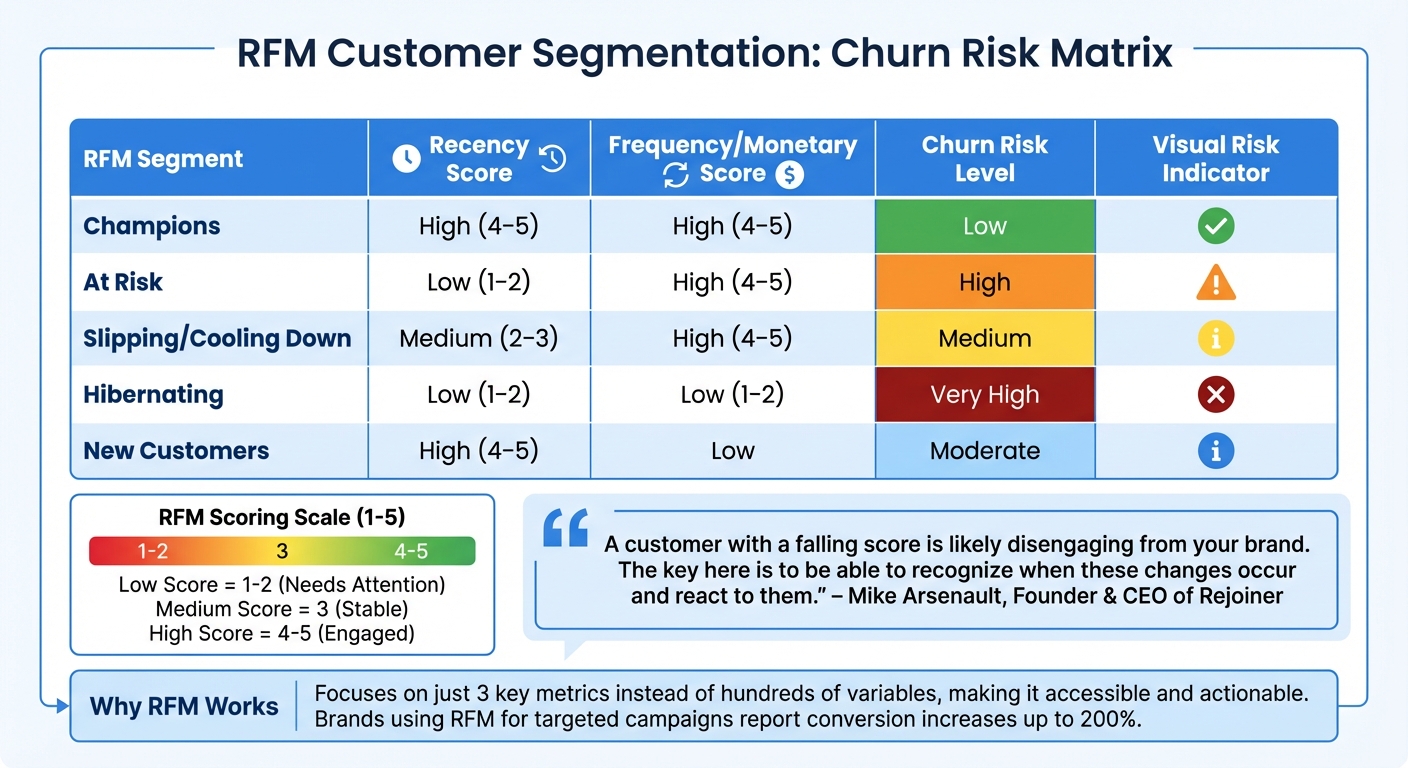
RFM Customer Segmentation Churn Risk Matrix for E-Commerce
To identify and address churn risks, you can group customers using three primary methods: demographic, behavioral, and value-based segmentation (via RFM analysis). Each method offers unique insights – demographics reveal who is churning, behavior highlights how they are disengaging, and value-based segmentation identifies high-priority customers who need immediate attention. Let’s break these methods down to help you fine-tune your strategy.
Demographic Segmentation
This method organizes customers by characteristics like age, location, and income. It helps identify broad trends, such as whether loyalty or price sensitivity varies by region or age group. For example, a customer moving to a new city or experiencing financial changes could signal potential churn. Recognizing these shifts early allows you to adapt your approach and address their evolving needs.
Behavioral Segmentation
Behavioral segmentation zeroes in on how customers interact with your brand. Key indicators of churn include declining purchase frequency, missed subscription renewals, stalled second purchases, or even negative experiences with customer support.
Take BPN (Bare Performance Nutrition) as an example. In 2022, they used churn-risk modeling to identify high-value subscribers who had stopped engaging. By targeting these customers with specific retention campaigns, they generated approximately $900,000 in additional revenue and achieved a 12% re-purchase rate.
This method doesn’t just track actions – it helps you act preemptively before customers fully disengage. Adding transactional value into the mix can provide even deeper insights into customer behavior.
Value-Based Segmentation Using RFM Analysis
RFM analysis evaluates customers based on three simple but powerful metrics:
- Recency: How long it’s been since the last purchase.
- Frequency: Total number of purchases.
- Monetary Value: Total spending.
By scoring customers on each metric (on a scale from 1 to 5) and dividing them into segments, you can quickly identify those at risk of churning. For example, a customer with high Frequency and Monetary scores but a low Recency score – like someone who used to shop monthly but hasn’t made a purchase in 90 days – falls into the "At Risk" category.
"A customer with a falling score is likely disengaging from your brand. The key here is to be able to recognize when these changes occur and react to them." – Mike Arsenault, Founder & CEO of Rejoiner.
RFM’s simplicity makes it highly effective. It avoids the complexity of machine learning models by focusing on just three key metrics. And it works – brands using RFM for targeted campaigns have reported conversion increases of up to 200%.
Here’s how RFM segments typically align with churn risk:
| RFM Segment | Recency Score | Frequency/Monetary Score | Churn Risk Level |
|---|---|---|---|
| Champions | High (4–5) | High (4–5) | Low |
| At Risk | Low (1–2) | High (4–5) | High |
| Slipping/Cooling Down | Medium (2–3) | High (4–5) | Medium |
| Hibernating | Low (1–2) | Low (1–2) | Very High |
| New Customers | High (4–5) | Low | Moderate |
The simplicity of RFM is its biggest advantage. While advanced models analyze hundreds of variables, RFM focuses on just three, making it accessible and actionable. Plus, it highlights the importance of your top customers – who often spend 10 times more than the average buyer and contribute about one-third of your revenue. Keeping these high-value customers engaged is key to maintaining steady growth.
How to Identify and Calculate Churn Risk
Fine-tuning your approach to customer retention starts with identifying churn risk. By setting clear time thresholds, keeping an eye on warning signs, and using automated segmentation, you can address churn before it becomes a bigger issue. Here’s how to make it work.
Setting Churn Windows
A churn window marks the period of inactivity after which a customer is unlikely to return. For subscription-based businesses, this is typically tied to the billing cycle – like 30 days for a monthly subscription. But for non-subscription e-commerce, you’ll need to dig into your customers’ purchasing habits.
Start by analyzing the average time between purchases. For instance, if your loyal customers usually reorder every 60 days, consider setting the churn threshold at 90 or 120 days of inactivity. This timing varies depending on the product category. Consumables like skincare or food might work with a 30-day window, while apparel or electronics may require a 90-day window to reflect their longer buying cycles.
"Churn prediction models help businesses proactively identify and retain customers who are most likely not to come back given time lapses that succeed the average next time to buy." – Christina Dedrick, Director of Engineering, Klaviyo
To establish a solid baseline, use cohort analysis. Group customers by the month of their first purchase and track how many return within your defined churn window. For accurate predictions, you’ll generally need at least 180 days of order history and data from at least 500 customers. Without this foundation, your churn prediction efforts may fall flat.
Churn rates also vary by industry. For example, research from Omniconvert shows annual churn rates of 62% in Beauty and Fitness and 82% in Consumer Electronics. Knowing these benchmarks can help you set realistic goals for your business.
Once your churn window is defined, the next step is to monitor key behaviors that signal a risk of churn.
Key Metrics That Predict Churn
By tracking the right metrics, you can spot churn risks early. The Recency and Frequency metrics from your RFM (Recency, Frequency, Monetary) analysis are among the most reliable indicators. However, it’s helpful to include other behavioral and engagement signals as well.
Start with purchase patterns. If a customer who typically buys every 45 days hasn’t returned after 75 days, that’s a red flag. A drop in Average Order Value (AOV) or increasing gaps between purchases can also indicate waning interest.
Engagement metrics are another early warning system. Declines in email or SMS open rates, reduced click-through rates, or behaviors like frequent browsing without purchases or rising cart abandonment rates are all signs of disengagement.
Don’t forget customer service data. A spike in support tickets, negative reviews, or low Net Promoter Scores (NPS) and Customer Satisfaction (CSAT) scores often signal dissatisfaction that can lead to churn. Return data is particularly telling – frequent returns or reasons like “poor quality” or “inaccurate descriptions” are clear churn drivers.
"Churn prediction is absolutely crucial because it usually costs more to acquire a new customer than retain an existing one." – Jessica Schanzer, Lead Product Marketing Manager, Klaviyo
Once you’ve identified churn signals, the next step is to act. Automating risk scoring and retention campaigns can make this process seamless.
Tools for Creating Churn Segments
Machine learning tools can assign churn risk scores (ranging from 0 to 1 or 0% to 100%) based on historical purchasing patterns. These tools adapt to your business, updating predictions as customer behavior changes.
For example, Klaviyo’s predictive analytics can pinpoint customers at risk of churning or likely to make a purchase soon.
"Our model learns the purchasing patterns of your business. Then, by using predictive modeling, we make profile-level predictions for your audience. These predictions update automatically in reaction to profile behavior. It’s all about the quality and quantity of your data – the more robust your real-time and historical data, the more accurate your churn prediction models will be." – Klaviyo
Set risk thresholds to guide your actions. A score of around 50% suggests stable engagement, while scores above 75% indicate the need for immediate intervention. Use these scores to create automated segments that trigger retention campaigns when a customer enters high-risk territory.
For the best results, combine churn risk scores with Predicted Customer Lifetime Value (CLV). This allows you to focus on high-value customers who are at risk, ensuring your retention efforts deliver the greatest financial return. Automated email or SMS flows can be set up to activate when a customer’s churn risk score hits your threshold or when they miss their “Expected Date of Next Order”.
sbb-itb-2ec70df
Retention Strategies for Different Churn Segments
Once you’ve identified the risk of churn, the next step is to create targeted strategies for each customer group. Different segments demand different approaches – what works for a loyal, high-spending customer won’t necessarily resonate with someone who just made their first purchase. Here’s how to fine-tune your retention efforts for maximum effectiveness.
How to Retain High-Value At-Risk Customers
High-value customers – those spending over $300 or with a high lifetime value – deserve special attention. These customers should be closely monitored, and personalized incentives should be ready to deploy when necessary. For example, if a VIP shows signs of churn, such as 30 days of inactivity or submitting multiple support tickets in a short period, initiate immediate personal outreach through email or SMS to address their concerns. This kind of tailored support demonstrates their importance to your business and helps resolve potential issues before they decide to leave.
Start by segmenting these high-value customers for focused attention. Rather than offering discounts right away, consider a softer approach. Begin with a friendly check-in email asking if they’re satisfied with their purchase or if they need assistance. If this doesn’t reignite engagement, move on to more personalized tactics. These could include product recommendations based on their purchase history, invitations to exclusive events, or early access to new products. Using multiple channels – like email, SMS, and social media ads – can help re-establish their connection to your brand.
For customers who are considering returns, offer alternatives like instant store credit or bonus loyalty points for choosing an exchange instead of a refund. You can also build automated win-back campaigns that start with a check-in, followed by helpful content or social proof, and only introduce a discount as a last resort.
Finally, keep an eye on "silent churners" by tracking engagement metrics such as email open rates and click-through rates. If these numbers drop, take proactive steps to re-engage them.
Re-Engaging Inactive Customers
Inactive customers aren’t necessarily lost – they might just need a nudge to come back. Retaining or reactivating customers can be six times more cost-effective than acquiring new ones.
To start, use uplift modeling to focus on "persuadables" – customers likely to respond positively to outreach – while avoiding "sleeping dogs", who might churn simply due to being contacted. Segment these inactive customers based on their past value. High-value customers should receive personalized offers and support, while lower-value customers can be targeted with broader campaigns.
Engage inactive customers with non-promotional content, such as product recommendations, how-to videos, or reminders about unused loyalty points. For cart abandoners, use price-drop alerts and multi-channel retargeting through email, Facebook, Google Ads, or SMS. Interestingly, 57% of U.S. shoppers who received an abandoned cart coupon said the discount influenced their decision to complete the purchase.
Exit surveys are another useful tool. A simple one-question survey asking if their inactivity is due to delivery issues, product challenges, or waiting for a sale can provide valuable insights. If all else fails, consider implementing a "sunset flow" – a final series of emails aimed at re-engaging the customer before removing them from your active list to protect your email sender reputation.
By applying these strategies, you can effectively bring dormant customers back into the fold.
Keeping New Customers from Churning
New customers are especially vulnerable in the early days after their first purchase. To prevent them from slipping away, use automated onboarding flows that include timely delivery updates, clear usage tips, and follow-ups to highlight your product’s value and build trust. For context, the average mobile app loses 77% of its daily active users within the first three days after installation, and e-commerce faces similar challenges. Considering that acquiring a new customer costs five to seven times more than retaining an existing one, stopping early churn is critical.
Focus on building trust rather than offering discounts. Start with simple follow-ups like, "Is everything working as expected?" to show your brand is supportive and invested in their satisfaction. Personalized in-app messages can work wonders here, with retention rates of 61%–74% within 28 days, compared to 49% for generic campaigns.
Use trigger-based messaging to catch early signs of disengagement. For instance, if a new customer browses a category without making a purchase, send them a personalized recommendation or offer. Pay attention to micro-signals like reduced site visits or unopened welcome emails, and activate proactive "save" campaigns when necessary.
Tailor recommendations based on their first purchase. Suggest complementary items or highlight frequently bought-together products. Offering bonus loyalty points right after their first purchase can also encourage a second transaction.
Finally, address involuntary churn caused by technical issues like failed payments or expired cards. Automated payment reminders and dunning management systems can tackle these problems effectively. For customers who haven’t returned within their expected purchase window, send surveys to understand if they’ve encountered delivery or usage issues. A positive first experience can set the stage for long-term loyalty and reduce overall churn rates.
How Growth-onomics Supports Churn Segmentation
Tackling churn segmentation effectively requires a solid data infrastructure and advanced analytical skills – resources that many e-commerce businesses often struggle to access. Growth-onomics steps in to fill this gap, providing a data-driven approach to pinpoint at-risk customers and implement retention strategies tailored to their needs.
Using Customer Data for Better Insights
Growth-onomics takes customer data analysis to the next level by converting raw information into actionable insights about churn. By helping e-commerce brands consolidate their data through Customer Data Platforms (CDPs), the agency makes predictive analytics – once reserved for major corporations – accessible to smaller businesses as well.
What sets Growth-onomics apart is its use of AI-driven predictive modeling that adapts to the unique patterns of each business. Instead of relying on one-size-fits-all academic models, the agency employs machine learning trained on hundreds of real-world datasets. This approach generates churn risk scores at the individual customer level, updating automatically based on real-time behavior.
"It’s all about the quality and quantity of your data. The more robust your real-time and historical data, the more accurate your churn prediction models will be."
- Jessica Schanzer, Lead Product Marketing Manager, Klaviyo
To further refine its predictions, Growth-onomics tracks key behavioral metrics, such as purchase frequency, time gaps between orders, and the recency of the last transaction. These metrics are essential for crafting the targeted retention strategies discussed earlier.
Creating Personalized Retention Strategies
After identifying at-risk customer segments, Growth-onomics creates tailored retention strategies for each group. For instance, the approach differs significantly for high-value VIP customers who have stopped purchasing versus first-time buyers who never returned.
Churn predictions are seamlessly integrated into automated workflows, triggering email and SMS campaigns at just the right moment. For example, if a customer’s churn risk score exceeds 75%, signaling the need for immediate action, automated retention flows are activated. These may include personalized offers, proactive support messages, or even educational resources, depending on what the data suggests will work best.
Conclusion and Key Takeaways
Churn segmentation is reshaping how e-commerce businesses approach their retention strategies. A small improvement in retention – just 5% – can lead to profit increases ranging from 25% to 95%, as retaining an existing customer costs only one-sixth of acquiring a new one. In industries where churn rates often reach 70%, mastering segmentation offers a major edge over competitors.
Summary of Churn Segmentation Methods
The key to effective churn segmentation lies in combining multiple frameworks rather than relying on just one. Here’s a breakdown of the methods we explored:
- RFM Analysis: Groups customers based on their purchase history into categories like "champions" or "at-risk", helping businesses focus their efforts where it matters most.
- Lifecycle Segmentation: Pinpoints critical moments in the customer journey, such as the vulnerable second-order conversion stage, to prevent drop-offs.
- Behavioral Segmentation: Tracks actions like browsing patterns, cart abandonment, and discount sensitivity, which are far better indicators of intent than demographic data.
- Value-Based Segmentation: Focuses on predicted Customer Lifetime Value (CLTV) to identify high-value customers and prioritize them for loyalty initiatives.
- Uplift Modeling: Identifies "Persuadables" – customers who can be influenced to stay – while avoiding unnecessary spending on "Sure Things" and "Sleeping Dogs."
Adopting real-time, dynamic customer cohorts is becoming an industry standard. For instance, BPN used churn-risk modeling to generate $900,000 in additional revenue and achieved a 12% re-purchase rate by targeting high-value, lapsed customers with personalized retention strategies. Similarly, Faherty leveraged micro-segment cohorts to drive $1.1 million in incremental revenue while cutting ad spend by 5%.
This mix of strategies provides a strong foundation for businesses looking to implement churn segmentation effectively.
Getting Started with Churn Segmentation
To begin, define your churn window – this is the period after which a customer is considered inactive, typically 60, 90, or 120 days depending on your product category. Then, consolidate all customer data into a single, unified view and keep track of key indicators like declining email engagement or an uptick in support tickets.
While 91% of e-commerce brands agree that segmentation is essential, only 23% feel confident in their current methods. Growth-onomics bridges this gap by using advanced data infrastructure and AI-driven models to turn churn insights into actionable strategies. If you’re ready to shift from reactive win-back campaigns to proactive churn prevention, Growth-onomics offers the tools to protect and strengthen your most valuable customer relationships.
FAQs
How can RFM analysis help improve customer retention in e-commerce?
RFM (Recency, Frequency, Monetary) analysis is a powerful way to group customers based on their purchasing habits. By evaluating recency (how long it’s been since their last purchase), frequency (how often they shop), and monetary value (how much they’ve spent), you can assign scores from 1 to 5 for each category. These scores combine into an overall RFM score, like 5-5-5, which represents your most valuable customers, often referred to as "Champions."
Once you’ve segmented your customers, you can create targeted strategies for each group. For instance:
- Champions: Reward their loyalty with perks like exclusive discounts, early access to launches, or special rewards programs.
- At-Risk Customers: Bring them back with tailored win-back campaigns, such as personalized offers or product suggestions.
- Hibernating Shoppers: Reignite their interest with seasonal sales, limited-time deals, or updates about new products.
Here’s why this matters: even a modest 5% boost in customer retention can increase profits by an impressive 25% to 95%. Growth-onomics offers tools to simplify this process, from analyzing data to crafting personalized campaigns, helping you keep your best customers engaged while reactivating those who might otherwise drift away.
What are the best tools to automate churn segmentation for e-commerce businesses?
Automating churn segmentation allows e-commerce businesses to pinpoint at-risk customers and execute retention strategies without the hassle of manual processes. The most effective tools combine data collection, AI-powered analytics, and visualization to ensure customer segments stay current as behaviors evolve.
Platforms like Google Analytics 4 (GA4) stand out with predictive metrics that identify potential churn risks and create automated audience lists for retargeting campaigns. Tools such as Amplitude and Mixpanel go a step further by offering in-depth customer behavior insights and cohort analyses. Meanwhile, data integration tools like Segment consolidate all your data, making it easier to model and analyze. For visualizing trends, solutions like Power BI are excellent for tracking churn rates and customer lifetime value over time.
For businesses looking for a fully automated solution, specialized churn-prediction software can seamlessly integrate into your analytics stack. These tools provide real-time risk scores and streamline outreach workflows. With the right setup, services like Growth-onomics can help you optimize these technologies, keeping your e-commerce business ahead of churn and focused on consistent growth.
How can behavioral segmentation help reduce customer churn?
Behavioral segmentation allows businesses to dive deep into customer actions, such as browsing habits, purchase history, and engagement patterns. By analyzing these behaviors, companies can tailor offers to individual preferences, spot early signs of dissatisfaction, and reconnect with customers who might be drifting away.
This strategy goes beyond just understanding customers – it helps build stronger relationships, boosts loyalty, and minimizes churn, paving the way for sustained growth in e-commerce.