


Cross-channel micro-conversion tracking is about understanding the smaller actions users take – like clicking an email link or watching a product video – before they complete a primary goal, such as making a purchase. Why does this matter? Because 73% of customers interact with multiple touchpoints before buying, and tracking only the final sale can lead to incomplete insights.
Here’s why you should care:
- Businesses using cross-channel tracking see 47% better attribution accuracy and 20-30% improved campaign results.
- Micro-conversions highlight weak points in your funnel, offering faster insights than waiting for final sales data.
- Tracking these smaller actions ensures smarter budget allocation and prevents cutting campaigns that contribute indirectly to sales.
For example, companies like PayU and Ixigo used micro-conversion data to refine checkout processes and email campaigns, achieving measurable improvements like a 6% increase in checkout success and a 54% rise in email open rates.
To succeed, focus on:
- Identifying key micro-conversions (e.g., video views, form starts).
- Using tools like Google Analytics 4 (GA4) and Google Tag Manager for unified tracking.
- Addressing common issues like data silos and attribution errors with solutions like UTM parameters and centralized data systems.
Cross-Platform Conversion Tracking on Google & Facebook Ads
What Are Micro-Conversions and How Do They Work?
Understanding micro-conversions is key to improving your website’s performance and guiding visitors toward your main goals. Let’s break down what they are and why they matter.
Defining Micro-Conversions
Micro-conversions are the smaller, incremental actions that users take on their journey to completing a primary goal. While a macro-conversion is the ultimate objective – like making a purchase or submitting a lead form – micro-conversions highlight the essential steps along the way.
"Micro-conversions are the completion of small steps or secondary actions by a website visitor that indicate that they are going to convert." – Hotjar
Think of actions like downloading a brochure, adding an item to a wishlist, watching a product video, clicking on an email link, or visiting a pricing page. In Google Ads, these are often categorized as "Secondary" actions (tracked for context), while macro-conversions are labeled as "Primary" and used for bidding optimization. For websites with lower traffic, micro-conversions are especially valuable, as they provide a wealth of data points even when macro-conversions are limited.
Why Track Micro-Conversions?
Now that we know what micro-conversions are, let’s look at why tracking them is so important.
Tracking micro-conversions helps you identify weak spots in your conversion funnel. For sites with low traffic, waiting for enough macro-conversions to analyze performance can take months. Micro-conversions, however, offer a faster way to gather actionable insights. They allow you to pinpoint problem areas and refine your site or campaigns more efficiently.
For example, PayU simplified its checkout process by removing the email requirement and asking only for a phone number. This small adjustment increased checkout success by 6%. Similarly, Ixigo, a travel platform, used micro-conversion data to A/B test email campaigns. The result? A 54% jump in open rates and a 3.5% boost in click-through rates. These successes came from analyzing user behavior at a granular level rather than relying solely on final purchase data.
Micro-conversions also help you avoid costly mistakes in your marketing strategy. If you only track final sales, you might prematurely cut a campaign that seems ineffective. But by monitoring smaller actions like social media follows or video views, you can see which channels are driving engagement and intent before a purchase happens. This kind of insight can improve cross-channel campaigns and increase overall conversion rates by up to 37%. Tracking these smaller steps ensures you’re making informed decisions and maximizing your marketing efforts.
Benefits of Tracking Micro-Conversions Across Channels
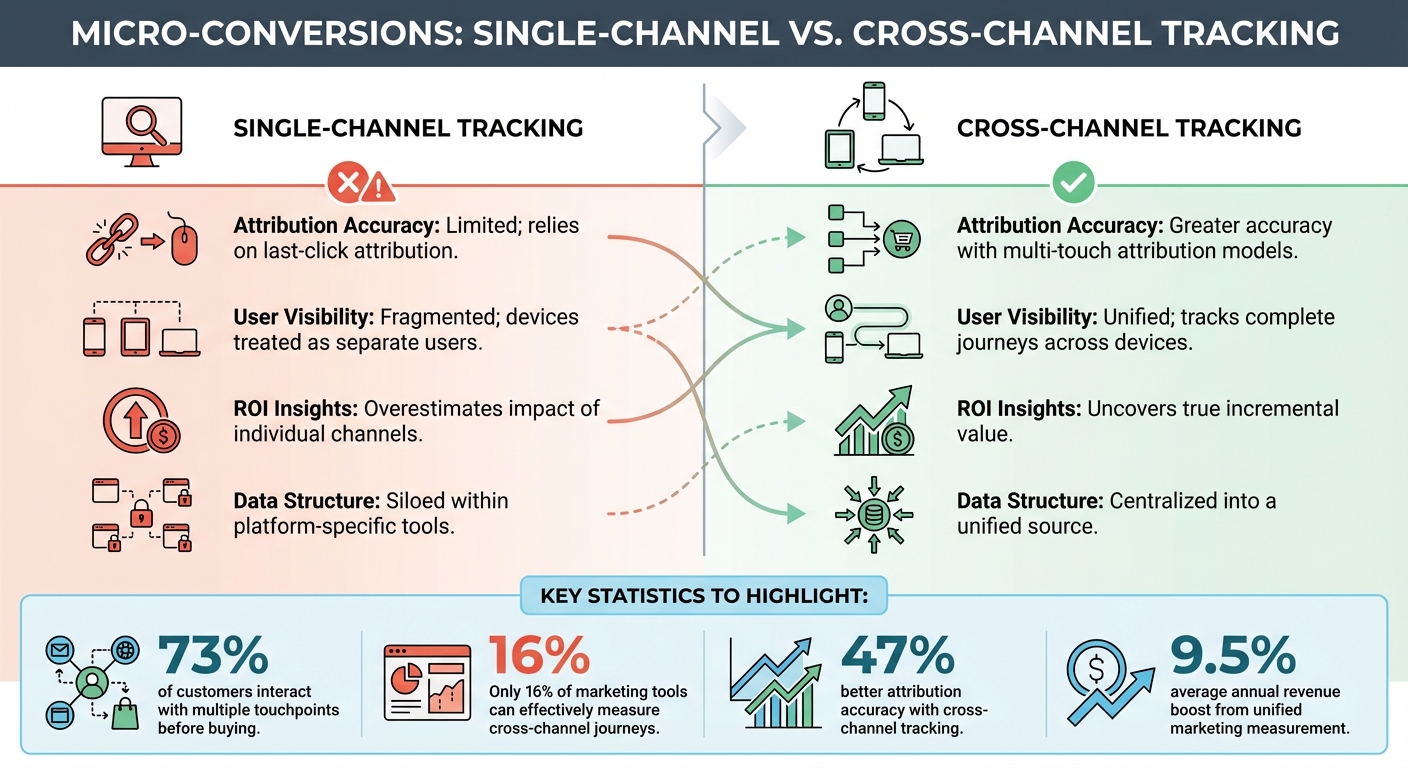
Single-Channel vs Cross-Channel Tracking Comparison
Cross-Channel vs Single-Channel Tracking
When it comes to tracking micro-conversions, understanding the difference between single-channel and cross-channel tracking highlights why adopting a unified approach is so impactful.
Single-channel tracking treats each platform – like email campaigns, social media ads, or search traffic – as an isolated event. It often relies on last-click attribution, giving credit only to the final touchpoint before a conversion happens.
Cross-channel tracking, on the other hand, connects the dots across platforms and devices. It paints a complete picture of how users move from initial research on one channel to making a purchase on another. Considering that nearly 75% of customers interact with multiple touchpoints before converting, but only 16% of marketing tools can effectively measure this journey, the need for cross-channel tracking becomes clear.
Here’s a quick comparison of single-channel versus cross-channel tracking:
| Feature | Single-Channel Tracking | Cross-Channel Tracking |
|---|---|---|
| Attribution Accuracy | Limited; relies on last-click | Greater accuracy with multi-touch models |
| User Visibility | Fragmented; devices treated as separate users | Unified; tracks journeys across devices |
| ROI Insights | Overestimates the impact of individual channels | Uncovers true incremental value |
| Data Structure | Siloed within platform-specific tools | Centralized into a unified source |
This comparison shows why cross-channel tracking is essential for gaining actionable insights and making smarter marketing decisions. Now, let’s explore how these insights translate into measurable improvements.
How Cross-Channel Tracking Improves Marketing Results
Cross-channel tracking doesn’t just provide better data – it drives real business results. Companies leveraging unified marketing measurement report an average annual revenue boost of 9.5%. And businesses that personalize customer experiences using cross-channel data see 40% higher revenue.
By understanding how channels work together, marketers can create strategies that amplify conversions. For example, H&R Block’s March-July 2025 campaign used Amazon Marketing Cloud to track interactions across Prime Video, Twitch, and display ads. Their findings? Adding online video to display ads increased conversions by 47%, and their full-funnel approach led to a 144% higher conversion rate compared to display-only campaigns.
"Multi-channel attribution, unlike single-channel or platform-specific analytics, provides a holistic view of your customer’s journey, tracing the path across multiple touchpoints and platforms before a conversion occurs." – adQuadrant
Cross-channel tracking also reveals indirect influencers – those early-stage touchpoints, like brand awareness ads or event attendance, that don’t result in immediate sales but play a critical role in later micro-conversions. In the B2B space, for instance, customers encounter an average of 36 touchpoints before converting. Without cross-channel visibility, many of these interactions would go unnoticed.
The financial benefits are undeniable. Take Rappi, a Latin American delivery service, as an example. They used real-time cross-channel audience syncing to create behavioral cohorts based on initial micro-conversions. By tailoring their messaging across push notifications, emails, and in-app channels, they reduced customer acquisition costs by 30%.
In addition to cost savings, cross-channel tracking ensures consistent branding and messaging, which can boost revenue by up to 23%. Customers who see cohesive branding across multiple platforms are 3.5 times more likely to make a purchase. Even better, when messaging adapts based on previous interactions, average order values increase by 13%.
Which Micro-Conversions to Track Across Channels
Common Micro-Conversion Examples
Micro-conversions generally fall into three categories: web actions, engagement signals, and channel-specific interactions. For web-based actions, think of activities like viewing product pages, adding items to a shopping cart, or starting the checkout process. These behaviors often signal an intent to purchase and can highlight where users drop off along the way.
Engagement signals, on the other hand, reflect early interest in your brand. Actions like signing up for newsletters, downloading whitepapers, or following your social media accounts show that someone is beginning to connect with your business. For mobile apps, deep link clicks can speed up first in-app actions by 2.8×.
Channel-specific interactions vary depending on the platform. These could include email opens and click-throughs, interactions with push notifications, QR code scans from print materials, or phone calls generated by paid search campaigns. For example, Windstream‘s Kinetic division used call tracking to refine their paid search keywords, cutting their Cost Per Acquisition by 17%. Similarly, Ixigo saw impressive results from targeted email tests, achieving a 54% increase in open rates and a 3.5% boost in click-through rates.
By identifying these micro-conversions, you can tie them back to your business objectives and create a more effective tracking strategy.
Matching Micro-Conversions to Business Goals
To get the most out of micro-conversion tracking, focus on those that align closely with your primary business outcomes. Start by pinpointing 3–5 micro-conversions that strongly connect to your macro-conversions, whether that’s a purchase, a demo request, or a subscription renewal.
"Micro-conversions are like the gas for your car… if you want to maximize your car’s performance – or make sure your customers actually convert – you have to pay attention to what gets them there in the first place." – Mike Belasco, Founder, Inflow
Take a data-driven approach to prioritization: "Given [data], changing [action] will [affect metric]". For instance, if users who watch a product video are three times more likely to make a purchase, then video views become a key micro-conversion to monitor and optimize.
Here’s a real-world example: PayU found that requiring both an email and phone number during checkout created unnecessary friction, leading to drop-offs. By switching to phone-only verification, they achieved a 6% increase in checkout success. This highlights how tracking and addressing micro-conversions can help pinpoint and eliminate obstacles in your funnel.
Device segmentation also plays a big role. While 83% of landing page visits happen on mobile, desktop still converts 8% better. Tracking micro-conversions by device can help uncover platform-specific challenges. For instance, email traffic converts at an average of 19.3%, outperforming both paid social (12%) and paid search (10.9%). If lead nurturing is your focus, prioritizing email engagement micro-conversions could yield better results.
sbb-itb-2ec70df
How to Set Up Cross-Channel Tracking
Configuring Google Analytics 4 for Cross-Channel Tracking
Google Analytics 4 (GA4) captures every user interaction as an event – whether it’s a click, scroll, form submission, or download – making it a powerful tool for tracking user behavior across devices and platforms. By default, GA4 automatically tracks over 30 events, such as first_visit, scroll, click, and file_download.
When setting up cross-channel tracking, GA4 follows a hierarchy: Event → Key Event → Conversion. To get started, go to Admin > Data Display > Events, and mark important interactions as "Key Events". For instance, if capturing newsletter signups is critical, mark that event as a key interaction so GA4 can recognize it as a conversion.
To ensure proper attribution, adjust your settings to give credit to both Google and non-Google channels. Under Attribution Settings, choose "Paid and organic channels" under "Channels that can receive credit". As Google Help explains:
"Choosing the Google paid channels attribution setting lets you see conversions from Google Ads… If you choose Paid and organic channels, you can report on conversions from both paid and organic sources".
In addition, use UTM parameters to track non-Google sources like Facebook ads, LinkedIn posts, or email campaigns. Properly tagging URLs is crucial for accurate reporting.
Extend your historical data retention settings for better year-over-year comparisons. By default, GA4 keeps data for only two months, but you can increase this to 14 months under Admin > Data Settings > Data Retention.
Other important steps include enabling Google Signals for cross-device tracking, linking your Google Ads account to import key events as conversions, and excluding internal traffic by filtering your office IP addresses under "Configure tag settings". Before launching, use GA4 DebugView or GTM Preview mode to ensure your custom events are firing correctly. Once these steps are complete, you can enhance your setup by integrating additional tools.
Adding Other Tracking Tools
While GA4 provides a solid foundation, other tools can expand your cross-channel tracking capabilities. One such tool is Google Tag Manager (GTM), which simplifies the process of managing event tags without needing to edit website code constantly – saving significant development time.
For businesses with mobile apps, deep linking ensures users are directed to the right content, maintaining seamless tracking. Deep linking has been shown to improve conversion rates by up to 40%, with campaigns using deferred deep links seeing a 37% increase in user retention after 30 days. Tools like PIMMS even offer unlimited smart links for a one-time fee of $59.
Customer Data Platforms (CDPs), such as Segment, help unify data from multiple touchpoints – web, mobile, and offline. They map an anonymousId to a userId when users log in, creating a complete view of the customer journey and enabling detailed tracking of micro-conversions across channels. If a full CDP isn’t in your budget, tools like Zapier can sync conversion data between marketing platforms and CRMs without requiring a dedicated tech team.
Integrated data tracking can lead to measurable business benefits. For instance, unified marketing strategies often result in a 9.5% annual revenue increase, while personalized campaigns based on unified data can boost revenue by 40%. However, many marketers (34.2%) admit they rarely or never measure ROI on their marketing spend, partly because fragmented manual tracking can cost between $4,000 and $7,500 annually.
For offline-to-online tracking, dynamic QR codes on packaging or print materials allow you to update URLs and monitor performance without reprinting. To avoid errors like inconsistent capitalization (e.g., "Facebook" vs. "facebook"), use a campaign URL builder and maintain a shared spreadsheet of tagged URLs. As Ginny Mineo from HubSpot highlights:
"UTM codes help you track where traffic is coming from, allowing you to properly measure each campaign’s, platform’s, or medium’s ROI".
| Tracking Method | Best Use Case | Data Accuracy | Setup Complexity |
|---|---|---|---|
| UTM Parameters | Digital campaigns (web, email, ads) | High | Low |
| QR Codes | Offline-to-online (print, packaging) | High | Medium |
| Deep Linking | Mobile app engagement | Very High | Medium |
Lastly, consider linking GA4 to BigQuery. BigQuery provides 10 GB of free storage for GA4 data streaming, enabling you to store raw data beyond the 14-month retention limit. This is particularly valuable for granular conversion testing and long-term analysis.
Using Micro-Conversion Data to Optimize Campaigns
How to Analyze Micro-Conversion Data
Once you’ve gathered cross-channel micro-conversion data, the real challenge is turning it into actionable insights. Start by diving into conversion path reports in GA4. These reports map out the sequence of touchpoints users go through before converting, helping you identify where they drop off. For example, you might notice users leaving after viewing a pricing page, abandoning a form midway, or clicking through an email but not engaging further.
It’s also crucial to spot discrepancies between platforms. If your email platform reports 500 conversions but GA4 only shows 450, you’ve uncovered a tracking issue that could lead to flawed decisions. Gareth Westhead, Head of Paid Media at Clickoo, emphasizes the importance of regular checks:
"Sometimes conversion tracking can get removed, dropped, or just not fire at the right time. So it needs to be checked on a regular basis – it’s never ‘set and forget’".
Channels that seem weak on a last-click basis might still play a key role in assisted conversions. GA4’s Model Comparison tool can help you uncover this. For instance, platforms like LinkedIn or email may not close the deal directly but often drive important micro-conversions – like downloading a whitepaper or signing up for a newsletter – that eventually lead to sales. Surprisingly, only 15% of companies have achieved a unified view of customers across all channels, even though 88% see it as crucial.
Technical issues can also lurk in your micro-conversion data. Broken deep links, for example, can waste up to 15% of ad spend and reduce customer lifetime value by 10–15%. Regularly monitoring your data ensures these issues are caught before they cause significant damage.
Behavioral cohort analysis takes things a step further by segmenting users based on specific actions. For instance, you might identify a group of users who viewed your pricing page multiple times but didn’t start a trial. This level of detail can shine a light on friction points that broader data might miss. By pinpointing where high-intent users stall, you can address these pain points directly.
These insights lay the groundwork for refining your campaign strategies.
Campaign Optimization Strategies
With these insights in hand, you can make targeted improvements across your campaigns. A/B testing, for instance, becomes much more effective when it’s based on actual user behavior rather than guesswork. Travel platforms have seen success using behavioral analytics to test email subject lines and layouts, which led to noticeable boosts in engagement.
Coordinating efforts across channels can amplify results even further. A great example is TicketSwap, a European event ticketing platform. In 2025, they used behavioral analytics to pinpoint technical issues like ticket confirmation delays and authentication glitches, which were causing users to abandon purchases. By syncing these insights with their paid social and CRM systems, they launched a coordinated campaign that increased sales funnel completion by 15%.
Budget reallocation is another area where micro-conversion insights can uncover hidden opportunities. For example, an online retailer working with PIMMS discovered that 52% of conversions were being misattributed across Google Ads, Meta Pixel, and GA4. After implementing unified tracking, their attribution accuracy jumped to 91%, resulting in $178,000 in additional annual revenue. Similarly, Windstream’s Kinetic Division reduced its Cost Per Acquisition by 17% by using accurate call tracking to refine their paid search campaigns.
Common Problems in Cross-Channel Micro-Conversion Tracking
Solving Data Silos
Data silos happen when platforms operate independently, creating a fragmented view of your customer journey. For example, Facebook Ads, Google Analytics, and email tools often define conversions differently, producing reports that don’t align. This disconnect makes it hard to see the bigger picture.
The problem gets worse with identity fragmentation. When users switch devices, their visits might appear as separate sessions until they log in or provide an email address to unify them. Offline interactions – like phone calls, in-store purchases, or trade show meetings – add another layer of complexity, further separating your data streams.
"Data silos are the silent killer of attribution: when online orders live in one database and in‑store receipts in another, every report is missing half the story." – Shopify
To fix this, start by centralizing your data. Use a data warehouse like BigQuery or Snowflake to create a Single Source of Truth where all platforms contribute their data. This allows you to align timestamps, match user identifiers (like emails or device IDs), and remove duplicate events.
When a user logs in or shares their email, you can connect their previous anonymous sessions across devices into a single profile. To close offline gaps, try using QR codes with UTM parameters on print ads or product packaging. Additionally, server-side tracking shifts data collection from the browser to your server, bypassing ad blockers and addressing privacy restrictions that disrupt traditional tracking methods.
Once you’ve centralized your data, the next hurdle is ensuring accurate attribution across all your channels.
Preventing Attribution Errors
Attribution errors crop up when different platforms report conflicting numbers. For instance, one system might show 500 conversions while another only records 450. These inconsistencies are often caused by mismatched UTM parameters – small variations like "Facebook" versus "facebook" can split your data into separate streams.
Double counting is another common issue. When multiple platforms claim credit for the same conversion, your numbers get inflated. One retailer found that 52% of their conversions were misattributed across Google Ads, Meta Pixel, and GA4. After implementing unified tracking and deduplication, they boosted attribution accuracy from 52% to 91%, unlocking an extra $178,000 in annual revenue.
Technical problems, like broken deep links, can also wreak havoc. These errors waste ad spend and reduce customer lifetime value. On top of that, ad blockers and browser privacy features (like Safari’s Intelligent Tracking Prevention) can lead to significant data loss. Without regular monitoring, these gaps can lead to poor decision-making.
To address these issues, enforce strict UTM governance. Create a company-wide data dictionary to standardize naming conventions for all campaign parameters. Use server-side tagging, such as Google Tag Manager Server, to capture data that client-side scripts might miss. Deep linking – like universal links for iOS or App Links for Android – can also help maintain tracking continuity between your website and mobile app, potentially increasing conversion rates by up to 40%.
Lastly, make auditing a regular habit. Use validation scripts to catch errors early, and compare metrics across platforms monthly to spot discrepancies before they snowball. These steps have been shown to improve cross-channel attribution accuracy by 47% and cut customer acquisition costs by 34%.
Conclusion
A surprising reality: only 15% of businesses have managed to maintain a consistent view of their customers across platforms. This gap presents a huge opportunity for improvement. Companies that adopt unified tracking report a 47% boost in attribution accuracy and a 34% drop in customer acquisition costs. For instance, Rappi cut their CAC by 30% by aligning behavioral segments across push notifications, email, and in-app messaging. Similarly, Jersey Mike’s saw their online ordering volume more than double by implementing coordinated cross-channel messaging.
Beyond these numbers, experts emphasize that the ultimate goal isn’t flawless tracking but smarter decision-making:
"The goal isn’t perfect tracking – it’s better decisions. Focus on the insights that change how you allocate budget, design campaigns, and create customer experiences." – Tom Wilkinson, Author
So, where do you start? Pick one channel to integrate right away. It could be as simple as standardizing your UTM naming conventions or adding QR codes to your next print campaign. By weaving cross-channel micro-conversion tracking into your current strategy, you create a clearer picture of your customer’s journey. Each micro-conversion highlights a step, helping you allocate your budget more effectively.
At the end of the day, success comes from insights, not just spending. With the strategies outlined here, you’re equipped to achieve measurable marketing results.
FAQs
What are the advantages of tracking micro-conversions across multiple channels?
Tracking micro-conversions across various channels offers a complete picture of the customer journey. It helps you see how users engage with your brand at different stages, improving the accuracy of attribution. This ensures that the right touchpoints get the credit they deserve and pinpoints traffic sources that truly deliver value.
When you understand what sparks engagement, you can fine-tune your campaigns, potentially increasing overall conversion rates by about 16.5%. Plus, it helps you get more out of your budget by cutting down on wasted ad spend. This approach relies on data to guide smarter decisions and make better use of your resources.
What’s the best way to set up cross-channel micro-conversion tracking for your business?
To set up effective cross-channel micro-conversion tracking, start by pinpointing the key actions that indicate customer intent. These might include newsletter sign-ups, product comparisons, or adding items to a wishlist. These small steps offer valuable insights into your customer journey and can guide smarter marketing strategies.
Next, ensure your tracking is consistent across all channels. Tag URLs with UTM parameters to monitor online campaigns, and use QR codes to bridge the gap for offline efforts. Tools like Google Tag Manager make it easier to track events such as button clicks or form submissions, which can then be linked to analytics platforms like Google Analytics 4. For a more comprehensive view, integrate this data into your CRM or data warehouse to centralize customer behavior insights.
Finally, dive into the data using attribution models to identify which micro-conversions have the most impact. Keep refining your campaigns by analyzing performance metrics like conversion rate (CVR) or return on ad spend (ROAS). A well-structured approach not only reveals actionable insights but also helps drive smarter decisions and business growth.
What are the common challenges with cross-channel micro-conversion tracking, and how can they be solved?
Tracking micro-conversions across multiple channels can be a complex puzzle. Why? Because consumer journeys are rarely straightforward. They often involve hopping between devices and platforms – think display ads, newsletters, and more. This makes it tough to piece together a clear picture of each user’s path. On top of that, data often gets scattered across tools like ad platforms, analytics software, and CRMs, creating mismatched metrics and leaving gaps in attribution. And let’s not forget the challenges posed by evolving privacy regulations, which can restrict tracking across devices.
So, how do you tackle these hurdles? Start by standardizing your tracking efforts. Use UTM parameters for online campaigns and tools like QR codes or deep-link URLs for offline ones. Next, pull all your data into a centralized platform – a customer data platform, for instance – to break down those silos and enable accurate multi-touch attribution. Lastly, prioritize privacy by implementing measures like consent banners, server-side tagging, and anonymized identifiers. These steps help you stay compliant while still gathering valuable insights.
This is where Growth-onomics can step in. They specialize in helping businesses turn scattered data into actionable insights, paving the way for smarter growth strategies.