


Churn segmentation helps subscription businesses understand why customers cancel and develop targeted strategies to retain them. Instead of treating all churned users the same, businesses can group subscribers by behaviors, subscription tiers, or sign-up cohorts. This approach allows you to identify patterns, address issues (like failed payments or dissatisfaction), and focus retention efforts where they matter most.
Key takeaways include:
- Churn types matter: Voluntary churn (e.g., dissatisfaction) vs. involuntary churn (e.g., payment failures) require different solutions.
- Segmentation methods: Analyze by behavior (e.g., feature usage), cohorts (e.g., sign-up dates), or tiers (e.g., pricing plans).
- Tactics that work: Use personalized cancel flows, proactive engagement, and flexible subscription options to reduce churn.
Businesses that apply segmentation can reduce churn by 10–20% and improve revenue retention significantly. Whether it’s spotting early warning signs like reduced logins or tailoring incentives for high-value users, segmentation helps you focus on what drives growth.
STOP treating every customer the same. TRY customer segmentation
sbb-itb-2ec70df
Why Churn Segmentation Matters for Subscription Businesses
Lumping all churned customers into one group might seem simple, but it hides the real reasons behind their decisions to leave. For instance, a customer who cancels due to financial constraints has entirely different needs compared to someone who quits because they couldn’t figure out how to navigate your product. Churn segmentation helps uncover these patterns, giving you the tools to identify at-risk subscribers before they cancel and tailor solutions to their specific concerns. These insights not only shape your retention strategies but also have a direct impact on your revenue.
The financial stakes become even clearer when you distinguish between voluntary churn – where customers leave due to dissatisfaction or pricing issues – and involuntary churn, which is often caused by things like failed payments or expired credit cards. Each scenario demands a unique approach: improving your product or pricing for voluntary churn and using dunning management to address involuntary churn. By keeping an eye on warning signs like fewer logins, reduced feature usage, or an uptick in support tickets, you can step in before cancellations happen. This level of differentiation is key to driving profitable growth.
How Churn Affects Revenue and Growth
Churn doesn’t just shrink your customer base – it creates a ripple effect on revenue, forcing you to constantly chase new customers just to maintain the status quo. Michael Redbord, former General Manager of Service Hub at HubSpot, puts it like this: "In a subscription-based business, even a small rate of monthly/quarterly churn will compound quickly over time." That compounding effect can turn minor losses into major problems.
The numbers tell a grim story. For example, paid video streaming services in the US have maintained a 37% churn rate since 2020. Telecommunications companies saw a 20% churn rate in the same year, while SaaS businesses typically report annual churn rates ranging from 32% to 50%. Considering how much more expensive it is to acquire a new customer than to retain an existing one, high churn forces businesses to pour resources into customer acquisition just to stay afloat – let alone grow.
Benefits of Targeted Retention Strategies
Churn segmentation allows for laser-focused retention efforts. Instead of blanketing all customers with the same discount or incentive, you can use uplift modeling to target "persuadables" – those who will only stay if offered an incentive. This avoids wasting resources on "sure things" who would stay anyway or "lost causes" who are unlikely to return no matter what.
The results speak for themselves. Tailored cancellation experiences can reduce churn by 10%-20%. Advanced billing recovery solutions often deliver a return on investment (ROI) of 10x or more for businesses generating over $200,000 in monthly recurring revenue. In B2B SaaS, targeted recovery strategies can achieve payment recovery rates exceeding 90%, compared to the 40%-60% range seen in less-focused eCommerce subscription efforts. By extending customer lifetimes and boosting lifetime value, segmentation doesn’t just stop revenue losses – it lays the groundwork for long-term growth.
Key Churn Segmentation Methods
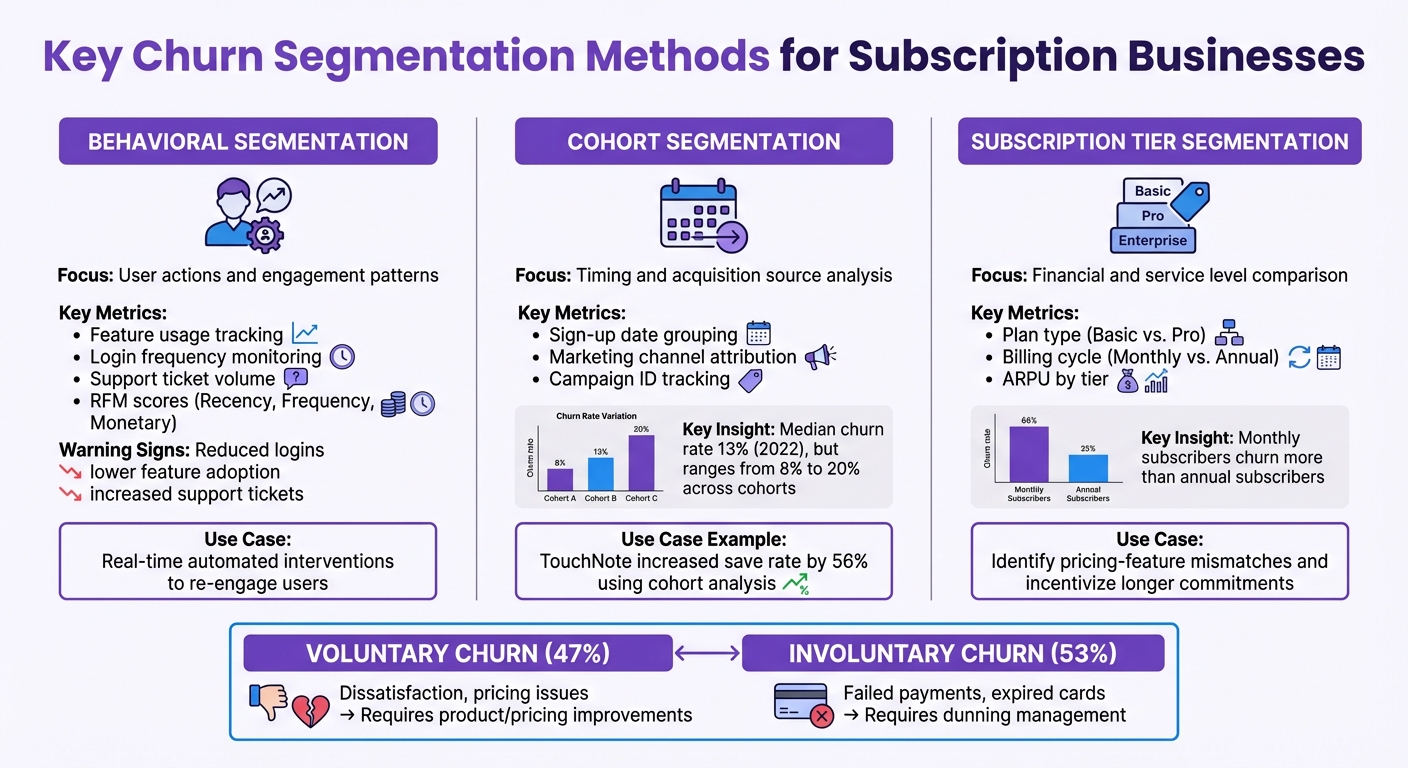
Churn Segmentation Methods Comparison: Behavioral, Cohort, and Tier Analysis
To understand and tackle subscriber churn, it’s essential to break it down into three key approaches: behavioral, cohort, and subscription tier segmentation. Each method sheds light on different aspects of customer behavior and helps uncover patterns that can inform retention strategies.
- Behavioral segmentation focuses on what users do (or don’t do) within your product. For example, a drop in login frequency or less interaction with key features could signal disengagement.
- Cohort segmentation groups subscribers based on when they joined or how they were acquired, making it easier to spot trends in churn over time or by acquisition channel.
- Subscription tier segmentation examines churn rates across different pricing plans, helping identify tiers that might be more prone to cancellations.
By combining these approaches, businesses can pinpoint where and why churn happens. For instance, behavioral signals might highlight early signs of dissatisfaction, while cohort analysis could reveal specific phases in the customer journey that need attention. Meanwhile, tier segmentation can shed light on whether pricing or feature offerings are driving cancellations.
It’s also important to distinguish between voluntary churn (caused by dissatisfaction) and involuntary churn (due to technical issues like failed payments). Each type requires a unique strategy.
Behavioral Segmentation
Behavioral segmentation zeroes in on specific user actions – or lack thereof – that often predict churn. Metrics like reduced login frequency, lower feature adoption, or an uptick in support tickets are key warning signs. Businesses that monitor these in real-time can deploy automated interventions to re-engage users before they leave.
One effective tool for this is RFM analysis (Recency, Frequency, Monetary), which scores customers based on how recently and often they engage, as well as their revenue contribution. This data helps identify which users are at risk and when to offer upsells or retention efforts.
Cohort Segmentation
Cohort segmentation groups users by shared events, such as their sign-up date or acquisition source. This method helps uncover when subscribers are most likely to churn. For example, analyzing cohorts can reveal critical points in the customer lifecycle that may benefit from targeted retention efforts.
A great example is TouchNote, which faced a surge in cancellations. By analyzing churn across cohorts and testing incentives, they increased their save rate by 56% in just one year. Additionally, churn rates can vary significantly across cohorts. In 2022, the median churn rate for private SaaS businesses was 13%, but some cohorts experienced rates as low as 8% and others as high as 20% – showing how valuable this approach can be.
Subscription Tier Segmentation
Not all pricing plans are equally vulnerable to churn. By comparing rates across tiers – like basic, standard, and premium – businesses can identify which segments are at higher risk. For instance, if monthly subscribers cancel more often than annual ones, it may be time to incentivize longer-term commitments.
This type of segmentation also highlights potential mismatches between pricing and features. If a specific tier shows unexpectedly high churn, it might indicate that the features offered don’t meet customer expectations. This insight can guide adjustments to pricing structures or feature sets.
| Segmentation Method | Focus | Key Metrics |
|---|---|---|
| Behavioral | User actions and engagement | Feature usage, login frequency, support tickets, RFM scores |
| Cohort | Timing and acquisition source | Sign-up date, marketing channel, campaign ID |
| Subscription Tier | Financial and service level | Plan type (Basic vs. Pro), billing cycle (Monthly vs. Annual) |
Armed with these segmentation insights, businesses can take more targeted actions to reduce churn. The next section will explore practical steps to put these methods into action.
Steps to Perform Churn Segmentation
Churn segmentation takes raw subscriber data and turns it into actionable retention strategies through three main steps: data collection, pattern analysis, and result visualization. To ensure accurate insights, define churn consistently – like canceled accounts for subscriptions or 60-120 days of inactivity for e-commerce businesses – so your analysis isn’t skewed. This process sets the stage for implementing effective retention strategies.
Collecting and Organizing Subscriber Data
Start by gathering data across five key categories:
- Demographic and firmographic details: Includes age, gender, location, or company size.
- Subscription or transaction history: Tracks details like signup dates, plan tiers, contract lengths, and ARPU (average revenue per user).
- Behavioral metrics: Covers login frequency, session lengths, and feature engagement.
- Customer support feedback: Includes ticket frequency, Net Promoter Score (NPS), and cancellation survey responses.
- Operational data: Looks at factors like shipping reliability and payment failures.
It’s important to distinguish between voluntary churn (customers canceling due to dissatisfaction or pricing) and involuntary churn (caused by failed payments or expired cards). In fact, involuntary churn makes up about 53% of all subscriber losses. Since each type requires different strategies, track them separately from the beginning.
Before diving into analysis, clean your data. Remove test accounts, fix errors, and eliminate duplicates. Use RFM (Recency, Frequency, Monetary value) analysis to organize your data and identify high-value subscribers who may be at risk.
Analyzing Churn Metrics and Patterns
Cohort analysis is a great way to identify when churn tends to spike. Keep an eye on warning signs like declining logins, increased app uninstalls, or a rise in customer support tickets – these can signal potential cancellations.
Two key metrics to track are:
- Customer churn rate: The percentage of subscribers lost.
- Revenue churn: The amount of monthly recurring revenue (MRR) lost, divided by total MRR. This distinction is crucial because losing ten basic-tier subscribers isn’t the same as losing one enterprise customer.
"In a subscription-based business, even a small rate of monthly/quarterly churn will compound quickly over time. Just 1 percent monthly churn translates to almost 12 percent yearly churn." – Michael Redbord, former General Manager of Service Hub at HubSpot.
For example, in 2021, Bare Performance Nutrition (BPN) used churn-risk modeling to identify high-value customers who had stopped purchasing. By analyzing behavioral data and launching targeted retention campaigns, they generated about $900,000 in extra revenue and achieved a 12% re-purchase rate among previously churned customers.
Visualizing and Prioritizing High-Impact Segments
Turning churn data into visual insights helps you focus your retention efforts where they’ll make the most impact. Tools like retention curves, cohort tables, and Sankey charts make complex metrics easier to understand. Use a low-effort, high-effect framework to prioritize segments – start with customers who are both highly valuable and likely to stay if targeted.
Tie churn metrics to financial indicators like lost MRR, Customer Lifetime Value (LTV), and acquisition costs to understand the economic impact of each segment.
| Metric | What It Reveals | Why It Matters |
|---|---|---|
| Cohort Churn Rate | Identifies which signup groups churn the most | Helps pinpoint vulnerable acquisition periods or channels |
| MRR Churn | Shows revenue lost from cancellations | Focuses on financial impact over subscriber count |
| Time to Churn | Tracks the average time before cancellations | Guides the timing of proactive retention efforts |
| RFM Score | Categorizes users by recency, frequency, and monetary value | Segments users into groups like "Champions" or "At Risk" |
With clear priorities in place, you can move forward with targeted retention strategies that address the specific needs of each segment and reduce churn effectively.
Churn Segmentation Strategies for Retention
Using segmentation insights, you can deploy targeted strategies to retain subscribers, focusing on the areas where your efforts will make the biggest difference. Whether it’s re-engaging inactive users, addressing payment issues, or strengthening ties with high-value customers, a focused approach can drive meaningful results.
Behavior-Driven Retention Tactics
Behavior-driven strategies hinge on identifying and amplifying actions that foster long-term loyalty. Take Calm, the meditation app, for example. They discovered that users engaging with their "reminders" feature had retention rates three times higher. As a result, they made this feature a key part of their onboarding process. Similarly, the banking app Dave saw a 5.7% boost in retention by encouraging users to record recurring expenses during onboarding.
Another proven strategy is personalizing cancel flows. Instead of offering a simple "cancel" button, you can introduce a feedback-driven process that includes discounts or feature walkthroughs. This approach has been shown to save 10–20% of users who initially intended to leave. Additionally, automated alerts for behaviors like a 30-day lapse in logins or a sudden drop in activity can trigger timely re-engagement emails, potentially preventing cancellations.
When targeting retention efforts, focus on "persuadables" – users who are likely to stay with the right incentive. At the same time, be cautious about contacting "sleeping dogs", as this might unintentionally prompt them to cancel. Tailor your interventions to specific customer cohorts for even better results.
Cohort-Specific Interventions
Different customer groups require different approaches. For new users, reducing the Time to Value (TTV) is critical. Guided walkthroughs that encourage early engagement can make a big difference. NBC, for instance, doubled its Day 7 retention rates by using funnel analysis and A/B testing to redesign its homepage based on user interests.
For users nearing known drop-off points, proactive check-ins can help. Sending reminders or offering incentives 1–2 months before typical retention dips can re-engage these users. History Hit, a subscription video service, learned this the hard way. A Black Friday promotion brought in customers at half the target acquisition cost, but their lifetime value was 36% lower, and cancellations spiked from 6% to 9% within weeks. This highlights the importance of monitoring cohort quality alongside acquisition costs.
"Honeymooners" – monthly subscribers who have renewed two or three times – are prime candidates for annual plan upgrades. Converting these users to annual plans can increase their lifetime value by 2.3×. For dormant cohorts, timely messages that create a sense of urgency – like reminders about expiring credits or notifications about popular classes – can prompt immediate action.
Tier-Specific Incentives
Adding tier-specific strategies to your retention playbook can further enhance results. High-value subscribers deserve personalized attention. Offer perks like early access to features, exclusive invitations, or direct support. If these subscribers show signs of disengagement – such as reduced usage or multiple support tickets – consider reaching out personally instead of relying solely on automated emails.
For freemium users, encourage upgrades with subtle usage limits and short premium trials. For instance, restrict access to high-value features like data exporting while offering brief, limited access to premium features. This gives users a taste of the benefits without requiring a full trial commitment.
Ahrefs faced a challenge with "serial trialists" and addressed it by switching from a 14-day free trial to a 7-day trial for $7. While this reduced the number of trials, it significantly increased the conversion rate from trial to paid subscribers and eased resource constraints.
Finally, offer flexible options for at-risk subscribers. Features like subscription pauses, skipped billing cycles, or temporary downgrades can keep users from canceling outright. Sometimes, customers just need a break.
| Segment Type | Risk Signal | Recommended Intervention |
|---|---|---|
| High-Value | Reduced usage; 2+ support tickets | Personal outreach, exclusive features, loyalty credits |
| New Cohort | Stalled onboarding; high TTV | Guided walkthroughs and timely support |
| Freemium | High engagement but no upgrade | Usage limits and short premium trials |
| At-Risk | Visiting cancellation page | Options like subscription pauses, downgrades, or discounts |
Conclusion
Churn segmentation has reshaped how subscription businesses approach customer retention by offering a more targeted and effective strategy. Instead of treating all cancellations as equal, it allows you to pinpoint who is leaving, why they’re leaving, and how to address it. This tailored approach not only helps maintain revenue but also leads to noticeable cost efficiencies.
The financial advantages of focusing on churn segmentation are undeniable. Research shows that keeping an existing customer is 5–7 times cheaper than acquiring a new one, and even small increases in churn can significantly impact long-term revenue. For example, companies like Bare Performance Nutrition have shown how churn-risk modeling can generate meaningful revenue growth through focused retention efforts.
To get started, focus on gathering the right data, identifying trends within behavioral cohorts and subscription tiers, and implementing strategies tailored to each segment. Whether you’re addressing payment failures with smarter dunning processes, re-engaging inactive users through personalized campaigns, or offering flexible pause options for at-risk subscribers, segmentation provides a clear roadmap to protect your recurring revenue. By following the data collection and analysis methods discussed earlier, you can transform your retention strategy into a proactive and profitable system.
The subscription economy continues to grow, with the average consumer expected to spend about $133 per month on subscriptions by 2025. Your ability to hold onto those subscribers using smart segmentation techniques could be the deciding factor between your business thriving or facing challenges. Use these data-driven insights to strengthen and expand your recurring revenue in this fast-changing landscape.
FAQs
How does churn segmentation help reduce payment-related churn?
Churn segmentation helps pinpoint subscribers more likely to experience failed payments. With this insight, you can implement strategies such as automated payment retries, providing different payment options, and sending reminders at the right time to encourage successful payments. These actions play a key role in lowering payment failures and cutting down on involuntary churn.
What are the key behavioral signs that indicate a subscriber might churn?
Subscribers often leave behind behavioral breadcrumbs that hint at their risk of churning. One of the clearest red flags? A drop in usage or engagement. This could look like fewer logins, spending less time on key features, or a noticeable dip in transactions. Keeping an eye on these trends in real-time can help you catch potential issues before they snowball.
Other telltale signs might include hesitation to adopt new features, less interaction with your content, or even a spike in support tickets. Churn usually doesn’t happen overnight – it’s often the result of several small shifts adding up over time. That’s why it’s crucial to monitor these subtle changes across all customer touchpoints. Pairing this data with customer feedback and insights from off-boarding processes can sharpen your ability to predict and address churn before it’s too late.
How does cohort analysis help identify subscription churn trends?
Cohort analysis is all about grouping subscribers who share certain traits – like their sign-up date – and monitoring how their behavior changes over time. This method reveals trends in retention and churn, offering a clearer picture of when and why specific groups of customers might choose to cancel their subscriptions.
Armed with this information, businesses can refine their retention strategies, anticipate churn with greater accuracy, and tackle the unique challenges faced by different customer segments.