


AI-powered lifetime value (LTV) prediction helps businesses identify which customers will generate the most revenue over time. Unlike older methods that rely on averages, AI uses machine learning to analyze thousands of data points – like browsing habits, purchase frequency, and email engagement – offering precise, individual-level predictions. This approach enables smarter marketing spend, better retention strategies, and improved customer targeting.
Key Takeaways:
- What it is: AI LTV prediction estimates the total revenue a customer will generate, using advanced models like deep learning and decision trees.
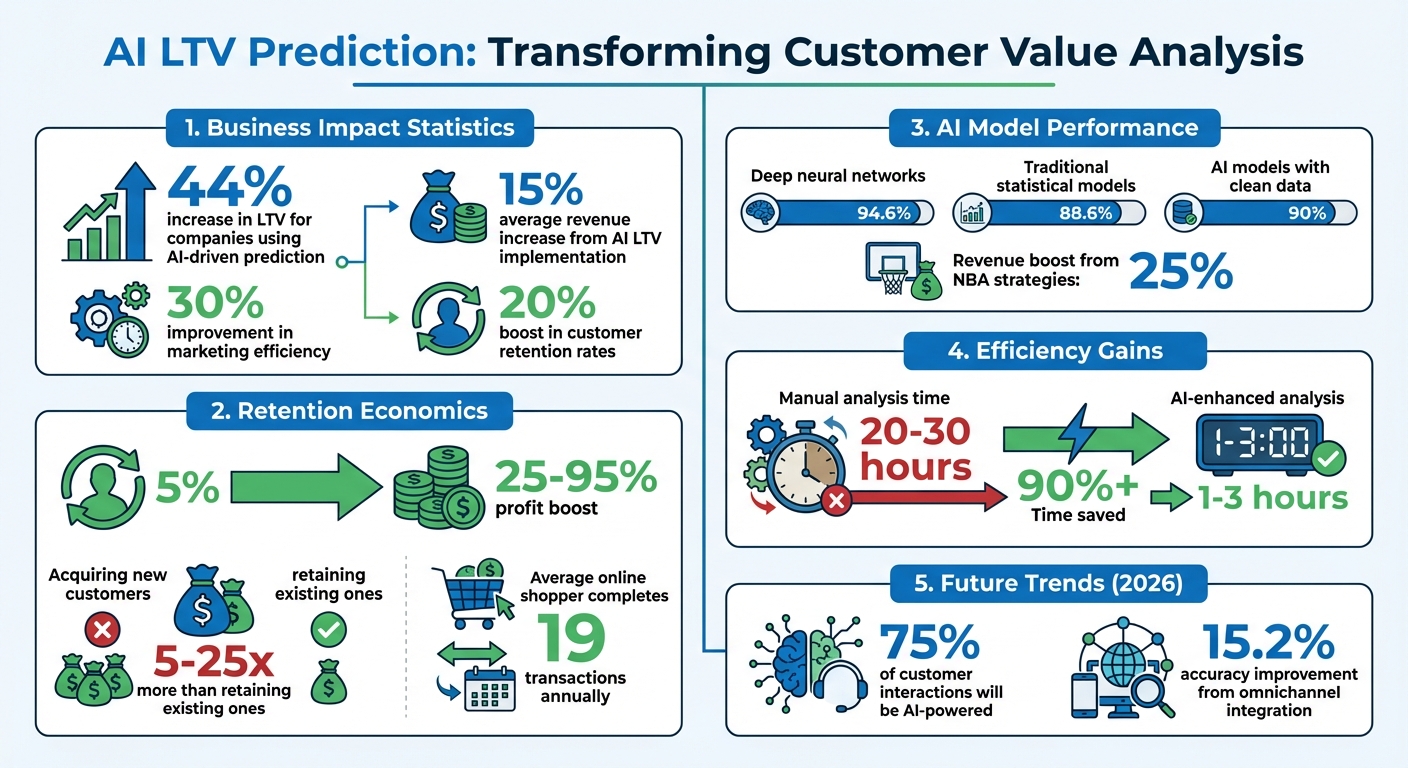
- Why it matters: Companies using AI-driven LTV have seen a 44% increase in LTV and 30% better marketing efficiency.
- Key benefits:
- Personalize marketing campaigns based on customer value.
- Predict churn and retain high-value customers.
- Optimize ad spend with value-based bidding.
- How it works: Combines customer data like RFM (Recency, Frequency, Monetary value) with behavioral signals to create real-time, accurate forecasts.
AI LTV prediction is transforming how businesses allocate resources, retain customers, and drive growth. Whether you’re in e-commerce or another industry, leveraging these insights can directly impact revenue and profitability.
AI LTV Prediction: Key Statistics and Business Impact
How AI Is Transforming Customer Engagement & Lifetime Value | Signifyd | FLOW Summit 2025
Key Metrics and Concepts in AI LTV Prediction
To get AI-powered lifetime value (LTV) predictions right, you need to start with the core metrics that drive these models. Unlike traditional methods that often rely on simple averages, AI leverages a broader and more detailed set of data points to deliver precise, individual-level predictions. Let’s break down the key metrics behind AI-driven LTV prediction.
Customer Lifetime Value (CLTV)
Customer Lifetime Value (CLTV) measures the total revenue a customer is expected to generate throughout their relationship with your business. It’s a forward-looking tool that helps businesses make smarter decisions about resource allocation and customer acquisition. By forecasting future behavior, CLTV provides clarity on how much you can invest in acquiring new customers while staying profitable.
The formula combines several components: average purchase value, purchase frequency, customer lifespan, and acquisition costs. For example, if a customer spends $50 per transaction, makes four purchases per year, and stays with your business for three years, their gross lifetime value would be $600. Subtract the customer acquisition cost (CAC) to calculate the net CLTV. This metric is invaluable for targeting high-value customer segments, allowing businesses to tailor marketing strategies accordingly. Considering that the average online shopper completes 19 transactions annually, CLTV becomes even more critical for planning.
RFM Analysis: The Foundation of Prediction Models
RFM analysis – short for Recency, Frequency, and Monetary value – is the backbone of most AI LTV prediction models. These three metrics distill raw transaction data into actionable insights that machine learning algorithms can process.
- Recency tracks the time between a customer’s first and most recent transaction, offering clues about their current activity or likelihood of churn.
- Frequency measures how often a customer makes repeat purchases, revealing engagement levels and buying habits.
- Monetary value calculates the average transaction amount, which is essential for projecting future revenue.
Models like BG/NBD use RFM data to predict future transactions and whether a customer will remain active. The Gamma-Gamma model then estimates the monetary value of those future transactions. Together, these approaches create forecasts that are far more nuanced than simple historical averages.
To adapt to changing consumer behavior, RFM analysis is evolving into RFM-D, where "Diversity" captures the variety of products a customer buys. This added dimension helps track more complex retail patterns. The RFM model also reflects the 80/20 rule: roughly 80% of business revenue often comes from the top 20% of high-value customers.
Adding Churn Risk to LTV Predictions
Revenue metrics alone don’t tell the whole story. Factoring in churn risk is crucial to avoid overestimating customer value. Churn risk analysis measures the "probability of survival", or how long a customer is likely to stay active. Without this, models may incorrectly assume indefinite customer relationships, leading to inflated LTV estimates.
The math is straightforward: customer lifespan equals 1 divided by the churn rate. For instance, a monthly churn rate of 5% translates to an average customer lifespan of 20 months.
Telmo Silva, Founder and CEO of ClicData, emphasizes this point:
"CLV is not just about predicting revenue; it’s also about understanding retention. Many CLV models overlook churn predictions, which can lead to an overestimation of customer value".
The stakes are high. A 5% increase in customer retention can boost profits by 25% to 95%. AI-powered churn analysis goes beyond historical trends to track real-time behavioral signals – such as reduced engagement with emails or shifts in purchasing habits. This allows models to adjust LTV predictions dynamically. For example, in e-commerce, customers with no repeat purchases are often categorized as "already churned" to prevent skewed projections.
Building and Deploying AI LTV Prediction Models
Creating an AI-driven LTV prediction model involves careful data management and thoughtful model selection. Start by collecting transactional, demographic, and behavioral data, ensuring you have at least 1,000 active profiles and 18–24 months of historical data for reliable predictions .
Data Collection and Preparation
Accurate predictions begin with clean data. Use efficient ETL pipelines to remove duplicates, negatives, and null values . Handle missing information with techniques like mean or median substitution, and identify outliers using Z-score or IQR methods to avoid skewing results. Normalize data with log transformation so features operate on a similar scale. As Telmo Silva from ClicData explains:
"A model is only as good as the data it’s trained on. Regular updates maintain relevance".
Once the data is cleaned, transform it into key features through feature engineering. For instance, create an RFM summary table and include a "T" metric to represent customer age since their first purchase. You can also derive metrics like "TotalSales" by multiplying quantity and unit price for each transaction . This structured approach helps your model identify meaningful patterns.
It’s crucial to ensure your dataset meets quality standards. Fields with missing values should not exceed 20%, and historical data should provide enough depth for accurate forecasting. For a 12-month LTV prediction, 18–24 months of historical data is ideal. Consolidate data from various sources into a unified, quality-checked dataset before training.
Selecting the Right Model Type
The choice of model depends on your data’s size and complexity. Probabilistic models like BG/NBD and Gamma-Gamma are effective for simpler, repeat purchase patterns and smaller datasets. For larger datasets with more varied and non-linear patterns, machine learning models such as Random Forest or Gradient Boosting (XGBoost) provide better results. Deep neural networks, capable of achieving up to 94.6% accuracy compared to 88.6% for traditional statistical models, are ideal for handling complex customer journeys involving large data volumes.
Start with probabilistic models when data is limited. As your data grows, transition to advanced machine learning models . Split your dataset into training and testing sets, and validate the model using metrics like Mean Absolute Error (MAE) and Root Mean Squared Error (RMSE). Compare your model’s performance against a simple heuristic baseline – such as multiplying average purchase value by average lifespan – to ensure it delivers meaningful improvements. Set up automated alerts to monitor error spikes, signaling when retraining might be needed.
Once validated, integrate the model’s predictions into your marketing systems for immediate impact.
Connecting Predictions to Marketing Systems
Bring your model’s insights to life by integrating them into tools like CRMs and advertising platforms. Enrich CRM data through platforms such as Salesforce or HubSpot using reverse ETL or API connections. This allows sales teams to focus on high-value customers. For advertising, connect LTV predictions to Google Ads or Meta Ads via server-side APIs to enable value-based bidding strategies . Marketing automation platforms can use webhooks or APIs to trigger personalized email and SMS campaigns for high-value customer segments. As Bytek highlights:
"Predictive LTV can be sent to advertising platforms (such as Google Ads or Meta Ads) as a value-weighted conversion signal, enabling value-based bidding strategies".
This feedback loop helps ad networks optimize targeting for high-value users. Depending on your needs, you can choose between batch predictions for periodic updates or real-time APIs for instant personalization. To keep predictions accurate, set up automated retraining pipelines that run monthly or quarterly. This ensures your model adapts to changing customer behaviors and seasonal trends, preventing performance degradation .
Businesses that implement AI-powered LTV prediction often see an average revenue increase of 15% and a 20% boost in customer retention.
| Integration Type | Primary Use Case | Delivery Method |
|---|---|---|
| CRM Enrichment | Sales prioritization and personalized support | Reverse ETL / API |
| Ad Networks | Value-based bidding and ROAS optimization | Server-side API |
| Marketing Automation | Triggered email/SMS flows for high-value segments | Webhooks / API |
| Analytics/BI | Strategic planning and budget allocation | Data Warehouse / SQL |
sbb-itb-2ec70df
Applications of AI LTV Prediction for Business Growth
Once you’ve set up AI-driven Lifetime Value (LTV) models, the real magic begins. These predictions can reshape your marketing strategies, helping you allocate resources wisely and focus on what truly drives growth.
Targeting High-Value Customers
AI-powered LTV predictions let you pinpoint which customers are likely to bring in the most revenue over time. This insight allows you to move beyond a one-size-fits-all approach to Customer Acquisition Cost (CAC). Instead, you can allocate budgets based on individual predicted value. Think of it as "Value Optimization" – where platforms automatically identify and bid higher for potential customers who resemble your most profitable ones. As Eran Birger from Voyantis puts it:
"LTV modeling can help marketers optimize their marketing resources and achieve higher returns by signaling ad networks the highest LTV users, and by investing in each of its marketing assets according to its LTV".
A hands-on approach could involve manually analyzing your top 10 to 50 customers with the highest predicted LTV. Look at their shopping patterns – what they bought first, the channels they used, or even how long they spent browsing. These insights can shape broader targeting strategies. Of course, AI platforms take this further by analyzing thousands of data points, uncovering patterns that human analysts might overlook.
But it’s not just about finding high-value customers. LTV insights also pave the way for personalized marketing that builds stronger relationships.
Creating Personalized Marketing Campaigns
With LTV predictions, you can fine-tune offers, messaging, and timing to match each customer’s potential value. By segmenting customers based on their projected LTV, businesses can craft customized packages and pricing that align with the value each group receives. For example, if a customer is projected to have a high LTV but currently buys low-cost items, personalized recommendations can guide them toward higher-value purchases over time.
AI models also use real-time signals to trigger Next-Best Action (NBA) strategies. If a customer’s behavior suggests they’re open to an upsell, AI can adjust their LTV projection instantly and recommend actions to maximize revenue. These models can achieve up to 90% prediction accuracy when using clean identity and event data, and implementing them can deliver a 25% boost in revenue.
By automating much of the personalization process, AI saves marketers hours of manual analysis. This efficiency means teams can run more experiments and improve campaigns faster. Don’t forget to use holdout tests before scaling LTV-driven offers to measure their actual impact against a control group.
Preventing Churn and Improving Retention
Pairing LTV predictions with churn risk scores enables you to focus retention efforts where they matter most. AI models can detect subtle signs of churn – like reduced engagement, shifting browsing habits, or shorter session durations – that traditional methods might miss. This allows you to prioritize high-value customers at risk of leaving by offering targeted interventions, such as exclusive discounts or premium support.
The financial upside of retention is hard to ignore. Boosting customer retention by just 5% can increase profits by 25% to 95%, and acquiring a new customer can cost 5 to 25 times more than keeping an existing one. Neil Hoyne, Chief Measurement Evangelist at Google, highlights the importance of this metric:
"When it comes to driving profitable growth in the long term, customer lifetime value (CLV) is a metric that can no longer be ignored".
Feed these predictions directly into your CRM or marketing automation tools to trigger personalized "win-back" campaigns or loyalty incentives as soon as a high-value customer shows signs of churn. Instead of relying solely on demographic data, segment customers by their predicted revenue potential for more precise retention strategies. Tools like reverse ETL or APIs can connect your data warehouse with marketing platforms, ensuring that LTV and churn risk scores are actionable in real time.
Advanced Trends in AI LTV Prediction for 2026
The world of AI-driven Lifetime Value (LTV) prediction is transforming at a stunning pace. Automated tools have drastically cut analysis times – from 20–30 hours down to just 1–3 hours. But this isn’t just about speed. These advancements are reshaping how businesses understand and act on customer value, enabling real-time insights across multiple touchpoints. Building on established AI methods, these trends are taking LTV prediction to a whole new level.
Real-Time Predictions Using Unstructured Data
Today’s AI models don’t just rely on structured purchase data – they also pull insights from unstructured sources like customer support tickets, product reviews, and social media activity. By combining these data streams, businesses gain a fuller picture of customer behavior. Thanks to real-time event streaming, LTV can now be recalculated instantly with every customer interaction.
This integration of unstructured data sharpens the precision of predictions and boosts revenue outcomes. As The Pedowitz Group puts it:
"Automated CLV forecasting replaces static, manual analysis with dynamic predictions that adapt to each customer’s latest actions".
A technique called "Signal Engineering" plays a key role here. It analyzes thousands of behavioral data points to uncover subtle patterns that predict future value. Instead of waiting for outdated monthly reports, businesses can now spot churn risks or upsell opportunities within minutes. Before rolling out offers based on these predictions, it’s crucial to maintain a confidence threshold of 85% or higher and validate results with holdout tests to measure incremental revenue gains.
Omnichannel Integration for LTV Models
Unifying data from various channels – like POS systems, mobile apps, ecommerce platforms, and in-store interactions – dramatically improves prediction accuracy. Studies show that integrating both online and offline sources can enhance LTV accuracy by an average of 15.2%.
The secret sauce here is identity resolution, which ensures that behavioral signals are correctly attributed to individual customers across all touchpoints. This unified view enables "Dynamic Scoring", where customer value estimates are updated in real time whenever they interact through any channel. The result? Sales and support teams can instantly identify and prioritize high-value leads directly within their CRM systems.
| Feature | Manual Process | AI-Enhanced Process (2026) |
|---|---|---|
| Time Investment | 20–30 hours | 1–3 hours |
| Update Frequency | Static/Periodic | Real-time/Event-driven |
| Data Scope | Limited behavioral patterns | Thousands of data points |
| Accuracy | Delayed insights | ~90% accuracy |
To make the most of these advancements, start by standardizing and governing your data. AI models are highly sensitive to incomplete or messy data. Focus on identifying "hidden gems" – customers who might not spend much now but show high potential for future value. These individuals are prime candidates for personalized rewards or targeted outreach.
Using Sentiment Analysis to Improve LTV Predictions
AI is now capable of analyzing customer sentiment from sources like voice calls, chat logs, and support tickets. This allows businesses to incorporate emotional cues – such as tone, empathy, and satisfaction levels – into their LTV predictions. These insights can highlight changes in churn risk or uncover upsell opportunities in real time.
Mike Murchison, CEO & Co-founder of Ada, captures this shift perfectly:
"The leaders won’t be the companies that simply use AI to run cheaper service, they’ll be the ones whose customer-facing agents are directly accountable for growing customer lifetime value".
One emerging trend is "Risk-Adjusted LTV" (RALTV), which accounts for revenue volatility and sentiment-driven churn risks to provide a more accurate estimate of customer value. By 2026, it’s anticipated that 75% of customer interactions will be AI-powered. To keep these models accurate, businesses must continuously monitor AI agents and update them with fresh data from unstructured sources to prevent model drift.
These developments highlight how AI tools are evolving to deliver real-time, actionable insights, helping businesses stay competitive and drive sustained growth. With sentiment analysis and real-time predictions, the future of LTV modeling is all about deeper, faster, and more precise customer understanding.
Conclusion: Using AI LTV Prediction to Drive Growth
AI-driven LTV prediction has become a key tool for businesses aiming to grow smarter and faster. By offering predictions at the individual customer level, AI models allow you to spot high-value customers as early as Day 1 or 2 of their journey . This level of accuracy helps optimize marketing budgets and enables proactive strategies for managing customer relationships.
Consider this: improving retention by just 5% can boost profits by 25%–95%, while acquiring new customers often costs 5–25 times more than keeping existing ones . With deep neural networks delivering 94.6% accuracy in LTV predictions – outperforming traditional statistical models at 88.6% – businesses can now make decisions grounded in reliable, data-backed insights.
These predictions translate into actionable strategies. Use LTV insights to refine bidding strategies, improve customer segmentation, and prevent churn, ensuring your marketing investments align with real-time revenue opportunities .
To get started, businesses can begin with simpler statistical models like Pareto/NBD and then transition to machine learning as their data systems evolve. Regularly monitor for model drift, integrate predictions with CRM and ERP systems, and ensure your data pipeline supports real-time updates to maintain accuracy.
FAQs
What makes AI-powered lifetime value (LTV) prediction different from traditional methods?
AI-powered LTV prediction uses machine learning to sift through massive, real-time datasets, identifying patterns and adjusting to ever-changing customer behaviors. It even takes into account external influences like market trends or seasonal shifts, making its predictions both precise and tailored to individual customers.
Traditional LTV methods, on the other hand, rely on static formulas based on averages or past data, assuming customer behavior stays the same over time. This rigid approach falls short compared to the adaptability and accuracy of AI-driven systems, which are better suited for businesses aiming to fine-tune their growth strategies.
What data is essential for accurate AI-powered lifetime value predictions?
Accurate lifetime value (LTV) predictions powered by AI rely on a mix of critical data points that reveal customer behavior and patterns. Among the most important are transaction history – details like how much customers spend, how often they make purchases, and how recent those purchases are. Another key factor is engagement metrics, which track how customers interact with your products or services. Additionally, demographic details – such as when a customer signed up or which segment they belong to – play a significant role.
Other helpful data includes churn indicators, which highlight signs that a customer might stop buying, and referral activity, showing the influence of word-of-mouth on customer value. When businesses combine these insights, they can develop sharper, more actionable LTV predictions that inform strategies and fuel growth.
How can businesses use AI to predict and optimize customer lifetime value (LTV)?
To bring AI-driven lifetime value (LTV) predictions into your marketing strategy, the first step is organizing your first-party data – think purchase records, website interactions, and loyalty program stats. Gather all of this into a centralized system, like a data lake or a customer data platform (CDP), ensuring it’s clean and ready for analysis. From there, machine learning models can dive in, analyzing patterns to forecast each customer’s potential future value. This gives you a clear view of high-value segments and retention trends.
Once you’ve validated these predictions, integrate the insights into tools like your CRM or marketing automation platform. These insights can power personalized campaigns – like offering exclusive perks to your most valuable customers or designing cost-effective win-back strategies for those with lower LTV. By aligning your marketing budget with predicted ROI, you can boost revenue while fine-tuning your approach based on real-time feedback from the AI model.