


Affiliate marketing thrives on data. Without tracking the right metrics, your program could waste resources and miss growth opportunities. Here’s what you need to know:
- Affiliate marketing accounts for 16% of global sales and is projected to grow to $36.9 billion by 2030.
- Key metrics like CTR, conversion rate, ROI, and CLV help measure performance, profitability, and customer quality.
- Fraud is a major issue, with 20% of affiliate traffic estimated to be fake, costing billions annually.
This guide covers essential metrics to track traffic, conversions, costs, and fraud. It also explains advanced tracking methods like server-side tracking and multi-touch attribution to improve accuracy. Whether you’re running an affiliate program or optimizing one, understanding these metrics is crucial for long-term success.
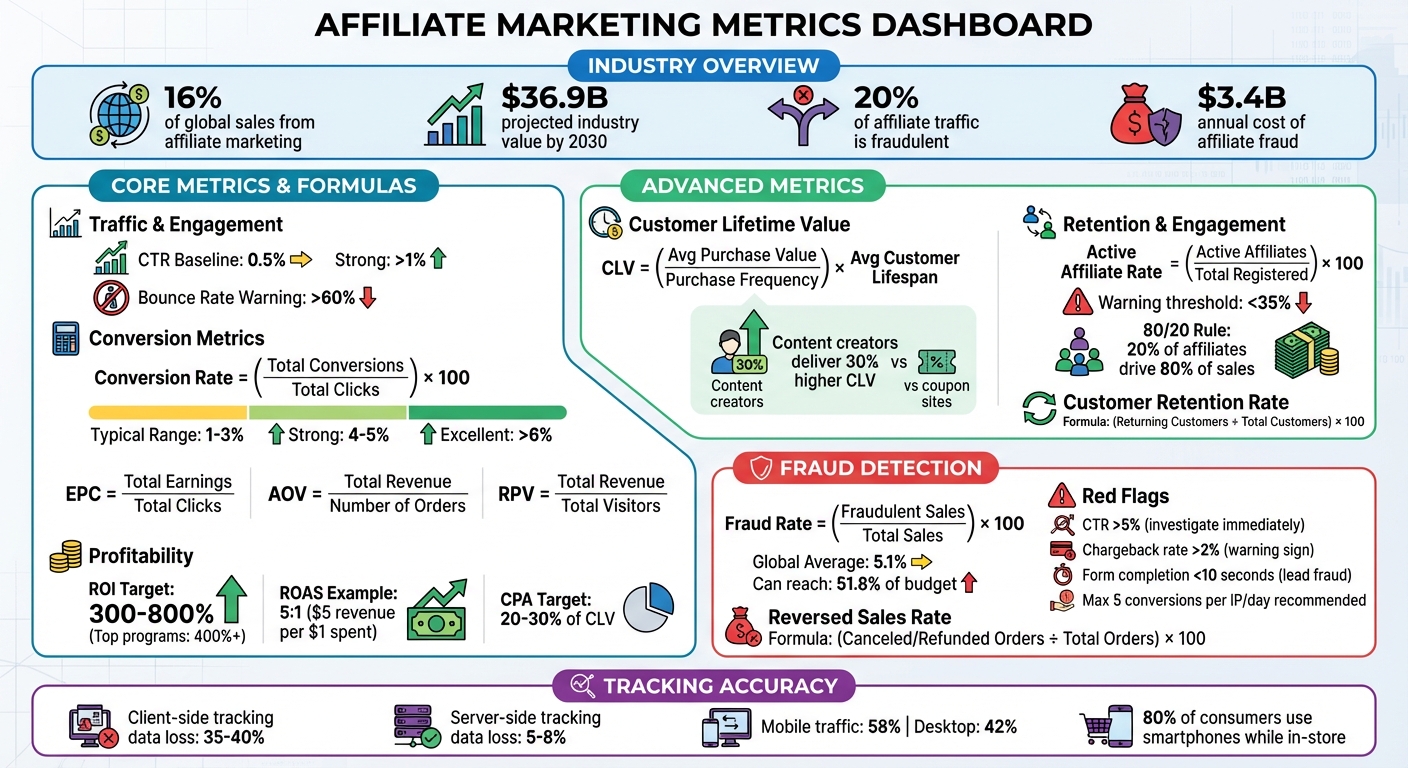
Essential Affiliate Marketing Metrics and Benchmarks Guide
Mastering Affiliate Marketing: Essential KPIs for Success in 2024 | Wati

Core Affiliate Marketing Metrics
Tracking the right metrics is the key to distinguishing profitable affiliate programs from those that simply drain resources. These metrics offer insights into traffic quality, revenue generation, and cost efficiency. At Growth-onomics, we focus on a balanced approach to ensure every campaign is fine-tuned for success.
Here’s a closer look at the most important metrics for evaluating affiliate program performance.
Traffic and Engagement Metrics
Clicks measure the total number of visitors directed to your site through affiliate links. This is a basic indicator of how much exposure your program is getting.
Click-Through Rate (CTR) compares clicks to impressions, showing how effective your affiliate content is at driving engagement. For affiliate links, a baseline CTR is around 0.5%, while anything above 1% is considered strong. A low CTR often points to issues with messaging or link placement.
Bounce Rate refers to the percentage of visitors who leave your site after viewing only one page. If this figure is high – typically above 60% – it suggests a mismatch between what the affiliate promised and what the landing page delivers.
Affiliate Program Activation Rate measures how many of the affiliates you’ve recruited actually begin promoting your brand. A streamlined onboarding process can significantly improve this rate.
Traffic Source Distribution reveals the channels – like social media, blogs, email campaigns, or paid ads – that drive traffic to your site. Relying too heavily on one channel can increase risk and limit growth.
Conversion and Revenue Metrics
Conversion Rate (CR) is the percentage of clicks that result in a sale or lead. It’s one of the clearest indicators of how well affiliate traffic aligns with your offering. As Shopify Staff puts it:
"Conversion rate is king among affiliate marketing KPIs because it directly reflects how your marketing channels are performing."
Typical conversion rates fall between 1% and 3%, with higher rates often seen from warm audiences, while cold traffic tends to convert at the lower end.
Earnings Per Click (EPC) calculates the average revenue generated from each click. Affiliates often evaluate programs based on EPC, so ensuring competitive earnings can help attract top-tier partners.
Average Order Value (AOV) tracks the average amount spent per transaction. Analyzing AOV across affiliates can highlight which strategies or promotions are driving higher-value purchases.
Revenue Per Visitor (RPV) combines conversion rate and AOV to provide a complete picture of the value each visitor brings. This metric is particularly useful for comparing traffic quality across campaigns.
| Metric | Formula | Purpose |
|---|---|---|
| Conversion Rate (CR) | (Total Conversions / Total Clicks) × 100 | Measures traffic quality and funnel effectiveness |
| Earnings Per Click (EPC) | Total Earnings / Total Clicks | Assesses revenue generated per click |
| Average Order Value (AOV) | Total Revenue / Number of Orders | Evaluates transaction value and upselling success |
| Revenue Per Visitor (RPV) | Total Revenue / Total Visitors | Compares visitor quality across campaigns |
Next, let’s dive into the costs and profitability metrics that shape your affiliate program’s bottom line.
Cost and Profitability Metrics
Return on Investment (ROI) measures the overall profitability of your program by comparing net profit to total costs. These costs include commissions, platform fees, creative development, and management labor. A strong ROI – around 400% – means earning $5 for every $1 spent, with top-performing programs often exceeding this benchmark.
Return on Ad Spend (ROAS) looks at the efficiency of individual campaigns by dividing attributed revenue by campaign costs. For example, a ROAS of 5:1 indicates that every dollar spent on affiliate commissions generates five dollars in revenue.
Cost Per Acquisition (CPA) tracks how much it costs to acquire a new customer through affiliates. For sustainable growth, CPA should be lower than the revenue each customer generates, ideally falling between 20% and 30% of the projected Customer Lifetime Value (CLV).
Customer Acquisition Cost (CAC) by Partner Type breaks down costs by affiliate category – such as bloggers, coupon sites, influencers, or review platforms. This segmentation helps pinpoint which partner types deliver the most cost-effective customers.
Advanced Performance and Retention Metrics
Once you’ve got the basics down, diving into Customer Lifetime Value (CLV) and retention metrics can help you distinguish between short-term wins and strategies that drive long-term growth. These insights reveal which affiliates bring in loyal customers and which ones only generate one-off purchases that don’t contribute to sustained profitability.
Customer Lifetime Value (CLV)
CLV is a projection of the total profit a customer brings to your business over their entire relationship with your brand. The formula is straightforward: (Average Purchase Value × Purchase Frequency) × Average Customer Lifespan. For example, if a customer spends $50 per order, makes four purchases each year, and stays with your brand for three years, their CLV would be $600.
Why does this matter? CLV helps you pinpoint affiliates who deliver high-value customers. Take content creators who write in-depth product reviews – they tend to bring in customers with a 30% higher CLV compared to coupon sites. This is because trust-driven content attracts buyers who are more likely to stick around. Shopify Staff explains:
"A high customer lifetime value can signal that your business is offering a consistent level of service – you’re keeping customers happy so that they come back to you."
By analyzing CLV by affiliate source, you can fine-tune your commission structures. Offering higher rates or bonuses to affiliates who consistently deliver loyal, high-value customers shifts the focus from sheer traffic volume to sustainable revenue. Segmenting CLV data by affiliate type can also help you identify which partners are the most profitable.
Retention metrics add another layer of understanding to customer loyalty and engagement over time.
Retention Rate and Active Affiliate Rate
Customer Retention Rate measures how many affiliate-referred customers make repeat purchases. The formula is: (Returning Customers from Affiliates ÷ Total Customers from Affiliates) × 100. A high retention rate indicates that affiliates are driving quality traffic that aligns well with your product offerings.
On the other hand, the Active Affiliate Rate tracks how engaged your affiliate base is. Calculate it as: (Number of Active Affiliates ÷ Total Registered Affiliates) × 100. Many affiliate programs follow the 80/20 rule, where 80% of sales come from just 20% of affiliates. If your Active Affiliate Rate drops below 35%, it’s a red flag that your program may need attention, whether through better onboarding, improved marketing materials, or re-engagement campaigns.
| Metric | Formula | Purpose |
|---|---|---|
| Customer Lifetime Value (CLV) | (Avg Purchase Value × Purchase Frequency) × Avg Customer Lifespan | Assesses the long-term profitability of acquired customers |
| Active Affiliate Rate | (Number of Active Affiliates ÷ Total Registered Affiliates) × 100 | Measures affiliate engagement and recruitment success |
| Customer Retention Rate | (Returning Customers ÷ Total Customers) × 100 | Tracks customer loyalty and the quality of affiliate traffic |
Review these metrics monthly to spot inactive affiliates early and take action to re-engage them before they drop off completely. Regularly pruning inactive partners lets you focus your resources on affiliates who consistently perform well.
Fraud Detection and Quality Control Metrics
Affiliate fraud is a massive $3.4 billion issue, with estimates suggesting that one in four affiliate traffic sources is fraudulent. Just like conversion and revenue metrics, maintaining accurate data through fraud detection is essential for running a successful affiliate program. Fraud not only distorts analytics but also drains commission budgets and clutters your CRM with fake leads, making optimization much harder.
Fraudsters use various tactics, including cookie stuffing (sneakily dropping tracking cookies to claim commissions on purchases they didn’t influence), click fraud (using bots to fake engagement), and lead fraud (submitting stolen or fake information through sign-up forms). Mobile apps face an extra challenge with click injection, where malware intercepts legitimate downloads and injects fake clicks to steal attribution. Jason Perumal, Content Marketing Manager at impact.com, sums it up:
"One in four affiliate traffic sources is fraudulent. That means that, statistically, for every four new partners who apply to your program, one is a scammer."
With 18% of all online interactions being fraudulent, implementing quality control metrics is critical to keeping your program afloat.
Fraud Rate
The Fraud Rate measures the percentage of deceptive activity in your program. It’s calculated as:
(Fraudulent Sales ÷ Total Sales) × 100.
This metric helps you understand the scale of the problem and pinpoint affiliates who need closer monitoring. While the global average fraud rate is 5.1%, ad fraud can sometimes eat up as much as 51.8% of a program’s budget.
To spot fraud, keep an eye out for red flags. For example, affiliates with click-through rates (CTR) over 5% should be investigated, as the industry average typically falls between 1% and 2%. Other warning signs include unusually high click volumes without conversions, multiple clicks from the same IP address, or traffic originating from improbable locations.
PUMA tackled these issues by using advanced monitoring tools and adding protective clauses in partner contracts, cutting fraudulent activities by over 90%.
| Fraud Type | Key Red Flags to Watch For |
|---|---|
| Click Fraud | High click volume with no conversions; clicks from suspicious sources |
| Cookie Stuffing | High conversions with minimal referral traffic; attribution for users who never clicked links |
| Lead Fraud | Sign-up forms completed in under 10 seconds; random-looking email addresses |
| URL Hijacking | Referral data showing typosquatting domains; extremely low time-on-site metrics |
To combat these issues, set up automated alerts for risky patterns and limit conversions to a maximum of five per IP address per day to reduce bot attacks. Additionally, consider a 30- to 60-day commission holding period before payouts to allow time for verifying transactions and handling potential chargebacks or refunds. For instance, Rosetta Stone saved $120,000 by using tracking tools to flag unauthorized activities.
Besides identifying fraudulent sales, keeping tabs on order reversals is another way to ensure your program’s integrity.
Reversed Sales Rate
After fraud detection, monitoring refunds and cancellations becomes a critical part of quality control. The Reversed Sales Rate tracks the percentage of affiliate-referred orders that are canceled or refunded. It’s calculated as:
(Canceled or Refunded Orders ÷ Total Orders) × 100.
This metric can highlight affiliates who might be engaging in shady practices, such as using stolen credit cards, placing fake orders to earn payouts, or over-promising product benefits, which leads to dissatisfied customers and returns.
A chargeback rate above 2% is a clear warning sign that requires immediate action. Affiliates with high reversal rates often indicate misrepresentation, resulting in unhappy buyers and more refunds. These reversals can also complicate profitability since you may need to claw back commissions already paid. Keeping track of the difference between gross commissions (initial amounts) and net commissions (after accounting for reversals) can help you understand the true cost of your program.
Affiliate management platforms that integrate with payment processors like Stripe can automatically reverse commissions for canceled or refunded orders. Regularly reviewing reversal data can help you catch problems early. For example, if an affiliate’s reversal rate suddenly spikes, pause their commissions and audit their traffic sources before things spiral out of control.
Tracking and Optimization Methods
After identifying fraud and quality issues, the next step is implementing robust tracking systems to capture accurate data and transform it into actionable strategies. Here’s an important stat: client-side tracking typically loses 35–40% of data, while server-side tracking reduces that loss to just 5–8% in Q4 2025. This shift is crucial as ad-blockers and the decline of third-party cookies make browser-based tracking increasingly unreliable.
These tracking solutions not only improve data accuracy but also lay the groundwork for better optimization strategies.
Tools and Techniques for Data Tracking
Server-side tracking (SST) has become a game-changer in 2026. It works by sending data directly from your server to the affiliate network’s server, bypassing the user’s browser entirely. This approach avoids the data loss caused by ad-blockers and privacy extensions that block traditional tracking pixels. Relying solely on client-side methods can result in missing over a third of conversions.
In addition to choosing the right tracking method, multi-touch attribution (MTA) provides a complete view of the customer journey, rather than attributing all credit to the final click. As Alexios Papaioannou, Founder of AffiliateMarketingForSuccess.com, explains:
"Last-click attribution is the biggest lie in affiliate marketing. It gives 100% of the credit to the final touchpoint… ignoring the awareness and consideration phases".
Using tools like Google Analytics 4, you can calculate metrics like "Assisted Conversion Value" to highlight the importance of upper-funnel content, such as blog posts, that introduce customers to your brand but don’t always generate the final click.
To improve tracking further, tag all affiliate links with UTM parameters (utm_source, utm_medium, and utm_campaign) to clearly identify traffic sources in your analytics platform. Combine this with branded link cloaking (e.g., go.yourdomain.com) to build trust and bypass spam filters. Conduct quarterly link audits using tools like Screaming Frog or Ahrefs to fix broken links and update offers. This simple practice can increase revenue by up to 15% without driving additional traffic.
If you need advanced tracking capabilities, Growth-onomics offers Data Analytics services to help businesses implement first-party data strategies and sophisticated attribution models. Their expertise includes setting up server-side tracking systems and creating custom dashboards that highlight the metrics driving growth.
Once your tracking is accurate, the next step is to segment the data for actionable insights.
Segmentation and Benchmarking
Data is only useful when segmented and compared against meaningful benchmarks. Avoid relying on "blended numbers" – averages across all channels – as they can obscure underperforming affiliate types. Typically, the 80/20 rule applies: about 20% of your affiliates drive 80% of program growth.
Break down performance by device, affiliate type, and geography. For example, as of September 2025, 58% of global online traffic comes from mobile devices, while 42% comes from desktops. If your mobile conversion rate lags behind desktop, consider optimizing your landing pages and checkout process for smaller screens. Additionally, 80% of consumers worldwide visit a retailer’s site via smartphone while shopping in-store, making mobile optimization crucial.
Content creators who craft in-depth product reviews often attract customers with a 30% higher Customer Lifetime Value (CLV) compared to coupon sites, which focus on volume but deliver less long-term value. Use this insight to adjust commission structures, rewarding affiliates who bring in high-quality traffic rather than just large volumes.
Geographic segmentation can uncover high-potential regions where your conversion rates and average order values excel. Focus on these areas while pausing campaigns in underperforming regions to avoid wasted budget. For instance, IG Group used monitoring tools to track influencer content for regulatory compliance across regions, resulting in a 128% increase in productive affiliates.
When benchmarking, compare your metrics to industry standards. A strong affiliate program typically delivers an ROI of 300%–800%. A conversion rate of 4–5% is solid, while anything above 6% is exceptional. For Click-Through Rates (CTR), aim for over 1%, with 0.5% as the minimum baseline. Affiliates focusing on revenue-driven KPIs rather than vanity metrics saw a 47% profit margin increase within 90 days.
Set SMART goals (Specific, Measurable, Achievable, Relevant, and Time-bound) based on these benchmarks to ensure your KPIs are meaningful. If your program falls short in certain areas, further segment your data to identify underperforming affiliates, traffic sources, or regions – and reallocate resources to maximize results.
Conclusion
If you’re not tracking the right metrics, your affiliate program could be wasting time, money, and valuable opportunities. The metrics outlined in this guide – like conversion rates, Customer Lifetime Value, fraud detection, and server-to-server tracking – serve as essential tools to pinpoint what’s working and what’s draining your resources. These numbers aren’t just stats; they’re the foundation for improving and refining your affiliate network.
With the affiliate marketing industry expected to reach $62.27 billion by 2033 – and nearly 20% of traffic flagged as fraudulent – accurate tracking isn’t just helpful; it’s critical for staying competitive and growing your business.
Turning raw data into meaningful growth requires both careful tracking and smart strategies. Make it a habit to conduct daily revenue checks, hold weekly reviews with your partners, and perform quarterly audits to uncover areas for improvement. Pay close attention to the top-performing 20% of affiliates, as they typically generate 80% of your program’s results. Use this data to design tiered commission structures that reward affiliates bringing in high-quality traffic. Keep an eye on revenue trends, partner performance, and conversion times, and ensure no single affiliate accounts for more than 50% of your traffic. This helps protect your program from sudden and significant disruptions.
For businesses looking to scale quickly, Growth-onomics offers a data-driven approach to affiliate marketing. Their Data Analytics and Performance Marketing services incorporate first-party data strategies, advanced attribution models, and custom dashboards. These tools highlight the metrics that truly matter, allowing you to shift from guesswork to precision. By doing so, they help transform affiliate programs from cost-heavy operations into powerful profit engines.
Leverage these insights to create an affiliate program that not only survives but thrives.
FAQs
What are the best ways to detect and prevent affiliate fraud in my program?
Detecting and stopping affiliate fraud takes vigilance and a solid strategy. Start by keeping a close eye on traffic and conversion patterns – look out for unusual spikes or mismatched IP addresses that could signal something fishy. Make use of fraud detection tools to uncover red flags, like cookie stuffing or unusually high conversion rates. When bringing on new affiliates, always verify their identity and review their past performance to ensure they’re legitimate.
Set clear compliance rules, such as banning incentivized clicks or restricting certain traffic sources, and make sure affiliates agree to these terms in writing. Regularly audit referral data and payouts to catch issues like duplicate orders or fake transactions. AI-powered alerts can be a game-changer here, helping you quickly spot and address anomalies before they escalate.
If managing all this feels overwhelming, you might want to team up with a performance marketing agency like Growth-onomics. They specialize in data-driven strategies, real-time analytics, and automated monitoring, making it easier to safeguard your budget while keeping your affiliate network secure and reliable.
What are some advanced techniques to improve the accuracy of affiliate marketing tracking?
To take your affiliate marketing tracking to the next level, you might want to explore some advanced strategies. One option is server-side GA4 tagging, which offers greater control over your data. Using first-party postback pixels is another way to prioritize data privacy while keeping tracking accurate. For a deeper understanding of your campaigns, granular UTM tagging can provide detailed insights.
If staying updated is key for you, real-time API reporting ensures you have the latest performance data at your fingertips. And to better anticipate customer behavior, predictive churn models can help you fine-tune your strategies. Together, these methods can sharpen your ability to measure and analyze affiliate marketing performance effectively.
How can I identify which affiliates are driving the most valuable customers?
To figure out which affiliates are driving the most value, keep an eye on key metrics like customer lifetime value (CLV), average order value (AOV), conversion rate, and cost per acquisition (CPA). Dive into the data to see how much revenue and profit each affiliate brings in per customer, then rank them by their overall impact on your business.
By looking at these numbers together, you’ll be able to spot the affiliates who consistently bring in high-value customers. This insight can help you fine-tune your affiliate program to boost growth and profitability.