


Affiliate marketing is booming, with the industry projected to hit $17 billion by 2026. But with growth comes stricter regulations and higher risks. Non-compliance can lead to fines exceeding $50,000 per violation, reputational damage, and lost revenue. Fraud is also rampant, with 45% of affiliate traffic deemed fraudulent, costing businesses millions.
To stay compliant in 2026, brands must navigate evolving rules from global regulators like the FTC, ASA, and ESMA. Key areas include mandatory disclosures, privacy laws (e.g., GDPR, CCPA), and fraud prevention. New tools like AI-powered monitoring and server-to-server tracking are essential for managing risks and ensuring transparency.
Here’s what you need to know:
- Disclosures: Affiliates must clearly state paid relationships (e.g., #ad, #sponsored).
- Fraud Prevention: Tactics like cookie stuffing and click fraud are major threats. Use IP risk scoring and device fingerprinting to detect issues.
- Regulatory Focus: Stricter rules now apply to live streams, short-form videos, and AI-generated content.
- Penalties: Fines, clawbacks, and reputational harm are common consequences of non-compliance.
Compliance isn’t just about avoiding fines – it protects your brand, builds trust, and ensures long-term success.
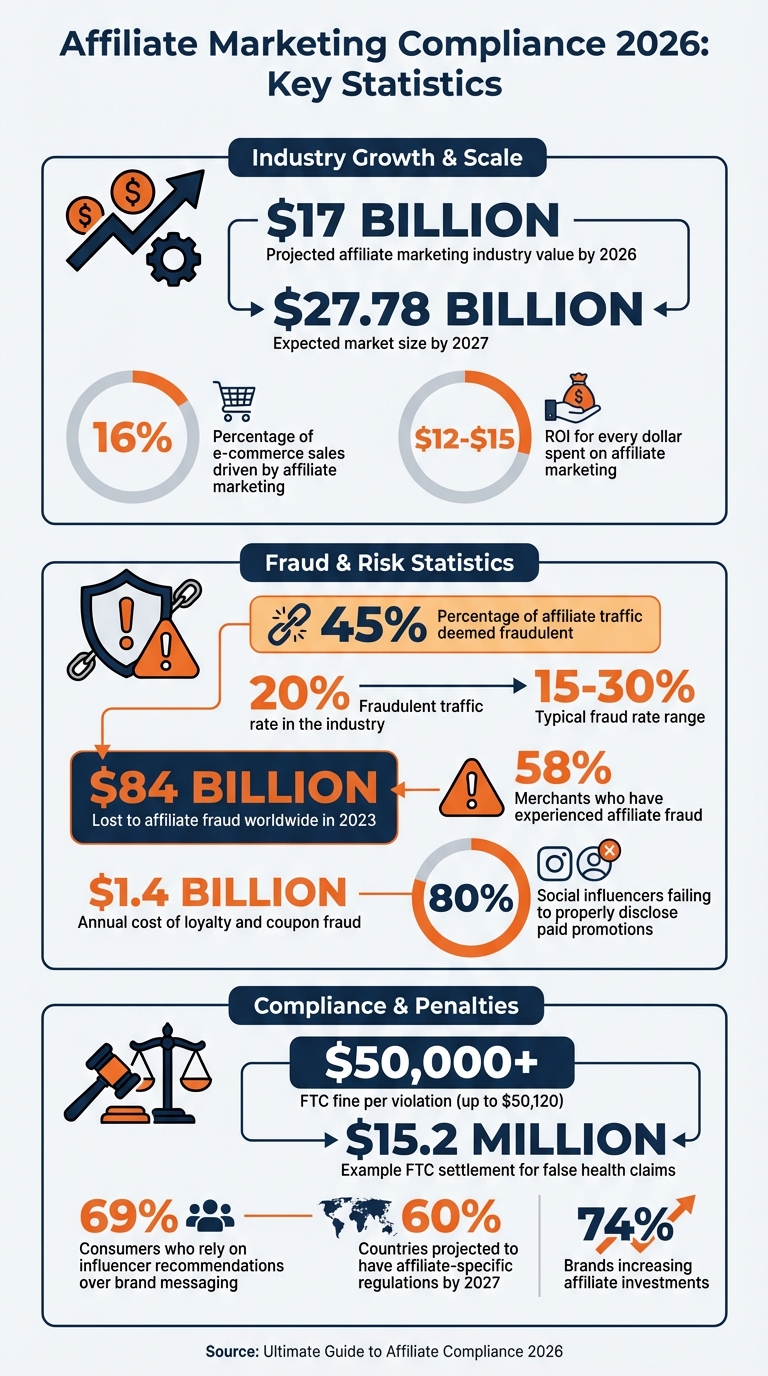
Affiliate Marketing Compliance Statistics 2026: Industry Growth, Fraud Rates, and Penalties
Core Compliance Regulations for 2026
Key Laws and Standards
As discussed earlier, strong compliance measures are essential for protecting your brand, and these laws and standards provide the framework to ensure that protection. By 2026, affiliate programs must navigate a maze of federal regulations enforced by various agencies across industries. One cornerstone remains the FTC Endorsement Guides, which require affiliates to clearly disclose any material connection to your brand – whether it’s through cash payments, free products, or commission arrangements. In the UK, the ASA mandates that only unambiguous labels like "#ad" meet compliance standards.
For affiliates promoting financial products, rules from the SEC and FINRA require explicit disclosure of compensation when endorsing stocks, cryptocurrencies, or investment products. The CFPB’s Circular 2024-01 specifically targets comparison shopping sites and lead-generation platforms by prohibiting "preferencing" – the practice of ranking affiliate offers based solely on commission rates rather than consumer benefit.
When consumer data is involved in affiliate marketing, the FTC Affiliate Marketing Rule (16 CFR Part 680) requires businesses to provide clear notice and an option to opt out of using sensitive data for marketing purposes. This opt-out must remain active for at least five years. While motor vehicle dealers fall under the FTC’s jurisdiction, most other financial entities are regulated by the CFPB under Regulation V.
The FTC Rule on Fake Reviews and Testimonials, finalized in 2024, explicitly bans fabricated reviews in online marketing. With approximately 80% of social influencers failing to properly disclose paid promotions, the focus on transparency is sharper than ever. These regulations are the foundation upon which penalties – outlined in the next section – are built.
Consequences of Non-Compliance
Failing to meet these rigorous standards doesn’t just lead to regulatory fines – it can inflict lasting harm on your reputation. Financial penalties for non-compliance are steep. The FTC can impose civil penalties of up to $50,120 per violation, with each instance counted separately. Enforcement actions and fine amounts have increased significantly in recent years, underscoring the regulators’ emphasis on transparency.
"Preferencing – ranking offers based on affiliate payments rather than consumer benefit – is an illegal abusive practice in comparison shopping sites." – CFPB Circular 2024-01
Beyond financial penalties, violations can lead to immediate termination of affiliate relationships and forfeiture of unpaid commissions. To avoid these risks, the FTC expects businesses to actively monitor affiliate content, with surprise audits becoming a common practice.
The cost of reputational damage can be even higher. For example, a tea company faced a $15.2 million settlement with the FTC after influencers made false health claims without proper disclosures, causing a significant loss of consumer trust. Given that 69% of consumers rely on influencer recommendations over direct brand messaging, any failure in transparency can quickly erode credibility. In the UK and EU, regulators may publicly name non-compliant companies, and in some cases, unauthorized financial promoters could even face criminal charges. These consequences highlight the critical role of transparency and adherence to regulations in maintaining trust and integrity in affiliate marketing programs.
Fraud Prevention Tactics for Affiliate Programs
Common Fraud Methods
Fraud prevention isn’t just about avoiding legal headaches – it’s about protecting your profits. With the affiliate marketing industry expected to hit $27.78 billion by 2027, it’s alarming to note that 20% of traffic is fraudulent. In 2023 alone, affiliate fraud drained marketers of over $84 billion worldwide, accounting for more than 22% of all digital ad spending. With fraud rates often falling between 15% and 30%, and 58% of merchants reporting direct experiences with affiliate fraud, staying informed about common tactics is crucial.
One widespread scheme is cookie stuffing, where fraudsters sneak tracking cookies onto a user’s browser using hidden scripts or iframes, allowing them to claim unearned commissions. Another is attribution theft, which hijacks the buying process by replacing a legitimate affiliate’s last-click cookie.
Other methods include click fraud, where bots or automated scripts generate fake clicks to inflate pay-per-click ads or affiliate links. Then there’s fake leads and sales, which involve fabricated data submissions or stolen credit cards to mimic real conversions. More advanced tactics like typosquatting – registering domains with slight misspellings of your brand (e.g., "amaz0n.com") – redirect accidental visitors through fraudulent affiliate links. Similarly, brand bidding involves affiliates targeting your trademarked keywords to poach traffic you’ve already invested in building.
"The fraud is in the attribution – fraudsters claim credit for sales they didn’t actually influence, making detection significantly more complex." – Fraudlogix
Loyalty and coupon fraud is another sneaky tactic. Here, tracking cookies are injected during checkout on cashback or coupon sites, stealing credit for sales that were already in progress. This alone costs merchants approximately $1.4 billion annually in fraudulent commission payouts. Fraudsters are also leveraging advanced tools like AI bots, geo-spoofing, and "CSS History Hacks" to hide fraudulent links from auditors while showing them to regular users.
Knowing these schemes is half the battle. The next step is implementing effective detection and prevention strategies.
How to Detect and Stop Fraud
Start by monitoring traffic patterns. Sudden, unexplained spikes – especially during off-hours or from unrelated regions – can be a red flag. Watch for high bounce rates paired with heavy traffic, repeated conversions from the same IP address, or mismatched device fingerprints. Blank referrers or obscure front websites that hide the original click source also deserve immediate attention.
Conversion timing analysis is particularly useful for spotting cookie stuffing. If conversions happen within seconds of a click, they’re likely fraudulent since real customers take time to browse and make decisions. Similarly, affiliates with unusually high conversion rates or frequent cancellations should be investigated.
Consider using IP risk scoring to block or flag traffic from data centers, proxies, or VPNs – common tools for bot activity. Device fingerprinting is another powerful tool, as it tracks unique device characteristics and can identify fraudsters who rotate IP addresses but use the same hardware. To discourage fraud, establish clear compliance rules in your affiliate agreements, explicitly banning tactics like brand bidding and unsolicited emails. This gives you legal grounds to terminate violators.
For new affiliates, adopt tiered commission structures. Lower initial commission caps or longer holding periods (30 to 60 days) can deter fraudsters seeking quick payouts, giving you time to verify transactions and check for chargebacks or returns. To combat brand bidding, simulate searches from different locations using VPNs or search modifiers to catch affiliates running unauthorized ads in regions they assume are unmonitored. Since manual checks can’t keep up with bot-driven fraud, many businesses now rely on real-time automated detection and machine learning tools to analyze transactions at scale.
| Fraud Type | Primary Detection Method | Red Flag |
|---|---|---|
| Cookie Stuffing | Conversion Timing Analysis | Conversions occurring within seconds of the click |
| Click Fraud | Traffic Pattern Monitoring | Unusual spikes from a single IP or unrelated geography |
| Fake Leads | Data Validation | Nonsensical info (e.g., "aaa@bbb.com") or high refund rates |
| Brand Bidding | Paid Search Monitoring | Affiliate ads targeting trademarked keywords |
| Bot Traffic | Device Fingerprinting | Multiple accounts or actions linked to the same device ID |
"Undetected fraud can lead to significant financial losses. Every fake click or fraudulent transaction chips away at your revenue." – Rewardful Team
These detection methods, combined with advanced tools, can strengthen your affiliate program and safeguard it against fraud.
Tools and Technology for Affiliate Compliance
Affiliate Tracking and Analytics Solutions
Staying compliant in affiliate marketing starts with reliable tracking that doesn’t depend on third-party cookies. Enter Server-to-Server (S2S) tracking, which has become indispensable in 2026. By directly communicating between servers, it ensures accurate attribution while adhering to GDPR and CCPA regulations, bypassing browser-based tracking limitations.
Modern tracking platforms also include features like conversion timing analysis, which helps detect cookie stuffing before commissions are paid. Tools such as Impact.com and Everflow manage billions of tracking events and complex multi-touch attribution paths. Meanwhile, platforms like Trackdesk (charging 2.5% of tracked revenue) and Tapfiliate (starting at $89/month) cater to e-commerce businesses with simpler implementation needs.
A real-world example? In 2023, Rosetta Stone used Impact.com’s Tracking Detail Reporting to validate sales data and uncover tracking errors. This saved them $120,000 by preventing fraud and ensuring compliance with affiliate agreements. Similarly, IG Group, a key player in trading and investments, utilized Impact.com to oversee influencer content for regulatory compliance, achieving a 128% boost in productive, compliant affiliates.
"In terms of pixel tracking, the level of accuracy is unequaled – server tracking and postback is a breeze!" – S. Sim, Gruppy Media
While tracking platforms enhance conversion accuracy, fraud detection tools add a much-needed layer of protection.
Fraud Detection Tools
Automated tools have revolutionized fraud detection, scanning millions of affiliate pages for hate speech, misleading claims, and unauthorized brand mentions. For example, Rightlander scans over 15 million pages every month – an impossible task for human teams. This is critical when you consider that nearly 45% of all affiliate traffic is reported as fraudulent.
Device fingerprinting is another powerful tool, identifying unique hardware characteristics to catch fraudsters who switch IP addresses but use the same device. This method spots "fingerprint collisions", where multiple high-value conversions come from identical devices. Complementing this is IP risk scoring, which blocks traffic from proxies, VPNs, and data centers – common tools for bot-driven fraud.
For paid search monitoring, tools like BrandVerity simulate searches from various global locations to detect trademark bidding and URL hijacking. Fraudsters often use geo-fencing to hide their violations. PUMA, for instance, implemented Impact.com’s monitoring tools and added protective contract clauses, reducing fraudulent affiliate activity by more than 90%.
AI-powered tools are also stepping up to combat more subtle forms of fraud. For example, slow-burn fraud – where small amounts of suspicious traffic are sent consistently to avoid detection – is now flagged by advanced algorithms. Popular options include Greip, which boasts a 4.5/5 Trustpilot rating for its IP and payment monitoring, and SEON, recognized by G2 for its digital footprint and social signal analytics.
| Tool | Primary Focus | Key Capability |
|---|---|---|
| BrandVerity | Paid Search Monitoring | Detects trademark violations and brand bidding |
| Bluepear | Behavioral Analytics | Tracks device fingerprinting and conversion paths |
| Anura | Traffic Quality | Real-time bot and fraud detection |
| Kount | Omnichannel Fraud | Uses AI to detect anomalies in high-traffic programs |
| SEON | Digital Footprint | Analyzes social signals and provides risk scoring |
How Growth-onomics Supports Compliance

While technology plays a significant role, strategic insights are equally critical – and that’s where Growth-onomics comes in. By combining Data Analytics with Performance Marketing, they help businesses maintain affiliate compliance. Their analytics service identifies suspicious patterns in affiliate performance, while their performance marketing expertise ensures tracking systems align with regulatory standards.
With Customer Journey Mapping, Growth-onomics provides a clear view of the entire attribution path, making it easier to spot last-click attribution errors. By blending real-time monitoring with strategic planning, they turn compliance into an operational strength, safeguarding revenue and strengthening relationships with trustworthy affiliates.
Practical Steps to Achieve Affiliate Compliance
2026 Affiliate Compliance Checklist
To maintain a compliant and effective affiliate program, start with a well-defined contract. Outline commission structures, prohibited promotional tactics (like brand bidding and spam), and the required disclosure language. Implement a pre-approval onboarding process that includes background checks, website verification, and social media account reviews. Given the high rates of fraud, this manual approach helps screen out potential bad actors. For tax compliance, ask U.S.-based affiliates to submit W-9 forms, while international partners should provide W-8BEN forms.
Equip affiliates with disclosure templates that meet FTC standards for being "clear and conspicuous." A good example is using phrases like, "I earn commissions from purchases made through this link." When updating terms for 2026, require all affiliates to re-accept the new policies in your affiliate portal to ensure their legal consent is current.
Leverage automated tools to catch violations like trademark bidding, cookie stuffing, and link cloaking. Fraudsters often use "reverse IP-geo-targeting" to hide their activities from your location. Combat this by using proxy servers or VPNs to view affiliate ads from different regions.
| Compliance Area | 2026 Requirement | Recommended Action |
|---|---|---|
| FTC Disclosures | Must be "clear and conspicuous" | Provide #Ad or #Sponsored tags for social media |
| Data Privacy | Explicit consent for data collection | Audit affiliate sites for opt-out mechanisms |
| Fraud Prevention | Detect "front" websites and cookie stuffing | Use real-time analytics to flag mismatched geos |
| Brand Protection | Prevent unauthorized trademark bidding | Use tools like BrandVerity to monitor paid search |
These steps lay the groundwork for a compliance system that minimizes risks and ensures smoother operations.
Monitoring and Auditing Your Affiliate Program
Once your compliance framework is in place, continuous monitoring is critical to catch issues early. Regular reviews help prevent small gaps from becoming major problems. For example, analyze sales metrics for sudden spikes in conversion rates, high return rates, or geographic data mismatches – common red flags for fraud. Without proper monitoring, brands risk losing up to 25% in inflated costs due to fraudulent activity.
Introduce activity logging to ensure affiliates document their campaign activities, such as published links or content, along with supporting attachments. This creates a clear compliance trail. High-earning affiliates, who pose a greater risk, should undergo periodic, detailed reviews. For these top performers, require unique display URLs and controlled ad copy to prevent competition with your own search rankings.
Develop an incident response plan that outlines how to detect, investigate, and resolve issues. This might include actions like clawing back commissions or terminating accounts.
"You want an even, methodical way of dealing with misconduct."
- Todd Crawford, Co-founder, Impact.com
Building a Compliance-First Organization
With processes and monitoring in place, focus on fostering a compliance-driven culture. Treat compliance as a strategic asset – it builds trust and ensures long-term growth. As affiliate marketing is projected to hit nearly $40 billion by 2032, strong compliance safeguards your share of this growing market.
Create a compliance handbook that breaks down legal requirements into simple templates and visual guides for affiliates. Share this resource during onboarding and make it easily accessible in your affiliate portal. Establish open communication channels, like dedicated Slack groups or email threads, where affiliates can ask regulatory questions without fear of immediate penalties.
"In affiliate marketing, compliance helps to build audience trust and protect brand reputation."
- Harpreet Singh, Tanot Solution
Brands are shifting from large, unmonitored networks to smaller, high-quality groups of vetted affiliates that align with their values. This approach reduces fraud and enhances program performance. By 2026, compliance will be the cornerstone of sustainable, revenue-generating partnerships. With affiliate marketing contributing up to 16% of a brand’s total online revenue, compliance directly impacts the bottom line.
Honey, We Have a Problem? Navigating the Affiliate Channel in 2026
Conclusion
Affiliate compliance in 2026 isn’t just about avoiding penalties – it’s about creating a marketing channel that drives growth while safeguarding your revenue and reputation. With the global affiliate marketing market expected to surpass $20 billion by 2026 and 60% of countries projected to implement affiliate-specific regulations by 2027, compliance has become a strategic advantage.
Affiliate fraud remains a costly issue, with an estimated $3.4 billion lost in 2022 and 17% of affiliate traffic still deemed fraudulent. Yet, the channel continues to deliver an impressive $12–$15 ROI for every dollar spent.
"Affiliate marketing is a strategic imperative for brands that want to grow efficiently, authentically, and sustainably in 2026 and beyond." – Caroline McMullan, Senior Marketing Strategist at Vested
The shift towards partnership-readiness has made compliance a key differentiator. With 74% of brands increasing their affiliate investments due to rising costs in other marketing channels, the quality of partnerships is more critical than ever. By focusing on strategic, vetted collaborations, brands can minimize fraud risks while enhancing performance. Authenticity remains a cornerstone of success – genuine recommendations with transparent disclosures consistently outperform traditional paid promotions.
To stay ahead, brands must adopt a solid compliance framework. This includes leveraging AI-powered tools for real-time fraud detection, utilizing blockchain for secure transaction verification, and prioritizing first-party data strategies as third-party cookies become obsolete. Success in 2026 will belong to brands that invest in accurate measurement, collaborate with niche creators who foster genuine engagement, and regularly audit content to stay aligned with evolving standards.
These efforts not only ensure compliance but also drive sustainable growth. Affiliate marketing already accounts for 16% of e-commerce sales. A compliance-focused approach builds trust, scales effectively, and strengthens customer relationships while navigating regulatory challenges.
FAQs
What are the most common types of affiliate fraud, and how can businesses prevent them?
Affiliate fraud remains a persistent challenge for marketers in 2026, with bad actors finding ways to manipulate affiliate programs and pocket unearned commissions. Some of the most common tactics include cookie stuffing (sneakily placing tracking cookies to claim sales they didn’t generate), attribution theft (hijacking brand keywords or ad bids to steal conversions), bot traffic and fake clicks (using non-human activity to inflate metrics), and credit card or fake account fraud (creating bogus profiles to trigger payouts). These schemes often exploit gaps in tracking systems, lack of oversight, and insufficient vetting of affiliate partners.
To combat these threats, businesses need a layered, data-focused strategy. Start by using automated tools to flag unusual patterns, such as sudden spikes in traffic or IP addresses that don’t match expected locations. Strengthen your onboarding process by thoroughly verifying affiliate identities and conducting regular audits. Real-time bot detection can help filter out fake traffic, ensuring leads are genuine. Keep an eye on brand keyword usage to catch unauthorized bidding or trademark misuse. By combining vigilant monitoring, advanced analytics, and clear compliance rules, businesses can safeguard their affiliate programs while maintaining growth.
Growth-onomics supports brands in creating secure and transparent affiliate systems by leveraging strategies like performance marketing analytics, SEO, and customer journey mapping to drive success.
How can AI tools improve compliance and prevent fraud in affiliate marketing?
AI tools are transforming affiliate marketing by processing massive datasets in seconds, spotting patterns and irregularities that might escape human attention. For example, machine learning algorithms can quickly identify unusual traffic spikes, mismatched attribution windows, or suspicious conversion rates. This allows businesses to tackle potential fraud before it becomes a bigger issue.
Beyond fraud detection, AI also streamlines compliance efforts. It can monitor affiliate content, ad placements, and disclosures to ensure they align with regulations like FTC guidelines. These tools can automatically flag non-compliant language or improper trademark use, saving businesses time and reducing the risk of legal trouble. By combining speed, accuracy, and automation, AI not only helps prevent fraud but also simplifies compliance, safeguarding businesses and maintaining their brand reputation.
What are the main compliance requirements for affiliate marketing in 2026?
Affiliate marketing compliance in 2026 focuses heavily on the Federal Trade Commission’s (FTC) truth-in-advertising and endorsement rules. The FTC mandates that affiliates must clearly disclose any "material connection" with merchants – such as commissions, free products, or other perks – in a way that’s easy for consumers to understand. These disclosures should be placed near the endorsement to ensure transparency. Affiliates are also responsible for ensuring that any claims they make are supported by reliable evidence and are not misleading.
The FTC’s Affiliate Marketing Rule (16 CFR Part 680) adds another layer of responsibility. Businesses must provide consumers with a straightforward way to opt out of affiliate-driven offers, such as a single-click opt-out link. These requests need to be processed promptly. Additionally, businesses are required to maintain records of disclosures and opt-out requests for an appropriate period to demonstrate compliance.
By embedding these practices into their operations, businesses can protect their reputation, build consumer trust, and steer clear of potential penalties – all while growing their affiliate programs responsibly.