


Cross-device tracking connects user activities across devices – smartphones, desktops, tablets, and more – to create a single, unified profile. But in 2026, this process is more complex than ever due to privacy regulations, cookie restrictions, and user behavior. Here’s what you need to know:
- The Problem: Without cross-device tracking, marketers see fragmented data, misattribute conversions, and waste ad budgets.
- Key Methods:
- Deterministic Tracking: Matches users via logins or emails. Highly accurate but limited to logged-in users.
- Probabilistic Tracking: Uses signals like IP addresses and device types. Broader coverage but less precise.
- Major Challenges:
- Solutions: Hybrid approaches combining server-side tracking, first-party data, and AI-driven models improve accuracy while respecting privacy.
Cross-device tracking is evolving, but balancing accuracy and compliance is critical for success.
How to use Google Signals and the Cross Device Tracking Reports
sbb-itb-2ec70df
How Cross-Device Tracking Works
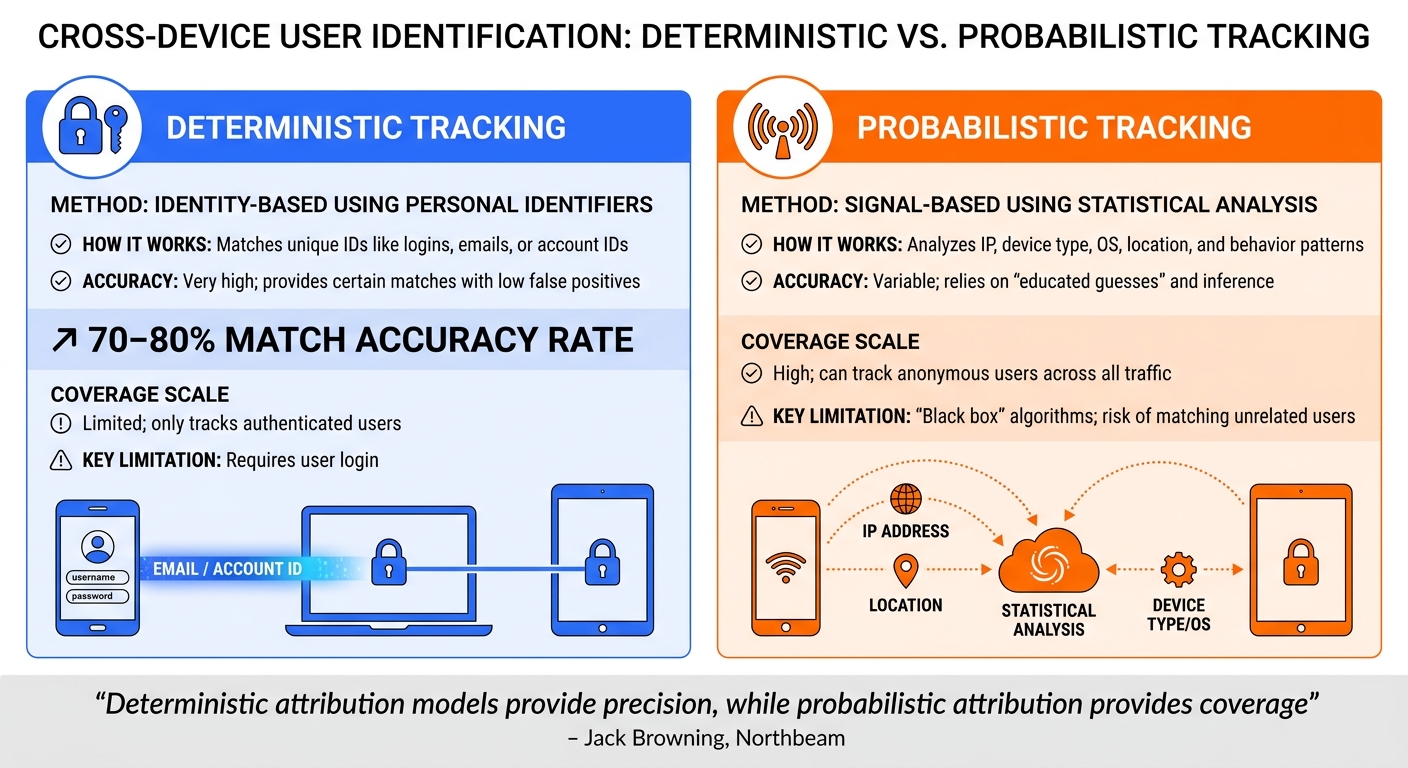
Deterministic vs Probabilistic Cross-Device Tracking Methods Comparison
Cross-device tracking relies on two key methods: deterministic and probabilistic tracking. Each takes a unique approach to link a user’s activity across devices like smartphones, laptops, and tablets.
Deterministic tracking works like a lock and key system. For example, when you log into a streaming service on both your phone and smart TV, the platform uses your login credentials – such as an email address or account ID – to identify you as the same user. This approach depends on identifiers users provide when they authenticate themselves. Companies like Google, Facebook, and Amazon excel with this method because their users often stay logged in across multiple devices. Deterministic tracking achieves a match accuracy of about 70–80%. However, it has a major limitation: it only works when users log in. If someone browses anonymously, this method can’t connect their devices, making it necessary to use an alternative.
Probabilistic tracking, on the other hand, relies on inference. Instead of requiring a user login, it analyzes signals like IP addresses, device types, and locations to predict which devices belong to the same user. Machine learning algorithms process these signals to make educated guesses. This approach is especially useful for tracking anonymous visitors or users who never create accounts. However, its reliance on statistical inference can sometimes result in false matches, particularly when devices share the same network.
Jack Browning from Northbeam explains the distinction well:
Deterministic attribution models provide precision, while probabilistic attribution provides coverage.
Marketers today often combine both methods. Deterministic data serves as a reliable anchor, while probabilistic modeling fills in the gaps where deterministic tracking falls short.
| Feature | Deterministic Tracking | Probabilistic Tracking |
|---|---|---|
| Method | Identity-based using personal identifiers | Signal-based using statistical analysis |
| How It Works | Matches unique IDs like logins, emails, or account IDs | Analyzes IP, device type, OS, location, and behavior patterns |
| Accuracy | Very high; provides certain matches with low false positives | Variable; relies on "educated guesses" and inference |
| Coverage Scale | Limited; only tracks authenticated users | High; can track anonymous users across all traffic |
| Key Limitations | Requires user login | "Black box" algorithms; risk of matching unrelated users |
Together, these methods form the backbone of cross-device tracking, tackling the challenges of identifying users across devices and contexts.
Technical Challenges in Cross-Device Tracking
Even with a solid understanding of cross-device tracking techniques, technical barriers make it difficult to achieve seamless tracking across multiple devices. These challenges complicate the process of linking user activities into a cohesive journey.
Device ID Fragmentation and Data Integration
Deterministic and probabilistic methods are foundational for cross-device tracking, but technical limitations often prevent them from reaching their full potential. One major obstacle is the integration of data from various sources into a unified customer profile. Consider this: in 2023, the average U.S. household owned 17 connected devices. That’s a lot of data – and a lot of inconsistency. Different platforms rely on different identifiers: CRM systems use email addresses, mobile apps track device IDs, and websites depend on cookies. These systems rarely communicate effectively.
Universal ID solutions like Unified ID 2.0 aim to address this fragmentation. However, their real-world match rates are often between just 20% and 50% of the total audience. These systems depend heavily on users being logged in, leaving anonymous visitors and those using privacy-focused browsers outside their reach. As House of MarTech puts it:
Universal ID cross-device tracking… delivers a connected view of known, opted-in customers but leaves anonymous and privacy-protected users unreachable.
Data silos within closed ecosystems further limit the effectiveness of identity graphs, making integration even more challenging.
Browser and Platform Blocking Features
Browser restrictions have fundamentally changed tracking. Safari’s Intelligent Tracking Prevention (ITP) limits certain cookies to a lifespan of just 7 days. Firefox blocks third-party cookies by default, and Chrome offers opt-in blocking. These measures significantly reduce the effectiveness of traditional tracking methods.
Mobile tracking is facing similar hurdles. Apple’s App Tracking Transparency (ATT) framework requires users to opt in for IDFA access, with only 25% of users granting permission. This leaves roughly 75% of iOS users invisible to cross-device tracking efforts. Google is preparing to implement similar restrictions for the Google Advertising ID (GAID), which will further complicate the connection between mobile and web activity.
The impact is undeniable. About 46% of shoppers start researching products on mobile devices but switch to desktops to complete their purchase. Without the ability to link these sessions, marketers risk breaking one customer journey into multiple, disconnected profiles. These browser and platform restrictions only add to the challenges caused by cookie loss.
Signal Loss from Cookie Deprecation
Cookie blocking disrupts the algorithms used to connect devices, leading to less accurate matches and more errors – like mistakenly linking devices that share an IP address.
Tom Wilkinson from Usercentrics highlights the issue:
Most marketing analytics treat each device as a separate user, creating fragmented data that misses the full customer story.
Consent restrictions also reduce the amount of available attribution data by 30–40% in regulated markets. Server-side tracking, which processes data on secure servers instead of relying on client-side methods, has emerged as a workaround. However, it cannot recover data that users choose not to share.
| Blocking Feature | Impact on Tracking | Primary Consequence |
|---|---|---|
| Safari ITP | Limits cookie duration to 7 days | Breaks attribution for long sales cycles |
| Apple ATT (iOS) | Requires opt-in for IDFA access | Loss of mobile-to-web tracking for ~75% of users |
| Third-Party Cookie Phase-Out | Eliminates cross-site identifiers | Fragmented user profiles and "blind spots" |
| Ad Blockers | Prevent tracking scripts from firing | Complete loss of session data on the client side |
Given these challenges, shifting to first-party data is now more critical than ever. As House of MarTech warns:
Your universal ID strategy is only as strong as your consent collection.
Without authenticated users who willingly share their data, cross-device tracking risks becoming an unreliable guessing game with diminishing returns.
Privacy and Legal Compliance Challenges
Legal hurdles add a whole new layer of complexity to cross-device tracking. Privacy regulations now dictate not just how but if you can track users across devices. Violating these rules can lead to fines in the millions, making compliance a critical factor alongside technical challenges.
GDPR and CCPA Regulations
Both GDPR and CCPA set strict boundaries for consent and data-sharing practices. Under GDPR, you must obtain explicit opt-in consent before linking devices for marketing or analytics purposes. In contrast, the CCPA (expanded by the CPRA) uses an opt-out model, allowing tracking unless users explicitly object.
The CPRA also redefined "sharing" to include cross-context behavioral advertising. This means unified user IDs fall under opt-out rights, even when no financial transaction occurs. For example, if a California user clicks "Do Not Sell or Share My Personal Information", you must notify all vendors within 15 business days.
The penalties are steep. GDPR violations can cost up to €20 million or 4% of global revenue, while CCPA fines reach $7,500 per intentional violation. When tracking millions of users, these numbers add up fast.
| Regulation | Consent Model | Key Requirement | Maximum Penalty |
|---|---|---|---|
| GDPR (EU) | Opt-in | Explicit user consent before tracking | €20M or 4% of global turnover |
| CCPA/CPRA (California) | Opt-out | Honor "Do Not Sell/Share" requests | $7,500 per violation |
| ePrivacy Directive | Opt-in | Prior consent for cookies and tracking | Varies by EU member state |
Adding to the complexity, the EU AI Act (effective August 2, 2026) classifies AI systems using cross-device behavioral data for decisions like ad targeting as "high-risk." This requires businesses to implement rigorous documentation and human oversight measures.
Apple’s App Tracking Transparency and Consent Issues
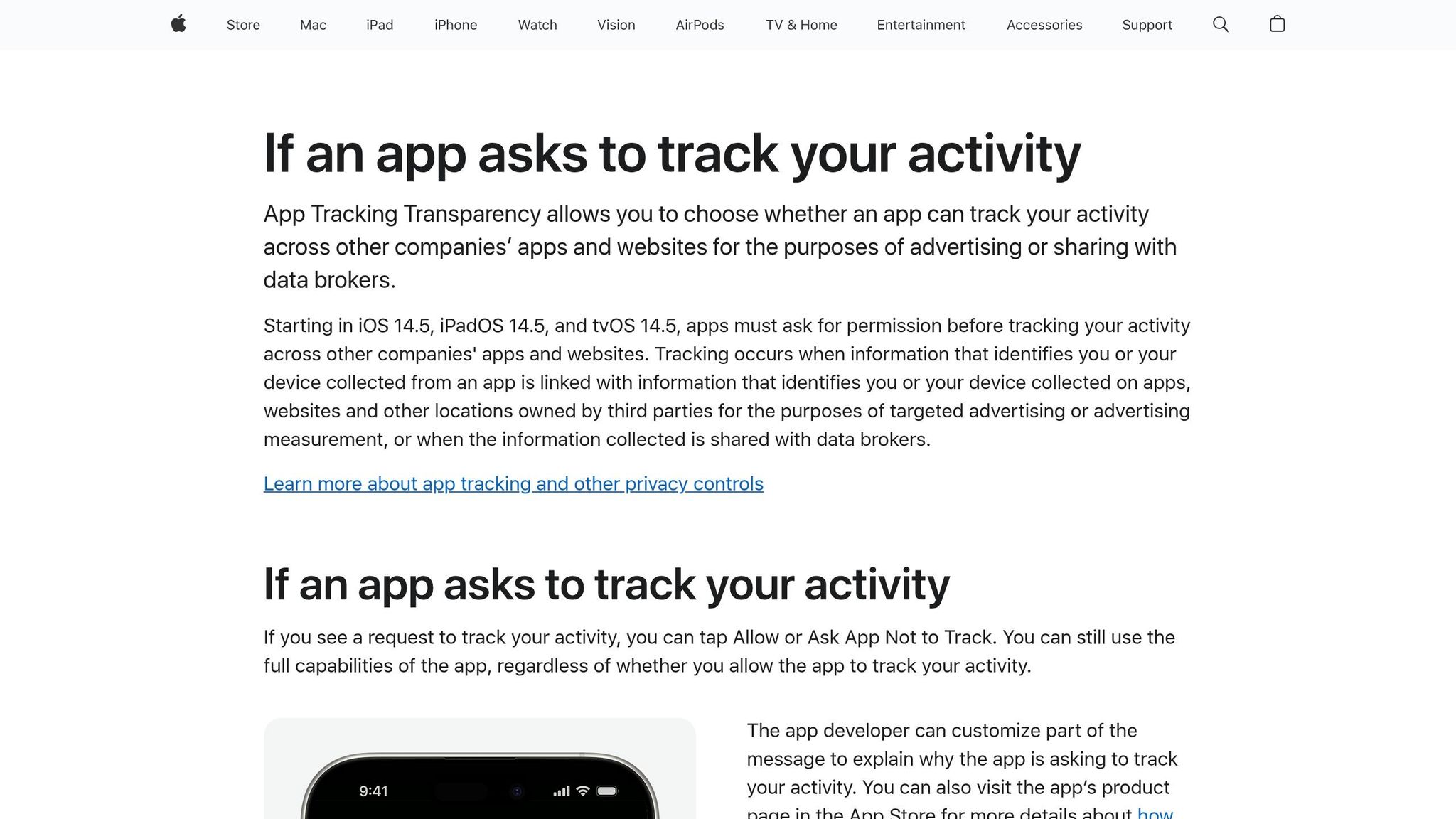
Platform-specific frameworks like Apple’s App Tracking Transparency (ATT) further complicate things. For example, a user might allow tracking on a mobile website but decline it in a native app, creating gaps in cross-device visibility. Attribution between apps becomes even trickier, as users must give consent in both the advertiser’s and publisher’s apps.
The challenge is compounded by low opt-in rates – tracking permissions average around just 25%. In February 2025, the UK’s Information Commissioner’s Office (ICO) criticized Google’s fingerprinting practices as "irresponsible", asserting that such methods violate GDPR and PECR if done without consent.
The economic impact is substantial. Facebook estimated that ATT could reduce its annual revenue by as much as $86 billion, demonstrating how consent rules can reshape the financial landscape of cross-device tracking.
Risks of Handling Sensitive Data
Cross-device graphs, which combine multiple identifiers, come with risks. They can inadvertently expose extensive user networks or mistakenly merge data from separate individuals, leading to errors in personalization and Data Subject Access Request (DSAR) accuracy. To address this, businesses should adopt strict access controls, showing analysts only pseudonymous IDs instead of full identity resolution tables, adhering to the "least privilege" principle.
Large-scale monitoring also qualifies as "systematic observation" under CPRA, requiring risk assessments for businesses handling data from over 250,000 California consumers.
Mitigation strategies include pseudonymization – replacing raw identifiers with hashed email addresses or CRM IDs – and automating retention limits to ensure data isn’t stored longer than necessary. For instance, retaining years of behavioral data after users withdraw consent could lead to compliance violations.
While server-side tracking centralizes privacy controls, it doesn’t solve everything. If users refuse to share data, no amount of technical wizardry can retrieve it. Organizations must also scrutinize vendor contracts, especially GDPR Article 28 agreements with third-party device graph providers, to ensure consent signals are properly handled. Ultimately, your organization bears the legal responsibility for compliance, not your vendors. Successfully navigating cross-device tracking requires addressing both legal and technical challenges head-on.
User Behavior and Attribution Challenges
User behavior adds a layer of complexity to cross-device tracking because customer journeys are rarely straightforward or linear.
Frequent Device Switching
People often move between devices – like smartphones, tablets, and desktops – throughout their day. Unfortunately, most marketing analytics tools treat each device as a separate user, which fragments user profiles. This fragmentation creates gaps in identity resolution. Even when users log in, those credentials don’t always transfer across apps or browsers. Without clear, deterministic data like logins, platforms have to rely on probabilistic methods, such as tracking IP addresses and behavior patterns. These methods are less accurate by nature. Every time a device switch occurs, there’s a risk of breaking the tracking continuity, making it harder to piece together a complete picture of user actions.
Attribution Gaps Across Devices
When tracking is incomplete, conversions are often credited only to the last device used, ignoring all earlier interactions. This oversimplification skews the insights marketers rely on. Studies show that effective cross-device tracking can reduce cost per action by 30–50% and improve ROI by 50–100%. Achieving these results, however, requires overcoming challenges like browser restrictions, the loss of mobile identifiers, and inconsistent user logins. Without addressing these gaps, attribution models remain biased, highlighting the need for advanced identity resolution strategies.
| Challenge | Impact on Attribution | Mitigation Strategy |
|---|---|---|
| Cookie Deprecation | Disrupts tracking across websites | First-party data & Server-side tracking |
| ATT/IDFA Restrictions | Limits tracking between apps and websites | Probabilistic modeling & Universal IDs |
| Frequent Device Switching | Inflates unique user counts; misses touchpoints | Identity graphs & Deterministic logins |
| Shared Devices | Merges behaviors from multiple users | Behavioral filtering & Session-based analysis |
Shared Devices and User Overlap
Shared devices complicate tracking even further. For example, when multiple family members use the same tablet or smart TV, tracking systems can mistakenly combine their actions into one user profile. Probabilistic models, which often rely on shared IP addresses and behavioral patterns, may wrongly attribute one person’s activity to another. This can result in irrelevant ad targeting – like showing desktop ads based on a family member’s mobile browsing habits. Such inaccuracies in attribution make it harder to understand individual customer behavior and intent, leading to less effective marketing strategies.
Solutions and Future Outlook
Businesses grappling with cross-device tracking challenges have several practical solutions at their disposal. The most effective approach blends multiple strategies rather than relying on just one.
Hybrid Tracking Approaches
A hybrid approach combines server-side tracking, first-party data, and AI-driven probabilistic methods to address privacy challenges and improve tracking accuracy. Here’s how these methods work:
- Server-side tracking processes data on secure servers instead of the user’s browser. This bypasses ad blockers, extends cookie lifespans, and enhances data security.
- First-party data strategies involve gathering information directly from users through actions like logins or newsletter sign-ups. This creates stable identifiers that work across devices.
- AI-enhanced probabilistic techniques use machine learning to analyze vast amounts of data, filling in gaps caused by privacy restrictions and predicting user behavior in real time.
Deterministic matching offers 90-99% accuracy, while probabilistic matching typically achieves 70-90%. When combined in a hybrid model, businesses can reach accuracy levels of 85-95%. This approach is particularly effective for tracking both logged-in and anonymous users, though it does require integrating multiple data streams, which can be technically challenging.
| Approach | Benefits | Implementation Challenges |
|---|---|---|
| Server-Side Tracking | Bypasses ad blockers; extends cookie lifespans; improves data security. | Requires secure server infrastructure; higher technical complexity. |
| First-Party Data Strategy | High accuracy; builds customer trust; resilient to third-party cookie loss. | Requires user authentication; harder to scale for anonymous users. |
| AI-Enhanced Probabilistic | Works for anonymous users; fills privacy-driven gaps; provides predictive insights. | Not 100% accurate; needs large data volumes for machine learning. |
| Hybrid Model | Combines accuracy and reach; tracks logged-in and anonymous users. | Complex data integration and identity resolution. |
This hybrid strategy not only improves tracking but also lays the groundwork for deeper customer connections, as explored in the next section on first-party data and journey mapping.
First-Party Data and Customer Journey Mapping
Relying on first-party data transforms how businesses understand their customers. Beyond improving accuracy, this strategy builds trust by ensuring compliance with GDPR and CCPA regulations and adapting to the decline of third-party cookies.
Customer journey mapping takes this a step further by consolidating fragmented touchpoints into a unified profile. This process eliminates errors like double-counting and misattributed conversions. It also highlights friction points, such as when users abandon a journey after switching from a mobile ad to a desktop site. Growth-onomics specializes in Customer Journey Mapping and Data Analytics, helping businesses refine their strategies to enhance tracking accuracy while respecting user privacy.
"Businesses need to be familiar with both relevant privacy regulations and the tracking tools they’re using… not just with a one-time audit, but over time as regulations and technologies in use change." – Tilman Harmeling, Senior Privacy Expert, Usercentrics
These strategies provide a strong foundation for tackling future challenges in cross-device tracking.
Future Trends in Cross-Device Tracking
Looking ahead, emerging trends aim to address technical gaps while prioritizing privacy. By 2027, AI-powered prediction models are expected to refine probabilistic tracking, forecasting customer journeys and conversions even before they occur. At the same time, privacy-preserving APIs like Google’s Privacy Sandbox will allow the use of aggregated data without accessing personal information.
Another growing trend is the adoption of zero-party data – where users voluntarily share their preferences with brands. By 2028, 70% of brands are projected to use this approach.
New technologies are also reshaping the landscape. For example, CTV integration connects Connected TV ad views with mobile actions using QR codes, while blockchain identity systems enable secure, cross-device verification. These innovations aim to strike a balance between accurate tracking and the increasing demand for privacy, paving the way for a more effective and privacy-conscious future in digital marketing.
Conclusion
Cross-device tracking remains a critical component for precise marketing, yet it faces mounting challenges. The decline of third-party cookies, restrictions like Apple’s App Tracking Transparency (ATT) framework, and stricter privacy regulations have introduced attribution gaps that can distort campaign insights and customer profiling efforts.
To address these hurdles, a hybrid strategy combining server-side tracking, first-party data, and AI-driven probabilistic modeling offers a practical solution. This approach not only improves measurement accuracy but also creates more seamless customer journeys, ultimately boosting return on investment (ROI).
"A device graph is only as legally clean as the consent layer that feeds it." – Secure Privacy Blog
Successfully managing cross-device consent and integrating varied data streams requires robust infrastructure and clear documentation of user consent. As highlighted earlier, overcoming these complexities is essential to unify fragmented customer touchpoints.
Growth-onomics supports businesses in tackling these challenges through its Data Analytics and Customer Journey Mapping services. Their expertise helps organizations craft privacy-first tracking strategies that strike a balance between accurate measurement and user trust. By prioritizing first-party data collection and creating unified customer profiles, businesses can achieve effective cross-device attribution while adhering to evolving privacy standards.
FAQs
What’s the best way to track users across devices without third-party cookies?
The best way to track users across devices in a world without third-party cookies is by turning to privacy-first attribution technologies. These methods are designed to respect user consent while still providing a clear picture of user behavior.
Two common approaches are:
- Deterministic tracking: This relies on explicit identifiers like login credentials to recognize users across devices.
- Probabilistic tracking: This uses techniques like device fingerprinting or first-party data to make educated guesses about user identity.
By focusing on privacy-compliant identifiers and working with anonymized data, businesses can stay aligned with privacy laws while still gaining the insights they need. This balance ensures both compliance and a deeper understanding of how users engage across their digital ecosystem.
How can I stay GDPR/CCPA compliant when doing cross-device tracking?
To stay in line with GDPR and CCPA requirements during cross-device tracking, put user privacy and consent first. Always secure explicit consent before gathering or handling any data. Make sure your privacy notices are clear and easy to understand, and give users the option to opt out of tracking if they choose.
Using tools like consent management platforms can streamline this process. Additionally, stick to data minimization principles – only collect what you truly need. Transparency and strict compliance with legal standards are key to maintaining privacy-focused and lawful tracking practices.
How do you avoid wrong matches from shared devices or IP addresses?
To reduce the chances of incorrect matches on shared devices or IP addresses, it’s essential to go beyond basic identifiers. Advanced attribution methods like behavioral data analysis, device fingerprinting, and probabilistic matching can help distinguish between users. These techniques work by analyzing factors like user interactions, device characteristics, and browsing habits.
By combining multiple data points – such as login information and behavioral patterns – you can achieve more precise tracking, even when dealing with shared or dynamic devices and networks. Just make sure to stay compliant with privacy regulations while implementing these strategies.