


Traffic trends reveal opportunities to outpace competitors. Businesses that analyze long-term data – like shifts in mobile traffic (up to 63.8% by 2025) – can predict market changes and refine strategies. Tools like Semrush Traffic Analytics provide quick insights into competitor behavior, while agencies like Growth-onomics turn data into actionable plans.
For example, identifying a spike in a competitor’s organic traffic can help adjust SEO or ad campaigns. Combining automated tools with expert analysis ensures you’re not just reacting but staying ahead. The key takeaway? Use data to make informed decisions and align them with your business goals.
Website Traffic Analysis Tutorial (Yours + Competitors)
1. Growth-onomics
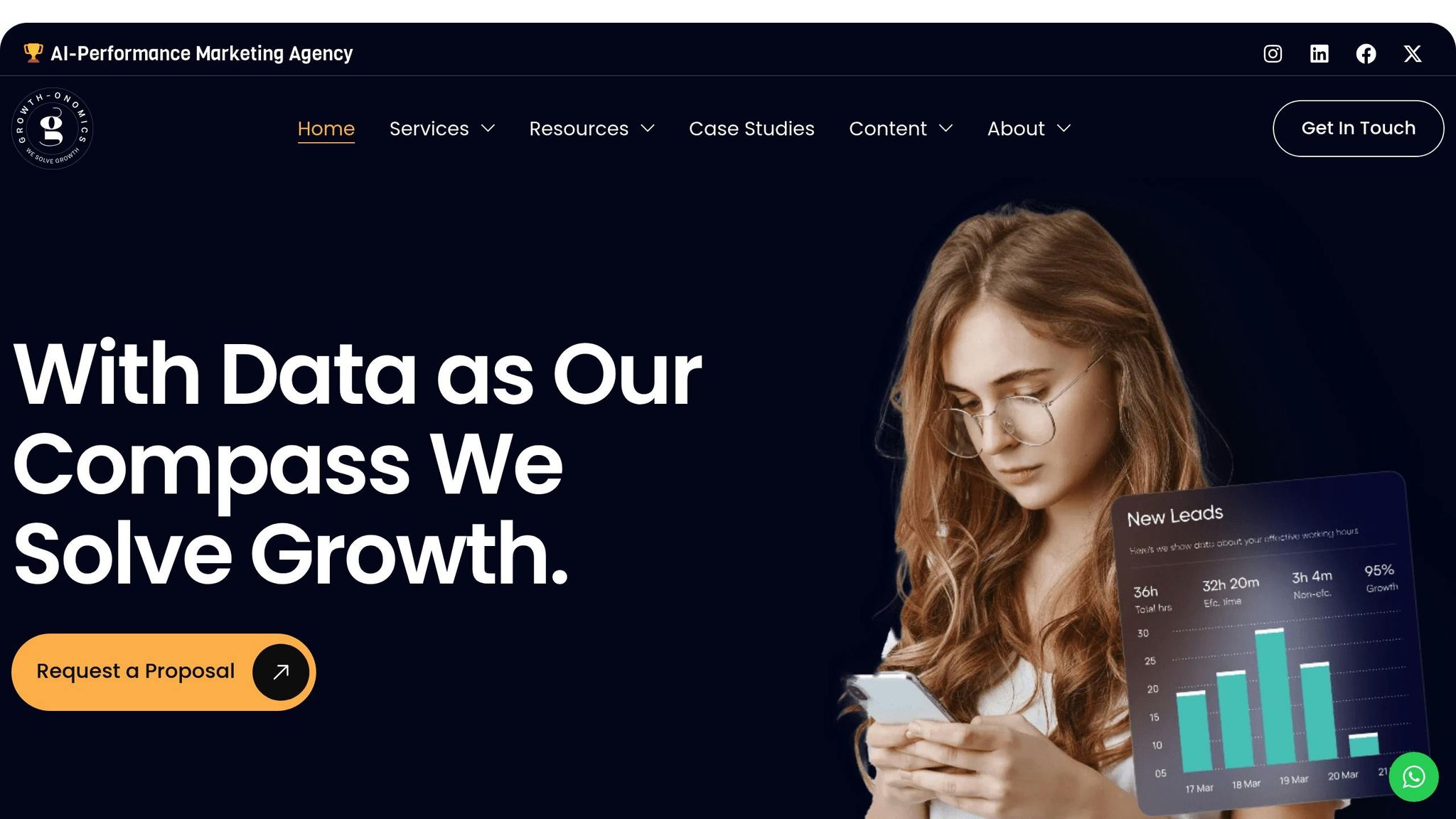
Growth-onomics takes raw traffic data and turns it into actionable insights that help businesses strengthen their market position and gain an edge over competitors. By analyzing traffic trends and competitor movements, they help clients adapt to shifting market dynamics and seize opportunities.
Traffic Analysis Capabilities
Growth-onomics leverages advanced analytics and AI to track and interpret competitor traffic patterns. They focus on key metrics like organic vs. paid traffic, bounce rates, session durations, conversion rates, referral sources, and keyword rankings. For instance, when a retail client noticed a spike in a competitor’s organic traffic, Growth-onomics discovered the competitor was ranking for new long-tail keywords tied to seasonal products. Armed with this insight, the client optimized their content strategy, recovered lost traffic, and boosted conversions.
Their AI-driven tools streamline data collection and identify trends faster, such as shifts in user intent or the popularity of new content formats. These insights allow businesses to act quickly and create strategies that are both timely and data-backed.
Data-Driven Insights
Growth-onomics follows a five-step methodology, starting with funnel data analysis and ending with actionable strategies. Their Data Analytics & Reporting service helps businesses track performance trends and make informed choices.
"We transform insights into winning campaigns that drive growth and outperform competitors." – Growth-onomics
By analyzing data, they pinpoint high-performing channels, seasonal opportunities, and underperforming areas. For example, if a competitor’s paid search traffic suddenly surges, Growth-onomics might suggest launching targeted ad campaigns or refreshing content to stay competitive.
Mobile optimization is also a key focus, ensuring clients are well-positioned to capture increasing mobile traffic.
Marketing Strategy Integration
Growth-onomics doesn’t stop at traffic analysis – they integrate these insights into broader marketing strategies using their Sustainable Growth Model (SGM). This framework aligns traffic data with business goals like generating leads, building brand awareness, and retaining customers.
By combining SEO insights with broader traffic data, Growth-onomics helps businesses improve their online visibility and attract more organic traffic. Meanwhile, their Performance Marketing strategies focus on measurable outcomes. They also emphasize collaboration between marketing, sales, and product teams, ensuring that insights are acted on quickly. Through feedback loops, businesses can adapt their strategies in days rather than months.
To keep clients ahead of the curve, Growth-onomics prepares them for emerging trends like Generative Engine Optimization (GEO) and Answer Engine Optimization (AEO), ensuring their content is optimized for AI-driven search environments. This proactive approach ensures that their strategies remain aligned with evolving technologies and search algorithms.
2. Semrush Traffic Analytics

Semrush Traffic Analytics transforms website traffic data into actionable insights, giving marketers a powerful tool for competitive intelligence as of 2025. Let’s break down how its features can strengthen competitive strategies.
Traffic Analysis Capabilities
Semrush offers a detailed look into competitor website performance, providing estimates for traffic volume, a breakdown of traffic sources (like direct, referral, search, social, and paid channels), and audience demographics. It also identifies top-performing landing pages, geographic trends, and device usage. For the U.S. market, these metrics align with broader trends, such as the increasing mobile engagement seen in industries like e-commerce and media.
In addition to these metrics, Semrush tracks engagement stats like average visit duration, bounce rates, and audience overlap with competitors. These insights help businesses pinpoint where competitors are drawing traffic from and how users are interacting with their sites.
Here’s an example: An e-commerce retailer noticed seasonal spikes in a competitor’s social traffic. Using this insight, they revamped their social strategy, leading to a 20% boost in referral traffic and higher conversion rates during the next promotional period.
Data-Driven Insights
Semrush goes beyond surface-level data, offering tools to uncover trends that can shape marketing strategies. Its machine learning algorithms analyze data from multiple sources to identify traffic spikes, seasonal patterns, and changes in user behavior. This allows businesses to pinpoint which marketing campaigns or content types are working best for competitors, enabling smarter, evidence-based adjustments. Real-time monitoring also flags competitor campaigns, allowing for quick and informed responses.
The platform’s segmentation features provide even deeper insights, breaking data down by source, device, and region. Predictive analytics and automated insights further enhance its value by helping businesses identify emerging opportunities – whether it’s a new keyword, content format, or marketing channel gaining traction.
Marketing Strategy Integration
Semrush doesn’t just deliver data – it integrates seamlessly with tools like Google Analytics and CRMs, helping businesses benchmark their performance against competitors. By identifying gaps in customer acquisition strategies, it opens up opportunities to explore new referral partnerships or content approaches.
For instance, if a competitor ramps up their SEO efforts and sees a surge in organic search traffic, Semrush enables businesses to quickly adjust their own content marketing strategies to stay competitive. Regular monitoring through Semrush dashboards ensures that companies can respond proactively to shifting market dynamics.
Beyond data export, the platform’s integration capabilities support A/B testing, content planning, and budget allocation. This ensures that the insights gained from Semrush directly inform both day-to-day decisions and long-term strategies.
sbb-itb-2ec70df
Advantages and Disadvantages
Building on our earlier discussion of Growth-onomics and Semrush Traffic Analytics, let’s dive into how these two approaches compare. Understanding their strengths and limitations is key for businesses aiming to refine their competitive intelligence strategies. Each method brings something different to the table.
Growth-onomics stands out for its personalized approach. By blending traffic analysis with broader marketing goals, it delivers insights tailored to a business’s unique needs. Its strength lies in combining advanced analytics with expert consultation, turning raw traffic data into strategies that drive growth. With a focus on internal data and customer journey mapping, Growth-onomics aligns traffic insights with SEO, UX improvements, and performance marketing efforts.
That said, Growth-onomics has its challenges. It may not be as scalable or as broad in data coverage as automated platforms. Its effectiveness depends on the quality of the client’s data and requires ongoing collaboration, which can demand significant time and resources – making it less ideal for businesses seeking quick, self-service analytics.
Semrush Traffic Analytics, on the other hand, excels at delivering fast, scalable insights into competitor performance, website traffic, and user behavior. Its automated reports and benchmarking capabilities provide instant access to actionable data, making it perfect for businesses that need quick results without diving into deep customization.
However, Semrush isn’t without its drawbacks. While it offers robust data, it lacks the contextual interpretation and strategic integration that Growth-onomics provides. The platform doesn’t account for offline factors or nuanced customer journeys, leaving businesses to interpret the data and align it with their broader strategies.
Here’s a side-by-side comparison:
| Capability | Growth-onomics | Semrush Traffic Analytics |
|---|---|---|
| Traffic Analysis | Tailored, agency-driven approach; integrates multiple data sources for a holistic view | Automated analysis; includes benchmarking, competitor analysis, and detailed traffic data |
| Data Insights | Actionable insights paired with strategic recommendations | Detailed quantitative data, trends, and historical comparisons; less focus on strategy |
| Marketing Strategy Integration | Deep integration with marketing goals, including UX and customer journey mapping | Primarily a tool for data analysis, requiring user interpretation |
For businesses looking to maximize their competitive intelligence, combining these two approaches can be highly effective. Experts agree that while platforms like Semrush are excellent for collecting and benchmarking data at scale, human expertise – like that offered by Growth-onomics – is essential for interpreting this data and embedding it into a cohesive marketing strategy. Together, they provide a balanced approach to strategic planning.
Final Thoughts
Understanding how traffic trends shape competitor strategies is more than just gathering data – it’s about transforming those insights into practical growth strategies that keep your business ahead in the competitive U.S. market.
To truly benefit, businesses need approaches that seamlessly turn traffic data into competitive advantages. Automated platforms are excellent for collecting competitor traffic metrics and offering benchmarking insights, but the real edge lies in how effectively you interpret and apply that data.
For U.S. businesses, the choice of tools and strategies should align with your main goals. Growth-onomics’ data-focused approach, for instance, helps turn raw insights into impactful campaigns – addressing the challenge that 95% of businesses face with unstructured data. Similarly, platforms like Semrush provide detailed, actionable data that allow for quick strategic pivots, which is critical since search engines account for 93% of website traffic.
In this rapidly changing digital environment, being quick and strategic in decision-making is vital. Consider this: the U.S. 5G market is expected to hit $797.8 billion by 2030 with an annual growth rate of 65.8%. This explosion in connectivity provides businesses with unparalleled access to real-time data. Companies already using AI-driven analytics and automation are seeing up to 40% boosts in production efficiency and 30% cost reductions. The combination of actionable insights and strategic execution is what delivers maximum competitive impact.
As we’ve discussed, the most effective approach blends automated tools for comprehensive data collection with expert interpretation to align insights with broader marketing goals. This hybrid strategy ensures you’re not just reacting to competitors but proactively positioning your business for lasting growth.
With consumer behavior constantly evolving and technologies like Generative Engine Optimization emerging, businesses that invest in both robust data collection and strategic analysis will stay ahead. The key is choosing solutions tailored to your needs and building the agility to act on traffic trends quickly and effectively.
In today’s data-driven world, the businesses that succeed treat traffic trend analysis as an ongoing strategic tool – one that informs every aspect of their digital presence through a mix of thorough data and sharp strategic thinking.
FAQs
How can businesses use traffic trends to anticipate market shifts and improve their strategies?
Businesses can use traffic trends as a powerful tool to better understand market behavior and fine-tune their strategies. By digging into website traffic patterns, search habits, and user engagement data, companies can uncover valuable clues about shifting customer preferences, seasonal demand changes, or even competitor moves.
Key metrics to pay attention to include peak traffic periods, geographic patterns, and conversion rates. These numbers aren’t just stats – they’re actionable insights. For instance, noticing traffic surges during certain times might prompt a business to adjust its ad spend or stock levels to match the increased demand.
When businesses weave these data insights into their overall plans, they position themselves to adapt quickly to market shifts and stay ahead of the curve.
How does Growth-onomics turn traffic data into actionable strategies for businesses?
Growth-onomics takes raw traffic data and turns it into clear, actionable insights using advanced data analytics. By digging into performance trends, they help businesses spot opportunities, tackle challenges, and make informed decisions that drive growth.
Their process involves analyzing traffic patterns, understanding customer behavior, and reviewing conversion metrics. This allows them to craft strategies that align perfectly with business objectives, ensuring every choice is grounded in meaningful data and delivers measurable results.
How do trends like Generative Engine Optimization and Answer Engine Optimization shape traffic strategies?
Emerging trends like Generative Engine Optimization (GEO) and Answer Engine Optimization (AEO) are changing the way businesses think about driving traffic. GEO is all about tailoring content to perform well in AI-generated search results – think chatbots or virtual assistants. AEO, meanwhile, focuses on crafting content that directly answers user questions, helping businesses appear in featured snippets or voice search results.
Adapting to these trends can boost your online visibility and keep you ahead of the competition. Using data-driven tools, like those from Growth-onomics, can fine-tune your approach to match these shifting search behaviors.