


Video content drives reach, while images and carousels deepen engagement. In 2026, platforms prioritize different formats depending on their audience and algorithm. Here’s what you need to know:
- Videos dominate reach: TikTok sees 3.70% engagement, while Instagram Reels reach 2.25× more users than images. Short-form videos like YouTube Shorts lead with a 5.91% engagement rate.
- Images and carousels excel in engagement: LinkedIn PDF carousels achieve a 21.77% engagement rate, outperforming videos by 196%. Instagram carousels drive 109% more engagement per person reached than Reels.
- Platform-specific trends matter: Facebook Live videos engage best during 30–40 minute sessions, while Pinterest videos generate 83% more engagement than images.
Key takeaway: Use videos to grow your audience and images/carousels to connect with existing followers. Align content with platform strengths and your goals for better results.
Instagram Engagement Is Changing in 2026: Benchmarks Explained by Social Media Strategists
sbb-itb-2ec70df
Engagement Performance by Platform: Video vs. Images
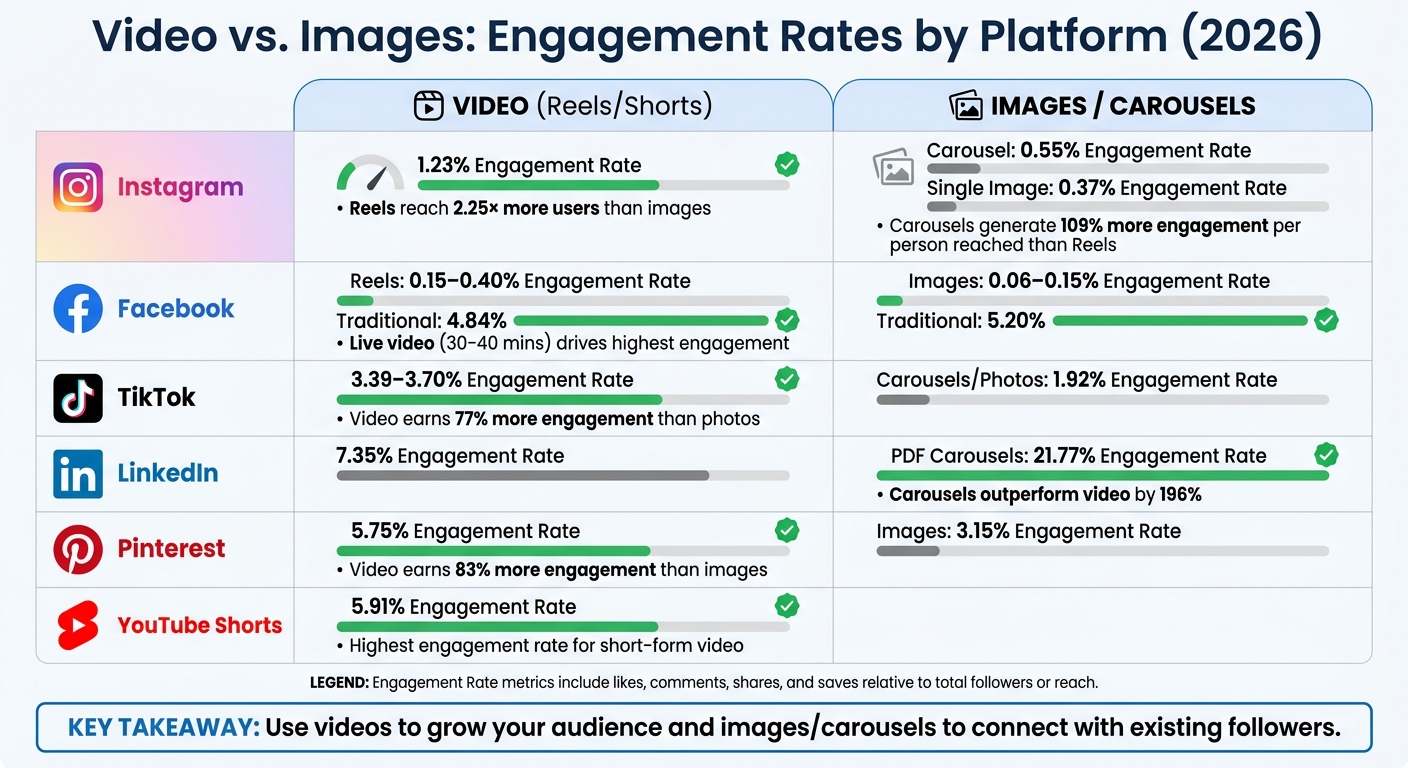
Social Media Engagement Rates: Video vs Images by Platform 2026
Facebook: Live Video Generates Higher Engagement
On traditional Facebook Pages, images and videos perform almost equally, with images slightly ahead at a 5.20% engagement rate compared to video at 4.84%. However, static content struggles with organic reach, often staying below 2%, which pushes brands to explore other formats.
Facebook Reels outperform standard image posts, delivering an engagement rate between 0.15% and 0.40%, compared to 0.06%–0.15% for images. Meanwhile, Facebook Live drives the highest engagement, especially during sessions lasting 30 to 40 minutes. Beyond this timeframe, viewers tend to lose interest. This makes live streaming an excellent choice for interactive events, product launches, or behind-the-scenes content. Additionally, engagement in Facebook Groups is 30–50% higher than on Pages, making community-based video strategies a smart move.
While Facebook capitalizes on live video, Instagram takes a different approach, excelling with its variety of visual content formats.
Instagram: Reels and Carousels Outperform Single Images
Instagram has embraced distinct content types like Reels, Carousels, and single images, each catering to different goals. Reels stand out with a 1.23% engagement rate and reach 2.25× more users than single-image posts, making them ideal for expanding visibility. On the other hand, Carousels generate 109% more engagement per person reached than Reels. They also benefit from a unique feature: if a user doesn’t interact with the first slide, the post can resurface with a different slide, increasing its chances of engagement. This makes Carousels particularly effective for educational content, tutorials, and step-by-step guides.
"Video is fantastic for reach and discoverability… Other formats (carousels, images, text) can be better for engagement, deepening connections with your existing audience."
- Kirsti Lang, Senior Content Writer, Buffer
The table below highlights key engagement metrics across platforms, showing how video and image formats perform differently depending on audience expectations.
Platform Comparison Table
| Platform | Video Engagement Rate | Image/Carousel Engagement Rate | Key Finding |
|---|---|---|---|
| 1.23% (Reels) | 0.55% (Carousel) / 0.37% (Image) | Reels reach 2.25× more users than images | |
| 0.15–0.40% (Reels) | 0.06–0.15% (Images) | Live video (30–40 mins) drives the most engagement | |
| TikTok | 3.39–3.70% | 1.92% (Carousels/Photos) | Video earns 77% more engagement than photos |
| 7.35% | 21.77% (PDF Carousels) | Carousels outperform video by 196% | |
| 5.75% | 3.15% (Images) | Video earns 83% more engagement than images | |
| YouTube Shorts | 5.91% | N/A | Highest engagement rate for short-form video |
TikTok continues to dominate with a 3.70% engagement rate in 2026, marking a 49% year-over-year increase. It also delivers 2.3× more engagement than Instagram across all follower tiers. Meanwhile, YouTube Shorts lead short-form video formats with a 5.91% engagement rate, and Pinterest sees video outperform images by 83%.
What Drives Video and Image Performance
Video: Attention and Engagement Advantages
Videos have a unique way of capturing attention – they demand time from viewers, which platforms interpret as a sign of quality. When people spend more time watching, algorithms take note, boosting the video’s reach. This is why video content often gets shared more widely. For example, TikTok saw shares climb by 45% year-over-year, even as comments dropped by 24%. It’s clear that people now show appreciation by sharing rather than participating in discussions.
Platforms are also shifting their focus to passive engagement metrics like watch time, shares, and saves. These signals are now more influential than traditional markers like comments. Additionally, short-form videos are particularly effective, with 73% of consumers preferring them to learn about products or services. This explains why video ads often outperform image ads in click-through rates. They’re perfect for showcasing products, educating audiences, and telling compelling stories – all in a short amount of time.
Images: Fast Consumption and Click Generation
Images, on the other hand, excel in situations where speed matters. They require less time to process, which makes them ideal for driving quick actions. In fact, images generate three times the engagement of text-only posts, making them a go-to choice for campaigns aimed at immediate user responses.
In fast-scrolling environments, images shine because decisions are made in an instant. Instagram carousels, for instance, keep users engaged longer through interactive swiping. Interestingly, carousels generate 12% more interactions per impression than Reels, even though Reels have a 36% advantage in reach. This highlights how images and videos perform differently depending on the platform and user behavior.
How Platform Algorithms Affect Performance
Algorithms play a huge role in shaping how videos and images perform. Take Instagram, for example – it’s almost like two platforms in one. Reels are designed to help users discover new content and reach non-followers, while carousels focus on engaging existing audiences. The numbers back this up: Reels reach 2.25 times more people, but carousels generate 109% more engagement per person reached.
Facebook, however, takes a more balanced approach. On this platform, the engagement rates for images (5.2%), videos (4.84%), and text (4.76%) are all within a single percentage point of each other. LinkedIn, in contrast, favors PDF carousels, which achieve a median engagement rate of 21.77% – a whopping 196% higher than video. Meanwhile, TikTok remains firmly focused on video, which earns 77% higher engagement than photos or carousels.
For businesses, the takeaway is simple: align your content with both the platform’s strengths and your specific goals. Use videos to build brand awareness and reach new audiences through discovery feeds. Opt for images or carousels when your goal is immediate action or deeper engagement with your current followers. By understanding how content types interact with platform algorithms, you can make smarter choices that align with your marketing objectives. This approach ensures your content works harder and delivers better results.
How to Optimize Engagement with Video and Images
Match Content Type to Platform
Each platform has its own strengths when it comes to content. On LinkedIn, PDF carousels reign supreme, boasting a median engagement rate of 21.77%. That’s a staggering 196% more than video posts and 585% higher than text posts. If you’re targeting B2B audiences, carousels should be your go-to format.
Instagram plays by a different set of rules. To expand your reach, lean into Reels, which generate 2.25 times more reach than single-image posts. However, if you’re aiming to connect more deeply with your existing followers, carousels are the better choice – they increase per-user engagement by 109% compared to Reels. Kirsti Lang from Buffer explains this dynamic perfectly:
"The format that reaches the most new people (usually video or reels) is rarely the format that drives the deepest engagement from existing followers (usually carousels)" – Kirsti Lang, Buffer
For TikTok and Pinterest, video takes the top spot, excelling in both reach and engagement. These trends align with the strengths of these platforms, making video an essential tool for connecting with audiences there.
By tailoring your content to each platform’s strengths, you can effectively balance reach and engagement.
Combine Videos and Images for Different Goals
Once you’ve nailed down platform-specific tactics, it’s time to mix your content types to hit different marketing objectives. Use video to build brand awareness and attract new audiences. Short-form videos, in particular, are highly effective at reaching non-followers – 2.5 times more than static posts.
When your focus shifts to driving action or building stronger connections with your current audience, images and carousels are your best bet. Static images are click magnets: Pinterest sees a 1.54% organic click-through rate, while Facebook follows at 1.21%. Instagram and TikTok lag behind, with click-through rates of 0.30–0.50% and 0.20–0.40%, respectively. Since link posts tend to underperform across platforms, you might want to place links in your bio or comments to maintain strong organic reach.
Use A/B Testing to Refine Your Strategy
Testing is the key to sharpening your approach. A/B testing can help you identify what works best for your audience. For videos, experiment with different lengths – try 15 seconds, 60–90 seconds for Instagram Reels, and up to 2 minutes on TikTok and LinkedIn. Use retention analytics to evaluate your hooks. If viewers drop off within the first 3–5 seconds, you’ll know your opening needs work. Try starting with the result first – show the outcome in the first 2 seconds – and compare it to a traditional chronological story to see which holds attention better.
Thumbnails also matter. Test bold, high-contrast images featuring a person making eye contact instead of text-heavy or brand-only covers. On LinkedIn, prioritize testing PDF carousels for engagement and native video for reach. Jamie Partridge from PostEverywhere offers a great reminder:
"A single month’s engagement rate is noise. Three months of directional movement is signal" – Jamie Partridge, PostEverywhere
Allow your experiments to run long enough to gather meaningful data before making adjustments.
Conclusion
To get the most out of your content strategy, aligning with platform-specific engagement benchmarks is essential. There’s no one-size-fits-all answer to the video versus image debate. The best choice depends on your objectives and where your audience spends their time. For example, video excels in reach and discovery – TikTok generates 2.3 times more engagement than Instagram, and social media videos are shared a staggering 1,200% more than text and image posts combined. On the other hand, images and carousels are ideal for strengthening connections with existing followers. LinkedIn’s PDF carousels boast a median engagement rate of 21.77%, while Instagram carousels drive 109% more engagement per person reached compared to Reels.
Tailoring your strategy to each platform has never been more important. What thrives on LinkedIn might flop on TikTok. Facebook, with its format-agnostic nature – where images, videos, and text posts perform within 1% of each other – is a rare exception. The brands that succeed in 2026 will use both videos and images strategically, choosing formats based on platform strengths and audience behavior.
The true edge lies in leveraging data to guide your decisions. Data-driven testing and retention analytics are invaluable for fine-tuning your approach. As Jamie Partridge from PostEverywhere wisely advises, "A single month’s engagement rate is noise. Three months of directional movement is signal". Let experiments run long enough to gather meaningful insights before making adjustments.
Finally, don’t overlook the basics of engagement. Simple actions, like replying to comments, can increase engagement by up to 42% on some platforms. Whether you’re sharing a 60-second Reel or a 10-slide carousel, the fundamentals – consistent interaction, understanding your audience, and staying engaged – are what truly drive results.
FAQs
Which format should I use for reach vs. engagement?
To get the most out of your content strategy, video content is a powerful tool for expanding your reach. Videos are shared far more often than text or images, making them an excellent choice for boosting visibility.
If you’re aiming for deeper engagement, actively interacting with your audience is key. Accounts that consistently reply to comments and messages tend to experience much higher interaction rates.
In short, use videos to grab attention and active responses to build stronger connections, depending on whether your focus is on growing your audience or fostering meaningful interactions.
How do I choose the best format for each platform?
Choosing the right content format hinges on understanding your audience and staying in tune with platform trends. For instance, video content dominates on Instagram and TikTok, with TikTok leading the pack with an impressive 4.25% engagement rate. On the other hand, LinkedIn users respond better to carousels and images, which see an engagement rate of 2.13%. Platforms like Facebook and LinkedIn often lean toward static content, so it’s crucial to align your strategy with the norms of each platform and the preferences of your audience.
What should I A/B test first to improve results?
Testing different content formats, such as videos and images, is a smart way to understand what works best for your audience. Videos, for instance, tend to generate significantly higher engagement – up to 1,200% more shares compared to text or image posts combined. Platforms like TikTok, Instagram Reels, and YouTube Shorts often prioritize video content, but results can differ depending on your specific audience and platform. By experimenting and analyzing engagement data, you can fine-tune your approach to match what truly connects with your followers.