

There’s a version of this decision that plays out in a lot of SaaS companies, and it usually starts with a vendor pitch.
One side says the fix is structural.
Add Organization schema, mark up your FAQs, publish an llms.txt, implement Product and Article markup across the templates, and the machines will finally understand you.
It sounds tractable, technical, and it can be scoped as a two-sprint project with a clear finish line.
The other side says the fix is editorial.
Restructure the pages so each section answers its heading directly, publish the comparison and pricing content buyers ask about, earn mentions on the sources models draw from.
It sounds slower, vaguer, and considerably harder to put in a project plan.
Both get sold as AEO. Only one of them has evidence behind it, and the evidence is more one-sided than the marketing suggests.
This article works through what each approach does, what the research shows about the schema half, and how to sequence the two because the answer is not that one is worthless; it is that they do completely different jobs and only one of them earns citations.
Defining the Two Approaches
Both terms get used loosely, so it is worth being precise about what each one contains before comparing them.
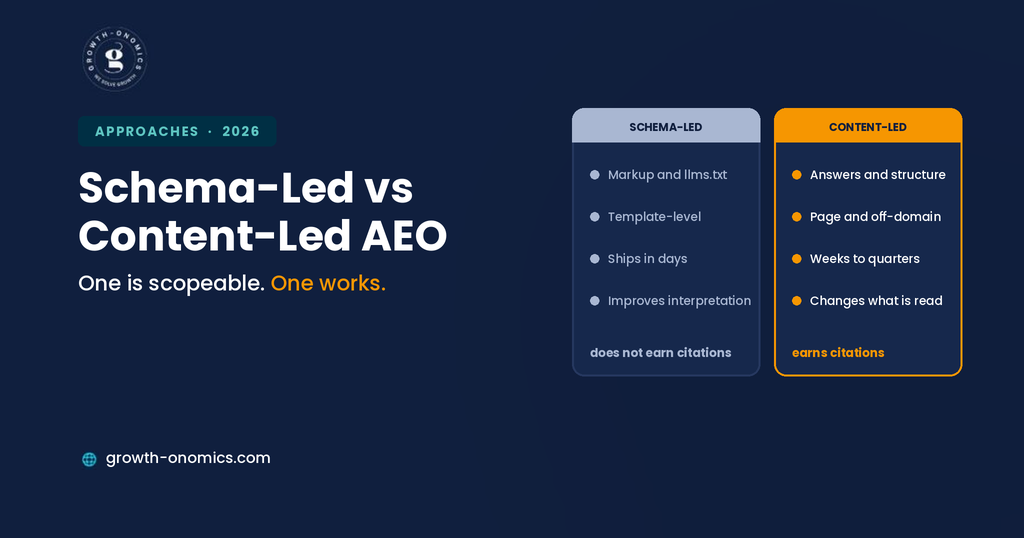
Schema-led AEO treats the problem as machine-readability. The work is structured data markup. Organization, Product, Article, FAQPage, Dataset plus adjacent technical artifacts like llms.txt files, semantic HTML, and entity relationship declarations.
The premise is that answer engines need explicit signals to understand and cite content, and providing those signals produces visibility.
Content-led AEO treats the problem as answerability.
The work is restructuring pages so answers are extractable, publishing the specific content buyers ask about, correcting how the product is described across sources, and earning presence on the third-party platforms models draw from. The premise is that engines cite sources that answer questions well and are corroborated elsewhere.
The framing that causes trouble is treating these as competing strategies. They are different layers, and the interesting question is not which is better but which produces citations and which supports them. That distinction turns out to be sharper than most vendors admit.
It also explains why the two get sold so differently. Schema work has a defined scope, a validation report, and an end date, which makes it easy to price and easy to buy. Content work has none of those properties, which makes it harder to sell and considerably more likely to be the thing you actually need.
Quick Comparison
| Dimension | Schema-Led | Content-Led |
| What it changes | How machines parse your content | What your content says and where it appears |
| Effort profile | Front-loaded, template-level | Ongoing, page-level and off-domain |
| Time to implement | Days to weeks | Weeks to quarters |
| Time to see citations | Not demonstrated | Weeks for restructuring, months for authority |
| Evidence base | Correlation only | Consistent with how retrieval works |
| Risk of overinvestment | High | Low |
| Ceiling | Accurate interpretation | Actual citation |
What Schema-Led AEO Does
Structured data tells a machine what a thing is. Organization markup with a sameAs array connects your site to your verified profiles elsewhere, which helps entity resolution.
Product markup describes what you sell. Article markup declares authorship and modification dates. All of this is genuinely useful, and none of it is controversial.
What it does is reduce ambiguity. A system reading your page has fewer inferences to make about who published it, when it was updated, and what entity it belongs to.
For companies with a common name, a similarly named competitor, or a recently renamed product, that clarity solves a critical issue: being confused with another organization is worse than being unmentioned.
What it does not do is make a page worth citing. A retrieval system selecting sources for an answer is scoring content against a query. Markup describes the content; it does not improve the content’s answer to the question.
A page with flawless markup and no answer to the question being asked loses to a page with no markup and a clear one, which is the whole argument and the reason the evidence looks the way it does.
The Evidence Problem
Here’s where the schema-led pitch runs into difficulty.
The correlation exists. Analyses have repeatedly found that pages cited in AI answers carry structured data far more often than uncited pages. That finding gets quoted constantly, usually without the next paragraph.
The causation is not established. Cited pages also tend to live on larger, better-maintained, more authoritative sites and those sites implement schema as part of routine, alongside every other technical practice. The markup travels with site quality rather than obviously producing it.
The controlled test came back flat. A matched analysis published in 2026 tracked nearly 1,900 pages that added JSON-LD and compared them against control pages with similar citation levels that did not. Across Google AI Overviews, AI Mode, and ChatGPT, citations barely moved. That’s the closest thing this industry has to an experiment, and it points one direction.
Platform statements support interpretation, not preference. Microsoft has said schema helps its systems understand content. Google has said structured data offers an advantage in Search and separately that AI Overviews require no special markup. Interpretation and preference are different claims, and only the first has support.
None of this means schema is worthless. It means the mechanism people attribute to it is not the mechanism it has. Growth-onomics separates technical hygiene from visibility diagnosis when auditing a site for that reason, conflating the two is how a team spends a quarter on markup while the actual gap sits in content and third-party authority.
What Content-Led AEO Does
The content approach targets the mechanism directly, which is why the causal story is simpler.
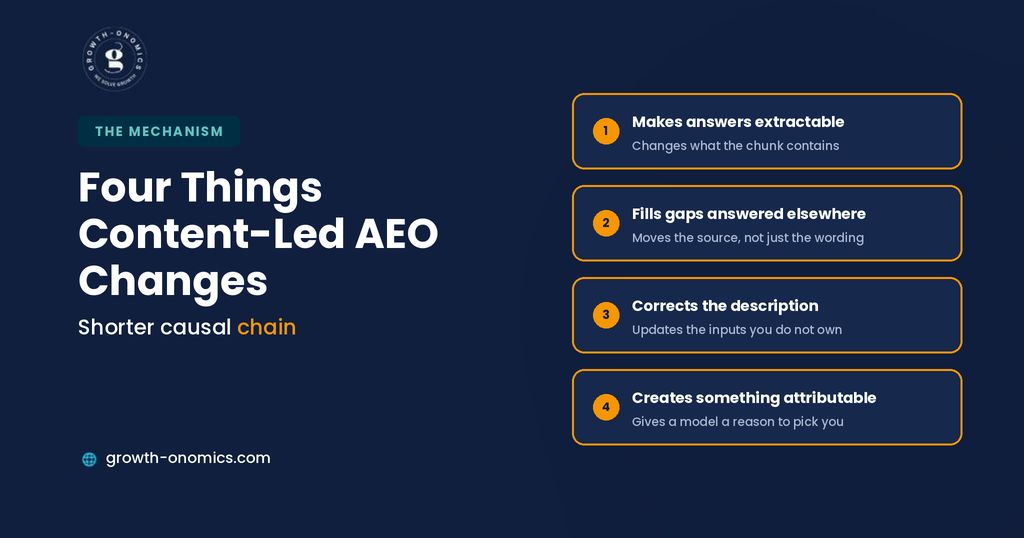
It makes answers extractable. Retrieval works on passages. A definition in the first two sentences under a question-shaped heading scores against a query; the same definition buried in paragraph 9 of a narrative section does not. Restructuring changes what a chunk contains, which changes whether it gets selected.
It fills gaps that generate answers elsewhere. When no page on your site explains your pricing model or confirms an integration, the model answers from a directory listing, a forum post, or a competitor’s comparison page. Publishing the answer moves the source rather than merely improving it.
It corrects the description. A substantial share of what models say about a product comes from review platforms, community threads, and third-party roundups. Updating those changes the input rather than the interpretation, which is the only lever available for content you do not own and the one most teams never pull.
It creates something worth attributing. Original research, named benchmarks, and specific constraints give a model a reason to cite you rather than any of 50 sites saying similar things generically.
Each of these operates on what the system reads and scores. That is a shorter causal chain than “markup makes a system prefer us,” and it matches what the controlled evidence shows.
Why the Content Side Moves Faster
Speed is the specific claim in this article’s title, so it is worth being precise about it.
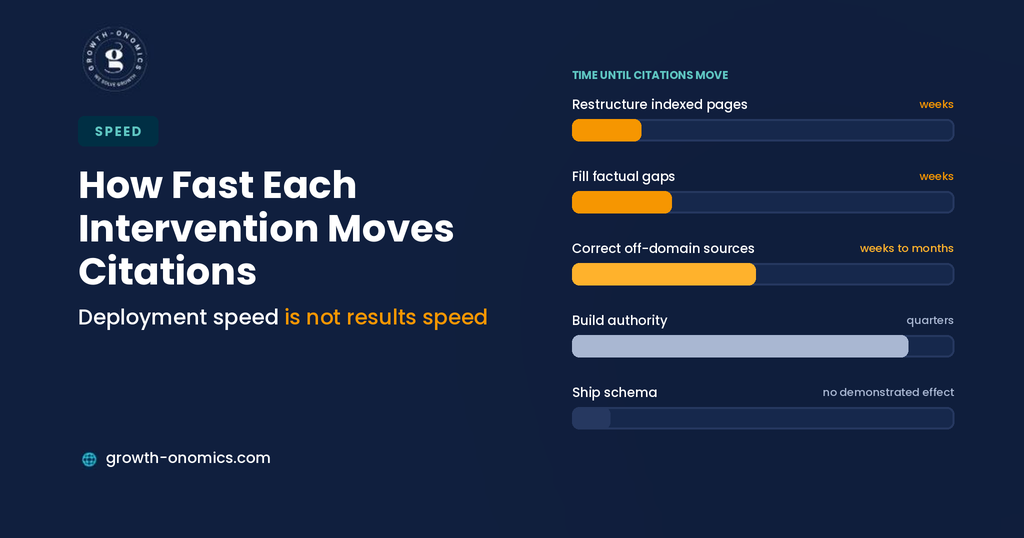
Restructuring an indexed page is the fastest intervention available. The page is already crawled, already ranking, already carrying authority. Changing its internal organization so sections answer directly can register within weeks of the next crawl, because nothing about discovery or trust has to be rebuilt.
Filling a factual gap is nearly as fast. A pricing explainer or integration page on an established domain gets indexed quickly and immediately becomes the best available source for a question that previously had no good answer from you.
Off-domain correction is medium-speed. Updating a review profile or correcting a community thread propagates as those sources get recrawled and reused, which typically takes weeks rather than days.
Authority building is genuinely slow. Earned coverage, original research gaining traction, and consistent expert presence compound over quarters. This is the part of content-led AEO that deserves its reputation for taking time.
Schema implementation is fast to deploy and has not been shown to accelerate citation at all. Template-level markup ships in days, and a validation report arrives the same week. That is deployment speed rather than results speed, and the two get conflated constantly in vendor pitches because one of them is easy to demonstrate.
The practical ranking is therefore clear. If you want citations to move this quarter, restructure existing high-value pages and fill the obvious content gaps. Nothing else on either list is faster.
Where Schema Genuinely Helps
This is not an argument for skipping structured data, and 3 cases justify it independently of citations.
Entity disambiguation. If your company shares a name with another organization, has been renamed, or operates in a category adjacent to a better-known one, Organization markup with a complete sameAs array gives systems something unambiguous to work from. Being confused with a different company is a commercial problem that content alone does not solve, and it is the clearest case where markup does work; no amount of writing can replace it.
Recency signals. Accurate dateModified values in Article markup let systems see that a page was genuinely revised rather than guessing from a copyright footer. Answer engines favor current sources for time-sensitive questions, which describes most B2B software topics, where pricing and capabilities change quarterly.
Product and capability clarity. SoftwareApplication markup describing platforms, features, and pricing structure reduces the chance of a model inferring wrongly from context, provided every marked-up claim matches visible page content.
The cost of doing all 3 is low and the maintenance burden is minimal once templates are set. That is the right way to justify schema: it is cheap technical hygiene that improves accuracy. It is not a visibility lever, and any proposal pricing it as one is mispricing it.
The Sequencing That Works
Neither approach is a strategy on its own. The order matters most.
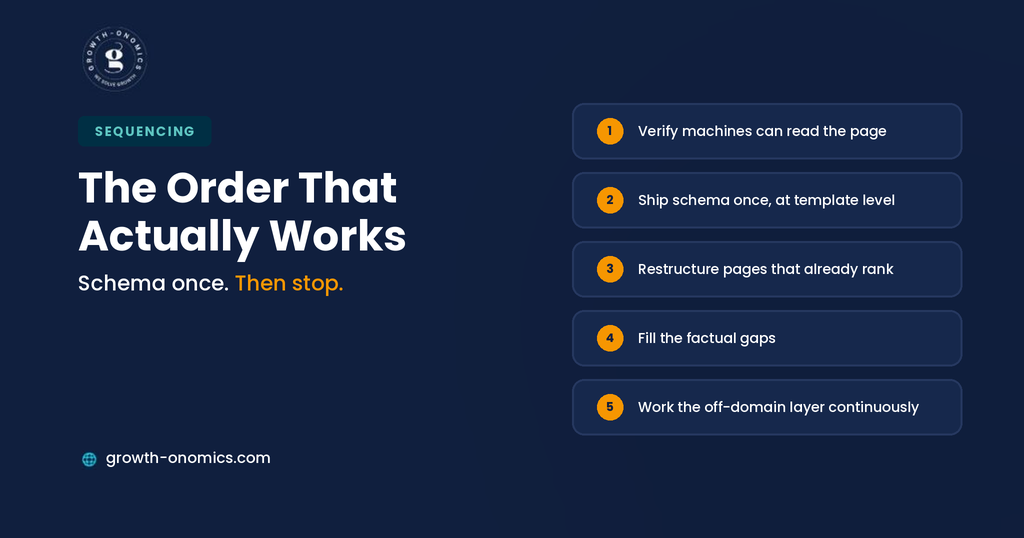
First, verify machines can read the page at all. Raw HTML check on your highest-value pages. If pricing, features, and integrations only appear after JavaScript executes, nothing on either list matters, because most crawlers feeding AI answers do not render. This is the finding that invalidates everything downstream.
Second, ship schema once, at template level. Organization, Article, Product, and BreadcrumbList, generated by the CMS rather than added per page, validated after release. Budget days, not sprints, and then stop; additional markup effort has sharply diminishing returns.
Third, restructure the pages that already earn traffic. Answer-first openings, question-shaped headings, tables for comparisons. This is where the fastest citation gains reside, and it applies to assets you already own, indexed, and carrying whatever authority they have earned.
Fourth, fill the factual gaps. Pricing structure, security documentation, integration pages, comparisons. These answer questions models are currently answering badly from third-party sources.
Fifth, work the off-domain layer continuously. Review profiles, community presence, earned coverage, original research. Slowest to compound, hardest to shortcut, and the reason some competitors seem permanently present in answers.
Growth-onomics scopes engagements in roughly this order: technical verification, then structural refinement, then the brand mentions and listings work because a program that starts at step two and skips step one produces beautifully marked-up pages that no non-rendering crawler has ever read.
How to Tell Which One You Need
3 checks resolve most cases in under an hour.
Ask an assistant to describe your company and product. If the answer confuses you with another organization, uses a product name you retired, or gets your category wrong, you have an entity problem, and schema plus consistent third-party profiles is the relevant fix.
Ask it a commercial question like pricing, integrations, security. If the answer is vague, wrong, or sourced entirely from directories and forums, you have a content gap. No amount of markup fixes a question your site does not answer.
Run your category’s unbranded buying question. If competitors appear and you do not, and your own pages are absent from the cited sources, you have an authority and content problem rather than a parsing problem.
The pattern in most audits is that the entity check passes, the commercial questions fail, and the unbranded query is dominated by third-party sources. That combination points at content and off-domain work, which is precisely the diagnosis that schema-led proposals are designed not to reach. Run the 3 checks before accepting any proposal, because they take an hour and they tell you which conversation you should be having.
Conclusion
The schema-led pitch is appealing because it is scopeable. A defined list of markup types, a two-sprint implementation, a validation report at the end, and a clear sense of completion. Content-led work offers none of that; it is ongoing, it depends on subject-matter input, and its off-domain half cannot be scheduled with any precision.
But scopeability is not evidence. The controlled research on structured data and AI citations came back flat, the platform statements support interpretation rather than preference, and the causal story for content-led work is far shorter: engines cite sources that answer questions well and are corroborated elsewhere.
The honest recommendation is unglamorous. Ship schema once at template level because it is cheap and improves accuracy, then stop. Spend the remaining effort on restructuring pages you already own, filling the factual gaps that models currently answer from directories, and building the off-domain presence that decides whether you are treated as a credible source. That sequence gets you cited faster, and the first two steps are achievable this quarter.
If you want a read on which of those your program is actually missing, the Growth-onomics team can audit the technical, content, and off-domain layers together and tell you where the gap sits rather than which package to buy.
FAQs
Does schema markup increase AI citations?
Not on the available evidence. A matched analysis published in 2026 tracked nearly 1,900 pages that added JSON-LD against comparable control pages and found citations barely changed across Google AI Overviews, AI Mode, and ChatGPT. The correlation people cite, that cited pages carry more schema is genuine but confounded, since cited pages tend to sit on stronger sites that implement schema routinely alongside everything else. Schema helps systems interpret content accurately, which is worth having. Treat it as hygiene supporting accurate representation rather than a lever producing visibility.
How long does content-led AEO take to work?
It depends which part. Restructuring an already-indexed page so sections answer their headings directly can register within weeks, because the page is already crawled and carrying authority; only its internal organization changed. Publishing a missing pricing or integration page on an established domain is nearly as fast. Off-domain correction, such as updating review profiles or fixing community threads, propagates over weeks as those sources are recrawled. Authority building through earned coverage and original research genuinely takes quarters. Sequence accordingly: fast wins first, compounding work started early.
Should I skip schema entirely then?
No, because the cost is low and two problems it solves exist. Entity disambiguation is vital if your company shares a name, was recently renamed, or sits adjacent to a better-known category being confused with a different organization is a commercial problem content cannot fix. And accurate modification dates help systems judge recency, which is crucial in dynamic software categories. Implement Organization, Article, Product, and BreadcrumbList once at template level, validate after releases, keep markup consistent with visible page content, and then redirect the remaining effort to content.
What about llms.txt? Does that count as schema-led AEO?
It belongs to the same category and carries the same caveat. No major model provider has publicly committed to using llms.txt in production retrieval, and Google has stated AI Overviews require no special file. What is established is narrower: AI coding agents and IDE assistants do consume it, which is critical if developers are your buyers, and writing one forces a useful audit of which pages you consider most important. Publish it if it takes an afternoon. Do not let anyone position it as a visibility strategy, because the evidence for that does not exist.
What if a vendor insists schema is the priority?
Ask two questions. First, what evidence supports the claim beyond correlation, specifically, whether they can point to a controlled comparison rather than an observation that cited pages carry more markup. Second, what the proposal would do about the commercial questions your site currently answers badly, since markup does not create an answer that does not exist. A good technical partner will agree that schema is cheap hygiene worth shipping and then talk about content and off-domain work. A proposal built entirely around markup is scoped for what is easy to deliver rather than what is likely to move.
How do I know whether my problem is technical or editorial?
Run 3 checks. Ask an assistant to describe your company; errors here point at entity and technical signals. Ask it a commercial question about pricing, integrations, or security; vague or third-party-sourced answers point at content gaps on your own site. Then ask your category’s main unbranded buying question; if competitors appear and your pages are absent from the cited sources, the gap is content and off-domain authority. Before any of that, check your raw HTML, since a page that only renders with JavaScript fails every test for reasons that have nothing to do with either approach.
