


When it comes to understanding which marketing efforts drive sales, rule-based attribution models offer a clear way to assign credit across customer touchpoints. Unlike machine learning-based methods, these models rely on predefined rules, making them simple to use and interpret. Here’s a quick breakdown:
- Single-Touch Models: Credit goes to either the first or last interaction (e.g., First-Touch or Last-Touch Attribution).
- Multi-Touch Models: Distribute credit across multiple touchpoints (e.g., Linear, Time-Decay, and Position-Based Attribution).
- Key Use Cases: Evaluate top-of-funnel efforts, track final conversion triggers, or analyze the entire customer journey.
- Benefits: Easy to implement, requires minimal data, and works well for businesses starting with attribution analysis.
- Limitations: Oversimplifies customer behavior and lacks the ability to adjust to changing trends.
Rule-based attribution is a practical starting point for marketers, but it’s important to choose the right model based on your goals and sales cycle. The article dives into each model, their strengths, and drawbacks, helping you decide which one fits your needs.
What is attribution? Attribution Models Explained – 2022 Beginner Friendly Tutorial
Types of Rule-Based Attribution Models
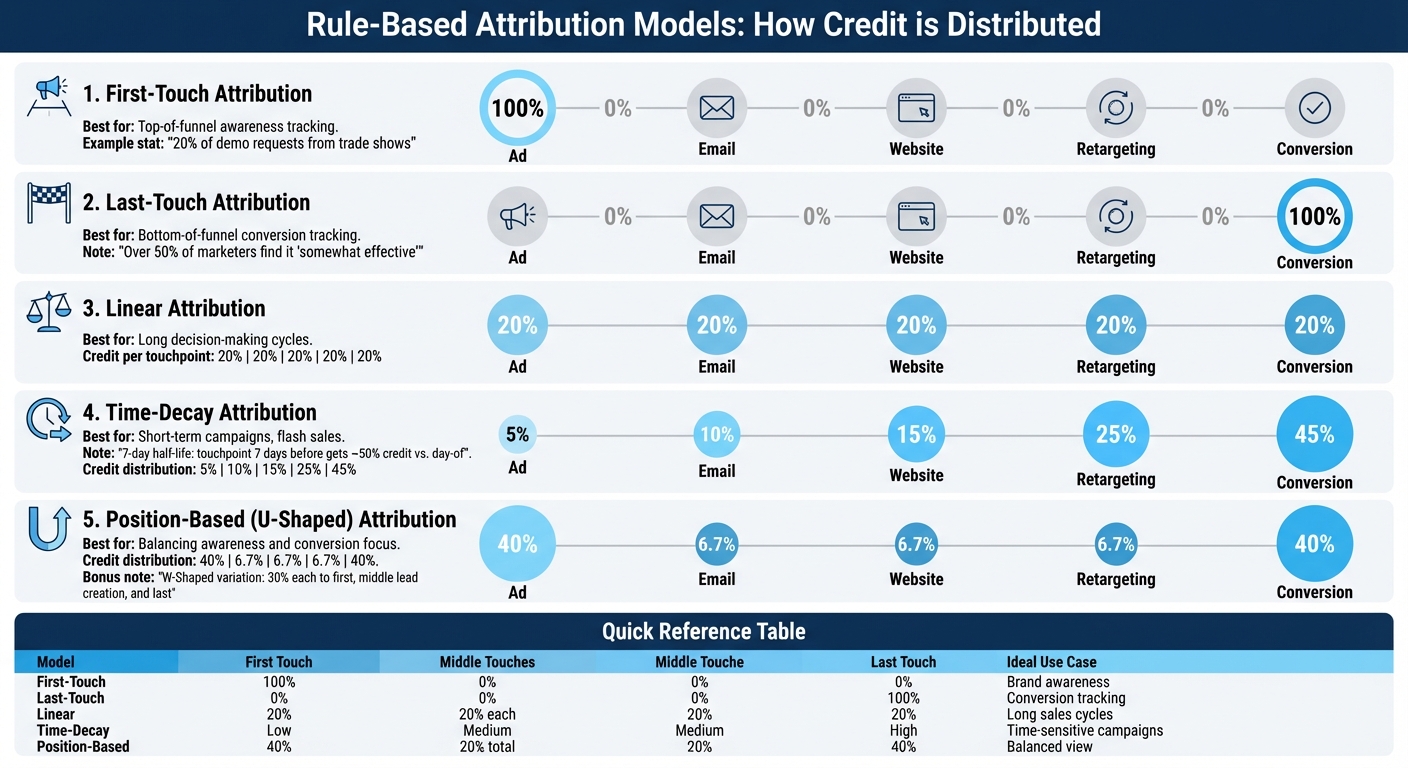
5 Rule-Based Attribution Models Comparison: Credit Distribution and Use Cases
Rule-based attribution models come in five main types, each offering a different perspective on how to evaluate marketing performance. Whether you’re focused on brand awareness, conversion efficiency, or the entire customer journey, there’s a model that aligns with your goals. Here’s a breakdown of each model and its role in understanding marketing impact.
First-Touch Attribution
First-Touch Attribution assigns all the credit to the very first interaction a customer has with your brand. For instance, if a Facebook ad introduces a customer who later converts through other channels, the Facebook ad takes 100% of the credit.
This approach is great for identifying which top-of-funnel channels are driving initial awareness. For example, in a B2B tech scenario, trade show leads accounted for 20% of demo requests when First-Touch Attribution was used to track pipeline drivers.
The downside? It overlooks all subsequent interactions – like nurturing emails, retargeting ads, and sales calls – that play a critical role in converting prospects.
Last-Touch Attribution
On the flip side, Last-Touch Attribution gives 100% of the credit to the final interaction before conversion. For example, if a customer’s last action before purchasing was clicking a Google ad, that ad gets full credit – even if other channels were involved earlier in the journey.
This model is the default in many analytics platforms, and over half of marketers surveyed found it "somewhat effective". It’s especially useful for evaluating bottom-of-funnel performance, like identifying which channels are best at closing sales. For impulse buys – like low-cost e-commerce items – this model often aligns well with reality, as the final ad frequently acts as the tipping point.
However, as Darshil Gandhi, Director of Product Marketing at Amplitude, points out:
"In attributing all credit for the conversion to the last touch, we’re essentially saying that all the emails sent during the week weren’t necessary because they didn’t convert the customer."
A variation called Last Non-Direct Click Attribution excludes direct traffic – like when users type your URL directly – and instead credits the last identifiable marketing channel. This tweak provides a more accurate picture of the effort that drove the final visit.
Linear Attribution
Linear Attribution spreads credit evenly across every touchpoint in the customer journey. For example, if a customer interacts with your brand five times before converting, each interaction gets 20% of the credit.
This model is well-suited for businesses with long decision-making cycles, where multiple touchpoints contribute to the final outcome. It provides a broad view of how various interactions work together. However, by treating all touchpoints equally, it may not fully capture the varying influence of each interaction.
Time-Decay Attribution
Time-Decay Attribution assigns more credit to interactions that happen closer to the conversion. Using a standard 7-day half-life, a touchpoint that occurs 7 days before conversion gets about 50% of the credit compared to one on the day of conversion.
This model is particularly effective for short-term campaigns or scenarios where timing is critical, like flash sales. However, it tends to undervalue earlier touchpoints that initially sparked the customer’s interest, which can be a drawback in longer sales cycles.
Position-Based Attribution
Position-Based Attribution, also known as the U-Shaped model, allocates 40% of the credit to both the first and last interactions, with the remaining 20% distributed among the middle touchpoints. This approach highlights the importance of both initial brand discovery and the final trigger that seals the deal, while still recognizing the role of intermediary steps.
This model is often chosen by marketers who want to balance their focus between awareness-building efforts and final conversion triggers. A more advanced variation, the W-Shaped model, assigns 30% credit each to the first touch, the middle "lead creation" touch, and the final conversion touch.
As the Adobe Experience Cloud Team explains:
"The best model for you will depend on how many touches you typically have before a conversion, and the way those touches are distributed across the sales funnel."
Position-Based Attribution is a solid choice for businesses aiming to get a comprehensive view of their efforts, from creating awareness to driving conversions.
Benefits of Rule-Based Attribution Models
Understanding the benefits of rule-based attribution models helps highlight why they can be a practical choice for many businesses. These models offer a clear and structured approach, making them especially appealing for companies just beginning their attribution efforts or working with limited budgets.
Easy to Understand and Use
One standout feature of rule-based models is their simplicity. Unlike algorithmic models, which often feel like a "black box", rule-based frameworks rely on straightforward, fixed rules. This makes them much easier to explain to stakeholders. When you’re presenting marketing performance to executives or clients, you can clearly outline the logic behind the results without having to dive into complex statistical analyses.
Matt Scharf from Adobe Analytics explains it well:
Think of your attribution model as the blueprint for incentivizing the behavior you want.
Platforms like Google Analytics and Adobe Analytics make this process even easier by offering standardized templates. Adobe Analytics, for instance, provides seven different multi-touchpoint rule-based models. With these ready-made options, businesses can quickly implement attribution tracking without needing custom development.
Minimal Data Requirements
Another key advantage is that these models don’t demand extensive data to deliver results. They work effectively even without large historical datasets or advanced data infrastructures. This is a game-changer for businesses that don’t have all their marketing data centralized or lack a persistent customer identifier to connect various data sources. While algorithmic models typically require a unified data hub – an expensive and time-intensive setup – rule-based models can function well in fragmented data environments. This makes them especially useful for organizations at an earlier stage of analytics development or those operating within tight budgets.
Customizable Rules
Rule-based models also offer flexibility through customization, allowing businesses to adapt the rules and weightings to meet their specific goals. For instance:
- If your priority is building brand awareness, a first-touch model could highlight the effectiveness of top-of-funnel channels.
- For short-term promotions, a time-decay model might be better suited, as it emphasizes interactions closer to conversion.
Many companies use historical data to refine their rules. As Paul Stainton, Director of Content & SEO at AgencyAnalytics, points out:
Rule-based models have the benefit of clarity and ease of implementation, but may hide the nuance of a complex buyer’s journey.
sbb-itb-2ec70df
Limitations of Rule-Based Attribution Models
Rule-based attribution models are straightforward and easy to use, but they come with some serious drawbacks that can lead to flawed marketing decisions. Before relying on these models, it’s essential to understand their limitations.
Oversimplified View of Customer Journeys
One of the biggest issues with rule-based models is that they rely on assumptions rather than actual customer behavior. For example, single-touch models like first-touch or last-touch completely ignore other interactions in the customer journey, often leading to skewed attribution. Imagine a customer first sees a brand awareness ad, explores blog posts, engages with email campaigns, and finally clicks a retargeting ad to convert. A last-touch model would give 100% of the credit to that last click, completely disregarding the earlier touchpoints that played a role.
Even models like the linear attribution method, which spread credit evenly, can oversimplify. They might treat a quick scroll on social media the same as a detailed product evaluation, failing to reflect the true weight of each interaction.
Matt Scharf from Adobe highlights this issue perfectly:
If your perceptions are off, your entire attribution model could go out the window.
This oversimplification not only misrepresents touchpoints but also limits the model’s flexibility.
No Adaptive Learning
Another major flaw is that rule-based models rely on fixed rules and don’t adapt to new data or changing customer behavior. If consumer trends or marketing channels evolve, the model remains stuck in its original framework until someone manually updates it. This can leave businesses making decisions based on outdated insights.
Nielsen emphasizes this problem:
By arbitrarily applying rules, these methods fail to measure the contribution of every touchpoint in the consumer journey accurately, causing marketers to make decisions based on skewed data.
This rigidity can lead to more than just technical issues. Departments might choose models that make their own work look more impactful, creating bias. Without regular reviews – experts recommend at least quarterly updates – businesses risk basing critical decisions on outdated or biased logic. For organizations making significant financial decisions, this is a costly risk.
Comparison Table: Rule-Based vs. Algorithmic Models
Here’s a side-by-side look at how rule-based models stack up against algorithmic alternatives:
| Factor | Rule-Based Models | Algorithmic Models |
|---|---|---|
| Logic Type | Fixed, predefined rules | Dynamic machine learning algorithms |
| Accuracy | Lower; prone to bias | Higher; identifies true influence from data |
| Ease of Use | High; easy to implement | Lower; requires data science expertise |
| Data Requirements | Minimal; works with siloed data | High; needs integrated, quality data |
| Adaptability | None; static rules | Highly adaptable; updates with trends |
| Cost | Low to moderate | High; includes implementation expenses |
| Best For | Small businesses, simple journeys | Large enterprises, complex B2B paths |
Rule-based models can work as a starting point, especially for smaller businesses with limited resources. But as a business grows and customer journeys become more complex, these models may fall short. To address these limitations, combining rule-based attribution with incrementality testing – like geographic holdouts – can help ensure your model reflects reality rather than reinforcing existing biases.
Understanding these challenges is crucial when considering a shift to more adaptive and data-driven strategies.
How to Implement Rule-Based Attribution Models
Start with Basic Models
If you’re just stepping into the world of attribution, it’s best to begin with something straightforward – like a single-touch model such as Last Non-Direct Click. These models are simple to set up and don’t demand extensive data or technical expertise. The Last Non-Direct Click model is especially helpful because it ignores direct traffic (where users type your URL directly) and instead credits the last marketing channel that actively drove the visit. This eliminates unnecessary noise and gives you a clearer view of which campaigns are making an impact.
For businesses with short buying cycles, these basic models can provide quick, actionable insights. Once you’ve established a baseline and gotten familiar with your data trends, you can start exploring multi-touch models, such as Position-Based or Time Decay, to gain a deeper understanding. After selecting a model that fits your needs, the next step is setting it up using an analytics platform.
Use Analytics Platforms
Google Analytics 4 (GA4) is a go-to tool for setting up rule-based attribution across different channels. To configure your model in GA4, navigate to Admin > Data display > Events > Attribution settings. From there, you can choose your model and set a lookback window – typically 30, 60, or 90 days – to capture relevant touchpoints. If your product involves a longer decision-making process, extending the window to 90 days ensures that early interactions aren’t overlooked.
GA4 also offers a Model Comparison Tool, which allows you to compare how different attribution models distribute credit among channels. This feature is invaluable for identifying which channels might be undervalued under your current setup. As explained by Google Analytics Help:
An attribution model can be a rule, a set of rules, or a data-driven algorithm that determines how credit is assigned to touchpoints along a user’s path to completing important actions.
It’s worth noting that in November 2023, GA4 retired several traditional rule-based models, including first-click, linear, time-decay, and position-based.
To maintain accuracy, review your attribution model at least once a year or whenever you make significant changes to your marketing channels. Also, ensure that your Google tags and Conversion Linker tags are active on all confirmation pages to prevent data gaps. Once your platform is set up, you may want to consider seeking professional advice to fine-tune your approach.
Work with Experts for Better Results
While analytics platforms provide the tools, tailoring an attribution model to fit your business goals often requires expert insight. This is where partnering with a performance marketing agency, like Growth-onomics, can make a difference. Their expertise in Customer Journey Mapping and Data Analytics helps businesses pinpoint which touchpoints genuinely influence conversions, moving beyond generic platform defaults to create models that reflect actual customer behavior.
For businesses with complex sales cycles – like B2B companies – or those running multi-channel campaigns, expert guidance ensures your model aligns with the unique dynamics of your funnel. As Chris Larkin, CTO at Arcalea, puts it:
The key is choosing a model aligned with your business’ sales cycle, marketing strategy, and revenue goals.
Professionals can also assist with advanced customizations, such as adjusting credit allocation for specific stages in the journey or exporting hit-level data to tools like BigQuery for deeper analysis. Their expertise ensures you’re interpreting your data accurately, giving you a clearer picture of your marketing performance and channel effectiveness.
Conclusion
Rule-based attribution models offer businesses a way to pinpoint which marketing channels contribute to conversions. Whether you’re using First-Touch to gauge brand awareness or Time Decay for short-term campaigns, these models provide a clear framework for analyzing customer journeys across various channels. This structure is particularly helpful for justifying marketing budgets to stakeholders and making smarter decisions about where to allocate resources.
That said, these models come with limitations. Because they rely on fixed rules, they can oversimplify the complexity of buyer behavior. As Nielsen highlights:
By arbitrarily applying rules, these methods fail to measure the contribution of every touchpoint in the consumer journey accurately, causing marketers to make decisions based on skewed data.
For businesses running multi-channel campaigns or navigating long B2B sales cycles, a single model may fall short of capturing the complete picture.
Selecting the right model starts with understanding its limitations and aligning it with your business goals. For instance, Time Decay works well for short-term promotions, while Position-Based or W-Shaped models are better suited for high-consideration products. As a reminder:
Attribution isn’t just about reporting on what happened. It’s a tool for making decisions.
To address these challenges, consider working with experts like Growth-onomics. Their skills in Customer Journey Mapping and Data Analytics can help you transform raw data into actionable insights that fuel growth.
Start with a simple model, experiment with different approaches, and don’t hesitate to seek expert guidance to make smarter investment decisions.
FAQs
How can I select the best rule-based attribution model for my business?
Picking the right rule-based attribution model comes down to your marketing goals and how your customers engage with your business. These models, such as first-touch, last-touch, or position-based, assign credit to specific touchpoints based on set rules.
Think about what stage of the customer journey you want to emphasize. For example:
- If your focus is on the first interaction that draws attention to your brand, a first-touch model is a solid choice.
- If you’re more interested in the final step that leads to a conversion, then a last-touch model might suit your needs.
For businesses looking to understand how multiple touchpoints work together to drive conversions, a position-based model or other multi-touch options can provide a broader perspective. However, these models often require more data and effort to implement effectively. On the other hand, simpler models are easier to set up but may offer less detailed insights.
The key is to choose a model that aligns with your goals and helps you track and improve your marketing performance. Keep your data, resources, and channel complexity in mind when making your decision.
What’s the difference between rule-based and algorithmic attribution models?
The main distinction between rule-based and algorithmic attribution models lies in how they distribute credit across marketing touchpoints. Rule-based models follow predefined, straightforward rules – such as first touch, last touch, or linear attribution – to assign credit. These models are easy to grasp and implement, but they often oversimplify the customer journey and fail to account for the interplay between different channels.
On the other hand, algorithmic models use data-driven methods, often incorporating machine learning, to evaluate customer behavior. They dynamically assign credit based on the actual impact of each touchpoint, delivering a more precise and flexible analysis. That said, they demand more advanced data capabilities and analytical tools.
In short, rule-based models prioritize simplicity but can lack accuracy, while algorithmic models offer a more detailed understanding but come with added complexity.
Can rule-based attribution models keep up with shifts in consumer behavior?
Rule-based attribution models can adjust to changes in consumer behavior, but their ability to do so hinges on how they’re set up. These models rely on predefined rules to distribute credit across different touchpoints in the customer journey. However, they need manual updates to account for emerging trends or shifts, which makes them less adaptive than models driven by real-time data or machine learning.
To maintain their effectiveness, it’s crucial to frequently review and fine-tune the rules using fresh consumer insights and performance metrics. This helps ensure the model stays in step with changing behaviors and marketing goals.