

Retaining customers is cheaper and more profitable than acquiring new ones. Yet, many businesses fail to measure which retention strategies deliver the best financial returns. This article compares three key strategies – feedback loops, loyalty programs, and onboarding optimization – to help you understand their impact on customer retention and ROI.
- Feedback Loops: Directly address customer concerns, increasing retention by 51% and revenue growth by 41%. They’re cost-efficient and create long-term advocates.
- Loyalty Programs: Reward repeat purchases, with 58% of customers spending more when enrolled. However, they require careful cost management to ensure profitability.
- Onboarding Optimization: Prevents early churn by improving the first 30–90 days of customer experience. Structured onboarding can improve retention by up to 50% and cut support costs.
Quick Takeaway: Feedback loops deliver the highest ROI by tackling churn throughout the customer lifecycle, while loyalty programs and onboarding focus on specific retention stages. Combining these strategies can amplify results.
What Is The ROI Of Customer Retention Strategies?
1. Feedback Loops
Feedback loops are a powerful way to turn customer insights into tangible retention gains. Instead of waiting for customers to voice complaints, these proactive systems actively seek out issues before they escalate into bigger problems. When customers see swift action taken on their feedback, their purchasing behavior can increase by an impressive 46%. This proactive approach lays the groundwork for measurable improvements in retention.
Retention Rate Improvement
Companies that make feedback a priority enjoy a 51% higher retention rate and experience revenue growth 41% faster than their competitors. Top-performing businesses have been able to cut customer attrition by 20% while doubling their revenue growth rate. Even a modest 5% boost in retention can lead to profit increases ranging from 25% to 95%.
Take Allianz, for example. By using customer feedback to address delays in reimbursements, they significantly improved their Net Promoter Score (NPS) and renewal rates. Similarly, Grohe discovered that limiting sales visits to three per customer not only maximized satisfaction but also freed up 25% of their sales team’s capacity.
Cost Efficiency
Feedback loops are also a cost-saving tool. They tackle issues at their root, reducing the volume of support tickets and preventing small problems from snowballing into larger ones.
Retaining customers is far more cost-effective than acquiring new ones. Promoters – those who actively recommend your business – have a lifetime value that’s 600% to 1,400% higher than Detractors. Resolving customer complaints effectively can make 83% of customers feel more loyal to your brand. This creates a base of loyal advocates who drive organic growth through referrals, eliminating acquisition costs and compounding savings over time.
Long-Term ROI
The benefits of feedback loops don’t just stop at retention – they create exponential returns. SaaS companies with a Net Revenue Retention rate above 100% grow nearly twice as fast as their competitors. Loyal customers not only spend more but also become brand ambassadors, driving referrals that fuel growth.
"The real value is not in asking for feedback. It is in turning that feedback into action that customers can see and feel." – Chaviva Gordon-Bennett, Content Strategist, monday.com
Charles Schwab offers a great example of this approach. Every morning, branch managers review customer feedback collected through brief email surveys. This daily ritual ensures that teams can address concerns promptly, often resolving issues before the day even begins. Acting quickly on complaints can dramatically increase repeat business rates, boosting them from 70% to 95%.
2. Loyalty Incentives
Loyalty programs take a unique approach to customer retention by rewarding repeat behavior. Unlike feedback loops, which focus on improving the product itself, loyalty incentives aim to build emotional connections and show appreciation, encouraging customers to return again and again. While both methods contribute to retention ROI, loyalty incentives do so by fostering deeper emotional bonds. The idea is simple: offer customers meaningful rewards for their loyalty.
Retention Rate Improvement
Loyalty programs have a proven track record of increasing customer spending, with 58% of consumers spending more when enrolled in such programs. By offering rewards, these programs encourage repeat business and strengthen customer relationships.
That said, measuring success can be tricky. For instance, 41% of corporate loyalty leaders find it challenging to quantify the financial impact and ROI of their programs. The difficulty lies in distinguishing naturally loyal customers from those genuinely influenced by the program. To address this, businesses can use A/B testing with control groups to pinpoint the true impact of their loyalty efforts. This clarity in measurement paves the way for analyzing cost efficiency.
Cost Efficiency
Running a loyalty program requires both upfront and ongoing investments. These include direct costs like reward liabilities and technology, as well as indirect expenses such as data management and compliance. Despite these costs, loyalty programs can reduce marketing expenses over time. Once you establish a strong base of loyal members, reaching them with new offers or products becomes far more cost-effective than acquiring new customers from scratch.
Long-Term ROI
The benefits of loyalty programs extend well beyond immediate returns. They help build lasting emotional connections and turn customers into advocates for your brand. While feedback loops often deliver quick wins by addressing immediate concerns, loyalty programs focus on creating long-term affinity that keeps customers engaged for years.
"Loyalty programs are no longer just nice-to-haves; they are critical business strategies that drive customer retention, growth and brand loyalty across industries." – EY
To maximize the impact of your loyalty program, integrate its data into your broader marketing strategy. Leverage member preferences and behaviors to create personalized experiences that make customers feel genuinely valued. The ultimate goal isn’t just to encourage repeat purchases – it’s to cultivate advocates who promote your brand naturally, eliminating the need for additional acquisition costs.
sbb-itb-2ec70df
3. Onboarding Optimization
To maximize ROI in retention strategies, an effective onboarding process is crucial. Onboarding provides immediate value to customers, laying the groundwork for long-term retention. While feedback loops refine your product and loyalty programs nurture emotional connections over time, onboarding is all about getting customers to see value fast. This "time-to-value" approach is essential to prevent early churn – a critical point where many retention efforts succeed or fail.
Retention Rate Improvement
A structured onboarding process can improve retention rates by up to 50%. This is particularly important when you consider that about 20% of new customers leave within the first 45 days, often due to poor onboarding. Moreover, 69% of customers are likely to stay with a company for three years or more if their onboarding experience was positive.
But the benefits don’t stop there. Companies with formal onboarding programs report 62% higher productivity among new users, and a well-executed onboarding process can increase engagement by 54%. On the flip side, ineffective onboarding leads to a 33% drop-off rate among users. These early wins in retention not only keep customers engaged but also translate into significant cost savings.
Cost Efficiency
Optimizing onboarding isn’t just about keeping customers – it also saves money. Acquiring new customers can cost up to nine times more than retaining existing ones.
For example, in 2024, TSB Bank partnered with Sprinklr to enhance its customer onboarding experience, saving over 1,000 agent hours annually and reducing first-response times from over two hours to just 21 minutes. Similarly, Canto used Productboard to close information gaps between its Customer Success and Product teams, increasing the product team’s focus by 75% and improving the delivery of features requested during onboarding.
Cost savings multiply when businesses turn to self-service solutions and automation during onboarding. By reducing high-volume interactions, companies can lower their "cost-to-serve" without needing to expand their workforce as they grow. This contrasts with feedback loops, which often require continuous investment in software, implementation, and operational overhead for programs like Voice of the Customer.
Long-Term ROI
The long-term ROI of onboarding optimization follows the 1:10:100 Rule: spending $1 on concept research saves $10 in design changes and avoids $100 in post-release fixes. Investing in user experience early can cut product development cycles by 33% to 50%.
"A rule of thumb is for every one dollar invested in User Experience research you save $10 in development and $100 in post-release maintenance." – Clare-Marie Karat, Principal UX Consultant
McAfee provides a real-world example: the company reduced support costs by 90% by incorporating usability testing to better understand customer needs during onboarding. Additionally, design-driven companies focusing on long-term customer experience outperformed the S&P index by 228% between 2003 and 2013.
While feedback loops help refine products over time, onboarding optimization eliminates potential issues from the start. This proactive approach not only saves money but also builds a deep knowledge base, turning users into loyal brand advocates and creating ROI that compounds over time.
Advantages and Disadvantages
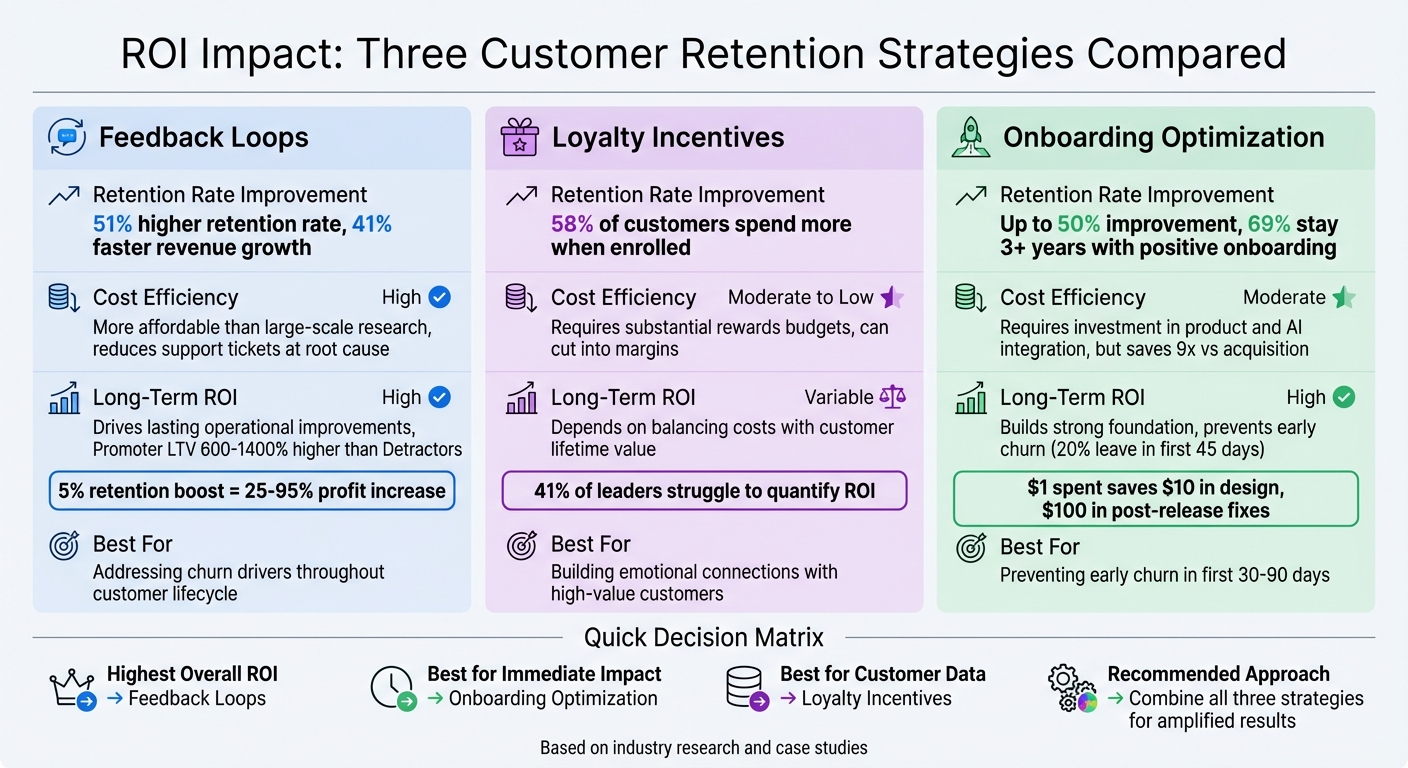
ROI Comparison: Feedback Loops vs Loyalty Programs vs Onboarding Optimization
Every strategy brings its own set of benefits and challenges, shaping how companies approach ROI and customer retention. Let’s break down the strengths and limitations of each method.
Feedback Loops are a powerful tool for quickly identifying critical customer experiences that can make or break satisfaction levels. They’re often a more budget-friendly option compared to large-scale, centralized research efforts. However, their effectiveness hinges on frontline employees being empowered to act on feedback immediately. Without closing the loop, the insights risk becoming theoretical. Historically, these loops have delivered noticeable improvements in metrics like NPS and customer renewals.
Loyalty Incentives shine when it comes to gathering detailed data on a company’s most valuable customers. This allows businesses to offer targeted rewards and recognition. The downside? If not carefully managed, these programs can cut into margins, especially when rewards are extended to lower-value customers. They require a thoughtful investment to ensure profitability. A great example comes from 2025, when True Classic used Saras Analytics to identify high-value customer cohorts. This allowed them to focus rewards on these segments, boosting margins instead of undercutting them.
Onboarding Optimization is key to preventing early churn by ensuring a smooth start for customers. Incorporating feedback into onboarding processes helps refine and improve the experience over time. However, onboarding workflows need regular updates to keep pace with evolving products. When done right, onboarding significantly reduces early churn and sets a strong foundation for long-term customer relationships.
"The greatest impact comes from relaying the results immediately to the employees who just served the customers – and empowering those employees to act on any issues raised." – Rob Markey, Fred Reichheld, and Andreas Dullweber
Here’s a quick comparison of the key ROI metrics for these strategies:
| Strategy | Retention Rate Improvement | Cost Efficiency | Long-Term ROI |
|---|---|---|---|
| Feedback Loops | High; addresses specific churn drivers directly | High; more affordable than large-scale research | High; drives lasting operational improvements |
| Loyalty Incentives | High; prioritizes retaining top customers | Moderate to Low; requires substantial rewards budgets | Variable; depends on balancing costs with customer lifetime value |
| Onboarding Optimization | High; prevents early churn with better UX | Moderate; requires investment in product and AI integration | High; builds a strong foundation for long-term retention |
Conclusion
Drawing from our exploration of feedback loops, loyalty incentives, and onboarding strategies, it’s clear that feedback loops stand out as a more effective way to improve retention. Unlike loyalty incentives that offer short-term rewards or onboarding efforts that primarily focus on the first 30–90 days, feedback loops address the deeper issues that drive churn throughout the entire customer lifecycle.
The numbers back this up. Businesses that emphasize feedback loops report revenue growth 41% faster than their peers, with promoter lifetime values soaring between 600% and 1,400%. Even a modest 5% increase in retention can translate to profit gains of 25% to 95%.
"It’s not the score that matters; it’s what you do with it to make promoters that really counts." – Fred Reichheld, Fellow, Bain & Company
To make the most of feedback loops, adopt a 48-hour response rule and focus your efforts using an impact-effort matrix. Acting on customer feedback builds trust and loyalty – 83% of customers say they feel more connected to brands that listen and take action on their input.
This isn’t about choosing one strategy over another. Feedback loops go beyond the surface fixes of loyalty programs and the limited scope of onboarding. They provide a solid framework for tackling retention challenges at their core. By integrating these practices into your strategy, you can drive meaningful retention improvements and achieve lasting financial results.
FAQs
How can businesses use feedback loops to boost customer retention?
To make the most out of feedback loops for keeping your customers around, start by focusing on 2–3 channels where they’re already active. This could be post-purchase email surveys, in-app prompts, or even phone interviews. Use these channels to ask straightforward, measurable questions like, “How likely are you to recommend us?” This approach helps you collect actionable insights, such as Net Promoter Scores. Gather this feedback in real time and feed it into a live analytics platform. That way, you can quickly spot issues like broken links or frustrating user experiences and fix them right away – boosting your ROI in the process.
Once you’ve got the data, turn it into action. Make sure your team has the tools and authority to address customer concerns immediately. For instance, give employees access to live sentiment scores and empower them to resolve problems on the spot. You can also use AI to detect recurring issues and zero in on high-priority improvements. Don’t stop there – close the loop by letting customers know their feedback made a difference. Share updates about the changes you’ve made based on their input. Finally, keep an eye on retention metrics like repeat purchase rates and churn reduction. This ensures your feedback loop isn’t just running but actively improving the customer experience over time.
What costs should businesses consider when creating a loyalty program?
When creating a loyalty program, it’s important to account for several key expenses that can impact your budget:
- Rewards: Offering points, discounts, free products, or exclusive experiences can become costly, particularly if your program strongly incentivizes repeat purchases.
- Technology: You’ll need to invest in software, app development, and system integrations (like POS or e-commerce platforms) to seamlessly manage rewards and track customer activity in real time.
- Data and Analytics: Gathering, analyzing, and utilizing customer data requires tools and skilled staff. This effort ensures the program evolves effectively and delivers measurable results.
- Marketing and Administration: From designing the program to training staff and running ongoing promotions, you’ll need a budget to keep members engaged and informed.
These expenses should be carefully measured against the cost of acquiring new customers, which is often much higher than retaining existing ones. By managing these factors wisely, businesses can design loyalty programs that not only keep customers coming back but also provide a solid return on investment.
Why is optimizing the onboarding process essential for reducing early customer churn?
Optimizing the onboarding process is essential because it shapes how customers perceive your business right from the start. A well-thought-out onboarding experience makes it easier for customers to grasp the benefits of your product or service, encouraging them to stick around and stay engaged over time.
On the flip side, a confusing or disorganized onboarding process can leave customers feeling lost, frustrated, or even unimportant – paving the way for early churn. By meeting their needs early on and helping them achieve success, you not only establish trust and loyalty but also boost retention rates and see better returns on your investment.