


Want to make your video ad budget work harder? Here’s the bottom line: using multiple platforms like Google, YouTube, and TikTok together can boost purchase rates by 287% compared to sticking with just one. But not all platforms deliver ROI in the same way – each has strengths, weaknesses, and ideal use cases.
Key takeaways:
- Google Video Ads: High purchase intent and ROAS (up to 8:1), but higher costs and reliance on last-click attribution can undervalue its full impact.
- YouTube: Long-term brand trust with a strong ROI (100–250%), but requires significant investment in video production.
- TikTok: Outstanding engagement and ROAS (up to 10:1 for retargeting), but ads need frequent updates due to short content lifespans.
Quick Comparison
| Platform | Primary Strength | Main Weakness | Best Use Case |
|---|---|---|---|
| Google Video | High-intent audiences | Expensive CPCs | Direct response, lead gen |
| YouTube | Long-term visibility | High production costs | Education, storytelling |
| TikTok | Viral reach, low CPC | Short ad lifespan | Rapid awareness, retargeting |
Pro Tip: Use a 70/20/10 budget split – 70% for proven platforms, 20% for extending reach, and 10% for testing new options. Focus on measuring incremental ROI, not just average ROAS, to avoid overspending on saturated channels.
Let’s break down how each platform contributes to your ROI and where your ad dollars will go the furthest.
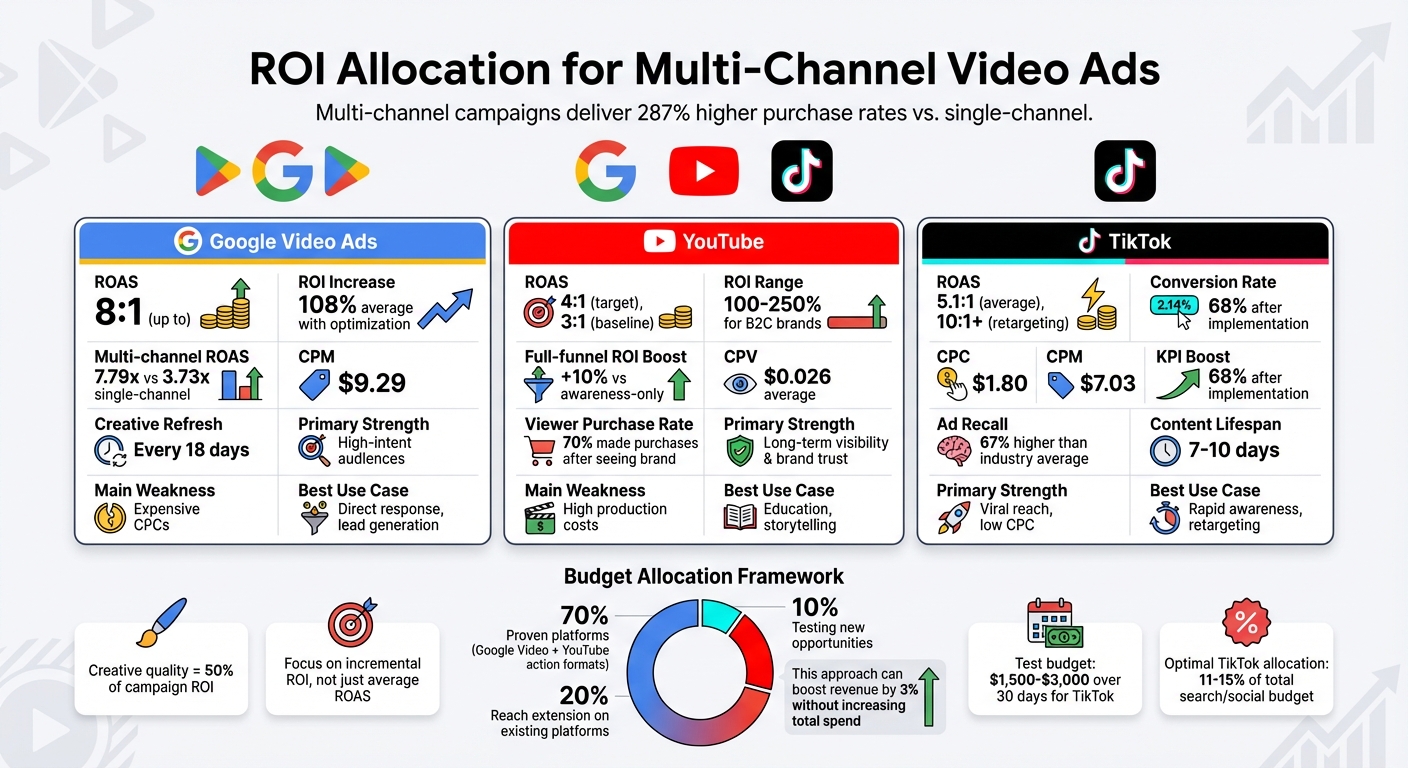
Multi-Channel Video Ad Platform Comparison: ROI, Costs, and Performance Metrics
1. Google Video Ads
ROI Range
When optimized effectively, Google Video Ads can deliver impressive returns. For instance, brands that partnered with Google on marketing mix models saw their YouTube and Google Video return on ad spend (ROAS) increase by an average of 108%. Running campaigns across both channels proved even more effective, achieving a 7.79x return compared to 3.73x from single-channel campaigns. A standout example is Sulwhasoo, a luxury skincare brand from South Korea, which adopted a full-funnel YouTube strategy in June 2022. This approach led to a 91% drop in cost per acquisition and a remarkable 13.8x boost in conversion rate.
Budget Allocation
To maximize results, brands should consider increasing their Google Video ad spend by 2 to 6 times their current levels. Historical campaigns illustrate the potential: a 2015 Snickers campaign saw YouTube delivering over twice the ROI of TV ads, while Danone France’s Danette campaign achieved ROIs that were 2 to 3 times higher. Shifting the focus from average ROAS to incremental ROI can help pinpoint where additional investment will drive the greatest returns.
Key Strengths
Google Video stands out for its ability to integrate seamlessly across the marketing funnel, making it a cornerstone of a well-rounded, data-driven video strategy. Following Google’s "ABCD" creative principles has been shown to deliver a 30% higher sales lift. Additionally, the platform’s Smart Bidding feature – powered by AI – automatically allocates budgets across Search, Display, and Video to secure the highest-ROI conversions in real time. Oreo’s use of Google’s Insights Finder to segment audiences is a great example, as it helped the brand double its YouTube ROI year-over-year.
Weaknesses
Despite its strengths, Google Video Ads come with some challenges. The average CPM sits at $9.29, significantly higher than the $3.44 average for display ads. Moreover, ad creatives that remain unchanged for more than 30 days experience a monthly performance decline of -0.95%, prompting many successful advertisers to refresh their creatives roughly every 18 days. Another limitation is the reliance on last-click attribution, which often undervalues Google Video’s role in building awareness and consideration. This can lead to budget cuts that negatively affect overall channel performance.
Next, let’s take a closer look at YouTube Video Ads to refine multi-channel strategies further.
2. YouTube Video Ads
ROI Range
YouTube delivers a strong 100-250% ROI for European B2C brands when measured over 14-28 day attribution windows. For most B2C businesses, aim for a ROAS of 4:1, with 3:1 being the baseline. However, keep in mind that platform-reported ROAS might overinflate results due to overlapping attribution windows. These performance benchmarks make YouTube a platform worth considering for strategic budget increases.
Budget Allocation
To maximize results, consider increasing YouTube ad spend by 2 to 6 times. The best outcomes often come from a mix of awareness and action-driven ad formats. This full-funnel approach can deliver a 10% higher ROI compared to focusing solely on awareness formats. For example, e-commerce brand Shapermint ran a seven-week campaign in 2022, experimenting with creative elements like testimonials, product demos, and special offers. By fine-tuning their messaging, they reduced their cost per acquisition by 21% and boosted purchases by 50%. Creative testing should also be a key part of your budget, as effective creative contributes to about 50% of a campaign’s total ROI. These strategies align well with YouTube’s strengths in engagement and cost efficiency.
Key Strengths
YouTube stands out from feed-based platforms because its search-driven nature attracts users actively looking for solutions. This leads to higher purchase intent – 70% of viewers say they’ve made a purchase after seeing a brand on YouTube. The platform’s TrueView format adds to its cost efficiency, charging only when users watch 30 seconds or interact with the ad, with an average CPV of just $0.026. Unlike fleeting social media posts, YouTube content remains searchable and evergreen. Brands can also safely increase weekly ad frequency from one to three exposures without losing effectiveness. TrueView’s pay-per-engagement model ensures efficient use of ad budgets while maintaining control over exposure and user experience.
Weaknesses
Despite its advantages, YouTube video ads come with some challenges. Its 28-day view-through attribution window can overstate results, making independent econometric modeling necessary to measure true incrementality. Additionally, pushing budgets too far can lead to diminishing returns. For instance, one retail brand saw ROI drop from 2.8:1 to 1.2:1 after exceeding a certain weekly spend threshold. Mobile optimization is another critical factor, as repurposing desktop-focused assets for YouTube Shorts often underperforms. Lastly, about 30% of YouTube’s total sales impact occurs in the weeks following a campaign, complicating immediate performance evaluations.
How to Track REAL Marketing ROI (Not Just Attribution) | The Ad Lab Live! EP046
sbb-itb-2ec70df
3. TikTok Video Ads
TikTok offers unique return-on-investment (ROI) characteristics that can fine-tune your multi-channel ad strategy.
ROI Range
TikTok delivers an impressive 5.1:1 ROAS – outperforming YouTube (4.5:1), Instagram (4.2:1), and Facebook (3.8:1). While a "good" ROAS typically ranges between 3:1 and 4:1, retargeting campaigns on TikTok can push this to 10:1 or more. The platform also boasts a conversion rate of 2.14%, which is higher than Instagram (1.85%) and YouTube (1.8%). Additionally, TikTok campaigns show a 68% boost to primary KPIs after implementation. Beyond digital sales, every dollar earned through TikTok ads generates an extra $0.34 on Amazon and $0.57 in physical retail locations.
Budget Allocation
To test TikTok effectively, allocate between $1,500 and $3,000 over a 30-day period to gather actionable insights. Most brands achieve the best results by dedicating 11–15% of their total search and social budget to TikTok. However, allocating more than this can lead to diminishing returns.
A balanced approach works best: split the budget between prospecting (targeting new audiences) and retargeting (re-engaging previous visitors). Prospecting typically achieves a 1.5x–2.5x ROAS, while retargeting drives higher profit margins. For example, Willow Boutique, an e-commerce brand, used a combination of TikTok Shop video ads and organic content in 2025 to achieve an 8x ROAS, with 69% of sales directly attributed to TikTok ads. They also slashed their cost per acquisition by 65%.
Given TikTok’s fast-paced environment, where creative content often "burns out" after 7–10 days, regularly refreshing ads with native, low-fidelity content is crucial to maintaining its 50%+ contribution to sales growth.
Key Strengths
TikTok is known for its cost efficiency. Its average cost-per-click (CPC) is $1.80 – cheaper than Instagram ($2.50) and Facebook ($2.85). The average cost-per-thousand impressions (CPM) is $7.03, which is below the industry standard of $8.00–$12.00. With users spending approximately 95 minutes per day on the app, brands benefit from extended audience exposure. TikTok ads also have a 67% higher ad recall rate than the industry average, and videos under 15 seconds achieve a 73% completion rate.
The TikTok Shop integration further boosts performance, driving 40% higher conversion rates by simplifying the checkout process. These efficiencies make TikTok a valuable addition to any video ad strategy. As Eric Siu, CEO of Single Grain, explains:
The mistake many brands make is assuming TikTok is still just for teenagers. The platform has matured, and so has its audience. What makes TikTok ads worth the investment is their ability to reach diverse demographic segments with highly targeted creative.
Weaknesses
One of TikTok’s challenges is the need for constant content production. Ads often lose effectiveness after just 7–10 days. High-quality, traditional ads tend to underperform compared to authentic, low-budget content, meaning repurposing assets from platforms like YouTube or TV is rarely successful.
Additionally, TikTok’s conversion algorithm is considered less advanced than those of Meta or Google for bottom-of-funnel purchases. Ad sets also require 50 conversions to exit the learning phase, which can delay optimization.
For instance, RentSocial, a multifamily housing company, overcame these challenges by tailoring native content and using precise geographical targeting. This approach helped them achieve a $4.00 cost per lead, a 27% higher click-through rate (CTR), and a 16% lower CPC compared to industry averages.
These factors highlight TikTok’s potential, as well as the effort required to maximize its effectiveness within a broader advertising strategy.
Pros and Cons
Let’s break down the key strengths and weaknesses of each platform to understand how they influence ROI and guide budget allocation. Each channel has its own unique features that can either work in your favor or present challenges, depending on your goals.
Google Video Ads stands out with an impressive average ROAS of 8:1 for search campaigns. This makes it a go-to for capturing high-intent users actively looking for solutions. On the flip side, it comes with higher CPCs in competitive niches and requires a strong grasp of keyword research to succeed. While it’s excellent for direct response and lead generation, its technical setup can feel a bit daunting compared to social platforms.
YouTube is more of a long-term play, with content that continues to generate leads for years. Creative quality plays a massive role here, accounting for nearly 50% of ROI. Ads following the "ABCD" principles even see a 30% boost in sales lift. The catch? Producing high-quality content takes time and money, requiring a significant upfront investment.
TikTok is known for its viral potential, boasting engagement rates that are 3–9x higher than other platforms. Even brand-new accounts can achieve massive reach, regardless of their follower count. However, TikTok’s content has a short shelf life – just 72 hours, which means you’ll need to constantly refresh your creative to avoid ad fatigue. It also demands higher daily budgets of $20–$50 and tends to work best for younger audiences rather than broad demographics.
| Platform | Primary Advantage | Main Disadvantage | Best Use Case |
|---|---|---|---|
| Google Video Ads | Highest ROAS (8:1) and strong purchase intent | High CPC in competitive niches | Direct response and lead generation |
| YouTube | Long-term SEO value and brand trust | Substantial production time and cost | Full-funnel education and storytelling |
| TikTok | High viral reach and 3–9x engagement | 72-hour content lifespan | Rapid awareness and impulse purchases |
This comparison highlights why a balanced, data-driven approach is crucial when planning your video ad strategy. Each platform plays a distinct role, and leveraging their combined strengths can lead to better overall performance across your campaigns.
Conclusion
When it comes to allocating your video ad budget across platforms like Google, YouTube, and TikTok, the goal isn’t to crown a single winner. Instead, it’s about understanding how each platform contributes to your overall success. The numbers tell a compelling story: campaigns that leverage three or more channels see a 287% higher purchase rate compared to single-channel efforts. This isn’t just about dividing your budget – it’s about creating synergy, where each platform complements the others at various stages of the customer journey.
A smart way to approach this is by following the 70/20/10 budget framework. Allocate 70% of your budget to reliable performers like Google Video Ads and YouTube action formats, 20% to extending your reach on platforms you already use, and 10% to experimenting with new opportunities. This balanced strategy ensures stability while leaving room for innovation. Businesses applying this method have reported up to a 3% revenue boost without increasing their total spend.
Instead of focusing solely on average ROAS, shift your attention to incremental ROAS and keep an eye on investment sensitivity curves. This helps you recognize when a channel is nearing saturation, allowing you to redirect your budget to less saturated platforms and avoid diminishing returns.
Another key factor? Creative quality. It’s not just about where your ads run but how they resonate. Creative execution accounts for about 50% of your campaign’s ROI. Whether it’s crafting vertical, attention-grabbing videos for TikTok or adhering to YouTube’s ABCD principles, your content must feel authentic and tailored to each platform’s audience.
If juggling a multi-channel video ad strategy feels like a lot, Growth-onomics can help. Their expertise in performance marketing, conversion tracking, and strategic budget allocation can guide you toward a video ad strategy that drives measurable results throughout the customer journey.
FAQs
What’s the best way to allocate my video ad budget across Google, YouTube, and TikTok?
To make the most of your video ad budget across Google, YouTube, and TikTok, it’s important to leverage the strengths of each platform while staying aligned with your campaign goals. Google shines when it comes to intent-driven actions like search and display ads. YouTube is perfect for delivering compelling stories through video, and TikTok excels at connecting with younger audiences through viral, trend-focused content.
Start by diving into performance data to pinpoint which platforms are delivering the best ROI for your specific objectives. A practical approach is to allocate around 70% of your budget to tried-and-tested channels, such as search and retargeting, while setting aside the remaining 30% to experiment with new platforms or creative ideas. Keep a close eye on metrics like CPA (Cost Per Acquisition), ROAS (Return on Ad Spend), and CTR (Click-Through Rate). Adjust your budget dynamically based on these insights to ensure your spending generates the best possible returns. Using this adaptable, data-driven approach will help you get the most out of your ad investment.
What is the 70/20/10 budget allocation strategy, and how can it boost ROI for video ads?
The 70/20/10 budget allocation strategy is a smart way to divide your marketing budget to balance steady performance with opportunities for growth and experimentation. Here’s how it works: 70% of your budget goes to tried-and-true platforms that consistently deliver results, 20% is allocated to emerging or experimental platforms that show promise, and 10% is reserved for entirely new ventures to explore fresh channels or ideas.
This method ensures most of your resources are invested in reliable strategies while leaving room to test and adapt to new trends. For example, when running video ads, applying this strategy across platforms like Google, YouTube, and TikTok can help you maintain consistent returns while uncovering exciting new paths for growth.
Why should I prioritize incremental ROI over average ROAS when allocating video ad budgets?
Focusing on incremental ROI is important because it shows the extra value your ad spend creates, rather than just summarizing past results. This perspective allows you to pinpoint which channels are genuinely contributing to growth and ensures your budget is spent where it matters most.
By concentrating on incremental ROI, you can make more informed, data-backed decisions to fine-tune your ad strategies across platforms like Google, YouTube, and TikTok. This not only boosts your campaign performance but also helps you get the most out of your investment.