


RFM analysis is a simple yet effective way to identify your most valuable customers based on three key metrics: Recency (last purchase date), Frequency (how often they buy), and Monetary Value (how much they spend). By assigning scores to these metrics, businesses can segment customers into actionable groups, such as "Champions" (top-tier buyers) or "At-Risk" customers (those likely to churn).
When combined with Customer Lifetime Value (CLV) – a measure of total revenue a customer is expected to generate – RFM insights help businesses focus on high-value customers, reduce churn, and improve marketing efficiency. For example:
- Retention: A 5% boost in retention can increase profits by 25%-95%.
- Targeted Campaigns: Tailored strategies can increase engagement by 20% and campaign performance by 25%.
- Cost Savings: Retaining customers is 5-25x cheaper than acquiring new ones.
Whether you’re in e-commerce, subscription services, or retail, RFM analysis can transform customer data into smarter marketing strategies that drive growth.
What The RFM Model Can Teach You About Your Customers
Key Benefits of Using RFM Analysis for CLV
By linking RFM analysis with Customer Lifetime Value (CLV), businesses can make smarter marketing choices. The key benefits include precise segmentation, better retention, and smarter spending on marketing.
Better Customer Segmentation
RFM analysis focuses on customer purchase behavior to create detailed segments. For example, you can identify "Champions" who are your most loyal and valuable customers, "Potential Loyalists" who might need encouragement to make another purchase, and "At-Risk" customers who require attention to prevent churn.
Consider this: a customer with an RFM score of 555 (high-value) is treated differently from one with a 311 score (low-value). This tailored approach has been shown to increase marketing ROI by up to 77% and boost email click-through rates by 50%. Such segmentation allows for hyper-targeted retention strategies that truly resonate.
Higher Customer Retention Rates
RFM analysis acts as an early warning system for customer churn. For instance, if a high-value customer’s Recency score drops, it might indicate they’re exploring competitors – often before other metrics reveal a problem. This insight gives businesses the chance to launch personalized win-back campaigns before it’s too late.
Take Digital Trawler’s success story: over a six-month period, they applied RFM analysis for a B2B SaaS company with 2,000 active customers. By tailoring offers based on recent engagement, they achieved a 15% increase in customer retention and a 10% rise in Average Order Value. Similarly, a retail business used RFM to re-engage 1,500 dormant customers who hadn’t interacted in six to 12 months. Their four-month campaign, featuring personalized incentives, revived 22% of those inactive customers.
These examples highlight how RFM analysis can drive retention and increase revenue when paired with CLV-focused strategies.
More Efficient Marketing Budgets
RFM analysis helps businesses spend their marketing budget more effectively. Instead of sending expensive direct mail to every customer, you can focus high-cost efforts on your most valuable segments, like "Champions." Meanwhile, more cost-effective strategies, such as automated emails, can target less engaged groups like "Hibernating" customers. This ensures every dollar is spent where it matters most, maximizing returns.
Industry Use Cases for RFM Analysis
RFM analysis finds applications across a variety of industries, with each tailoring the framework to address specific business challenges. Let’s dive into how e-commerce, subscription services, and retail businesses leverage RFM to maximize customer lifetime value.
E-commerce: Driving Repeat Purchases
Online retailers rely on RFM to analyze customer buying behavior, segmenting shoppers based on when they last made a purchase (Recency), how often they shop (Frequency), and their spending patterns (Monetary value).
For instance, a fashion e-commerce brand partnered with Cache Merrill, Chief Product Officer at Zibtek, to apply RFM analysis over three months. By targeting high-value customers who had recently purchased and using customized RFM cutoffs, the brand saw a 25% improvement in campaign performance within six to eight weeks.
Different customer segments receive tailored strategies. High-scoring "Champions" enjoy VIP perks and early access to collections, while "Promising" shoppers receive personalized product recommendations to encourage higher spending. If a customer’s recency score drops, automated win-back emails are triggered, aiming to re-engage them before they churn.
"Why am I sending the same offers to a $20 customer that I would give my $100 customer?" – Jimmy Kim, CEO of Royal Prospect
This approach works because personalization matters. Studies show that customers spend 38% more when their experience is tailored, and 56% of consumers become repeat buyers following personalized interactions. The success of these strategies offers a blueprint for subscription businesses to tackle their own challenges.
Subscription Services: Reducing Churn
For subscription-based businesses, the focus shifts from transactions to engagement metrics. Many replace Monetary value with indicators like login frequency, time spent on the platform, or feature usage.
Neptune.AI, a platform for machine learning teams, used RFM analysis alongside their CRM to address user engagement concerns. They hosted exclusive webinars and showcased new features to "low-recency, high-value" users, demonstrating the platform’s evolving capabilities. The outcome? A 20% boost in engagement rates, a 15% drop in churn, and a 10% increase in customer lifetime value over the campaign period. Such proactive strategies help secure long-term revenue by addressing dissatisfaction early.
Declining recency scores often signal potential churn, indicating that high-value users might be exploring competitors or feeling disengaged. For these cases, personal outreach to identify and resolve issues is more effective than offering generic discounts.
"Use RFM scores as an early warning system. Declining scores often signal churn risk before other metrics show problems." – HubSpot
Brick-and-mortar retailers also harness RFM to create targeted, in-store experiences that resonate with their customers.
Retail: Personalizing In-Store Promotions
Physical retailers apply RFM analysis to craft in-store promotions that align with specific customer behaviors. Instead of blanketing all shoppers with the same offers, they tailor campaigns based on proven purchasing patterns.
By segmenting customers based on in-store activity, retailers replicate the precision of online strategies. For example, "Champions" with top-tier 5-5-5 scores are invited to exclusive VIP events or offered personal shopping services – initiatives that build loyalty without sacrificing profit margins. Meanwhile, "Loyalists", who visit frequently but spend less, are incentivized with offers like "Spend $100, get $20 off" to encourage higher spending. For "At-Risk" customers with declining recency scores, automated "We Miss You" campaigns are deployed to re-engage them.
This segmentation aligns with the 80/20 rule, where approximately 80% of a retailer’s revenue comes from just 20% of its customers. By focusing on high-value segments, retailers can allocate their marketing budgets where they’ll see the greatest return.
sbb-itb-2ec70df
How to Implement RFM Analysis: Step-by-Step
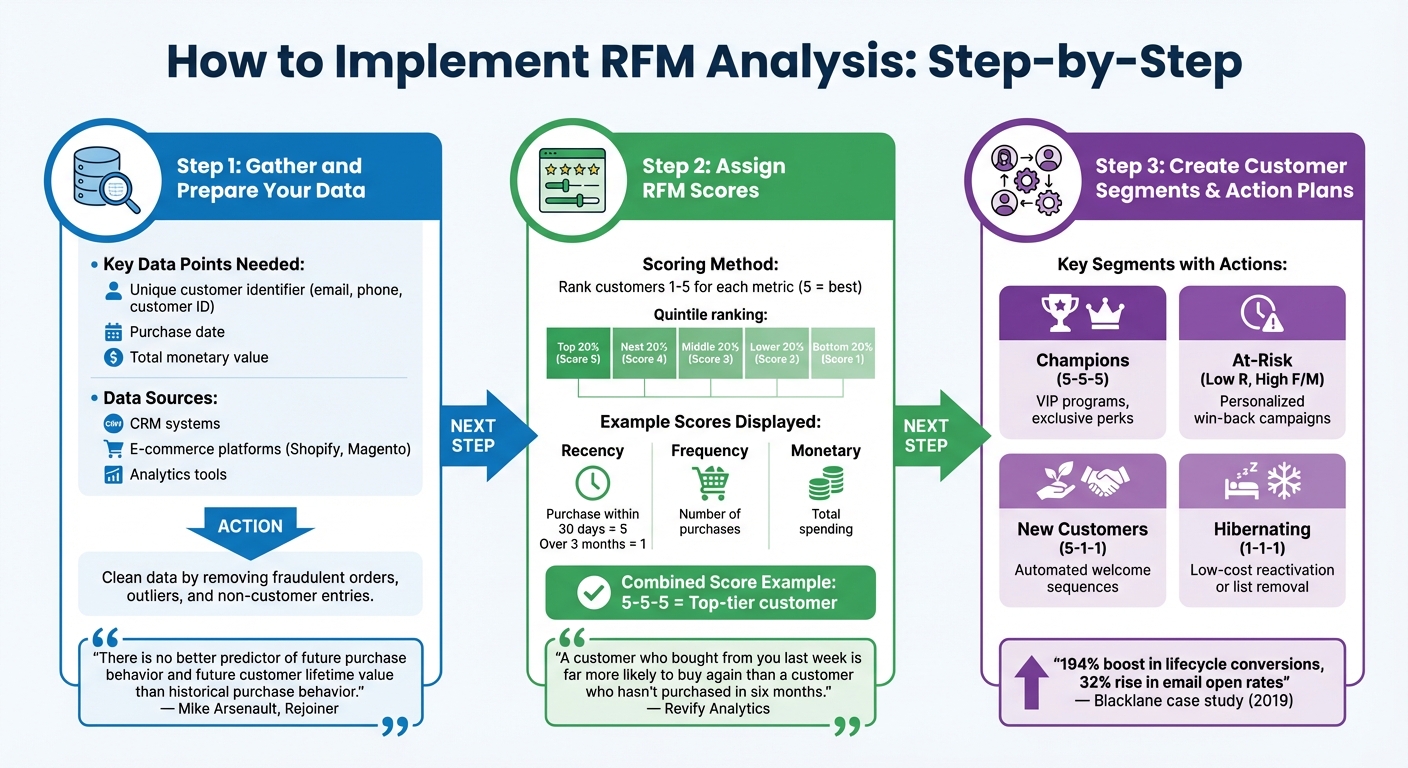
RFM Analysis Implementation: 3-Step Process for Customer Segmentation
Gathering and Preparing Your Data
To kick off RFM analysis, gather three key data points for every transaction: a unique customer identifier (like an email, phone number, or customer ID), the purchase date, and the total monetary value. This data is usually exported from CRM systems, e-commerce platforms (such as Shopify or Magento), or analytics tools in a CSV format.
Before diving into analysis, make sure your dataset is clean. Eliminate fraudulent orders, outliers, and non-customer entries. Then, aggregate transactions for each customer to calculate their Recency, Frequency, and Monetary values.
"There is no better predictor of future purchase behavior and future customer lifetime value than historical purchase behavior."
- Mike Arsenault, Founder & CEO, Rejoiner
When calculating Monetary value, more advanced approaches factor in net revenue by including discounts, rebates, and shipping costs. If your business serves both wholesale and retail customers, it’s wise to analyze these groups separately since their purchasing habits and average order values can vary greatly.
Assigning RFM Scores to Customers
Next, rank customers on a scale of 1 to 5 for each category – Recency, Frequency, and Monetary value – where 5 represents the most favorable behavior. A common method is quintile ranking: sort customers by each metric and split them into five equal groups. The top 20% earn a score of 5, the next 20% a score of 4, and so on.
Alternatively, you can use fixed ranges. For example, a purchase made within the past 30 days might score a 5 for Recency, while a purchase made over three months ago might score a 1. The definition of "recent" varies by industry – a grocery store might consider purchases within the last week as recent, whereas a luxury car dealership might use a six-month timeframe. Combining these scores into a three-digit code (e.g., 5-5-5) creates a straightforward way to categorize customers, with a 5-5-5 customer being top-tier across all dimensions.
"A customer who bought from you last week is far more likely to buy again than a customer who hasn’t purchased in six months, regardless of their past spending habits."
To maximize efficiency, automate score updates in real time. This allows you to trigger targeted marketing workflows based on the latest customer behavior. Once scores are assigned, the next step is turning these insights into actionable customer segments.
Creating Customer Segments and Action Plans
With RFM scores in hand, segment your customers based on their combined scores. For example:
- Champions (5-5-5): These are your best customers. Instead of offering discounts, focus on VIP programs or exclusive perks to maintain their loyalty while protecting your profit margins.
- At-Risk Customers (low Recency but high Frequency and Monetary scores): These customers need personalized win-back campaigns to re-engage them before they churn.
A real-world example: In 2019, Blacklane used RFM-based segmentation with Braze to categorize chauffeur service users by activity and value. This approach led to a 194% boost in lifecycle conversions, a 32% rise in email open rates, and a 51% drop in the unsubscribe-to-open rate. The key was tailoring actions to specific segments rather than sending generic offers to everyone.
Focus on impactful segments. For instance:
- New Customers (5-1-1): Use automated welcome sequences to guide them toward a second purchase.
- Hibernating Customers (1-1-1): Consider low-cost reactivation campaigns or even removing them from your list to reduce marketing expenses.
Conclusion: Using RFM Analysis to Grow Your Business
RFM analysis transforms how businesses engage with customers by focusing on their actual purchasing behavior – a reliable indicator of future buying trends and Customer Lifetime Value (CLV). Instead of relying on guesswork, you use solid data to identify who’s likely to buy again, who might churn, and where your marketing efforts will have the most impact. These insights provide a clear path for strategies that deliver measurable results.
Consider this: a 5% increase in customer retention can lead to a profitability boost ranging from 25% to 95%. By prioritizing high-value customers, you cut down on wasted marketing spend and move away from reactive discounting toward proactive, data-driven engagement. Companies like Neptune.AI and Digital Trawler showcase the potential of RFM strategies, reporting up to a 20% increase in engagement, a 15% drop in churn, and a 10% rise in CLV. These aren’t just projections – they’re real outcomes achieved by businesses that shifted from manual analysis to automated, real-time systems.
Start by focusing on three key customer segments: Champions, At-Risk Customers, and New Buyers. Automating score updates ensures your marketing adapts instantly to changes in customer behavior. Using percentiles instead of fixed dollar thresholds keeps your model scalable as your business grows. And remember, it’s up to 10 times cheaper to sell to an existing customer than to acquire a new one.
RFM analysis isn’t just about crunching numbers – it’s about turning customer behavior into actionable strategies that drive ongoing growth. When paired with advanced analytics and customer journey mapping, RFM insights create a feedback loop of smarter engagement and continuous improvement. At Growth-onomics, we specialize in helping businesses implement these data-driven approaches to maximize customer value and achieve tangible success.
FAQs
How can RFM analysis help boost customer retention?
RFM analysis is a method used to enhance customer retention by grouping customers based on three key factors: Recency (how recently they made a purchase), Frequency (how often they shop), and Monetary value (how much they spend). This approach helps businesses pinpoint their most valuable customers, reconnect with those who have stopped engaging, and fine-tune marketing efforts to address specific customer preferences.
With these insights, businesses can craft personalized promotions, elevate customer experiences, and foster stronger connections. The result? Improved retention rates and loyalty that lasts over time.
Which industries benefit the most from using RFM analysis?
Industries with regular customer engagement and large volumes of transactional data – like retail, e-commerce, and consumer goods – gain the most from RFM analysis. By assessing customer behavior through recency, frequency, and monetary value, these businesses can pinpoint their most valuable customers, fine-tune marketing efforts, and increase customer lifetime value (CLV).
Beyond these, sectors such as distribution, manufacturing, and private equity also benefit from RFM analysis. It helps them sharpen customer segmentation, adjust pricing strategies, and streamline operations. Essentially, any industry with a broad customer base and access to transaction data can use RFM analysis to strengthen customer loyalty, retention, and overall profitability.
How can businesses automate RFM scoring for real-time marketing?
Automating RFM scoring for real-time marketing means setting up a system that continuously collects, processes, and updates customer data. By using tools like SQL or Python, businesses can bring together transactional, demographic, and behavioral data into one central platform. From there, algorithms or machine learning models take over, calculating Recency, Frequency, and Monetary scores for each customer automatically.
To keep these scores accurate and up-to-date, advanced systems can process new data as it comes in, instantly adjusting customer segments based on recent transactions. This setup allows marketers to act fast with tailored offers, retention plans, or promotions aimed at their most valuable customers. Through automation, businesses can make their marketing more timely and relevant, boosting customer engagement and increasing lifetime value.