


Retention saves money; acquisition drives growth. Acquiring new customers can cost 5 to 25 times more than retaining existing ones. Boosting retention by just 5% can increase profits by 25% to 95%. Meanwhile, rising ad costs and lower conversion rates make acquisition more expensive and less efficient over time.
Key Takeaways:
- Retention: Costs less, higher conversion rates (60-70%), and leads to increased spending (31% more per transaction).
- Acquisition: Expands your customer base but comes with high upfront costs and lower conversion rates (5-20%).
- Retention vs. Acquisition: Balance both strategies for sustainable growth. Retention ensures profitability, while acquisition fuels expansion.
| Feature | Customer Retention | Customer Acquisition |
|---|---|---|
| Cost | Lower | 5-25x higher |
| Conversion Rate | 60-70% | 5-20% |
| Customer Behavior | More loyal, spends 31% more | Price-sensitive, less loyal |
| Long-Term Impact | Higher profitability | High churn risk |
Retention builds long-term success, while acquisition helps grow your market presence. Smart businesses use both.
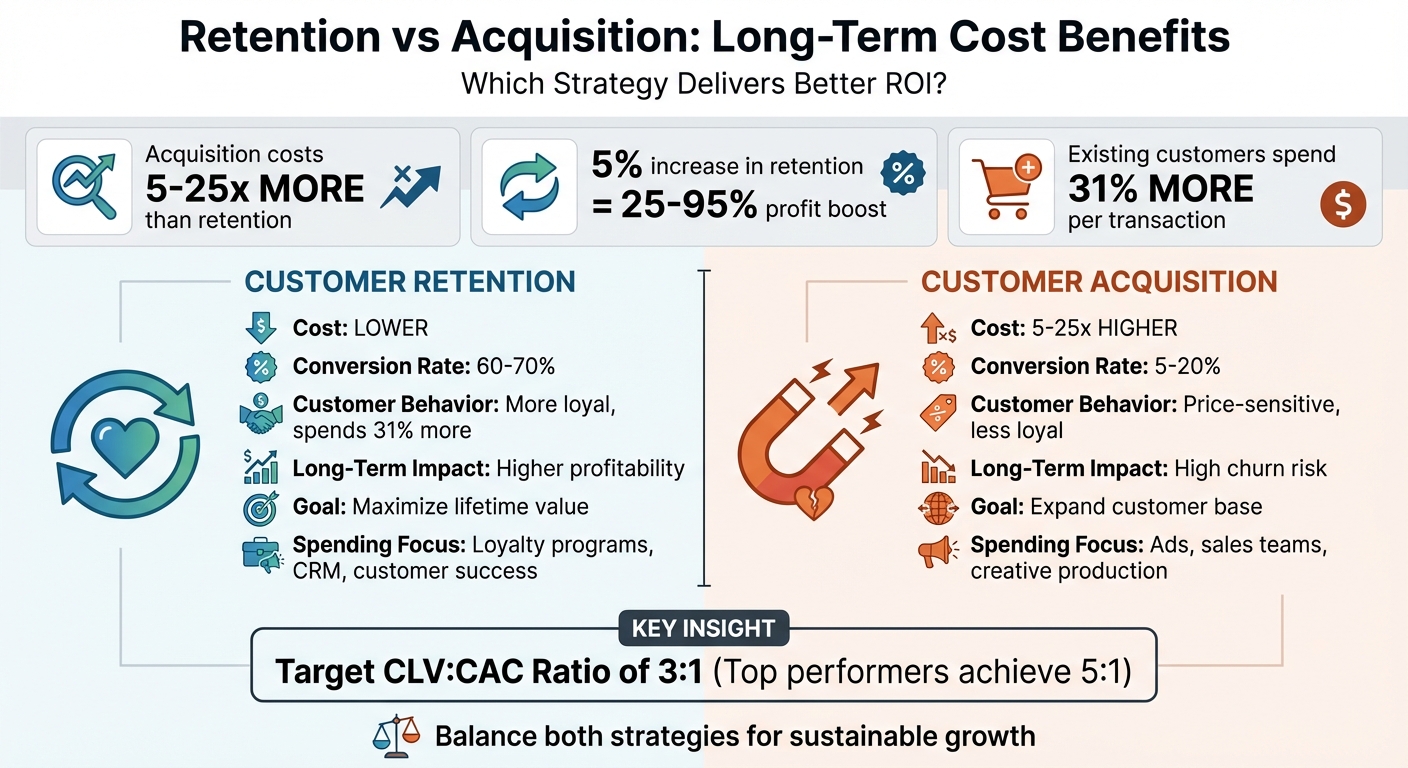
Customer Retention vs Acquisition Cost Comparison Infographic
1. Customer Retention
Cost Breakdown
Keeping customers is far less expensive than acquiring new ones. Instead of spending heavily on ads, sales teams, or agency fees for every transaction, retention focuses on loyalty programs, customer service systems, and CRM tools. The payoff? It’s quicker and more reliable. Selling to an existing customer has a 60% to 70% success rate, compared to only 5% to 20% for new prospects.
The math is simple: you’ve already invested once to bring that customer in. Every additional purchase they make builds on that initial cost, eliminating the need to "re-acquire" them. Plus, existing customers tend to spend 31% more on average and are 50% more likely to try out your new products. They’re familiar with your brand, trust your offerings, and require less hand-holding.
These cost advantages directly contribute to stronger profitability over time.
Long-Term Profit Impact
Retention isn’t just about cutting costs – it’s a powerful driver of profitability. Companies boasting a Net Revenue Retention (NRR) above 120% often see valuation multiples that are 50% to 100% higher than those with an NRR below 100%. Investors view this metric as a key indicator of a company’s financial health.
The impact of retention compounds over time. Losing a customer doesn’t just mean losing their next purchase – it means losing all future revenue they could have generated. This is especially critical in subscription-based and B2B models, where profits accumulate gradually rather than upfront. To stay on track, aim for a Lifetime Value to Customer Acquisition Cost (LTV:CAC) ratio of at least 3:1, with top-performing companies often hitting 5:1 or better.
Strategies for Cost Efficiency
Retention strategies don’t have to break the bank – they just need to be smart. One effective approach is to align team incentives. For example, tie account executive commissions to renewals and allocate 30% to 50% of customer success managers’ bonuses based on NRR. This encourages teams to prioritize long-term relationships over short-term wins.
The first month of a customer’s journey is crucial. Customers who engage twice during this period are far more likely to stick around long-term. Automate processes and personalize onboarding to guide them to their "aha moment" early on, all while keeping support costs in check. These small adjustments can lead to big gains in retention and profitability.
2. Customer Acquisition
Cost Breakdown
Acquiring new customers comes with a hefty upfront price tag. To calculate Customer Acquisition Cost (CAC), you divide all marketing and sales expenses by the number of new customers gained within a specific timeframe. These costs typically include several components: paid advertising on platforms like Google Ads, Facebook, Instagram, and TikTok; salaries and commissions for sales and marketing teams; creative production for campaigns; subscriptions to CRM and analytics tools; and promotional discounts for first-time buyers. These initial expenses often make acquisition less profitable in the long run.
In fact, bringing in new customers can cost anywhere from 5 to 25 times more than retaining current ones. For instance, in the B2B SaaS space, the average CAC is $205 for organic methods and $341 for paid advertising. Financial services companies face even higher costs, sometimes exceeding $1,000 per customer through paid channels. To make matters worse, advertising costs have been climbing – Amazon’s cost-per-click alone jumped 30%, from $0.93 to $1.20. These rising expenses pose a challenge to maintaining long-term profitability.
Long-Term Profit Impact
While customer acquisition can drive immediate revenue and expand market share, it often falls short in long-term profitability. The reason? Companies must continually invest to replace customers who churn. Alarmingly, around 50% of new customers don’t return after their first month, creating what’s often called a “leaky bucket” problem.
"Acquisition is how you find customers, retention is how you build a business." – Ben Salomon, Growth Marketing Manager, Yotpo
One key metric to measure the effectiveness of acquisition efforts is the customer lifetime value to CAC ratio (CLV:CAC). A ratio of 3:1 is considered healthy, meaning each customer generates three times the cost of acquiring them. Top-performing businesses can hit ratios of 5:1 or better, while a 1:1 ratio signals that acquisition costs aren’t being recovered effectively.
Strategies for Cost Efficiency
The goal of acquisition isn’t just to cut costs but to spend smarter. One way to do this is by using lookalike audiences – leveraging data from your best customers to help platforms like Google and Meta find similar prospects. This approach can improve conversion rates and lower CAC. Focusing on channels that both reduce CAC and increase customer lifetime value is another way to maximize efficiency.
Building organic traffic through SEO and content marketing is another cost-effective strategy. These efforts generate sustainable traffic and reduce dependency on paid ads. The first month is critical for new customers – getting them to return for a second visit significantly increases their long-term engagement. For example, in November 2025, Gulf Oil teamed up with Upside to expand to more than 350 locations. By combining personalized cash-back offers with loyalty rewards, they managed to lower acquisition costs while boosting initial customer engagement. This approach highlights how strategic acquisition can complement the cost savings typically associated with customer retention.
Customer Retention vs Acquisition? Which One Should You Choose?
Pros and Cons
Deciding how to allocate your resources is crucial: acquisition drives growth, while retention ensures profitability. Let’s dive into the unique advantages and challenges of each approach.
Acquisition is all about growing your customer base and grabbing a larger share of the market. But it comes with a hefty price tag. Between paid ads, sales teams, and creative production, the upfront costs can be steep. Plus, the conversion rates for new customers are relatively low, hovering between 5% and 20%. Many new shoppers are also less committed, making it harder to turn them into loyal customers.
Retention, in contrast, leverages the effort you’ve already put into acquiring customers. Existing customers are far more likely to buy again, with a 60%–70% probability of making another purchase. On top of that, they tend to spend 31% more per transaction compared to new buyers. They’re also 50% more likely to try your new products. The financial payoff is undeniable – a mere 5% increase in retention can boost profits by 25%–95%. Unlike acquisition, which often feels like trying to fill a leaky bucket, retention creates a snowball effect as loyal customers not only stick around but also spread the word, driving organic growth.
| Feature | Customer Acquisition | Customer Retention |
|---|---|---|
| Goal | Expand customer base and market share | Maximize profitability and lifetime value |
| Cost Factor | 5× to 25× more expensive | Far more cost-efficient |
| Conversion Rate | 5%–20% | 60%–70% |
| Spending Focus | High upfront costs (Ads, Sales, Creative) | Ongoing investments (Loyalty, Customer Success, Support) |
| Customer Behavior | Price-sensitive and less committed | Spends 31% more; less price-sensitive |
| Long-Term Impact | Quick revenue but high churn risk | Compounding returns and organic growth |
This side-by-side look highlights why a combination of both strategies is essential for sustainable growth. Striking the right balance can help you achieve a solid CLV:CAC ratio of at least 3:1 – meaning every customer should generate at least three times what it costs to acquire them. While acquisition fuels your growth engine, retention keeps it running smoothly, making it the more profitable long-term strategy for established businesses.
Conclusion
Retention stands out as a smarter, more cost-efficient strategy for long-term success. This undeniable cost advantage highlights the importance of striking a balance between acquiring new customers and keeping the ones you already have.
"You can’t really choose one over the other. You need both. You have to bring customers in, and once you get them, you must engage in activities that will keep them engaged and help them realize value".
While acquisition drives initial growth, retention ensures that growth translates into lasting profitability. For startups or businesses entering new markets, acquisition naturally takes center stage to establish a customer base. But as your business matures, shifting focus to retention becomes essential. By doing so, you can maximize the lifetime value of your customers and maintain a healthy CLV:CAC ratio.
Pay close attention to the critical first month of a customer’s journey – those who engage twice within their first 30 days are far more likely to stick around. Incorporate personalized loyalty programs, responsive customer service, and genuine engagement to turn one-time buyers into loyal supporters. And when those loyal customers start referring friends and family, you’ve unlocked acquisition fueled by retention – at a fraction of the cost.
Acquisition might open the door, but retention builds the foundation for long-term success. Investing in both ensures a growth engine that can thrive for years to come.
FAQs
Why is focusing on customer retention more cost-effective than acquiring new customers?
Focusing on keeping your current customers happy is often much easier on the budget than trying to win over new ones. In fact, research reveals that holding onto an existing customer can be 5 to 25 times less expensive than bringing in someone new.
Beyond the cost savings, loyal customers tend to stick around and buy more. They have a 60-70% chance of making repeat purchases, while new customers only convert at a rate of 5-20%. This higher repeat purchase rate not only boosts your profits but also delivers a stronger return on investment (ROI) over time.
How can businesses effectively balance customer retention and acquisition strategies?
Balancing customer retention and acquisition is all about seeing them as two sides of the same coin. Retention tends to be more cost-efficient – after all, bringing in a new customer can cost 5 to 25 times more than keeping an existing one. Plus, loyal customers are more likely to buy again, with a 60-70% chance of making a purchase, compared to just 5-20% for new shoppers. Even better? A modest 5% boost in retention can lead to profit increases of 25-95%.
When deciding where to allocate your budget, focus on the return on investment (ROI) for each strategy. For retention, concentrate on your most valuable customers with tools like loyalty programs, personalized messaging, and referral rewards. These efforts not only strengthen relationships but can also transform loyal customers into brand advocates, helping you attract new buyers – often at a lower cost. For acquisition, focus on high-impact tactics like targeted digital ads, SEO, and campaigns that can be tracked and adjusted in real time.
Data is your secret weapon here. Insights from your retained customers – like their buying habits and preferences – can shape how you approach new customer acquisition. At the same time, what works well in acquisition can feed back into your retention strategies. By treating retention and acquisition as interconnected, you can drive sustainable growth while keeping costs under control.
What metrics should I use to evaluate customer retention and acquisition efforts?
To evaluate the effectiveness of customer retention, you’ll want to keep an eye on a few key metrics. Start with the repeat purchase rate, which measures how often customers come back to buy again (typically around 60-70%). Another critical metric is customer lifetime value (CLV) – this gives you an estimate of the total profit a customer is likely to bring over their entire relationship with your business. Don’t forget to weigh the cost of retention against the potential profit it can generate. Even a small improvement in retention – say, a 5% increase – can drive profits up by anywhere from 25% to 95%.
When it comes to customer acquisition, focus on metrics like the first-purchase conversion rate, which usually falls between 5-20%. You’ll also need to track customer acquisition cost (CAC) and cost per acquisition (CPA) – these are often 5 to 25 times higher than retention costs. To measure how well your acquisition efforts are paying off, look at the return on investment (ROI) and the overall profit impact of your campaigns.
Balancing retention and acquisition involves comparing the acquisition-to-retention cost ratio, the ROI of both strategies, and how much each contributes to your net profit. By prioritizing retention, you can help offset the increasing costs of acquiring new customers, paving the way for steady, long-term growth.