


Evaluating recommendation systems boils down to assessing how well they predict user preferences, rank relevant items, and drive business outcomes. Here’s what you need to know:
- Accuracy Metrics: Tools like MAE and RMSE measure how close predictions are to real user ratings. RMSE penalizes larger errors more heavily, making it ideal for applications where big prediction mistakes matter.
- Ranking Metrics: Metrics like Precision@K and NDCG focus on whether the most relevant items are shown at the top of recommendation lists, reflecting user behavior.
- Beyond Accuracy: Metrics such as diversity, novelty, and serendipity ensure recommendations are varied, surprising, and engaging – preventing "filter bubbles."
- Business Metrics: Retention rates, churn rates, and conversion rates tie system performance to user satisfaction and revenue growth.
No single metric provides the full picture. Combining accuracy, ranking, behavioral, and business metrics helps balance user needs with company goals. Start by identifying your priorities – whether it’s prediction accuracy, discovery, or engagement – and choose metrics that align with your platform’s objectives.
Accuracy Metrics for Recommendation Systems
Root Mean Square Error (RMSE) and Mean Absolute Error (MAE)
When a recommendation system predicts a user’s rating for an item – like giving a 4.2-star prediction for a movie – accuracy metrics help determine how close that prediction is to the actual user rating. Two of the most commonly used metrics for this purpose are Mean Absolute Error (MAE) and Root Mean Square Error (RMSE).
MAE calculates the average of the absolute differences between predicted and actual ratings. For instance, if the system predicts a 4-star rating but the user rates it 2 stars, the error is 2 points. MAE treats all errors equally, no matter their size. RMSE, on the other hand, squares each error before averaging and then takes the square root. This squaring step makes RMSE more sensitive to larger errors, penalizing them more heavily.
"Root Mean Squared Error calculates a larger difference for large errors in the rating prediction." – Ricci et al.
For example, a model with an MAE of 1.6 and an RMSE of 2.0 shows how RMSE amplifies the impact of larger errors. In fact, RMSE was the metric used to evaluate models during the Netflix Prize competition. If you want to treat all errors equally, MAE is a better choice. But if larger deviations are more critical to your application, RMSE provides a clearer picture.
R² and Mean Absolute Percentage Error (MAPE)
While MAE and RMSE focus on the size of prediction errors, R² (R-squared) – also called the coefficient of determination – measures how well a model explains the variability in user ratings. Studies suggest that R² often gives a better sense of overall model performance compared to MAE, MAPE, MSE, or RMSE, as it reflects the model’s ability to fit the data rather than just the magnitude of errors.
However, relying on a single metric can skew results in favor of certain algorithms. As Asela Gunawardana and Guy Shani explain, "The decision on the proper evaluation metric is often critical, as each metric may favor a different algorithm". To get a more comprehensive evaluation, practitioners often combine metrics. For example:
- Use RMSE to highlight large errors.
- Use MAE for a balanced view of average errors.
- Use R² to understand the overall fit of the model.
That said, these metrics only measure predictive accuracy and don’t address whether recommendations are diverse or novel. To explore these aspects, ranking metrics offer additional insights into recommendation performance.
sbb-itb-2ec70df
Evaluation Measures for Search and Recommender Systems
Ranking Metrics: Evaluating Recommendation Order
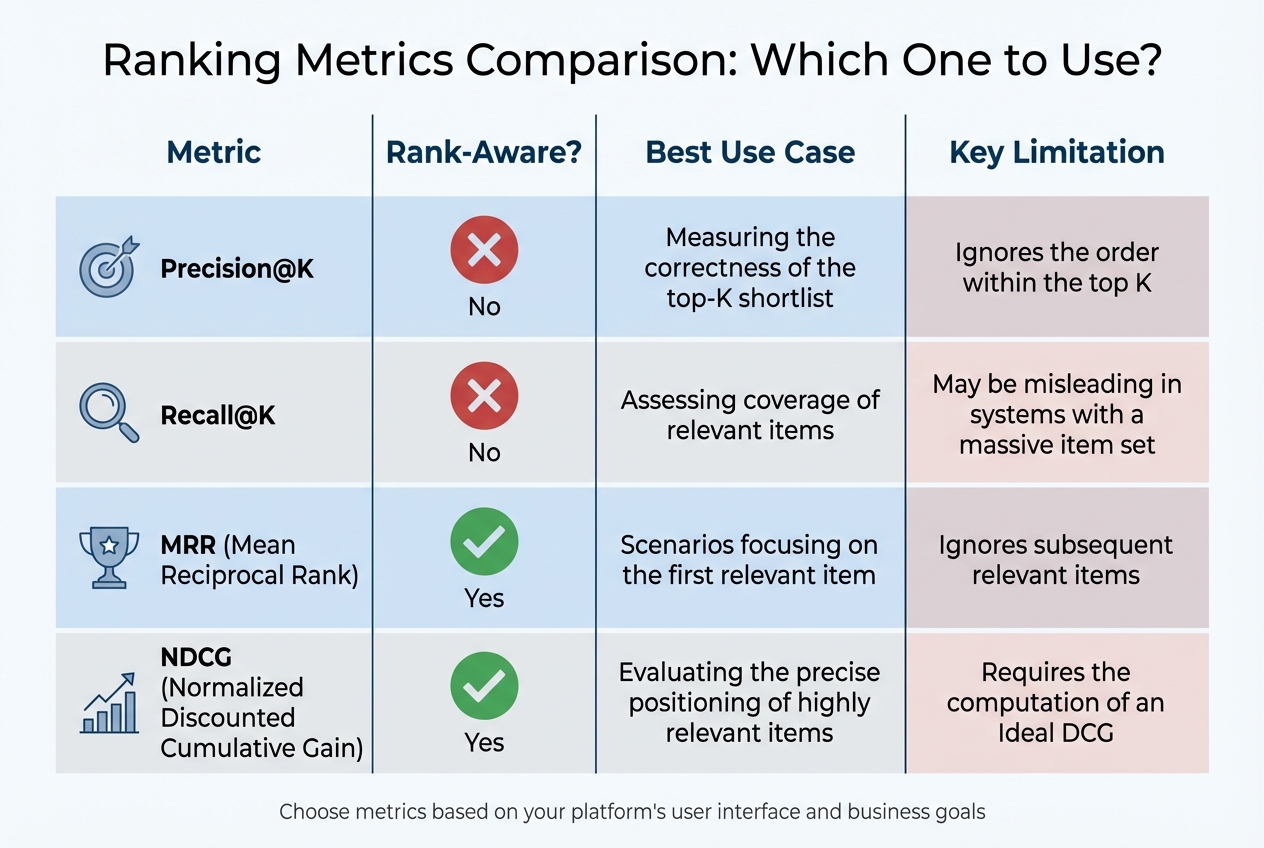
Comparison of Key Recommendation System Evaluation Metrics
Ranking metrics take the evaluation of recommendations a step further by focusing on the order in which items are presented. While accuracy metrics determine how close predictions are to actual user ratings, they don’t address a key question: Are the most relevant items appearing at the top of the list? This matters because users typically pay attention to only the first few items on a recommendation list. As a result, the shift from rating predictions to top‑N recommendation evaluations reflects real-world user behavior, where only a short list of items is visible.
Getting the ranking right can significantly improve user satisfaction and conversion rates by minimizing the effort needed to find relevant content. Since recommender systems generate sorted lists, evaluating the order of recommendations becomes more critical than relying on proxy metrics like Mean Squared Error. Below, we’ll explore how metrics like Precision@K, MRR, and NDCG measure the effectiveness of recommendation order.
Precision@K and Recall@K
Precision@K calculates the percentage of relevant items within the top‑K recommendations. For example, if a system recommends 10 movies (K = 10) and 7 of them are relevant to the user, the Precision@10 is 70%. On the other hand, Recall@K measures how many of the total relevant items appear in the top‑K results. If a user has 20 relevant movies in the catalog but only 7 show up in the top 10, the Recall@10 is 35%.
However, these metrics don’t consider the order of relevant items within the top K. This is critical because users are much more likely to engage with items at the very top of the list. When using these metrics, it’s important to select the K value based on the number of items visible in your interface – for instance, a mobile screen might display only 5 items, so evaluating at K = 5 makes sense.
Precision@K is particularly useful when dealing with incomplete data, while Recall@K becomes more meaningful in large-scale systems where the total number of relevant items is vast or unknown. Since A/B testing often spans weeks, offline ranking metrics like these are crucial for making quick iterations. But when it comes to understanding the impact of item positioning, rank-aware metrics offer a deeper perspective.
Mean Reciprocal Rank (MRR) and Normalized Discounted Cumulative Gain (NDCG)
Rank-aware metrics like MRR and NDCG address the limitations of Precision and Recall by focusing on the importance of item positioning.
Mean Reciprocal Rank (MRR) evaluates the position of the first relevant item in the list. For instance, if the first relevant item appears at position 3, the reciprocal rank is 1/3 (approximately 0.33). MRR scores range from 0 to 1, with 1 indicating that the first relevant item always appears at the top. This metric is particularly effective in scenarios where users are searching for a single "best" result, such as friend suggestions or search engines.
"MRR is excellent for scenarios with a single correct answer… It ignores all other ranks." – Evidently AI Team
Normalized Discounted Cumulative Gain (NDCG) provides a more detailed evaluation by penalizing relevant items that appear lower in the list using a logarithmic discount. Unlike MRR, NDCG can handle graded relevance levels, such as 1–5 star ratings, instead of just binary relevance. To ensure consistency, NDCG normalizes the Discounted Cumulative Gain (DCG) by dividing it by the Ideal DCG, resulting in a score between 0 and 1. This makes NDCG especially useful for platforms like e-commerce or streaming services, where users may be interested in multiple items with varying degrees of relevance.
| Metric | Rank-Aware? | Best Use Case | Key Limitation |
|---|---|---|---|
| Precision@K | No | Measuring the correctness of the top‑K shortlist | Ignores the order within the top K |
| Recall@K | No | Assessing coverage of relevant items | May be misleading in systems with a massive item set |
| MRR | Yes | Scenarios focusing on the first relevant item | Ignores subsequent relevant items |
| NDCG | Yes | Evaluating the precise positioning of highly relevant items | Requires the computation of an Ideal DCG |
Beyond Accuracy: Recommendation-Specific Metrics
When evaluating recommendation systems, accuracy and ranking metrics often take center stage. While these metrics are essential for understanding how well a system predicts user preferences, they fail to capture other critical aspects like variety, surprise, and breadth. These factors are what keep users engaged over time and contribute to long-term business success.
"Being accurate is not enough: How accuracy metrics have hurt recommender systems." – Sean M. McNee, John Riedl, and Joseph A. Konstan
Focusing solely on accuracy can lead to issues like "filter bubbles", where users are repeatedly shown popular, mainstream content. This approach limits exposure to diverse options and stifles discovery. To address these challenges, incorporating metrics like diversity, coverage, novelty, and serendipity can provide a more comprehensive view of recommendation quality, ensuring the system not only predicts preferences but also expands users’ horizons.
Diversity and Coverage Metrics
Diversity measures ensure that recommendations offer a mix of options rather than repetitive suggestions. For instance, Intra-list Diversity calculates the average dissimilarity between items in a recommendation list using measures like cosine distance. Imagine a list of 10 recommended movies: if all are action films, the diversity score would be low, even if they align with user preferences.
Coverage metrics, on the other hand, evaluate how well the system utilizes the entire catalog. Two key types include:
- Catalog Coverage: Tracks the percentage of items in the inventory that the system recommends.
- User Coverage: Measures the proportion of users receiving recommendations.
High catalog coverage ensures that niche or "long tail" items are not overlooked, making the most of the available inventory. For example, if users typically view five items on a mobile app, setting a cutoff (K) at five ensures that recommendations align with user behavior.
The impact of diversity is clear. Research from Spotify in 2020 revealed that users with broader listening habits were 10–20 percentage points less likely to stop using the platform compared to those with narrower tastes.
"Users with diverse listening are between 10–20 percentage points less likely to churn than those with less diverse listening." – Christabelle Pabalan, Data Science Contributor, Towards Data Science
To strike a balance between accuracy and diversity, post-ranking greedy optimization algorithms can help. These algorithms adjust recommendations to ensure they are both relevant and varied. Additionally, metrics like the Gini Index or Average Recommendation Popularity can track and mitigate popularity bias, ensuring the system doesn’t disproportionately favor a small subset of popular items.
Novelty and Serendipity
While diversity broadens the range of suggestions, novelty and serendipity focus on the uniqueness and surprising value of recommendations. Novelty measures how uncommon or unfamiliar the recommended items are, which can be evaluated at different levels:
- Life-level novelty: Items completely unknown to the user.
- System-level novelty: Items the user hasn’t interacted with yet.
- Recommendation-list novelty: Ensures non-redundant suggestions within a single list.
By offering novel recommendations, systems can help users break out of their usual patterns and discover new content.
Serendipity takes it a step further by ensuring that unexpected recommendations are not only rare but also relevant. While novelty focuses on introducing less familiar items, serendipity ensures these recommendations resonate with user interests. This creates delightful surprises, fostering trust and long-term engagement. For example, suggesting obscure items that align with a user’s taste can enhance satisfaction, but irrelevant surprises may backfire.
To implement these metrics effectively, it’s crucial to distinguish between system-level and life-level novelty. This allows for tailored discovery experiences that balance user preferences with the platform’s goals. Multi-objective optimization frameworks can then align relevance, diversity, and coverage to meet both user satisfaction and business objectives.
| Metric Category | Key Metric | Primary Benefit |
|---|---|---|
| Diversity | Intra-list Similarity | Prevents repetitive suggestions and covers varied interests |
| Coverage | Catalog Coverage | Promotes long tail items and maximizes inventory utility |
| Novelty | Item Rarity/Popularity | Helps users discover items they might not encounter |
| Serendipity | Unexpectedness + Relevance | Provides pleasant surprises and builds long-term trust |
Business and User-Focused Metrics
When it comes to assessing a system’s value, business metrics offer a clearer picture than technical ones. While technical metrics focus on algorithm accuracy, business metrics tie that performance to outcomes like revenue, customer loyalty, and satisfaction.
The best evaluations combine different types of metrics. Offline experiments are great for testing predictive accuracy, but live testing uncovers the true impact on metrics like retention rates and sales growth. For example, revenue-focused metrics such as Average Revenue Per User (ARPU) and conversion rates highlight economic performance, while engagement indicators like Click-Through Rate (CTR) measure how users interact with recommendations. Together, these metrics bridge the gap between technical performance and real-world business outcomes.
Churn and Retention Rates
Retention rates are a key indicator of whether your recommendation system consistently delivers value. Unlike accuracy metrics, retention reflects the system’s ability to maintain customer loyalty and satisfaction over time. If users keep coming back, it’s a strong sign that your recommendations are hitting the mark.
On the flip side, churn rate – measuring the percentage of users who stop using your service – can reveal gaps. A high churn rate often signals that recommendations aren’t resonating. Metrics like session length and bounce rate can provide additional context by showing how users engage before they churn.
A/B testing is essential for assessing how algorithm updates affect these outcomes. Testing a new model against the existing one in a live setting can reveal shifts in retention and flag potential issues early on. For instance, a sudden drop in retention might indicate deeper problems that technical metrics alone could miss.
While retention captures the long-term picture, immediate engagement relies heavily on user trust and the system’s responsiveness.
Customer Trust and System Responsiveness
Trust plays a pivotal role in whether users engage with recommendations. People are more likely to act on suggestions if they understand how and why they were made. Features like explanation interfaces can help clarify the reasoning behind recommendations, building trust and improving the user experience.
"Users may also be interested in discovering new items, in rapidly exploring diverse items, in preserving their privacy, in the fast responses of the system, and many more properties of the interaction with the recommendation engine." – Guy Shani and Asela Gunawardana, Microsoft Research
Speed is another crucial factor. While accuracy is important, slow recommendations can frustrate users. Striking a balance between algorithm complexity and real-time performance is critical to keeping the system effective in real-world scenarios.
Trust also extends to safeguarding user data and ensuring the system resists manipulation. Systems that protect privacy and withstand shilling attacks maintain credibility over time. Unlike technical metrics, trust and responsiveness require direct user feedback through studies or online experiments to gauge how well the system performs in real-world conditions.
Combining Metrics for Complete Evaluation
Selecting the Right Metrics
When dealing with the trade-offs between metrics, combining different sets becomes crucial. Start by pinpointing the key properties you want to evaluate, such as accuracy, novelty, diversity, or responsiveness.
"A first step towards selecting an appropriate algorithm is to decide which properties of the application to focus upon when making this choice."
Using a hypothesis-driven approach can help keep the evaluation process on track. For example, you might test whether Algorithm A performs better than Algorithm B in predicting user ratings. This method ensures your evaluations stay goal-oriented.
Context also plays a big role in setting evaluation parameters. Take the K parameter, for instance – the number of top recommendations you assess. This should align with how your system presents items to users. If your checkout sidebar displays five products, evaluate at K=5. This alignment makes sure your metrics mirror actual user experiences rather than hypothetical ones.
Additionally, the tasks at hand should guide your choice of metrics. For example, use MRR (Mean Reciprocal Rank) when a top-ranked result is critical, while novelty metrics are better suited for discovery-focused tasks. By aligning metrics with both user intent and business goals, you create a strong foundation for using multiple metrics effectively.
Using Multiple Metrics Together
No single metric can fully capture the strengths and weaknesses of a system. Instead, a combination of metrics is needed to evaluate predictive quality, ranking accuracy, behavioral impact, and business outcomes. For instance, even a highly accurate system can fall short if it only suggests popular items, leading to a phenomenon known as popularity bias.
To get a comprehensive view, use a mix of offline, qualitative, and online tests to assess both technical performance and business impact.
When combining metrics like Precision and Recall, the F-Beta score can help balance correctness and coverage based on your business priorities. At the same time, keep an eye on behavioral metrics, such as the Gini index, to avoid over-recommending popular items and ensure a diverse range of suggestions.
Trade-offs are inevitable. As Asela Gunawardana and Guy Shani point out, different metrics often emphasize different aspects of performance. For example, optimizing for novelty or diversity can lead to lower immediate accuracy metrics like Precision. The challenge lies in balancing these metrics to meet both user needs and business goals effectively.
Conclusion
Summary of Key Metrics
Evaluating recommendation systems requires looking at multiple angles. Accuracy metrics like RMSE and MAE measure how well predictions match actual outcomes. Ranking metrics, such as NDCG and MRR, focus on whether relevant items are ranked at the top. Beyond these, behavioral metrics – like diversity and novelty – address issues like popularity bias, while business metrics, including click-through and conversion rates, connect technical results with economic goals.
No single metric tells the whole story. A system could excel in accuracy but fail to provide variety, repeatedly suggesting the same popular items. To get a full picture, combine different metrics that reflect both technical performance and business impact.
Applying These Metrics in Practice
The real challenge lies in applying these metrics effectively. Start by identifying what matters most – accuracy, responsiveness, or discovery – and tailor your evaluation accordingly. For example, if your platform shows five recommended items in a sidebar, use K = 5 in your tests to replicate the actual user experience. Initial offline testing helps compare algorithms, but A/B testing is key to understanding real-world performance.
"The effectiveness of recommendation systems… transcends mere technical performance and becomes central to business success." – Aryan Jadon and Avinash Patil
Choose metrics that align with your goals. Continuously monitor event data, such as clicks, cart additions, and skips, to evaluate performance in production. This ensures your system performs well in tests while driving engagement and revenue in practice. At Growth-onomics, we stress the importance of combining technical and business insights to create strategies that support long-term growth. By using these measurement approaches, you can not only refine technical evaluations but also fuel data-driven strategies for success.
FAQs
Which metric should I prioritize for my recommender?
When it comes to evaluating recommendation systems, metrics like NDCG (Normalized Discounted Cumulative Gain), MRR (Mean Reciprocal Rank), and MAP@K (Mean Average Precision at K) are essential. These metrics focus on how well recommendations are ranked, which directly impacts the effectiveness of the system.
Why are these metrics so important? They provide a clear way to measure how accurately a system prioritizes the most relevant items. For example, NDCG accounts for the position of relevant results, rewarding systems that place the most useful recommendations higher up. MRR evaluates the rank of the first relevant result, making it particularly useful for scenarios where users are likely to engage with the first suggestion. Meanwhile, MAP@K considers precision across multiple recommendations, offering a broader view of system performance.
These tools are widely accepted as benchmarks in the field, helping teams fine-tune their systems to deliver better, more user-focused results.
How do I choose the right K for top‑K metrics?
When deciding on the right value for K in top‑K metrics, it’s crucial to consider your evaluation goals and how much weight you place on relevant items within the cutoff. Essentially, K defines the point at which recommendations are evaluated. Selecting the right value involves finding a balance between precision and recall, tailored to your specific context and objectives.
How can I measure and reduce popularity bias?
To gauge popularity bias in recommendation systems, you can rely on metrics that examine how recommendations lean toward popular items instead of niche ones. For instance, evaluating item coverage across various popularity levels is a useful approach.
To address this bias, methods like personalized re-ranking or causal inference techniques can be applied. These approaches tweak recommendations to ensure that less popular items receive fair exposure, all while preserving accuracy. By pairing these metrics with bias-reduction strategies, you can work toward recommendations that are both balanced and diverse.