


Real-time segmentation is transforming how businesses approach cross-selling by responding to customer actions instantly. Unlike static segmentation, which relies on outdated data, real-time systems use live behavior – like clicks, cart additions, or browsing – to create personalized offers when customers are most likely to act. This strategy boosts conversions, increases customer lifetime value, and strengthens loyalty.
Key insights:
- Static segmentation is slow: Updates happen every few days or weeks, missing key moments.
- Real-time segmentation is fast and precise: Customer profiles update in milliseconds, reflecting current behavior.
- Cross-selling works: Selling to existing customers is 5-25x cheaper than acquiring new ones, with a 70% chance of success.
- AI enhances segmentation: Predictive models and dynamic clustering improve offer relevance.
Real-world examples show impressive results:
- Panera Bread increased retention by 5% using real-time personalization.
- Luxury Escapes achieved 142% of its membership signup goal in one month.
Demo: Beyond Dashboards: Building an Actionable, Real-Time Customer Segmentation Pipeline
What is Real-Time Segmentation?
Real-time segmentation is all about instantly categorizing customers based on their most recent actions – like clicks, hovers, or purchases – without any delays. Unlike older methods that might take days or weeks to refresh, this approach reacts in real time. Imagine a customer adding an item to their cart, hesitating at the checkout, or browsing a specific product category. The system picks up on these actions immediately and adjusts their segment within seconds.
Here’s how it works: an event-driven architecture captures every interaction – be it a click, scroll, or tap – using tools like Apache Kafka. This data is processed through a streaming layer and stored in Materialized Views, which are constantly updated. A real-time engine then uses this live data to keep customer profiles up-to-date. As Team Braze puts it:
Real-time segmentation is accurate segmentation. It means that as soon as a user carries out an action or generates an event… you can immediately generate a relevant journey for that user.
By combining historical context with real-time behavior, businesses can create highly specific customer segments. For example, someone with a strong purchase history but no recent activity might be labeled as "Dormant High-Value." Meanwhile, a user actively browsing and adding items to their cart without completing a purchase could fall into a "High Potential" category. This dynamic approach ensures that customer profiles reflect both their past habits and what they’re doing right now, creating a constantly evolving picture.
How Real-Time Segmentation Works
The process of real-time segmentation is both fast and efficient. Data is captured as it happens and processed immediately to update customer segments.
Once collected, this live data flows into streaming databases capable of performing complex calculations instantly. These databases rely on Materialized Views to track metrics such as purchase frequency, browsing habits, and engagement levels, updating them incrementally as new events are recorded. The entire data-to-action cycle can be completed in just one second.
Take these examples: In October 2025, RisingWave demonstrated how their real-time engine, powered by Kafka and Materialized Views, identified "High Potential" customers – those browsing heavily but not purchasing – and sent them a targeted email with a limited-time offer. Similarly, in July 2025, SingleStore showcased an eCommerce scenario where a shopper hesitated over a limited-edition sneaker. The system immediately triggered a countdown timer with a small discount to encourage the purchase.
The secret lies in temporal filters and rolling time windows. Instead of analyzing all historical data, the system focuses on recent behavior – like the last two months – to ensure segments stay relevant and manageable. This keeps customer groups fresh and aligned with current interests, pinpointing the exact moment when engagement is most likely. AI further refines this process by adding predictive insights to make segmentation even smarter.
AI and Machine Learning in Segmentation
AI takes real-time segmentation to the next level by analyzing multiple data points simultaneously – like visit frequency, preferred product categories, discount preferences, and even device type – to uncover patterns that traditional methods might overlook. While older models might rely on broad categories like age or location, AI dives deeper into behavior to identify hidden customer clusters. For instance, AI might find a group of users who ignore discounts but are highly responsive to early access offers.
Machine learning adds another layer by assigning predictive scores to customers, ranking them based on their likelihood to purchase, upgrade, or churn. This shifts the focus from "what customers did" to "what they’re likely to do next." With real-time data, these models continuously update scores and move customers between segments in minutes, ensuring every interaction – like a cross-sell offer – matches the customer’s current mindset.
Here’s a real-world success story: In April 2024, Panera Bread used an AI-powered decision engine integrated with Braze to manage a major menu overhaul. The system delivered over 4,000 personalized combinations of offers and recommendations across email, app, and web, leading to noticeable improvements in both retention and conversions.
AI also employs dynamic clustering, grouping customers who exhibit similar behaviors – even if they don’t share obvious demographic traits. These clusters evolve in real time as new data comes in, creating fluid segments that adapt to changing patterns. The result? A system that doesn’t just respond to customer actions – it predicts them, delivering tailored offers at the perfect moment.
Benefits of Real-Time Segmentation for Cross-Sell
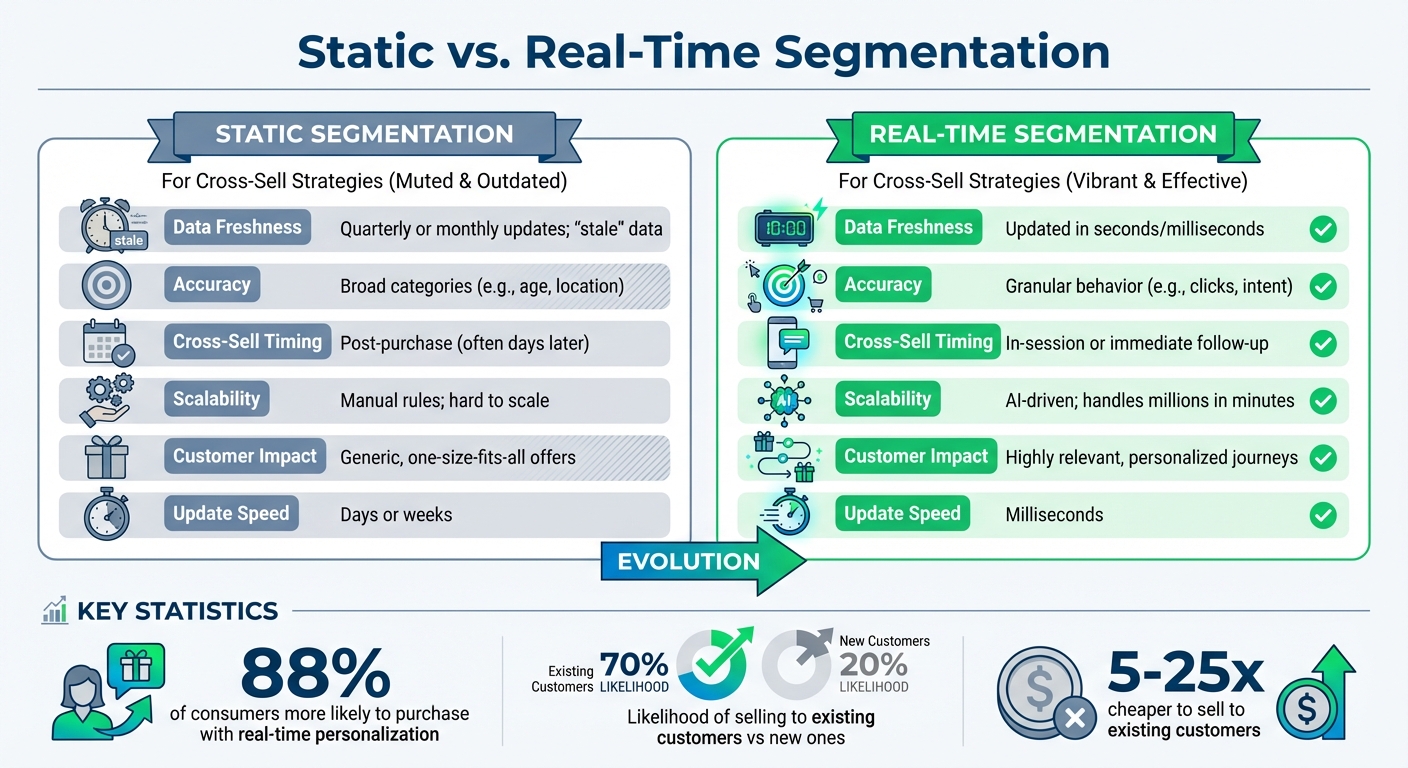
Static vs Real-Time Segmentation: Key Differences for Cross-Sell Success
Real-time segmentation offers immediate and measurable advantages for cross-sell strategies, going beyond traditional methods by responding to customer behavior as it happens. This approach ensures the right offer reaches the customer at the exact moment they’re ready to act – whether it’s hesitation at checkout or adding an item to their cart – creating opportunities that static systems often miss.
Personalized Offers and Higher Conversion Rates
When cross-sell offers are delivered in-session, they feel like tailored recommendations rather than generic pitches. Real-time segmentation enables businesses to engage customers mid-journey, presenting relevant add-ons before they leave the site. For instance, suggesting ink cartridges as soon as a printer is added to a cart creates a sense of urgency without feeling intrusive.
The impact of personalization is clear: 88% of consumers are more likely to make a purchase when brands personalize in real time.
A great example is Too Good To Go, a platform focused on reducing food waste. By using behavioral segments to match surplus food with local demand in real time, they sent notifications when relevant "Surprise Bags" became available nearby. This strategy resulted in a 135% increase in purchases linked to CRM efforts and doubled their message conversion rates.
Better Customer Insights and Accuracy
Real-time segmentation isn’t just about timing – it’s about precision. Traditional segmentation often relies on broad categories like age or location, which can miss the nuances of individual behaviors. Real-time systems analyze hundreds of signals simultaneously, such as visit frequency, product mix, and discount sensitivity, uncovering patterns that manual methods might overlook.
By focusing on intent-based segments – what the customer is actively trying to do – businesses can deliver cross-sell offers that feel natural and relevant.
Luxury Escapes, an Australian travel company, showcases this well. Using Braze Cloud Data Ingestion, they synchronized membership statuses in real time. By dynamically displaying exclusive "LuxPlus+" benefits to members and sign-up incentives to non-members, they achieved 142% of their membership signup goal in just one month, along with a 10% increase in email click-through rates.
Static vs. Real-Time Segmentation
The core difference between static and real-time segmentation lies in speed, relevance, and scale. Static systems rely on batch updates – sometimes daily or weekly – leaving gaps in fast-moving moments like cart recovery or in-session upsells. Real-time systems, on the other hand, process clicks, scrolls, and taps in milliseconds, ensuring customer profiles reflect their current mindset.
| Feature | Static Segmentation | Real-Time Segmentation |
|---|---|---|
| Data Freshness | Quarterly or monthly updates; "stale" data | Updated in seconds/milliseconds |
| Accuracy | Broad categories (e.g., age, location) | Granular behavior (e.g., clicks, intent) |
| Cross-Sell Timing | Post-purchase (often days later) | In-session or immediate follow-up |
| Scalability | Manual rules; hard to scale | AI-driven; handles millions in minutes |
| Customer Impact | Generic, one-size-fits-all offers | Highly relevant, personalized journeys |
As Kevin Wang, Chief Product Officer at Braze, explains:
What makes these cases of mistaken personalization so jarring is that they undercut the customer relationship, revealing to people that your brand doesn’t know them as well as they’d thought. It’s like waking up one day and finding out your best friend doesn’t know your last name.
Real-time segmentation avoids this disconnect by grounding cross-sell offers in fresh, context-rich data. This ability to deliver timely, relevant engagement is what makes real-time segmentation a game-changer for cross-sell strategies. By addressing customer needs in the moment, businesses can unlock new opportunities for growth and loyalty.
sbb-itb-2ec70df
How to Implement Real-Time Segmentation for Cross-Sell
To make real-time segmentation work, you need to unify customer data, set up workflows based on behavior, and use AI-powered tools to handle the heavy lifting.
Building Unified Customer Profiles
Start by pulling together data from every customer interaction – whether it’s email clicks, website activity, mobile app usage, or even in-store behavior – into a single, comprehensive profile. This means breaking down barriers between your CRM, support systems, and marketing tools, ensuring data flows seamlessly across channels. For small businesses, integrating your CRM is a practical first step. It allows you to track buying habits across devices without requiring a significant investment in infrastructure.
A unified profile should include a mix of data points like purchase history, demographic details, real-time behavioral cues (e.g., how long a customer lingers on a product page), product usage stats, and even customer sentiment from support interactions. To make this work in real time, you’ll need a streaming layer that captures live events – clicks, scrolls, and hovers – with millisecond accuracy. This ensures profiles reflect current behavior rather than outdated data. Don’t forget to keep an eye on negative signals, such as unresolved support tickets or recent complaints, as these might indicate it’s better to hold off on cross-sell offers to maintain trust.
Once these profiles are in place, they lay the groundwork for automated, behavior-driven cross-sell strategies, allowing you to act on high-intent moments with precision.
Using Behavioral Triggers for Cross-Sell Offers
With unified profiles ready, the next step is setting up workflows that respond to specific customer actions. Think of moments like adding an item to a cart, browsing a product category, or completing a purchase. For example, if a customer adds sunscreen to their cart, a real-time system could offer a limited-time discount on complementary products, like a beach towel or sunglasses. This tactic has been shown to boost conversion rates to nearly 6%.
A great example comes from Vacasa, a vacation rental platform. They used browsing data to send personalized emails recommending similar rental options, which tripled their guest bookings. Technically, implementing this is straightforward: add a tracking snippet to your website, define key events (like "Product Added"), and connect these triggers to your email or SMS system. To make it even more effective, use "Identify" calls to link anonymous browsing behavior to specific customer profiles. This lets you send personalized follow-ups while keeping recommendations focused on just a few highly relevant products.
Scaling with AI-Driven Tools
As your customer data grows, managing it manually becomes impossible. That’s where AI-powered tools come in. Customer Data Platforms (CDPs) like Twilio Segment can centralize data from online and offline sources, creating real-time customer profiles. Over 25,000 companies already use this approach. For processing large amounts of data, tools like Apache Kafka and RisingWave can handle raw event streams with millisecond-level speed.
Conclusion
Key Takeaways
Real-time segmentation eliminates the delays of traditional methods, allowing businesses to respond to customer actions – like adding items to their cart or exploring specific categories – within moments. This approach enables personalized, in-session offers that can significantly boost both revenue and conversions.
The transition from static to real-time segmentation leads to tangible results. Companies leveraging behavior-based triggers and unified customer profiles report higher conversion rates, stronger customer trust, and greater lifetime value. For example, Panera Bread experienced a 5% increase in retention and a twofold rise in loyalty offer redemptions with AI-driven real-time personalization in April 2024. Similarly, Luxury Escapes exceeded its membership signup target by 142% within the first month by showcasing personalized benefits based on real-time subscriber data.
With unified profiles, behavior-based triggers, and AI tools, businesses can act on high-intent moments with precision. Automation not only reduces manual effort but also ensures cross-sell offers align with a customer’s current behavior rather than outdated data. Considering there’s a 70% likelihood of selling to existing customers versus just 20% for new ones, mastering real-time segmentation can directly enhance profitability.
To fully harness these advantages, expert guidance is essential for seamlessly integrating real-time segmentation into your business strategy.
Work with Growth-onomics
Implementing real-time segmentation requires more than just tools – it needs a strategic approach to unify data sources and build workflows driven by customer behavior. Growth-onomics specializes in transforming raw customer data into actionable insights that deliver results instantly.
Their expertise spans Customer Journey Mapping, Data Analytics, and Performance Marketing, ensuring your cross-sell efforts connect with the right customers at the right time. Whether you’re starting from scratch or upgrading existing systems, Growth-onomics provides the technical know-how and strategic support to turn segmentation into measurable growth. Visit Growth-onomics to learn how their team can help you leverage real-time segmentation to drive business success.
FAQs
How does real-time segmentation make cross-selling more effective than traditional methods?
Real-time segmentation takes cross-selling to another level by tapping into live customer data – like browsing activity, clicks, or recent purchases – to deliver instant, tailored recommendations. This approach doesn’t just increase sales; it also creates a smoother shopping experience by offering suggestions that feel timely and relevant.
Unlike older, static methods that depend on historical data or fixed customer categories, real-time insights adapt to the ever-changing preferences of customers. This means your offers hit the mark when it matters most, making them more accurate and effective at driving results.
How does AI improve real-time segmentation for cross-selling?
AI significantly improves real-time segmentation by analyzing live customer data – like browsing patterns, purchase history, and demographic details – to deliver instant, tailored recommendations. This allows businesses to pinpoint opportunities for cross-selling, enhancing both the shopping experience and sales outcomes.
With AI, companies can address customer needs as they arise, making their marketing strategies more responsive and effective.
How can I effectively implement real-time segmentation for cross-selling?
To make real-time segmentation work seamlessly, begin by gathering live customer data. This could include tracking clicks, browsing habits, or cart activity as it happens. The key is to use tools capable of processing this data instantly, so you can group customers dynamically based on their behavior.
From there, develop a system that not only updates user profiles continuously but also connects with automation tools. This setup lets you trigger personalized campaigns or offers right when they matter most. It’s equally important to keep an eye on the system’s performance, fine-tuning it regularly to maintain both accuracy and relevance. By staying responsive to customer behavior, you can create timely, tailored interactions that significantly improve your cross-sell opportunities.