


Real-time journey orchestration uses live data and AI to shape customer experiences as they happen. It ensures personalized, responsive interactions across multiple touchpoints, improving satisfaction and outcomes. Here’s how it works:
- Unified Customer Data: Combines all customer interactions (clicks, calls, payments) into one profile for consistent engagement.
- AI Decision-Making: Predicts the best next steps based on behavior, sentiment, and context.
- Omnichannel Integration: Delivers instant, coordinated responses across platforms like SMS, email, and chat.
This approach leads to measurable results. For example, businesses using such systems report up to a 20% increase in conversions and a 25% improvement in customer satisfaction. Companies like HSBC and Air France have seen reduced abandonment rates and faster issue resolution after implementation.
To get started, gather real-time customer data, map your customer journey, and align all communication channels. Focus on high-impact areas like abandoned carts or onboarding for quick wins and gradual scaling.
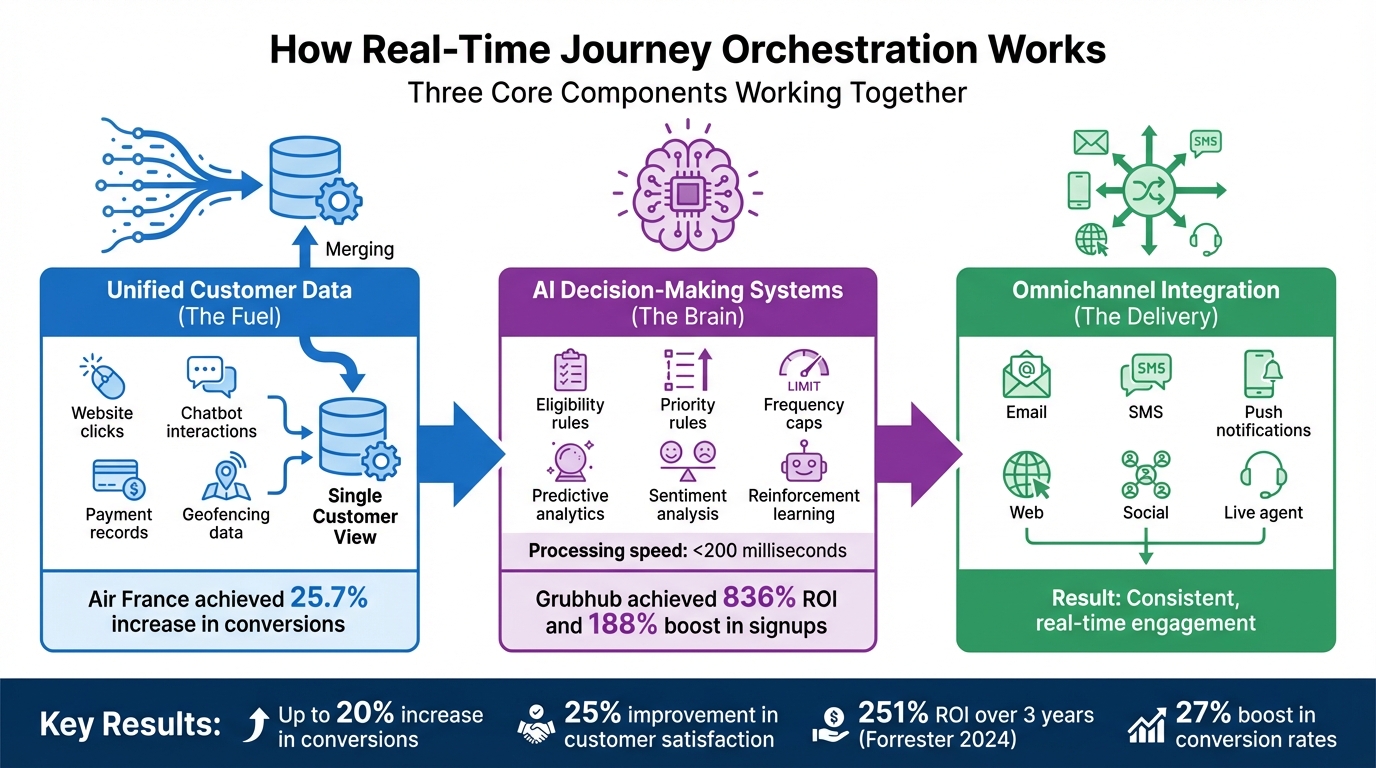
How Real-Time Journey Orchestration Works: 3 Core Components
Driving personalized interactions across the customer journey | OD344
sbb-itb-2ec70df
Core Components of Real-Time Journey Orchestration
Real-time journey orchestration operates through three key elements working together to deliver seamless customer experiences. Picture it as a finely tuned machine: unified customer data acts as the fuel, decision-making systems serve as the brain, and omnichannel integration functions as the delivery system. Here’s how each component contributes to creating smoother interactions.
Unified Customer Data and Context
Unified customer data brings everything together into one complete profile, powering every real-time decision. It pulls signals from various sources – like website clicks, chatbot interactions, CRM updates, payment records, and even external inputs such as geofencing data. This consolidated view ensures that customers don’t have to repeat themselves when moving between platforms or devices. Whether someone goes from browsing anonymously to logging into their account or switches from a mobile app to a phone call, their history stays intact. This approach eliminates friction and keeps interactions consistent.
For instance, Air France achieved a 25.7% increase in conversions by integrating its digital channels with its CRM. This allowed them to deliver personalized messages at just the right moment, creating a 360-degree customer view.
Decision-Making Systems
The decision-making system is like the brain of the operation, analyzing incoming signals to decide the best next step in real time. These systems handle multiple layers of decision-making, such as:
- Eligibility rules: Determining who qualifies for a specific action.
- Priority rules: Resolving conflicts when multiple actions are possible.
- Frequency caps: Avoiding overloading customers with too many interactions.
Advanced tools further elevate this process. Predictive analytics can forecast behaviors like churn risk, sentiment analysis gauges emotions in real time, and reinforcement learning continuously improves decision-making. Grubhub’s Campus program is a great example. By using adaptive orchestration to guide students through card verification and subscription activation, they achieved an 836% ROI and a 188% boost in Grubhub+ Student signups in 2025.
Omnichannel Integration and Activation
Once decisions are made, omnichannel integration ensures they translate into consistent, real-time customer engagements. This system synchronizes interactions across platforms – paid media, owned channels, web, social, and even offline touchpoints. It processes and activates data in under 200 milliseconds, triggering personalized responses like emails, SMS, push notifications, or even escalating to a live agent when needed.
The key is maintaining continuity. If an automated tool like a chatbot reaches its limit, the system can quickly transfer the conversation to a human agent who already has the full context, including the transcript and recent customer activity.
As Jad Naciri, Cross-Channel Data Manager at Air France, explains:
"We needed a solution to connect all of our digital channels with our CRM. The Data Activation Platform helped us break down silos and implement an omnichannel strategy, so we could actually tell our story to the customer on the right channel at the right time".
How to Implement Real-Time Journey Orchestration
Setting up real-time journey orchestration comes down to three main steps: gathering all your customer data, defining the rules that guide interactions, and ensuring seamless coordination across all channels. While the process may seem intricate, breaking it into clear phases makes it far more approachable.
Data Collection and Unification
Start by connecting event streaming platforms like Apache Kafka, AWS SQS, or Google Pub/Sub to capture live customer actions. The data you need falls into four key categories:
- Behavioral events: Actions like website clicks or app usage.
- Customer attributes: Information such as names, email addresses, and phone numbers.
- Transactional data: Purchases, returns, and order history.
- Customer service data: Chat logs, NPS scores, and support interactions.
Using a Customer Data Platform (CDP), you can unify this data and create a Single Customer View. This involves assigning clear labels to events (e.g., "OrderPlaced"), mapping them to a primary customer ID, and validating incoming data with a JSON Schema. These steps ensure that every interaction ties back to the correct customer profile, eliminating gaps or duplicate entries.
"Data is the fuel you need to craft a great customer journey, so collecting it correctly is incredibly important".
– Ian Donnelly, Senior Content Marketing Manager at Bloomreach
Engage your data and engineering teams early to confirm that your tech stack can handle real-time data processing. With clean, unified data in place, you’re ready to set up the orchestration rules.
Building Orchestration Rules and Logic
The next step is defining the logic that determines what happens next. Use your unified data to create event-driven triggers – specific actions like "CartAbandoned" or "UserSignup" that kick off a journey. Each journey can branch into multiple paths based on customer profiles, behaviors, or timing. For example, you might send a reminder two hours after a cart is abandoned.
To keep things balanced, include rules for eligibility checks, priority settings, and frequency caps. These prevent over-messaging and ensure the customer experience stays positive.
A great example comes from Air France’s marketing team in 2024–2025. They used orchestration to connect their digital channels with their CRM. Mathieu Delecroix, Data Strategy Manager at Air France, shared:
"For the first customer journey, we gathered specialists from all marketing channels. It was the first time we sat together to brainstorm a journey based on everyone’s input – a fantastic opportunity for a cross-team collaboration towards a common objective".
When starting out, focus on high-impact use cases like cart abandonment or onboarding new customers. These are easier to implement and can demonstrate quick wins before scaling across the entire customer lifecycle.
Synchronizing Channels for Consistent Experiences
Finally, make sure all your channels – email, SMS, push notifications, web, and social – are working together seamlessly. Every channel should deliver consistent messaging at the same time, and post-click actions should flow naturally between them.
To maintain this consistency, use shared style guides and messaging frameworks. Break down silos between departments so that, for example, support agents are aware of recent campaigns a customer has interacted with. This level of synchronization pays off: triggered messages can outperform traditional email blasts by a staggering 624%, and well-coordinated flows can increase repeat purchase rates by up to 30x.
Measuring and Optimizing Journey Orchestration Performance
Once you’ve implemented real-time orchestration, keeping track of its performance is essential to optimize your customer journey and ensure smooth experiences. Focus on metrics that directly impact revenue, like Conversion Rate (CR) and Customer Lifetime Value (CLV). At the same time, keeping an eye on Retention Rate, Churn Rate, and Customer Satisfaction (CSAT) scores helps you gauge customer loyalty and overall experience.
Key Metrics to Monitor
Operational efficiency metrics like First Call Resolution (FCR) and Average Handle Time (AHT) are important indicators to track. Another critical factor is decision latency – how quickly your system reacts to customer actions. For optimal performance, this should stay under one second. Additionally, monitoring the quality of your data, including its completeness and freshness, is vital to ensure your orchestration logic operates on trustworthy information.
According to a 2024 Forrester study, companies using advanced journey orchestration reported a 251% ROI over three years and a 27% boost in conversion rates. A practical example comes from November 2025, when Indian real-estate group Ambuja Neotia implemented real-time lead scoring and instant routing. This strategy connected engaged prospects with representatives immediately, doubling their hot-lead conversions from 40% to 80%.
Tracking these metrics enables continuous improvements through real-time feedback loops, which help refine your orchestration strategy.
Real-Time Feedback Loops
Real-time feedback loops allow your system to adjust orchestration strategies dynamically. By capturing signals like clicks, chatbot logs, failed payments, and sentiment, your system can recalibrate actions in real time. Reinforcement learning further enhances this process, ensuring your system continuously optimizes its decision-making.
For example, triggers can be set for "rescue moments" to address issues as they occur. If a payment fails, the system can immediately send a retry link via SMS to keep the customer engaged. Similarly, if a customer repeatedly struggles with a chatbot, the system can detect the friction and seamlessly transfer the interaction to a live agent, complete with full context. This approach also addresses a common frustration – over 70% of customers dislike having to repeat their information across different interactions.
Finally, running A/B tests within your orchestration platform can confirm that AI-driven interventions outperform manual rules. Automated retraining pipelines ensure your predictive models stay accurate as customer behavior evolves. This combination of real-time adjustments and ongoing validation keeps your orchestration strategies sharp and effective.
Conclusion
Summary of Real-Time Journey Orchestration Benefits
Real-time journey orchestration is reshaping how businesses interact with their customers, offering personalized experiences at scale. By responding to live behavioral signals, it ensures that every customer interaction feels timely and relevant. The results are hard to ignore – companies leveraging AI-powered orchestration report 10% to 20% higher conversion rates and 15% to 25% greater customer satisfaction. On a broader scale, the market for this technology is expected to hit $12.5 billion by 2025, growing at an annual rate of 24%.
But it’s not just about boosting revenue. This approach also trims operational costs by predicting customer needs and resolving potential issues before they escalate. It helps unify fragmented customer data across departments, creating a seamless view of each individual. Even when things go wrong, orchestration can turn missteps into opportunities to strengthen customer loyalty through timely interventions.
With these benefits in mind, businesses are well-positioned to begin integrating this transformative approach.
Next Steps for Businesses
To get started, focus on small, manageable steps that align with your current systems. A good first move is adopting a Customer Data Platform (CDP) to unify your data and enable real-time updates and identity resolution. Collaboration across teams – marketing, sales, IT, and support – is essential to ensure smooth data sharing and implementation.
From there, pilot a specific use case that can deliver immediate value, such as recovering abandoned carts or improving onboarding processes. These early wins can build momentum and demonstrate the potential for broader adoption.
For tailored support in customer journey mapping, data analytics, or performance marketing, Growth-onomics provides expert solutions to guide you through this process. The key is to start small, track your progress, and refine your strategy based on real-time insights.
FAQs
How does real-time journey orchestration enhance customer satisfaction?
Real-time journey orchestration allows businesses to respond instantly and accurately to customer actions and needs as they occur. This capability ensures that customers enjoy personalized and relevant experiences during every interaction, making their journey smoother and more enjoyable.
Imagine a customer facing an issue like a failed payment or an unexpected account change. With real-time orchestration, businesses can immediately step in with support or solutions. By leveraging the most current data, companies can provide timely, meaningful interactions that ease frustration, build trust, and make customers feel genuinely valued.
This proactive method doesn’t just improve the overall customer experience – it also strengthens loyalty and deepens relationships. By addressing potential issues before they escalate, businesses can consistently deliver the right message or solution at the perfect moment, ensuring customers feel heard and supported.
How do I get started with real-time journey orchestration?
To get started with real-time journey orchestration, the first step is setting up real-time data connections. This means configuring a live data source – like Kafka – and ensuring real-time events can flow smoothly through your system. You’ll need to input key details such as server information, topic names, and security protocols.
After the connection is live, make sure real-time event tracking is fully operational within your organization. This part often involves working with your platform representative to verify that all necessary features are properly activated. Once these steps are completed, you’ll be ready to synchronize customer interactions across multiple channels, delivering seamless and tailored experiences as they happen.
How can businesses evaluate the success of real-time journey orchestration?
Businesses can measure the success of real-time journey orchestration by focusing on key performance indicators (KPIs) that highlight customer engagement, satisfaction, and business results. Metrics such as conversion rates, customer retention, and lifetime value are crucial for gauging how effectively personalized, timely interactions are driving outcomes. Tracking engagement across various channels – like email open rates, click-through rates, and social media activity – offers a clear picture of how well-targeted content is resonating with customers.
Another important factor is real-time analytics. By observing how customer journeys respond to live data, businesses can evaluate improvements in campaign performance and customer satisfaction. The real measure of success lies in how these metrics reflect stronger engagement, better customer experiences, and noticeable growth in business performance.