


Want to improve customer satisfaction, retention, and engagement? Real-time feedback is the answer.
By collecting customer input during or right after interactions, businesses can address issues faster, boost response rates, and reduce churn. Here’s why it works:
- 70% of experiences are forgotten within 24 hours. Real-time feedback avoids memory bias, ensuring accurate insights.
- Companies using it resolve problems 60% faster, achieve 5x higher response rates, and improve retention by 15-20%.
- Acting on feedback immediately builds trust and loyalty, preventing small issues from escalating into major problems.
Key methods include:
- In-app feedback widgets for seamless user input.
- Event-triggered prompts to capture responses at critical moments.
- Cross-device surveys for consistent insights across platforms.
Integrating feedback tools with CRMs or AI systems ensures quick action and smarter decisions. Businesses using these systems report 62% higher revenue growth and better customer experiences.
Ready to transform your customer journey? Dive in to learn how real-time feedback can make a measurable difference.
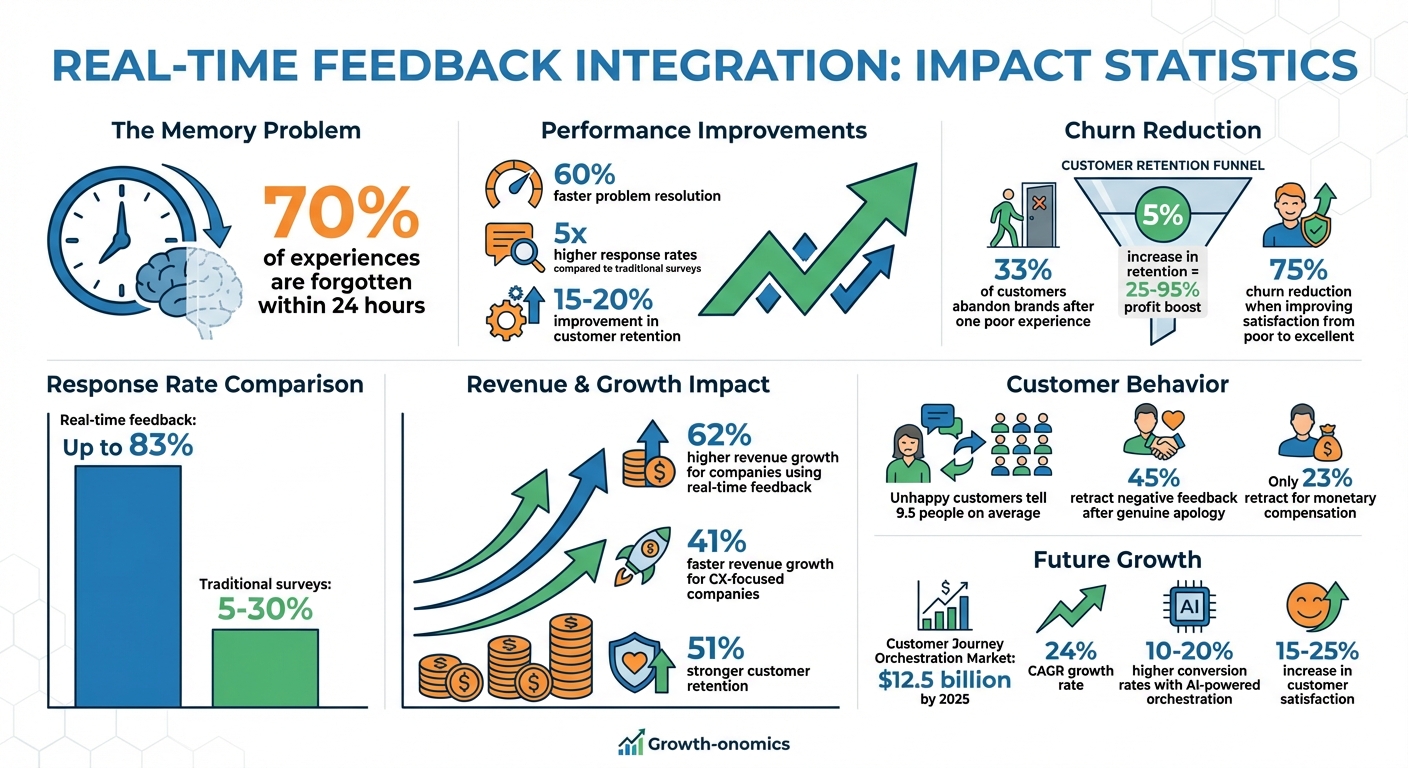
Real-Time Feedback Integration: Key Statistics and Impact Metrics
Benefits of Real-Time Feedback in Customer Journeys
Better Personalization
Real-time feedback empowers businesses to adapt experiences on the fly based on what customers are doing in the moment. Instead of relying on outdated survey data, it captures immediate preferences, allowing for instant personalization. This means businesses can determine the "next best step" for a customer – like recommending a product, fixing a confusing checkout process, or offering help before a problem escalates.
With AI-driven systems, companies can adjust content, recommendations, and product suggestions instantly based on user behavior. For example, skipping a song or rating a show triggers immediate, tailored responses.
"While all feedback provides value, real-time input from customers is a way to personalize content, recommendations and products to the customer." – Ashu Dubey, Founder and CEO at Helix
This ability to act instantly not only creates smoother customer experiences but also helps businesses quickly identify and address potential issues. These real-time adjustments enhance every step of the customer journey.
Faster Issue Resolution
Catching problems as they happen can make all the difference in retaining customers. Real-time feedback allows businesses to pinpoint friction points – like website glitches, confusing navigation, or checkout errors – right as they occur. This means you can fix issues before customers abandon their carts or leave negative reviews. Resolving complaints within 5 minutes not only solves the immediate problem but also builds loyalty and encourages future spending.
The impact of quick action is clear. On average, an unhappy customer shares their negative experience with 9.5 people. But here’s the silver lining: 45% of dissatisfied customers are willing to retract negative feedback after receiving a genuine apology, compared to just 23% who would do so for monetary compensation. Addressing issues quickly not only protects your reputation but also keeps the customer journey on track.
Higher Engagement Metrics
When customers see their feedback being valued and acted upon, they’re more likely to stay engaged with your brand. Real-time feedback generates response rates of up to 83%, far surpassing the typical 5% to 30% seen with traditional surveys. The key is timing – capturing feedback while customers are still interacting with your product or service ensures they’re focused and willing to participate.
This engagement goes beyond just higher response rates. When businesses make immediate changes based on customer input, it shows that customers’ voices lead to real improvements. This builds trust and strengthens the relationship, encouraging ongoing interaction. By actively responding to real-time insights, businesses create a dynamic customer journey that evolves with their audience’s needs.
Methods for Capturing Real-Time Feedback
In-App Feedback Widgets
You can embed feedback widgets directly into your app or website using JavaScript snippets or SDKs. These widgets can be customized to align with your brand’s design, ensuring a seamless user experience.
In-app surveys are particularly effective, boasting a 13% response rate. Keeping these surveys short – just 1 to 3 questions – can extend user lifetimes by up to 51%. Here’s a useful tip: display the first question prominently on the screen instead of hiding it behind a "Take Survey" button. This simple adjustment significantly boosts engagement.
Event-Triggered Prompts
Event-triggered prompts are activated based on specific user actions, such as completing onboarding, making a purchase, abandoning a cart, or performing rapid clicks. Timing is everything here – trigger these prompts during "success moments", like right after a user completes a task, to avoid disrupting their workflow.
A great example comes from HBO Max Latin America. By using in-app surveys through Braze, they achieved a participation rate of 35–50%. This initiative also led to a 40% improvement in CRM communications and a 15% increase in user engagement while reducing churn.
Cross-Device Surveys and Polls
Cross-device surveys allow you to gather feedback from users across multiple devices. By using mobile SDKs and web widgets that sync with your CRM, you can create a unified customer profile that captures feedback no matter which device they use.
Take Wahi, for instance. They integrated Survicate surveys with HubSpot to automatically update customer profiles. This integration saved them over 10 hours of manual data entry each week and improved their real-time messaging capabilities. Additionally, since 41% of customers prefer live chat as their go-to communication channel, engaging users on their preferred device can significantly increase participation.
These techniques ensure feedback collection is not only efficient but also seamlessly integrated into your broader business systems.
Integrating Real-Time Feedback into Business Systems
API and Backend Integration
Connecting feedback tools to your business systems through REST APIs and webhooks allows feedback data to flow seamlessly into platforms like Salesforce, HubSpot, or Zendesk. This integration creates a two-way data sync, logging feedback scores (like NPS) into customer records. The result? A complete view of customer health at your fingertips.
For example, when negative feedback comes in, the system can automatically generate follow-up tasks in your CRM or send instant alerts to Slack. For larger operations, technologies like Apache Kafka, AWS SQS, or Google Pub/Sub enable real-time data streaming to platforms such as SendGrid or Salesforce Marketing Cloud. A case in point: SmartBuyGlasses boosted their Net Promoter Score by 30% by embedding real-time feedback into their customer experience program.
Once integrated, secure and efficient data storage becomes critical for leveraging both immediate and long-term insights.
Data Storage and Processing
NoSQL databases like MongoDB or DynamoDB are popular choices for storing real-time feedback due to their flexibility with unstructured data. Firebase Realtime Databases are another option, especially for instant synchronization across devices. The goal is to choose a storage solution that can handle high data volumes while adhering to stringent security standards such as ISO 27001:2022, SOC 2, and HIPAA compliance.
Processing feedback can happen in real time for immediate actions or in batches for deeper analysis. If you’re using FIFO queues for processing, make sure deduplication settings are in place to avoid processing the same feedback multiple times. To reduce survey fatigue, implement suppression logic that cross-checks against your CRM to prevent over-surveying customers.
Once the data is stored and processed, automation and AI can transform raw feedback into actionable insights.
Automation and AI-Driven Insights
Modern tools harness Natural Language Processing (NLP) and machine learning to tag and categorize open-ended feedback into themes like "UX issues" or "pricing". This approach, often called "AI Feedback Intelligence", converts unstructured data into role-specific insights within minutes.
Agentic AI takes this a step further by automating feedback analysis and resolution. It identifies high-priority issues and sets goals without requiring manual intervention. By 2028, it’s estimated that 68% of customer support interactions will involve agentic AI, with up to 80% of customer service issues being resolved autonomously by 2029. These systems assess urgency, sentiment, and customer lifetime value to tackle the most critical problems first.
"Agentic AI bridges this execution gap. These autonomous systems continuously process feedback, detect friction in real-time, prioritize urgent issues, and trigger action without human direction." – Harsha Khubwani, Clootrack
To get started, focus on high-impact touchpoints like post-purchase or onboarding. Once these are optimized, scale the approach across your entire customer journey. These integrations empower businesses to act on feedback instantly, driving continuous improvements in customer experiences.
Measuring the Success of Real-Time Feedback Integration
Customer Satisfaction Metrics
Metrics like Net Promoter Score (NPS) and Customer Satisfaction Score (CSAT) have long been essential for assessing customer sentiment. However, real-time feedback systems elevate their value by turning them into dynamic tools. Unlike traditional surveys that capture feedback weeks after an interaction, real-time systems measure satisfaction at the exact moment of engagement, enabling immediate responses to prevent churn.
Here’s why this matters: companies focusing on customer experience report 41% faster revenue growth and 51% stronger customer retention. Additionally, improving satisfaction from "poor" to "excellent" can cut churn by 75%. Continuous monitoring of these metrics allows businesses to spot trends early. For instance, a negative customer rating should trigger an automatic alert for immediate follow-up, rather than being buried in monthly reports.
To go beyond traditional metrics, businesses can use AI-driven sentiment analysis to process unstructured feedback from various channels. Since 80–90% of customer feedback comes in unstructured formats that traditional surveys often overlook, modern NLP tools can analyze emotions and intent in real time. This approach provides a fuller understanding of customer sentiment across all touchpoints, enabling swift action to improve the customer journey.
Engagement and Conversion Rates
Real-time satisfaction insights directly impact engagement and conversions, making them essential for understanding customer behavior. Personalizing experiences through real-time feedback can increase online conversion rates by 8% and boost customer loyalty by 1.5×. These improvements translate into tangible revenue growth.
Metrics like Digital Engagement Scores track user actions during sessions, while Journey Completion Rates identify where customers drop off. For example, detecting "rage-clicks" (repeated rapid clicks on a single element) signals that something isn’t working as intended. Automated systems can respond by offering assistance or alternative navigation paths when such patterns emerge.
Companies using real-time feedback see 62% higher revenue growth compared to those relying on delayed feedback. Faster feedback loops allow quicker optimizations, which directly improve conversion rates. Monitoring channel switch rates – how often users move from self-service to live chat – can also highlight areas where documentation or interfaces fall short.
Churn Reduction and Retention
Reducing churn is vital for long-term success, and real-time feedback transforms it from a lagging indicator into a preventable issue. A single poor experience causes 33% of customers to abandon a brand, yet increasing customer retention by just 5% can boost profits by 25% to 95%. The key is addressing problems before they escalate.
One effective metric is First Contact Resolution (FCR), which predicts better retention rates. When negative feedback is routed instantly to the right team – whether it’s a bug for developers or a usability issue for UX designers – problems can be resolved quickly. Comparing resolution rates from real-time channels to delayed survey data can reveal how effectively your system handles customer issues.
"The customer feedback that arrives too late is the feedback that costs you money." – Aldona Krysiak-Adamczyk, Senior Content Manager, Survicate
Additionally, anomaly detection can help spot sudden spikes in complaints or unusual engagement patterns before they escalate. Using a formula like (Observed Value – Expected Value) / Standard Deviation, businesses can differentiate between normal fluctuations and urgent problems. By monitoring these anomalies alongside traditional retention metrics, companies can maintain a clear view of customer health and act quickly to resolve issues.
sbb-itb-2ec70df
Growth-onomics: Your Partner in Real-Time Feedback Integration
Custom Customer Journey Mapping
Growth-onomics zeroes in on the moments that matter most for collecting feedback – whether it’s during checkout, after a support interaction, or when someone abandons a form. Instead of relying on blanket surveys across the entire site, they focus on high-impact touchpoints, like post-purchase experiences, to gather feedback when it’s most relevant.
Their method ties event-triggered feedback to specific user behaviors. For instance, if a user starts "rage clicking" (rapidly clicking the same element), shows signs of exiting a checkout page, or abandons a form, Growth-onomics uses these signals to prompt immediate feedback. These carefully timed prompts help address issues before they escalate, reducing churn. By deploying tailored surveys or live chat at these critical moments, they ensure feedback feels natural and not intrusive. This thoughtful mapping turns customer interactions into actionable insights.
Data-Driven Strategies
Growth-onomics doesn’t just collect feedback – they transform it into actionable strategies. By combining real-time feedback with business data, they create a detailed, unified view of your customers. Through tools like sentiment analysis and topic modeling, they identify recurring themes such as "product issues" or "service quality", making it easier to prioritize improvements.
Their system integrates feedback with event streaming and AI analysis to quickly convert user behavior into targeted marketing responses. Negative feedback? No problem. Automated workflows instantly alert the right team – whether it’s sending bug reports to developers or usability concerns to UX designers – so issues are addressed before they snowball. They also pair qualitative feedback with behavioral data, like heatmaps and session replays, to uncover the root causes of user frustrations or drop-offs.
Complete Marketing Solutions
Growth-onomics takes these insights a step further by offering a full suite of marketing solutions. Their services – SEO, performance marketing, UX enhancements, and data analytics – are designed to turn feedback into measurable outcomes. With scalable systems powered by AI, they can handle increasing feedback volumes efficiently, ensuring your team stays focused.
The results speak for themselves. By resolving issues early, businesses see clear ROI. Companies that embrace real-time operations often experience noticeable boosts in revenue and retention. Growth-onomics equips teams with live dashboards and empowers them to act quickly on insights, fostering a customer-first approach that drives loyalty and growth.
Get Real-Time Feedback & Why It Works!
Conclusion: The Future of Real-Time Feedback Integration
Real-time feedback has become essential in today’s competitive landscape. The Global Customer Journey Orchestration Market is expected to hit $12.5 billion by 2025, driven by a compound annual growth rate of 24%. Companies adopting AI-powered journey orchestration are already reaping rewards, with 10% to 20% higher conversion rates and 15% to 25% increases in customer satisfaction. These results highlight the growing importance of leveraging feedback systems to stay ahead.
The evolution from reactive to predictive feedback is reshaping how businesses engage with customers. Michelle Huff, CMO of UserTesting, explains:
"Real-time feedback provides agility, enabling companies to incorporate human insights while working on designs and concepts, save on costs, and mitigate risk".
Looking ahead, technologies like Emotional AI and sentiment modeling will take feedback systems to the next level. These tools will identify customer emotions – like frustration or satisfaction – in real time, enabling immediate and empathetic responses. For example, Netflix saves an estimated $1 billion annually through its machine learning-driven recommendation engine, while Amazon generates 35% of its total sales via personalized suggestions. These predictive capabilities underline the potential of integrating feedback into unified data systems for seamless action.
As consumer expectations rise, with 71% of people wanting personalized interactions, businesses face increasing pressure to act quickly and effectively. Unified data ecosystems are key to meeting this demand. By breaking down silos between CRM, support, and eCommerce platforms, companies can create a 360-degree view of their customers. Implementing Customer Data Platforms (CDPs) to unify identities across devices and setting up workflows that trigger alerts for negative sentiment are essential steps for staying responsive.
Growth-onomics is well-positioned to help businesses adapt to this shift. Their expertise in Customer Journey Mapping, Data Analytics, and Performance Marketing equips companies to build scalable, AI-powered feedback systems that turn insights into actionable strategies. Whether it’s reducing churn, enhancing critical touchpoints, or fostering a feedback-driven culture, Growth-onomics ensures that feedback translates into measurable results.
Ready to elevate your customer experience? Contact Growth-onomics at https://growth-onomics.com to learn how real-time feedback integration can drive meaningful change for your business.
FAQs
How does real-time feedback help retain customers?
Real-time feedback plays a crucial role in keeping customers engaged and satisfied by addressing their concerns swiftly and effectively. When businesses collect feedback during or immediately after customer interactions, they can tackle issues before they grow into bigger problems. This approach makes customers feel acknowledged and appreciated, which naturally enhances their overall experience. Plus, when customers see their feedback leading to improvements, it builds a sense of trust.
Responding quickly to feedback also shows a company’s dedication to providing top-notch service and striving for betterment. This kind of responsiveness not only reduces the chances of losing customers but also strengthens loyalty and encourages them to return. By weaving real-time feedback into the customer journey, businesses create a more attentive and customer-centered experience, which goes a long way in boosting retention.
What are the most effective ways to gather real-time feedback?
To collect feedback in real time, it’s essential to use tools and techniques that capture and analyze input during customer interactions. For instance, feedback buttons on your website make it easy for visitors to share their opinions as they browse, helping you spot and address problems immediately. Similarly, in-app feedback tools and live surveys – triggered at critical moments like after a purchase or a support chat – offer targeted insights tied directly to the customer’s experience.
Using a mix of these approaches allows businesses to respond quickly to concerns, enhance customer satisfaction, and foster loyalty by showing attentiveness. Real-time feedback keeps you in tune with your customers’ changing needs.
How does AI improve real-time feedback analysis?
AI transforms how businesses handle real-time feedback by processing and interpreting customer data at lightning speed. Tools like sentiment analysis and pattern recognition allow AI to automatically sort feedback, flag pressing issues, and deliver actionable insights. This means businesses can address concerns faster and tailor customer experiences more effectively.
What’s more, AI thrives on live data, constantly refining its predictive models to stay accurate and support proactive decisions. By analyzing elements like behavior patterns and external conditions, AI turns raw feedback into practical insights. This helps businesses tackle issues early and adjust strategies on the go, leading to happier customers and improved results.