


Real-time ETL tools are transforming marketing by enabling immediate access to fresh data for decision-making. Unlike batch ETL, which often relies on outdated information, real-time ETL streams data continuously, helping marketers respond faster to opportunities and challenges. Key benefits include:
- Faster Campaign Adjustments: Identify underperforming ads or campaigns and reallocate budgets the same day.
- Improved Customer Targeting: Trigger personalized actions like cart abandonment emails in real-time.
- Accurate Attribution Models: Streamlined data integration improves metrics like LTV and CPA.
- Time Savings: Automating reporting reduces manual work by up to 80%.
Top tools like OWOX BI, Hevo Data, Fivetran, AWS Glue, and Integrate.io cater to different needs. For example, Integrate.io offers 60-second Change Data Capture (CDC), while Fivetran supports over 900 connectors. These tools help marketing teams act on data faster, improving ROI and efficiency.
| Tool | Sync Speed | Connectors | Pricing Model | Best For |
|---|---|---|---|---|
| OWOX BI | Real-time | 150+ | Custom/Annual | Attribution modeling |
| Hevo Data | Real-time | 150+ | Starts at $239/mo | SMBs needing no-code setups |
| Fivetran | 15-min standard | 900+ | Usage-based (MAR) | Large-scale data integration |
| AWS Glue | Batch/Streaming | 70+ | Pay-per-DPU hour | Technical, large datasets |
| Integrate.io | 60-sec CDC | 150+ | Fixed $1,999/mo | E-commerce and retail teams |
Real-time ETL is essential for staying competitive in fast-moving markets. By automating workflows and syncing data instantly, marketing teams can make smarter, faster decisions that drive better results.
Real-Time Data Transformation and Analytics with dbt Labs
sbb-itb-2ec70df
Key Features of Real-Time ETL Tools for Marketing Analytics
Real-time ETL tools are designed to address the challenges marketing teams face in working with up-to-the-minute data. Unlike traditional batch processing systems, these tools focus on speed, automation, and usability, enabling marketers to act faster and more effectively.
Automation and Scheduling Capabilities
Automation removes the need for manual data handling. Instead of juggling CSV files from platforms like Google Ads, Facebook, or your CRM, pre-built API connectors allow ETL tools to pull data directly from these sources. This eliminates delays and lets analysts focus on interpreting data rather than preparing it.
These tools offer both incremental data updates (to sync only new data) and full-refresh options, ensuring dashboards stay current without overloading systems. For example, platforms like Google Ads can handle incremental syncs at over 250 GB per hour.
Event-based triggers take automation up a notch by responding to customer actions immediately. Imagine a customer abandons their cart – within seconds, the system can send a discount email instead of waiting for the next scheduled data update.
Automating these workflows not only speeds up insights but also reduces operational costs.
"Marketing teams that use ETL effectively are far better equipped to make data-driven decisions and improve performance, with companies using these methods being five times more likely to gain actionable insights." – Funnel
This seamless automation lays the foundation for continuous, real-time data synchronization.
Real-Time Data Synchronization and Streaming
Real-time synchronization ensures data flows continuously from source platforms to analytics tools, bypassing the delays of scheduled batch updates. This feature is especially critical during time-sensitive moments, such as when customers are engaging with your customer journey. Waiting for tomorrow’s data update? That opportunity’s already gone.
Streaming data enables marketers to make adjustments within the same day. For instance, if Facebook ads underperform by 11:00 AM, you can shift the budget to Google Ads that afternoon, rather than discovering the issue the next morning. This ability to optimize "on the fly" helps protect budgets and boost ROI.
A real-world example? Activision Blizzard used Improvado’s real-time monitoring to catch a $2.4 million budget overrun in Google Ads just 18 hours before the month ended. They paused campaigns immediately, reallocating spend and avoiding a costly financial error.
| Feature | Batch ETL | Streaming (Real-Time) ETL |
|---|---|---|
| Processing Interval | Scheduled intervals (e.g., nightly) | Continuous, as data is created |
| Primary Benefit | Simplicity and legacy support | Speed and immediate reaction |
| Use Case | Daily revenue reporting, long-term trends | Fraud detection, cart abandonment triggers |
| Data Freshness | Hours or days old | Sub-second updates |
No-Code Interfaces and Pre-Built Connectors
No-code interfaces make it easy for non-technical users to set up workflows with drag-and-drop tools, while pre-built connectors simplify platform integration.
ASUS provides a great example. Before using Improvado, their marketing team spent days standardizing reports from various global locations. After implementing pre-built connectors, they could generate comprehensive reports in just minutes. Jeff Lee, Head of Community and Digital Strategy at ASUS, shared:
"Improvado helped us gain full control over our marketing data globally. Previously, we couldn’t get reports from different locations on time and in the same format, so it took days to standardize them. Today, we can finally build any report we want in minutes due to the vast number of data connectors and rich granularity provided." – Jeff Lee, ASUS
Signal Theory Inc. saw similar results. By automating reporting for 10 global clients, analyst Shayna Tyler reduced reporting time from four hours to just 30 minutes – a time savings of 80%.
This ease of integration ensures data is ready for transformation, delivering consistent and actionable metrics.
Data Transformation and Normalization for Marketing Metrics
Once data is extracted, transformation ensures it’s standardized and ready for analysis. Automated transformation aligns disparate inputs, such as currencies, time zones, and naming conventions, into consistent formats.
This process is particularly valuable for marketing-specific metrics like customer lifetime value (LTV), cost per acquisition (CPA), and multi-touch attribution. For example, transformation logic can combine purchase data, refunds, and subscription renewals to calculate accurate LTV or distribute credit across multiple touchpoints based on your attribution model.
"The right ETL tool doesn’t just move rows. It preserves marketing attribution logic, handles schema drift when platforms change APIs overnight, and transforms raw event streams into reportable metrics your CMO can trust." – Improvado
Advanced ETL tools also adapt to platform changes automatically. If Facebook or Google updates their API structure, these tools detect the change, adjust schemas, and backfill historical data to maintain reporting continuity. This ensures your pipelines remain stable without emergency engineering fixes.
Top Real-Time ETL Tools for Marketing Analytics
These ETL tools give marketing teams the ability to act on data as it happens, streamlining processes and improving decision-making.
When selecting an ETL tool, it’s important to consider your team’s technical expertise, data volume, and specific marketing objectives. Some tools cater directly to marketing teams, while others offer broader capabilities that might require more technical know-how. Here’s a closer look at five leading options.
OWOX BI

OWOX BI is tailored for marketing teams that need precise control over attribution modeling. Unlike pre-packaged solutions, it allows you to create custom attribution rules – whether first-touch, last-touch, linear, or entirely unique – using SQL-based Data Marts. The platform emphasizes server-side tracking without cookies, helping reduce "(direct)/(none)" traffic in reports by up to 30%. It also consolidates data from ad platforms, CRMs, and GA4 into Google BigQuery, creating a unified view for cross-channel ROI analysis.
Between 2023 and 2024, WorkSimpli saved over 10 hours of manual work per week using OWOX BI reports. Meanwhile, ZOOD transitioned from manual weekly reporting to automated daily reports in just six weeks by February 2024. With a 99% data collection success rate backed by an SLA, the platform can cut marketing reporting time by as much as 70%.
"I can finally automate reporting across my business with the precision and flexibility that I could previously only get from a team of 20 people." – Verified Client, OWOX BI
OWOX BI offers a free trial with 30 credits, and its Team Edition starts at $875 per month.
Hevo Data
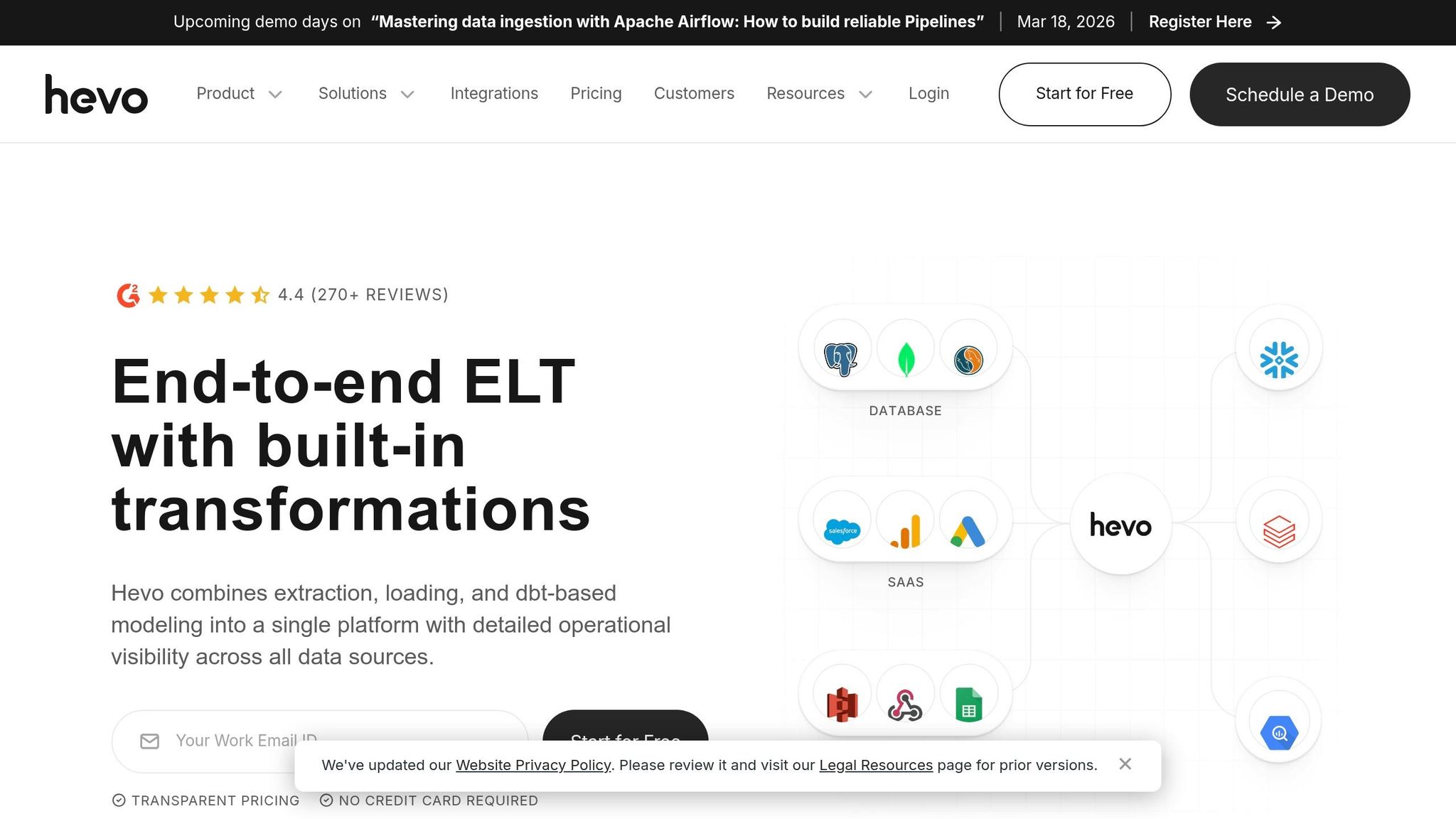
Hevo Data is a no-code platform, ideal for small to medium-sized businesses looking for quick deployment without relying on engineers. With over 150 pre-built integrations and 99.9% uptime, it ensures near real-time data replication from CRMs, ad platforms, and databases. Its automatic schema detection adjusts to changes in source data, eliminating the need for manual intervention. Marketing teams can set up new data pipelines quickly, with users reporting setup times that are five to ten times faster.
Thoughtspot used Hevo Data to maintain zero downtime, cut infrastructure costs by 85%, and reduce ELT tool expenses by 50%. Ramkumar Natarajan, Senior Manager of Data Operations, also reported a 30–35% increase in overall data usage across the organization.
"Hevo has simplified our workflow; I’m not dependent on any external team to help me set up data pipelines, which means faster reporting turnaround times for everyone!" – Parth Sarangi, Business Intelligence Manager
Hevo Data provides a free trial and transparent pricing models.
Fivetran
Fivetran shines with its extensive library of over 700 fully managed connectors – the largest among ETL tools. It automates data synchronization and standardizes schemas, eliminating the need for manual data preparation. With 99.97% uptime, it ensures reliability and includes advanced features like pre-built transformation models and "AI Columns" for data enrichment. The "Audience Hub" tool also empowers non-technical marketers to segment audiences without writing SQL.
In 2024, HubSpot implemented over 40 pipelines with Fivetran in less than 40 hours, saving nearly 1,000 hours and $100,000 across departments, achieving a 150% ROI. ClickUp leveraged Fivetran to activate lifetime value (LTV) models, cutting customer acquisition costs by 50%.
"This shift lets teams focus on strategic analysis rather than data transit." – Kynan Barton, Marketing Analytics Engineering Lead, Activision
Fivetran’s Managed Data Lake Service can lower ingestion costs by up to 95%.
AWS Glue
AWS Glue is a serverless data integration service designed for handling large-scale marketing datasets. It supports both a graphical interface and custom coding in Python or Scala, offering flexibility for data engineers. With over 70 data source integrations and a Data Catalog for metadata management, it handles both batch and streaming data processing. This makes it a strong choice for complex analytics and machine learning workflows. AWS Glue operates on a pay-as-you-go model, so you’re only charged for the resources you use.
Integrate.io
Integrate.io focuses on e-commerce and operational ETL, offering over 150 bidirectional connectors with robust Salesforce integration. It includes more than 220 pre-built transformations tailored to retail and e-commerce metrics and features Change Data Capture (CDC) for real-time database replication in just 60 seconds. Its low-code interface allows marketing teams to build data pipelines without coding while still offering customization options. The platform boasts a 92% customer satisfaction rate and an average first response time of just 2 minutes.
"Integrate.io has provided us with the best support we’ve ever experienced from a vendor. They’re quick, transparent, and always proactive." – Max Fang, Leukaemia Foundation of Australia
| Tool | Primary User | Key Marketing Feature | Connector Count |
|---|---|---|---|
| OWOX BI | Marketers / Analysts | Attribution Modeling & AI Insights | Multi-channel (Ads, CRM, GA4) |
| Hevo Data | Data Teams / SMBs | Real-time Data Replication | 150+ |
| Fivetran | Enterprise Data Teams | Automated Schema Normalization | 700+ |
| AWS Glue | Data Engineers | Serverless Scalability & Data Catalog | 70+ |
| Integrate.io | E-commerce / Ops | Bidirectional Salesforce Sync | 150+ |
This breakdown highlights the strengths of each tool, helping marketing teams identify the best fit for their specific needs.
Research Insights: Impact of Real-Time ETL on Marketing Performance
Real-time ETL tools are reshaping how marketers approach efficiency and ROI. Businesses leveraging real-time data report 62% higher revenue growth and 97% higher profit margins compared to those using slower data processes. Yet, despite these advantages, only 7% of organizations currently utilize this capability.
The financial stakes are massive. Poor data quality costs companies an average of $12.9 million annually. Additionally, 37% of marketing budgets are wasted due to poor data quality, with another 35% lost to inaccurate targeting. Real-time ETL solves these challenges by creating a continuously updated, unified source of truth. This eliminates the fragmented data issues that 44% of marketers struggle with, offering a critical advantage in fast-moving markets.
Better Intraday Ad Optimization Decisions
Real-time ETL brings together click, purchase, and engagement data into a single, reliable stream, offering marketers instant insights into campaign performance. With this up-to-the-minute visibility, underperforming ads can be identified and adjusted by midday, preventing wasted budget on ineffective strategies.
This shift from reactive to proactive decision-making is a game changer. Instead of sticking to a rigid media plan, teams can reallocate budgets dynamically. For instance, if search ads outperform social ads in real time, marketers can immediately shift spending to maximize returns. Similarly, when a specific creative or channel delivers strong results, exposure can be ramped up instantly to capitalize on the momentum.
"Real-time attribution has become the linchpin of agile, ROI-focused advertising by converting live campaign data into immediate action." – Lumenalta
Real-time ETL also supports continuous A/B testing, enabling marketers to experiment with messaging and targeting on the fly. With automated ETL and centralized data, marketing teams are 5x more likely to uncover actionable insights. Additionally, nearly 70% of businesses report scaling customer-focused decisions enterprise-wide thanks to real-time analytics.
While these insights optimize daily ad spend, they also improve the accuracy of long-term metrics.
More Accurate Attribution and Lifetime Value Modeling
The benefits of real-time ETL extend beyond immediate campaign adjustments to refining strategic metrics for sustained growth. By integrating CRM systems, ad platforms (like Google, LinkedIn, and Facebook), and e-commerce databases into a single data stream, real-time ETL enables more precise attribution models. These models can pinpoint which channels drive sales and automatically adjust budgets across connected platforms.
This unified data approach introduces "continuous intelligence", allowing organizations to define advanced metrics like Customer Lifetime Value (LTV) or Marketing Qualified Lead (MQL) in a centralized framework. By streaming detailed product usage and transaction data into a warehouse, marketers can create a live, 360-degree customer view. This foundation supports more accurate LTV modeling and better strategic planning.
Personalization is another area where real-time data shines. Companies tailoring web experiences for specific segments have seen conversion rates increase by 80%. Personalized experiences also encourage consumers to spend 38% more on average. With real-time data, businesses can cut acquisition costs by half and boost revenues by up to 15%. This precision transforms marketing from guesswork into a data-driven discipline, enabling teams to generate comprehensive reports in minutes rather than days.
Comparison of Real-Time ETL Tools for Marketing Teams
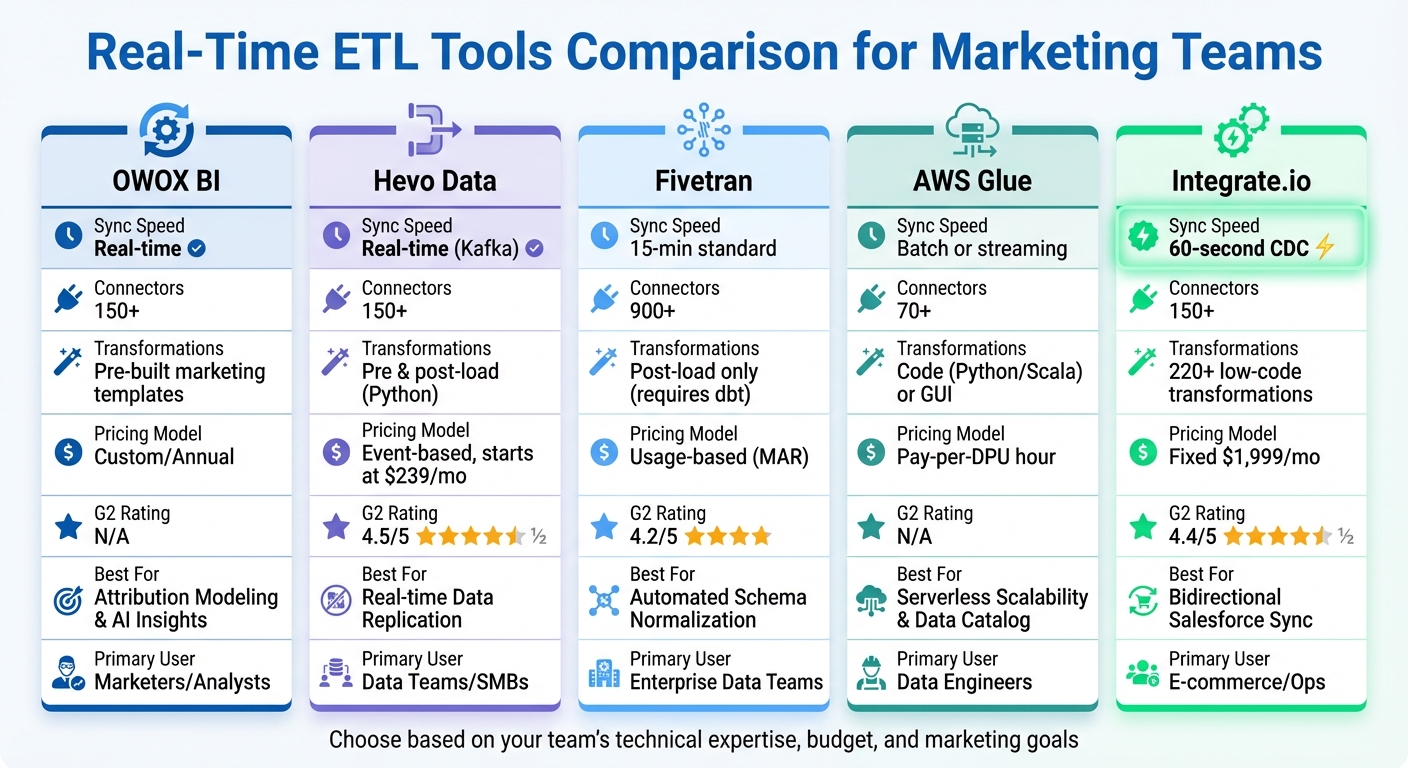
Real-Time ETL Tools Comparison for Marketing Analytics
When it comes to choosing a real-time ETL tool, the decision often boils down to your team’s technical expertise, budget, and marketing goals. The five platforms discussed earlier each bring something different to the table, from pricing models to transformation capabilities and connector ecosystems. For instance, Integrate.io offers a predictable, fixed-fee pricing model of $1,999/month, which covers unlimited data volumes, pipelines, and connectors – making it easier to manage costs.
Fivetran, on the other hand, boasts over 900 connectors and a 99.9% uptime SLA. While its standard sync interval is 15 minutes, it does offer 1-minute syncs for Enterprise-tier users. Meanwhile, Hevo Data relies on a Kafka-based architecture to enable real-time replication for over 150 sources, including 40+ free ones. For teams already embedded in the Amazon ecosystem, AWS Glue might be appealing, though it requires Python or Scala coding skills and is better suited for technical users.
Here’s a quick side-by-side breakdown of the tools:
| Tool | Sync Speed | Connectors | Transformations | Pricing Model | G2 Rating |
|---|---|---|---|---|---|
| OWOX BI | Real-time | 150+ | Pre-built marketing templates | Custom/Annual | N/A |
| Hevo Data | Real-time (Kafka) | 150+ | Pre & post-load (Python) | Event-based, starts at $239/mo | 4.5/5 |
| Fivetran | 15-min standard | 900+ | Post-load only (requires dbt) | Usage-based (MAR) | 4.2/5 |
| AWS Glue | Batch or streaming | 70+ | Code (Python/Scala) or GUI | Pay-per-DPU hour | N/A |
| Integrate.io | 60-second CDC | 150+ | 220+ low-code transformations | Fixed $1,999/mo | 4.4/5 |
Among these, Integrate.io stands out with its 60-second Change Data Capture (CDC) capability and extensive low-code transformation options – ideal for marketing teams that need speed, flexibility, and dependable customer support. This comparison highlights how these tools cater to diverse needs, enabling marketing teams to make faster, better-informed decisions. Real-time ETL is quickly becoming a cornerstone of effective marketing analytics.
Conclusion: Choosing the Right Real-Time ETL Tool for Your Marketing Needs
When selecting a real-time ETL tool, the key is ensuring it aligns with your specific marketing goals. Whether your focus is improving ROAS, lowering CAC, or increasing LTV, the right tool should seamlessly capture every critical data point. Start by auditing your data sources – from platforms like Google Ads and Meta to your CRM systems – to ensure no touchpoint is overlooked.
Consider your team’s technical expertise when evaluating tools. For smaller teams or those without technical specialists, no-code solutions can simplify processes. On the other hand, more advanced pipelines may require a higher level of expertise. The impact of real-time data is undeniable – companies leveraging it report over 62% higher revenue growth and 97% higher profit margins.
"It isn’t about real time, it’s about the right time." – Stephen Brobst, CTO, Teradata
Automated ETL processes also bring measurable efficiency, cutting manual reporting efforts by more than 80% and enabling faster, data-driven decisions throughout the day.
Growth-onomics exemplifies how businesses can turn raw data into actionable insights. Their approach focuses on aligning ETL pipelines with strategic marketing goals, operating under the guiding principle: "With Data as Our Compass We Solve Growth". Through services like server-side tracking, first-party identity graphs, and LTV-based targeting, they help businesses move beyond surface-level metrics. Whether it’s consolidating fragmented data or building predictive models, pairing the right ETL tool with a thoughtful strategy ensures your campaigns deliver results that consistently exceed expectations.
FAQs
Do I really need real-time ETL, or is batch ETL enough?
When deciding between real-time ETL and batch ETL, it all comes down to what your marketing analytics require.
Real-time ETL works by processing data as it comes in, giving you up-to-the-minute insights. This makes it perfect for tasks like adjusting live campaigns or engaging with customers in real time.
Batch ETL, however, processes data in chunks at set intervals. It’s a better fit for tasks like analyzing historical trends or creating periodic reports.
The right choice depends on whether you need immediate updates or prefer scheduled data processing to align with your objectives.
What data sources should I connect first for marketing analytics?
To get a clear picture of customer behavior and how your campaigns are performing, start by linking data sources that provide real-time insights. Some of the key platforms to connect include Google Ads, social media channels like Facebook, Instagram, and Twitter, as well as CRM systems and analytics tools such as Google Analytics. For a more comprehensive understanding of the customer journey, consider integrating data from email marketing platforms and e-commerce systems. This ensures your data is consistent and accurate, setting the stage for better decision-making and stronger campaign outcomes.
How do I ensure accurate attribution when data streams in real time?
To keep attribution accurate when working with real-time data, focus on practices like idempotent processing, validation rules, and continuous monitoring. These measures help maintain precision and reduce errors.
Architectures such as Lambda, Kappa, or hybrid models can provide the backbone for dependable tracking systems. Additionally, it’s essential to frequently validate your data pipelines and keep an eye out for any inconsistencies. This ensures that customer interactions are tracked and credited properly, safeguarding the reliability of your attribution data.