

Real-time data streaming is transforming marketing by enabling instant insights and decisions. Unlike traditional batch processing, which analyzes data after delays, real-time streaming processes customer actions (like clicks, purchases, or scrolls) as they happen. This allows marketers to respond immediately, improving personalization, campaign performance, and cost efficiency.
Key Takeaways:
- Immediate Insights: Real-time data delivers actionable insights within milliseconds, helping marketers react faster to customer behavior.
- Customer Expectations: 88% of consumers are more likely to buy when brands personalize their experience in real time.
- ROI Boost: Businesses using real-time analytics report a 42% increase in marketing ROI and a 30% reduction in customer acquisition costs.
- Technology at Work: Tools like Apache Kafka and Amazon Kinesis process data streams, enabling instant decision-making.
Real-time analytics isn’t just about speed – it’s about staying relevant in a fast-paced market. Companies that integrate these systems gain a competitive edge, improving customer experiences and optimizing marketing outcomes.
Real-Time Marketing Insights and Analysis | Know This or No to This
What Is Real-Time Data Streaming?
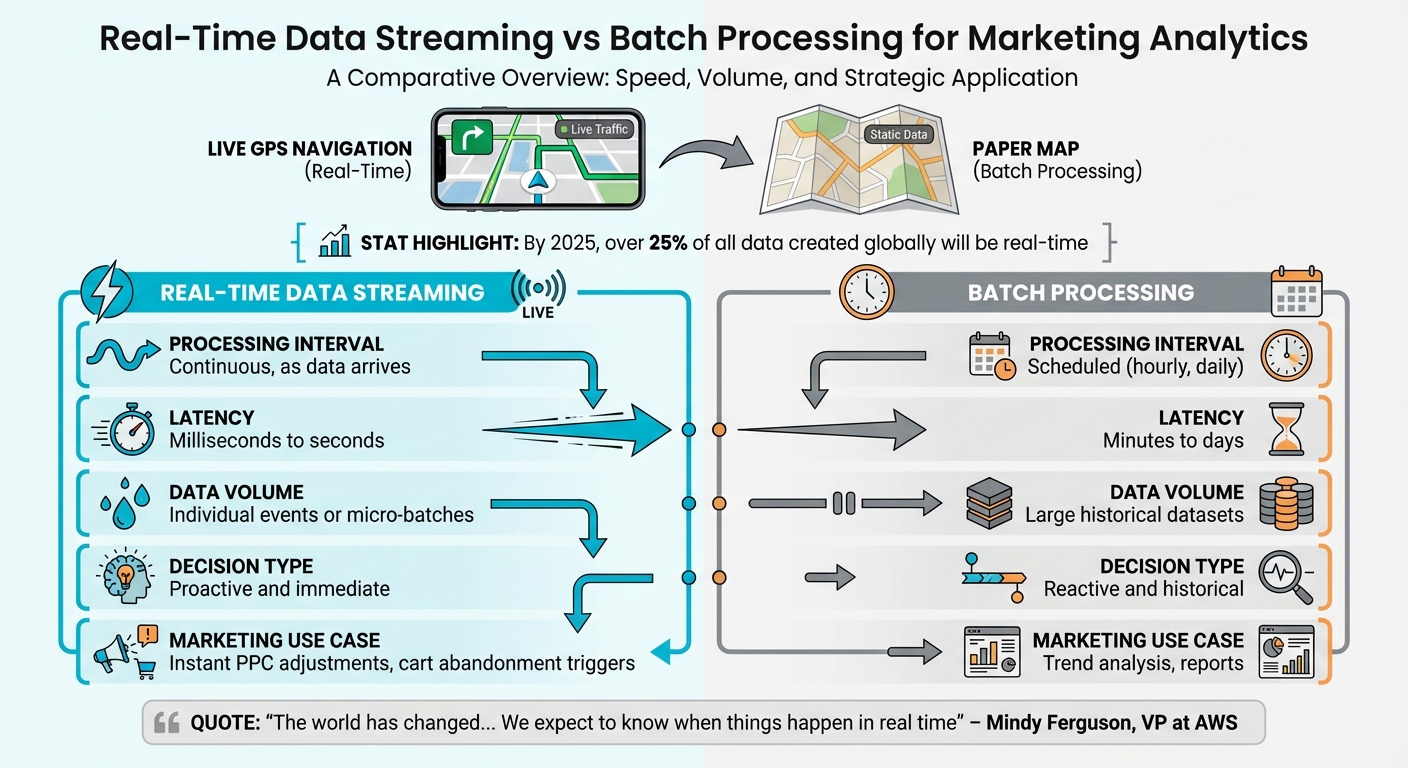
Real-Time Data Streaming vs Batch Processing: Key Differences for Marketers
Real-time data streaming is all about collecting, processing, and analyzing data the moment it’s generated – no waiting, no delays. It gives marketers insights within milliseconds, shifting decision-making from reacting to past events to engaging with what’s happening right now. Let’s dive into how event streams and modern platforms make this possible.
The core of this technology lies in event streams – continuous flows of data triggered by specific actions. Every click on a website, tap on a mobile app, social media interaction, or purchase creates an event that gets processed instantly. Common sources include website clickstreams and mobile app data. By 2025, it’s estimated that over 25% of all data created globally will be real-time.
This approach allows businesses to seize "fleeting opportunities" – those high-value moments that exist for only a brief time. Picture a customer hovering over the checkout button or deciding to abandon their cart. Real-time streaming enables marketers to act immediately, before the moment slips away. As Evren Eryurek PhD, Director of Product Management at Google Cloud, explains:
"Real-time data from event sources provides a high-value opportunity to act on a perishable insight within a tight window. That means businesses need to act fast".
How Real-Time Data Streaming Works
Real-time streaming relies on event-driven architectures, which process data the instant it’s generated. For example, a customer click, a scroll, or an email open becomes an event that flows through streaming platforms like Apache Kafka or Flink. These platforms handle the data within milliseconds. To ensure accuracy, even when events arrive out of order, systems use mechanisms called watermarks to track both the event’s actual time and when it’s processed.
This setup enables what’s known as "real-time decisioning" – the ability to respond immediately with tailored messages, offers, or content across digital channels. Instead of analyzing yesterday’s behavior to plan tomorrow’s outreach, marketers react to what’s happening in the moment. For example, a customer browsing winter coats might receive a personalized discount before leaving the site, rather than waiting for a follow-up email days later.
Real-Time Streaming vs. Batch Processing
The key difference between real-time streaming and batch processing comes down to speed and timing. Batch processing gathers data over a set period – like an hour, a day, or a week – and processes it at scheduled intervals . In contrast, real-time streaming handles data continuously as it arrives, with delays measured in milliseconds rather than minutes or days .
| Feature | Real-Time Data Streaming | Batch Processing |
|---|---|---|
| Processing Interval | Continuous, as data arrives | Scheduled (hourly, daily) |
| Latency | Milliseconds to seconds | Minutes to days |
| Data Volume | Individual events or micro-batches | Large historical datasets |
| Decision Type | Proactive and immediate | Reactive and historical |
| Marketing Use Case | Instant PPC adjustments, cart abandonment triggers | Trend analysis, reports |
Mindy Ferguson, Vice President of Messaging and Streaming at Amazon Web Services, highlights this change:
"The world has changed… We expect to know when things happen in real time".
She also notes:
"Anything outside of using real-time data becomes very frustrating for the end consumer and feels unnatural now".
While batch processing is still useful for analyzing trends or generating reports, it can’t match the context-aware decision-making that real-time systems provide . Think of it like comparing live GPS navigation to an old paper map – one adapts to current conditions, while the other shows you how things used to be. Real-time data streaming opens the door to smarter, more dynamic marketing strategies.
How Real-Time Data Improves Campaign Performance
Traditional batch processing often delays critical analysis, causing marketers to miss out on timely opportunities. Real-time data streaming flips this script by enabling adjustments to campaigns while they’re still in progress. This swift access to data not only fine-tunes active campaigns but also supports smarter ROI decisions.
Continuous Campaign Monitoring
With real-time data streaming, marketers gain an immediate view of activity across all channels. They can track clicks, scrolls, conversion rates, and drop-offs as they happen. This instant feedback allows them to address trends or issues on the spot – whether it’s troubleshooting a PPC ad that’s stopped performing or capitalizing on an unexpectedly popular social media post.
Real-time monitoring also opens the door to personalized, proactive engagement. Einat Weiss, Chief Marketing Officer at NICE Systems, highlights this advantage:
"Data analytics helps us interact with clients proactively and personally, helping to give them nudges toward the right services and products that meet their needs at the right time".
The numbers back up the power of real-time data. Seventy-five percent of companies have boosted their investment in real-time analytics to improve customer experiences. The results are compelling: browse abandonment emails triggered by real-time insights achieve a 0.96% conversion rate – 9.6 times higher than average email campaigns. Similarly, media plans using real-time insights can deliver 6.7 times more attentive seconds per dollar spent.
Increasing ROI with Data-Driven Decisions
Real-time insights go beyond monitoring; they enable marketers to make precise, data-driven financial decisions. For instance, budgets can be instantly shifted from underperforming channels to those delivering better results.
A great example comes from September 2025, when Druva’s SDR Manager EMEA, Antony Arcan, leveraged Cognism’s real-time data enrichment through Salesforce CRM. By updating marketing leads from events and webinars instantly – rather than relying on batch updates – his team achieved a 22% increase in their quarterly pipeline. This contributed to the largest marketing closed-won results for the financial year.
The broader benefits of real-time analytics are hard to ignore. Half of the organizations using these tools report improvements in customer retention, loyalty, and revenue growth. Businesses that dynamically allocate budgets based on live data have seen ROI gains of up to 45%. Additionally, real-time ad suppression prevents wasted spending on customers who’ve already converted, while real-time A/B testing helps quickly identify and scale winning strategies.
Better Customer Insights and Personalization
Real-time data streaming is reshaping the way businesses understand and interact with their customers. By observing user behavior as it happens – like browsing a product page, abandoning a cart, or searching for specific features – marketers gain immediate insights that traditional batch processing simply can’t provide.
This constant stream of data updates unified customer profiles across platforms like web, mobile, and IoT. These live updates allow for instant audience segmentation and tailored content delivery, creating opportunities for highly personalized interactions .
Here’s how this works in practice: real-time data enables businesses to move from broad, one-size-fits-all campaigns to precise, timely interactions. Instead of generic outreach, marketers can deliver relevant support and information exactly when it’s needed. And it works – 88% of consumers are more likely to make a purchase when brands personalize in real time, while 35% are significantly more inclined to buy when their experience aligns with their current behavior.
Examples of this personalization include in-session adjustments, where content shifts dynamically based on what a user is searching for at that moment. Event triggers, combined with contextual data like location or weather, allow businesses to send timely messages – such as a cart abandonment discount or a usage alert – within seconds .
Another practical use case is ad suppression. With real-time conversion data, companies can immediately stop showing ads for products a customer has already purchased. This not only saves on ad spend but also avoids frustrating customers with redundant ads.
The scale of these operations is massive. For instance, Uber processes over 30 billion messages daily to match drivers with riders, while Walmart‘s inventory system handles 500 million events each day to maintain an accurate global view of stock levels. These examples highlight that real-time personalization isn’t just for small businesses – it works effectively even at the enterprise level.
Higher Engagement and Retention Rates
Real-time analytics have a direct impact on customer engagement and loyalty. In fact, 50% of organizations using these tools report increases in customer retention, loyalty, and revenue growth. The key to these improvements lies in meeting customers at critical moments with timely, relevant responses.
Consider customer expectations: 80% of people expect companies to respond to their queries within 24 hours, and 60% will stop doing business with a company after experiencing poor or delayed service. Real-time data allows businesses to meet these demands by enabling immediate responses to customer needs.
That said, challenges persist. While 80% of business leaders aim to use analytics for real-time decision-making, only 22% feel they are succeeding. This gap is often due to outdated systems, fragmented data silos, and the complexity of managing multiple channels. Yet, companies that effectively implement real-time personalization often see measurable gains in customer engagement and retention.
AI and machine learning play a pivotal role here. These technologies process vast amounts of data across large audiences without manual input. They power tools like chatbots and recommendation engines, which continuously update with fresh, context-driven information . This capability positions businesses to overcome customer engagement challenges and deliver experiences that keep customers coming back.
sbb-itb-2ec70df
Reducing Risks with Real-Time Analytics
Real-time analytics isn’t just about boosting campaign performance or gaining customer insights – it’s also a powerful tool for managing risks. By processing data as events unfold, marketers can detect and address problems before they spiral into costly mistakes or strained customer relationships.
Detecting and Preventing Fraud
Fraud detection becomes significantly more effective with real-time analytics. By instantly analyzing transactions and monitoring user behavior, marketers can identify issues like stolen credit card use, click fraud, or bot traffic as they happen. For instance, if there’s a sudden spike in clicks from suspicious IP addresses, AI-powered tools can flag this activity immediately. Teams can then take quick action, such as pausing campaigns or blocking fraudulent sources, to minimize losses.
Live dashboards add another layer of protection by offering continuous oversight. Sudden shifts in key metrics can point to problems like bot-driven traffic, fraudulent ad placements, or even system failures. Real-time ad verification tools help businesses tackle these issues on the spot, reducing financial risks and avoiding potential regulatory penalties.
Fixing Issues Before They Escalate
Real-time analytics also shines when it comes to resolving operational hiccups. By continuously monitoring campaigns, marketers can quickly spot underperforming channels or technical problems. This allows for swift adjustments, such as reallocating budgets to better-performing strategies or fixing technical glitches before they drain resources .
The stakes couldn’t be higher: studies show that 60% of customers will walk away from a company after experiencing poor service. Real-time monitoring helps businesses catch service failures, slow response times, or broken customer touchpoints early, preventing these issues from snowballing into lost revenue. Wilson Raj, Global Director at SAS Customer Intelligence, highlights the value of this approach:
"With marketing operations, real-time analytics give businesses an instant edge for improving marketing performance and reducing costs".
How to Implement Real-Time Data Streaming
Once you’ve harnessed real-time analytics to mitigate risks, the next step is weaving these capabilities into your marketing processes. The good news? You don’t need to overhaul your entire system. By layering real-time features onto your existing tech stack, you can keep the parts that already work well while adding new capabilities. This "composable" approach ensures a smoother integration without disrupting your workflow.
Required Tools and Technology
To create a real-time data streaming system, you’ll need five essential components: source, ingestion, storage, processing, and destination.
For ingestion, tools like Apache Kafka and Amazon Kinesis are excellent at handling large data volumes with minimal delays. When it comes to processing, frameworks like Apache Flink and Apache Spark Streaming can manage complex data analysis efficiently.
Integrated platforms such as Google Analytics 4 and Salesforce Marketing Cloud Intelligence come with built-in real-time tracking and AI-driven insights, eliminating the hassle of combining multiple tools. Additionally, platforms like Fivetran and Improvado simplify data integration by centralizing information from various marketing sources, while also handling data cleaning and standardization. For example, Lider used Google Analytics as their single source of truth, resulting in an 18X boost in conversion rates and an 85% reduction in cost per acquisition.
Once you’ve selected the right tools, the next step is to embed real-time data into your everyday marketing operations.
Adding Real-Time Data to Marketing Workflows
To ensure seamless communication between systems, consider adopting an event-driven, publish-subscribe architecture. Here’s how it works: data sources send messages to a central broker (like Kafka), which then publishes them to topics that your marketing tools subscribe to. This setup allows different tools and services to scale independently while processing data instantly.
Another critical step is implementing server-side tracking. Unlike client-side tracking, server-side tracking bypasses browser blockers, reduces page load times, and offers stronger privacy controls. A key aspect of this is identity resolution, which unifies customer interactions across channels and devices into cohesive profiles. These profiles enable real-time personalization, making your campaigns more effective.
Take EY, for instance. In May 2025, they adopted Adobe Customer Journey Analytics, which cut their data latency by 90% and enabled them to launch 62% more personalized campaigns. By connecting their global marketing teams through a unified account view, they achieved remarkable results.
Automating alerts for unusual patterns or performance issues is another way to stay ahead of problems. Lastly, directly linking real-time conversion events to ad platforms can automatically stop ads for products customers have already purchased. This not only optimizes your ad spend but also saves you from unnecessary manual adjustments.
Conclusion
Let’s recap: real-time data streaming has become a must-have for today’s marketing teams. The stats back it up – 88% of consumers are more likely to make a purchase when brands personalize their experience in real time. On top of that, 50% of companies using real-time analytics report boosts in customer retention, loyalty, and revenue. And here’s another eye-opener: media plans built with real-time insights can deliver 6.7 times more attentive seconds per dollar compared to traditional plans.
But it’s not just about better campaign results. Real-time data is reshaping how businesses connect with their customers. Instead of relying on outdated information, marketers can respond instantly – whether it’s tweaking an offer while someone is browsing, stopping ads after a purchase, or catching fraud before it happens. As Mindy Ferguson, Vice President of Messaging and Streaming at Amazon Web Services, put it:
"Anything outside of using real-time data becomes very frustrating for the end consumer and feels unnatural now".
Still, there’s a gap between what companies want to achieve and what they’re actually doing. While 80% of businesses aim to use analytics for real-time customer interactions, only 22% feel they’re doing it effectively. That gap is both a hurdle and an opportunity. Companies that figure out how to integrate real-time streaming into their workflows will gain an edge, capturing value that others miss. It’s clear that real-time data streaming isn’t just beneficial – it’s a strategic necessity.
And with 97% of brands planning to increase their AI budgets over the next five years, the reliance on up-to-the-minute data will only grow. The real question isn’t whether to embrace real-time streaming – it’s how fast companies can implement it to keep up in a world where 60% of customers will walk away after a bad service experience.
FAQs
How does real-time data streaming enhance personalized marketing?
Real-time data streaming is reshaping personalized marketing by enabling businesses to react instantly to customer behaviors and preferences. By tapping into live data, marketers can serve up tailored content, offers, or recommendations at just the right moment, making customer interactions more engaging and relevant.
This quick responsiveness doesn’t just enhance customer relationships – it can also drive higher conversion rates and improve ROI. With these live insights, businesses have the flexibility to fine-tune campaigns as they happen, ensuring every interaction aligns with what customers want and delivers real value.
What’s the difference between real-time data streaming and batch processing?
The key difference between real-time data streaming and batch processing lies in the timing and method of data handling.
Real-time data streaming processes information as soon as it’s generated, offering businesses the ability to respond instantly. This approach is excellent for scenarios like personalized marketing, gathering immediate customer feedback, or making quick adjustments to campaigns.
In contrast, batch processing involves collecting data over a specific period and processing it all at once. This method is ideal for tasks like analyzing historical trends, creating detailed reports, or managing complex operations that don’t require immediate action.
The choice between these two approaches depends on your goals. If you need rapid decision-making, real-time streaming is the way to go. For deeper analysis and long-term strategies, batch processing is often more effective.
How can businesses use real-time data streaming to enhance their marketing strategies?
Businesses can tap into the power of real-time data streaming to reshape their marketing strategies. By using the right tools and focusing on small, achievable goals, marketers can react instantly to customer actions, tailor interactions, and refine campaigns as they happen. The result? Smarter decisions and a stronger return on investment (ROI).
The first step is setting up systems that offer instant access to customer insights. For instance, tracking behaviors like cart abandonment or browsing activity in real time enables automated responses, such as sending personalized messages or offering time-sensitive discounts. Starting with smaller pilot projects is a smart way to fine-tune these efforts while ensuring your technology infrastructure is ready to handle the data flow smoothly. This gradual approach not only boosts customer engagement but also lays the groundwork for future growth.