


Real-time algorithms are transforming how businesses recommend products to customers. By analyzing live customer behavior – like clicks, navigation paths, and time spent on pages – these systems generate personalized suggestions in milliseconds. This helps businesses increase sales, improve customer satisfaction, and reduce manual work.
Key takeaways:
- Cross-selling suggests complementary products (e.g., phone cases with smartphones).
- Upselling encourages higher-value purchases (e.g., premium models).
- Real-time systems use tools like Apache Kafka and TensorFlow to process live data and predict customer needs.
- Personalized recommendations can boost sales by up to 20% and contribute 31% of e-commerce revenue.
- Small businesses can leverage affordable platforms like Amazon Personalize or Redis to implement these systems.
Real-time algorithms turn anonymous traffic into actionable insights, creating tailored shopping experiences that drive revenue and customer loyalty.
Real-Time Recommendation Engine Explained | Architecture, Use-Cases & Implementation
How Real-Time Algorithms Work
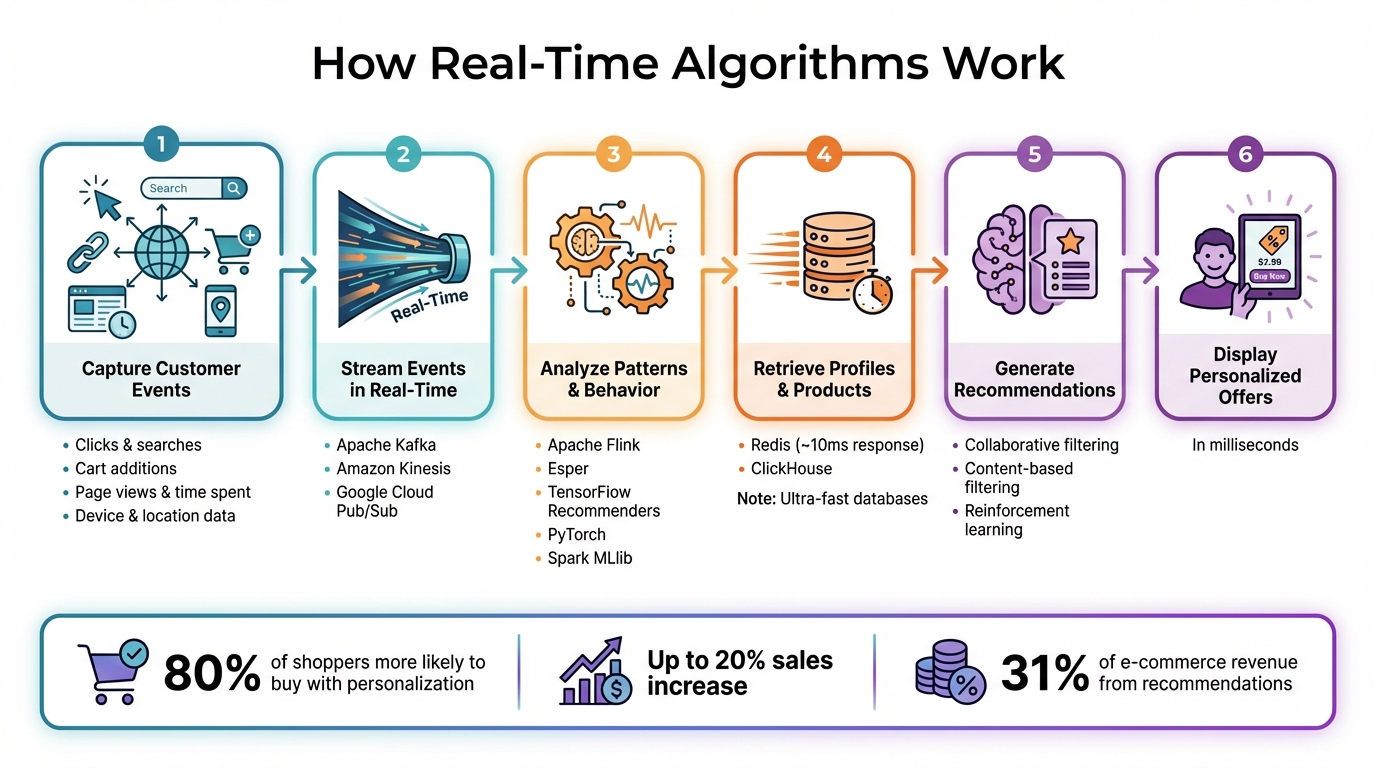
How Real-Time Recommendation Algorithms Work: From Data Collection to Personalized Offers
Real-time algorithms operate using event-driven architectures that capture customer interactions – like clicks, searches, or adding items to a cart – and funnel these actions into processing engines. Platforms such as Apache Kafka, Amazon Kinesis, or Google Cloud Pub/Sub handle the event streaming, while tools like Apache Flink and Esper analyze the incoming data. These engines look for patterns, such as a customer repeatedly viewing high-end laptops or approaching their cloud storage limit, and act on these insights instantly – like triggering a personalized offer.
Frameworks like TensorFlow Recommenders, PyTorch, and Spark MLlib use live data to make predictions, while ultra-fast databases such as Redis and ClickHouse retrieve customer profiles or product details with minimal delay. Beyond just analyzing past purchases, this setup tracks the sequence of actions within a session, offering a clearer view of immediate intent. This infrastructure is key to leveraging real-time data for timely, personalized customer experiences.
Key Data Sources for Real-Time Algorithms
Real-time algorithms rely heavily on several types of data to guide their decisions:
- Behavioral data: Information like clicks, search terms, and user actions during a session.
- Transactional data: Purchase history, order frequency, and average order values.
- Contextual data: Details like device type, location, time of day, and session length.
Another critical source is zero-party data – information customers willingly share, such as preferences provided through quizzes, account settings, or preference centers. For example, if a customer specifies an interest in vegan products, the system can immediately tailor its recommendations. Companies that excel at combining these data sources often generate 40% more revenue from personalization compared to slower-growing competitors. These data inputs form the backbone of precise, real-time personalization.
Techniques for Real-Time Personalization
Real-time personalization employs several strategies to predict and respond to customer preferences:
- Collaborative filtering: This method suggests products based on the behaviors of similar users. Think of the classic "Customers who bought this also bought…" approach. Tools like TensorFlow Recommenders and Spark MLlib identify user groups with shared habits.
- Content-based filtering: Instead of focusing on user behavior, this technique analyzes product attributes – like category, color, or brand – to recommend similar items. For instance, if someone is browsing running shoes, the system might suggest other athletic footwear with comparable features.
The most effective systems combine collaborative and content-based filtering to overcome challenges like cold starts (when limited data is available for new users or products). Additionally, they use reinforcement learning tools like Ray RLlib to adapt in real time based on customer feedback. Techniques such as association rule mining also help identify frequently co-purchased products. These methods are highly effective, with recommendation engines driving an average of 12% of customer purchases and, for some retailers, contributing up to 31% of total e-commerce revenue.
Benefits of Real-Time Algorithms in Cross-Selling and Upselling
Real-time algorithms are reshaping how businesses interact with customers, turning every touchpoint into a chance to grow revenue while trimming operational complexities.
Increasing Revenue Through Personalized Offers
Real-time algorithms thrive on live engagement data, tailoring offers to match customer intent in the moment . This adaptability boosts Average Order Value (AOV) by making timely suggestions, whether it’s recommending complementary products (cross-selling) or upgrading to premium options (upselling) . Here’s the kicker: 80% of shoppers are more inclined to buy when their experience feels personal. Personalization can drive sales up by as much as 20%.
The numbers back it up. Retailers have seen AOV jump by up to 12%, with personalized recommendations contributing to 31% of e-commerce revenue . For instance, Decathlon Singapore saw a 36% spike in click-through rates and a 50% boost in conversions after rolling out AI-powered recommendations in 2024. Huckberry also reported a 9.4% increase in website revenue thanks to their AI personalization strategy. These systems don’t just stop at surface-level suggestions – they use reinforcement learning to explore new product pairings and identify the perfect moment to present offers, like when a customer nears their cloud storage limit .
Improving Customer Satisfaction
Beyond driving revenue, real-time recommendations elevate customer satisfaction by cutting down on friction. These systems create a seamless feedback loop, constantly updating offers and content based on live behavior. The result? Customers find what they need with minimal effort, leaving them feeling understood and valued.
"Personalizing the online experience, meaning that you provide each customer with their relevant results in as few keystrokes as possible, shows that you really care about them."
– Lou Ebling, Sales Director, Algolia
Satisfied customers are more likely to stick around. Real-time systems anticipate customer needs, using predictive engagement scoring to act before issues arise. For example, businesses can offer upgrades during high-usage periods, ensuring a proactive rather than reactive approach. These efforts pay off: AI-based recommendations can lower bounce rates by 24% and increase order rates by 150%. Companies that focus on personalization not only grow faster but also generate 40% more revenue from these initiatives. By helping customers discover products they might have missed and ensuring a smooth experience across platforms, these systems build trust and loyalty.
Reducing Manual Work
Automation powered by real-time algorithms takes the grunt work out of the equation, freeing up teams to focus on bigger-picture strategies. These systems allow product and growth teams to tweak strategies and roll out new experiences without relying on developers or code deployments .
For example, AutoML platforms handle model selection, tuning, and deployment automatically, letting systems adjust to trends without human intervention . Staples Canada used AI-driven personalization to free up its engineering team, resulting in a double-digit boost in conversion rates. Similarly, YourSurprise, a Netherlands-based gift retailer, reduced manual workload and saw a 9% increase in conversions through automated behavior analysis.
Low-code interfaces make it easier for marketing teams to define audiences and set triggers on their own, moving from static to dynamic audience definitions in real time. On top of that, managed cloud infrastructure scales automatically to meet demand, removing the hassle of manual resource allocation. These advancements not only streamline operations but also create room for teams to innovate and grow.
sbb-itb-2ec70df
Implementing Real-Time Algorithms for Small Businesses
Small businesses can boost revenue and customer satisfaction by implementing real-time algorithms with affordable, ready-to-use tools.
Choosing the Right Tools and Platforms
For small businesses, managed SaaS solutions are a practical alternative to building in-house data science teams. This approach helps avoid the pitfalls of falling behind on technology updates – a challenge faced by over half of businesses that attempt to build personalization in-house.
The key is to select platforms that integrate seamlessly with your existing systems, such as CRMs (e.g., Salesforce), e-commerce platforms (like Shopify or BigCommerce), and content management systems. For instance, Amazon Personalize offers a free tier for two months, which includes up to 20 GB of data processing, 100 training hours, and 180,000 recommendation requests. Tools like Redis with RediSearch are also worth considering, as they can deliver lightning-fast recommendations in about 10 milliseconds using vector similarity search.
By choosing tools that align with your existing stack, you can set up real-time recommendations in just a few steps.
Steps to Set Up Real-Time Recommendations
Step 1: Begin with a robust data collection layer. Tools like AWS Amplify or Segment can track real-time events such as clicks, views, add-to-carts, and purchases. Ensure this setup combines both historical data (imported via CSV or database) and live event streams to train your algorithms effectively.
Step 2: Configure your recommendation engine with rules tailored to your customers’ needs. For instance, you can filter out items already purchased, set price range parameters, or focus on specific product categories. Start small – personalize one high-impact area, like checkout suggestions or "add to cart" pages, before scaling personalization across your site.
Step 3: Conduct A/B tests to evaluate the impact of recommendations on revenue. Compare results against a control group to measure the effectiveness. Many systems use a scoring model (ranging from 0 to 1) to indicate the likelihood that a customer will engage with a recommended item.
Once your system is in place, it’s important to address common challenges to maintain long-term success.
Overcoming Common Challenges
One major challenge is ensuring data quality. Misclassified purchases or missed interactions can lead to poor recommendations. A 2023 survey revealed that half of businesses struggle to collect accurate data for personalization. To improve data quality, consider using zero-party data collection methods, such as quizzes or simple rating tools.
Scalability is another concern as your business grows. Cloud-native solutions can automatically manage increased data volumes without requiring complex manual adjustments. Additionally, privacy regulations can complicate data collection. Clear landing page banners that explain how data is collected and provide easy opt-out options can help maintain customer trust while staying compliant.
"Online search and personalization is really difficult – there is no panacea in the marketplace. But finding the right partner… will provide great value to you and your customers"
– Lou Ebling, Sales Director, Algolia
Measuring Success and Optimizing Performance
Once your system is live, it’s crucial to monitor metrics to confirm the impact on revenue. These metrics directly reflect the effectiveness of the real-time algorithm adjustments discussed earlier. Start with financial metrics like conversion rate and average order value (AOV), as they provide immediate insights into sales performance. For instance, users clicking on recommended items tend to convert at over 5× higher rates. Additionally, personalization efforts can boost AOV by up to 12% for 98% of retailers.
But sales aren’t the only indicator of success. Engagement metrics help you understand how customers interact with your recommendations. Metrics like click-through rate (CTR), product detail page views, and time spent browsing recommended items can reveal whether your algorithm is surfacing relevant products. High engagement, as seen on leading platforms, underscores the effectiveness of real-time recommendations.
Key Metrics to Track
To gauge overall performance, focus on the following:
- Conversion rate, AOV, and revenue share from recommendations: Recommendations can contribute up to 31% of total e-commerce revenue.
- Engagement metrics like CTR and glance views: These show how well your recommendations capture customer interest and drive browsing behavior.
- Operational metrics: Keep an eye on return rates and order defect rates. Recommending products that customers frequently return can harm long-term satisfaction.
For technical performance, track metrics like recommendation latency (how quickly the system responds) and request success rates. Ultimately, the "North Star" metric to aim for is Customer Lifetime Value (CLTV), which emphasizes long-term customer retention over short-term gains.
Using Feedback Loops for Refinement
Metrics alone won’t optimize your system – you need to act on what they reveal. This is where customer feedback comes in. Use both explicit feedback (ratings, reviews, and "I Own This" buttons) and implicit feedback (clicks, page views, and cart additions) to refine your recommendations. Explicit feedback provides precise preferences but is often sparse. Implicit feedback, on the other hand, flows continuously and reflects actual customer behavior.
Real-time systems often use temporal weighting, giving more importance to recent interactions. For example, if a customer browsed winter coats yesterday but is now looking at swimwear, the algorithm should adapt immediately. Simple tools like thumbs up/down buttons or quick preference quizzes can also help customers fine-tune their profiles. Companies like Tencent have seen CTR increases of 6% to 18% by incorporating continuous feedback into their recommendation algorithms.
A/B Testing for Optimization
A/B testing is a powerful way to identify which recommendation strategies truly drive conversions. By splitting traffic evenly, you can compare a new algorithm or feature against your current system. It’s important to test one variable at a time – whether it’s the placement of recommendations, the number of items shown, or the algorithm itself.
Focus on metrics like CPA (Cost Per Acquisition) and ROAS (Return on Ad Spend) rather than vanity metrics like CTR. As Danielle Smith, VP of Marketing at Lotame, explains:
"CTR alone can be a trap as it tells you who clicks, not who converts".
Make sure your tests run long enough to reach statistical significance; drawing conclusions too early can lead to misleading results. Archive your findings to build a knowledge base and avoid repeating failed experiments. If a tactic works well in one area, test it across other parts of your site to see if it performs consistently. This approach ensures your recommendations remain aligned with real-time customer behavior.
Conclusion
Real-time algorithms are reshaping how businesses approach cross-selling and upselling by shifting from static models to dynamic, data-driven strategies. By combining Reinforcement Learning with Collaborative Filtering, companies can create systems that not only explore new product opportunities but also leverage existing customer preferences. These systems aim for long-term goals like Customer Lifetime Value instead of just chasing immediate clicks.
The numbers speak for themselves: conversion rates have climbed from 1.02% to 8.57%, and average order values have surged from $44.41 to over $400 in specific scenarios. These aren’t just incremental gains – they represent a major shift in how revenue is generated.
However, the key to success lies in integration. These algorithms must be embedded into existing workflows, not treated as isolated tools. As Acceleraid puts it:
"Success lies not only in the models themselves but in embedding them into CRM, marketing, and digital commerce processes".
Real-world examples underscore this point. In August 2024, Mariani Packing Company achieved a remarkable 99.8% efficiency rate by implementing AI-driven processes that identified customer patterns and minimized manual errors. Such integration ensures these algorithms blend seamlessly into daily operations.
From a technical standpoint, starting simple can make all the difference. Using SQL-based heuristics on real-time databases is a practical way to get to market quickly. Once the foundation is laid, businesses can gradually move toward more advanced deep learning models.
Real-time personalization has become a necessity in today’s competitive landscape. As noted by Algolia:
"Real-time personalization isn’t just a luxury – it’s becoming a necessity for companies that want to thrive in today’s marketplace".
This shift emphasizes the importance of adopting real-time personalization as a strategic priority. By creating feedback loops, tracking meaningful metrics, and adjusting strategies based on customer behavior, businesses can uncover revenue opportunities that static systems would overlook.
FAQs
How do real-time algorithms enhance cross-selling and upselling strategies?
Real-time algorithms take live customer data – like browsing habits, purchase history, and usage patterns – and use it to deliver personalized product recommendations and upgrade offers on the spot. By aligning these suggestions with individual preferences, businesses can create cross-sell and upsell opportunities that feel more relevant and engaging.
The result? Higher conversion rates, increased average order value, and a boost in overall revenue. On top of that, real-time personalization elevates the customer experience, helping to build satisfaction and loyalty over time.
What tools can small businesses use to implement real-time recommendations for cross-selling and upselling?
Small businesses have a range of tools at their disposal to implement real-time recommendations, helping boost cross-selling and upselling efforts. Amazon Personalize stands out as an easy-to-use, fully managed solution. By leveraging machine learning, it delivers personalized recommendations through a low-latency API. Plus, it works seamlessly with other Amazon services like DynamoDB for quick data retrieval and CloudWatch for monitoring performance.
For businesses focused on search-based recommendations, Algolia’s AI Recommendations platform is a solid choice. It provides real-time personalization, making it easy to display tailored suggestions such as “you may also like” directly within an online store. Both Amazon Personalize and Algolia are scalable and budget-friendly, aligning well with U.S.-style pricing formats, making them ideal for small businesses.
For those needing more customization, tools like Apache Kafka and AWS Kinesis can capture real-time user events, while Redis and Hazelcast enable ultra-fast data access. If decision-making requires more complexity, Apache Flink or Esper can analyze patterns and trigger upsell opportunities instantly. Additionally, businesses can deploy custom machine learning models using TensorFlow Serving or AWS SageMaker to create tailored real-time recommendations.
To tie it all together, companies like Growth-onomics specialize in integrating these tools into unified strategies that drive revenue growth and improve customer experiences.
How can businesses maintain high-quality data for effective real-time recommendations?
Maintaining top-notch data quality is crucial for delivering real-time recommendations. If your data is inaccurate or incomplete, you risk offering irrelevant suggestions, which can lead to missed opportunities for cross-selling or upselling. To get started, businesses should focus on capturing every user interaction – like clicks, page views, or cart additions – through a dependable event-tracking system. This data should then be sent to a central hub for processing. Validating the data as it comes in (such as checking for duplicates or ensuring timestamps are accurate) and storing it in a low-latency database ensures your inputs remain consistent and reliable.
To avoid problems like outdated or incomplete user profiles, it’s important to enforce strict data schemas, use idempotent processes to eliminate duplicates, and manage caches effectively. Regular testing is equally critical – validating transformation logic and auditing data pipelines can help identify issues before they escalate. Keeping an eye on key metrics like error rates and data drift provides real-time visibility into potential problems, ensuring your recommendations stay relevant and impactful.
Growth-onomics specializes in helping businesses build dependable data pipelines and governance frameworks, enabling them to generate clean, actionable insights for personalized recommendations.