

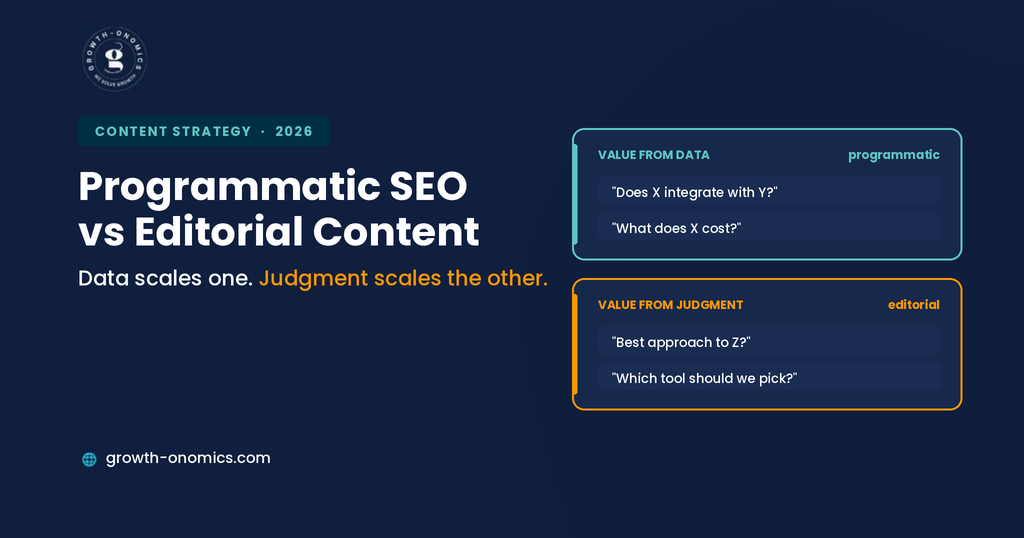
Programmatic SEO scales page volume. Editorial content scales authority.
B2B SaaS companies need both, applied to different query types, and applying either to the wrong one is an expensive mistake.
Programmatic works when a genuine dataset produces a genuinely different answer for every page; 200 integrations, each with its own setup steps, limits, and use case. Editorial works when the value comes from a position, an argument, or knowledge only your company has.
The failure is symmetrical and predictable. Programmatic applied without a dataset produces near-duplicate pages that Google classifies as scaled content abuse.
Editorial applied to enumerable queries produces four hand-written integration pages while a competitor ships two hundred.
The deciding question is not which approach is better. It is whether the answer to a query varies by data or by judgment. This article covers where each one works, what makes a programmatic page survive, why AI answers changed the calculation, and how to decide per query type rather than per company.
What’s the Actual Difference?
Not template versus handcrafted, which is how it usually gets framed. The actual difference is where the value in the page comes from.
Programmatic pages derive value from data. A structured source like your integration catalog, a pricing database, a set of locations, or industries; populates a consistent template. The page is valuable because the data is accurate, specific, and hard to find elsewhere. The template is a delivery mechanism.
Editorial pages derive value from judgment. A position on a contested question, an argument built from customer conversations, original research, a comparison that concedes where a competitor is stronger. The value is in what someone decided to say.
Why the distinction is important: it tells you which failure you are risking. A programmatic page fails when the data is thin, because then only the template remains. An editorial page fails when the judgment is generic, because then it is a summary of what already ranks.
Most B2B SaaS sites have queries of both kinds and treat their whole content programme as one or the other. That single decision made once, usually early, usually by whoever set up the first content plan explains most of the underperformance in this category.
How Do They Compare?
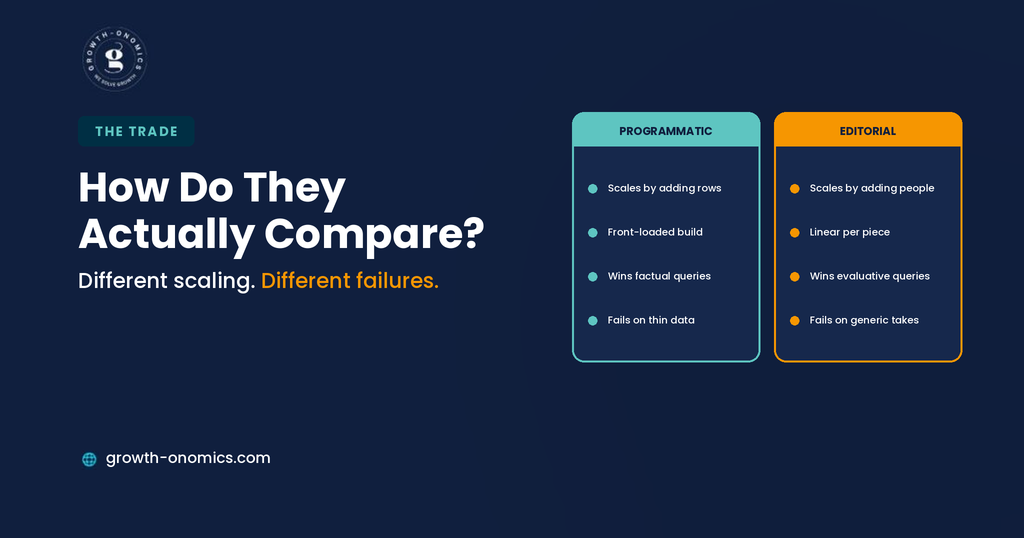
| Dimension | Programmatic | Editorial |
| Value comes from | A structured dataset | A position or argument |
| Scales by | Adding rows | Adding people |
| Cost shape | Front-loaded build, low marginal | Linear per piece |
| Wins queries like | “Does X integrate with Y” | “Best approach to Z” |
| Fails when | The data is thin | The take is generic |
| Maintenance | Data freshness, template updates | Refresh cycles, fact checks |
| AI citation profile | Strong for factual questions | Strong for evaluative questions |
| Risk | Scaled content abuse | Publishing nobody reads |
When Does Programmatic Work?
Programmatic works under 4 conditions, and all 4 have to hold. If one fails, the pages will be thin regardless of how good the template is.
1. You have a real dataset.
Not a list of names, but a set of attributes that differ meaningfully per row. Integration pages need the setup steps, the data direction, the plan requirement, and the specific limitations for each partner. If every row would produce the same paragraph with one word swapped, you do not have a dataset; you have a list, and a list produces one page rather than two hundred.
2. The queries genuinely exist.
People search “does [product] integrate with [tool]” for hundreds of tools. They do not search for most of the permutations you could theoretically generate from the same table. Search demand should govern which rows become pages, not dataset size.
3. Each page answers something specific.
A person arriving on that page gets an answer they could not have got from the parent page. This is the test that separates a useful set from a spam signal.
4. Somebody owns the data.
Rows go stale, integrations get deprecated, plan requirements change. Without a named owner, a programmatic set becomes a large collection of confidently wrong pages, which is worse than never building it, because the errors are now indexed, cited, and multiplied across every row.
The 4 use cases that reliably satisfy all 4 conditions: integration pages, comparison and alternatives pages, glossary and definition sets, and industry or use-case pages where you genuinely have sector-specific substance rather than the same page with a vertical name swapped in.
When Does Editorial Work?
Editorial work under 4 situations where a template has nothing to work with, because the value is in the argument.
1. Contested questions.
Anything where reasonable people disagree and your answer reflects a position you can defend. No dataset produces a point of view, and a template applied here produces the hedged non-answer that reads as marketing.
2. Original research and benchmarks.
Data you collected, with the methodology and sample stated. This is the most citable asset a B2B SaaS company can produce; it exists in exactly one place, so attribution comes back to you, and it is definitionally not programmatic.
3. Category education from expertise. How something actually works, written by someone who has done it and can name what goes wrong. Generic explainers still rank in some categories; expert ones get cited, which is a different and more durable outcome.
4. Positioning and comparison narrative.
The prose around a comparison table: why the trade-off exists, who each option suits, what changes at scale. The table can be programmatic. The judgment cannot.
Growth-onomics builds content plans around this split rather than around a single format, because the two answer different query types and a plan made entirely of one leaves half the commercial surface uncovered.
What Do Buyers Actually Search For in Each Category?
The abstract split becomes obvious once you look at query shapes, so here they are side by side.
Programmatic query shapes. “Does [product] integrate with [tool].” “[Product] vs [competitor].” “[Category] software for [industry].” “What is [term].” Each has hundreds of variants, each variant has a different correct answer, and the answer comes from a field in a table.
Editorial query shapes. “How should we approach [problem].” “Is [approach] worth it for a team our size.” “Why do [category] implementations fail.” “Best [category] strategy for [situation].” Each has one version, and the answer is a position rather than a lookup.
The one that fools people. “Best [category] software” looks enumerable and is not. It has few variants, the answer is a judgment about which options suit whom, and it draws heavily on third-party sources rather than on anything you publish. Teams that treat it as programmatic generate dozens of near-identical roundups and rank for none of them.
The other one that fools people. “[Product] pricing” looks editorial and is not, at least in part. The structure, tiers, what drives cost, adjacent expenses is factual and belong in a well-built page. The positioning around it is judgment. Most pricing pages get this backwards and publish the narrative while omitting the facts.
What Separates a Good Programmatic Page From Scaled Content Abuse?
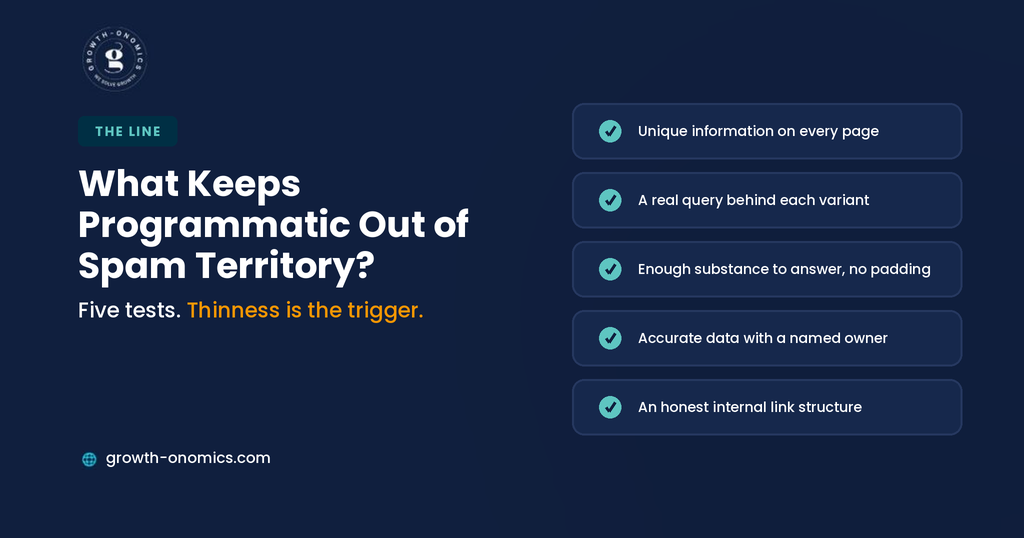
Google’s spam policy targets scaled content created primarily to manipulate rankings rather than help users, and the distinction is not about automation; it is about whether each page carries unique value. There are 5 tests that separate them.
Unique information per page. Something on the page that appears nowhere else on your site. If the only difference is a name and a logo, the page fails.
A real query behind it. Someone is searching for this specific thing. Generating every possible permutation because you can is the clearest signal of the wrong intent.
Enough substance to answer. A page that answers the question and stops is fine. A page padded to a word count with generic filler is a different thing, and readers spot it before search systems do.
Accurate, maintained data. Stale programmatic sets decay fast because errors multiply across every page. An integration set describing capabilities you removed is a liability at scale.
An honest internal link structure. Programmatic sets that exist only to pass links between each other, with no crawlable path from real navigation, look exactly like what they are.
The practical rule: if you would be comfortable showing a specific page to a prospect who searched for that exact thing, it belongs. If you would rather they landed somewhere else, it does not.
Does Programmatic Content Get Cited in AI Answers?
Yes, and disproportionately for factual questions, which has quietly strengthened the case for well-built programmatic sets.
Why it works. Answer engines reach for precise, structured, current sources when a question has a factual answer. “Does X integrate with Y,” “what does X cost,” “is X SOC 2 compliant” are exactly the questions a good programmatic page answers directly, and exactly the questions a narrative blog post answers badly.
Why thin sets fail harder now. A page with no unique information gives a retrieval system nothing to extract and nothing to attribute. It is not penalised so much as passed over, which reaches the same commercial outcome as a penalty and gives you no signal that it happened.
What editorial wins instead. Evaluative questions like which tool to choose, what the alternatives are, whether an approach is right for a given team. These draw heavily on third-party sources and on content that takes a position, and no template produces either.
The split maps cleanly onto how buyers ask questions. Factual questions about your product are programmatic territory. Evaluative questions about your category are editorial territory, supported by presence on sources you do not own.
What Does It Cost to Run Each One?
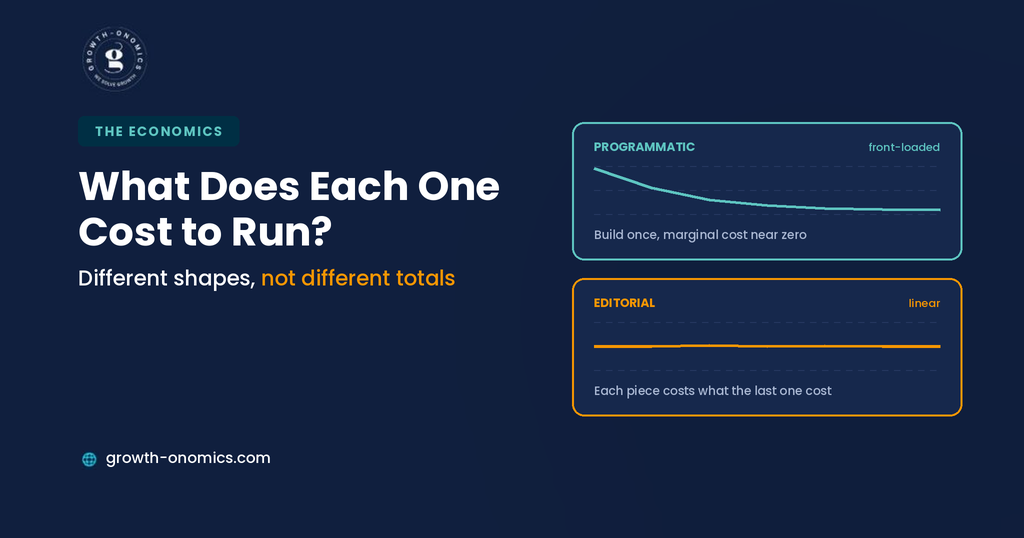
Different cost shapes, which is why comparing them per page misleads.
Programmatic is front-loaded. Template design, data model, quality control, and the engineering to generate and publish. After that, the marginal cost of page 200 is close to zero, which is the entire appeal. The recurring cost is data maintenance, small per row, unavoidable in aggregate, and the line most business cases leave out.
Editorial is linear. Each piece costs roughly what the last one cost, because the input is a person’s judgment and an expert interview. Volume scales with headcount or budget, not with a template.
The hidden cost of programmatic is quality control at scale. Reviewing 200 generated pages is a real job that nobody volunteers for, and skipping it is how a set ships with the same error repeated 200 times and discovered by a prospect.
The hidden cost of editorial is that most of it underperforms. A minority of pieces carry the results, and the distribution is severe enough that publishing more without improving selection mostly adds cost rather than results which is why volume targets are a poor proxy for an editorial programme working.
Neither is cheap. Programmatic front-loads the spend and creates a maintenance liability; editorial spreads the spend and creates a selection problem.
How Do I Decide Per Query Type?
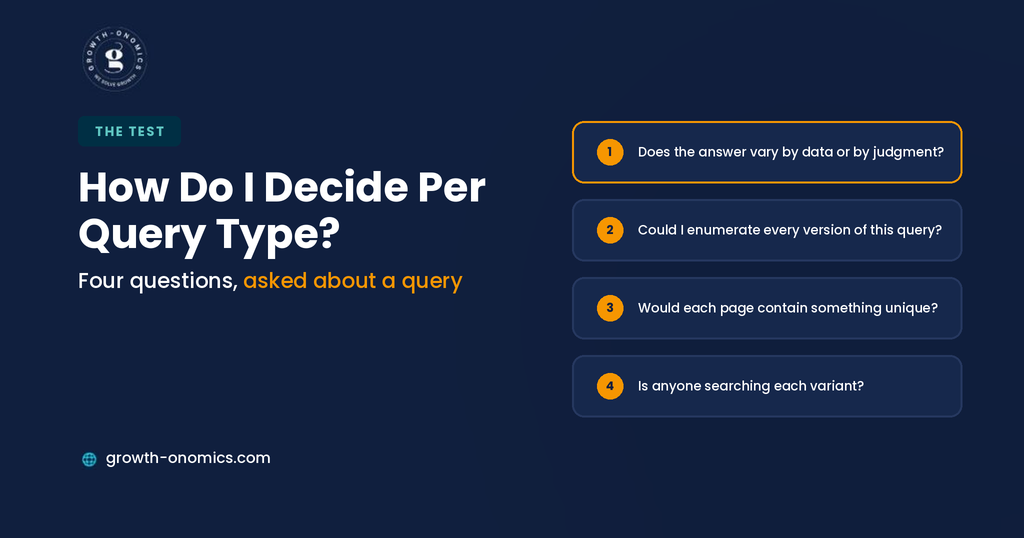
4 questions, asked about a query rather than about your company.
Does the answer vary by data or by judgment? If a spreadsheet column determines the answer, programmatic. If a person’s opinion determines it, editorial.
Could I enumerate every version of this query? Integrations, comparisons, and locations are enumerable. “How should we approach X” is not.
Would each page contain something unique? If the honest answer is no, the query is not programmatic; it is one page with a section per case.
Is anyone actually searching each variant? Check demand before generating rows. This is the discipline that separates a purposeful set from a spam signal.
Run those 4, and most content plans sort themselves. The common outcome is a small programmatic set covering integrations and comparisons, and an editorial programme covering everything else which is a different shape from what most SaaS content calendars currently contain.
What Does a Working Split Look Like?
4 components, in the order most teams should build them.
A small, high-quality programmatic set first. Integrations your buyers actually ask about, comparisons against competitors you actually lose to. 10 excellent pages beat 200 stubs, and the 10 surface every template problem while it is still cheap to fix rather than a migration.
Editorial for the evaluative and contested queries. Category arguments, original research, positioning narrative. Fewer pieces, more expert input, and a distribution plan attached to each one before it is written rather than after it underperforms.
Shared structural standards. Both types need answer-first openings, question-shaped headings, and specifics worth attributing. Structure is not a format decision, and applying it only to editorial leaves the programmatic set less citable than it should be which is a waste, since factual pages are the ones assistants reach for most.
One owner for data freshness. Programmatic sets fail quietly through decay rather than loudly at launch. Growth-onomics scopes a review cadence alongside any programmatic build for that reason; the pages that were accurate at publication are the liability 12 months later.
Conclusion
The question in the title has a clearer answer than the debate suggests. Programmatic scales page volume against enumerable, data-driven queries. Editorial scales authority against contested, judgment-driven ones. Neither scales the other, and the companies doing this well stopped choosing years ago.
What has changed recently is that AI answers have made the split sharper rather than blurrier. Factual questions increasingly get answered from precise, structured, current sources, which is what a good programmatic page is. Evaluative questions increasingly draw on third-party sources and on content that takes a position, which is what editorial produces. The middle ground, generic content that is neither specific enough to cite nor opinionated enough to matter, is where the losses concentrate.
Decide per query type, not per company. Build the small programmatic set first and prove the template. Reserve editorial for the questions where judgment is the product. And name whoever keeps the data current, because a programmatic set nobody maintains becomes a liability at exactly the scale that made it attractive.
If you want a content plan split by query type rather than by format preference, the Growth-onomics team can map which of your commercial queries belong on each side.
FAQs
Is programmatic SEO still safe for B2B SaaS?
Yes, when each page carries unique information and answers a query someone actually searches. Google’s spam policies target scaled content created primarily to manipulate rankings rather than help users; the trigger is thinness and intent, not automation. A set of integration pages with genuine setup steps, plan requirements, and limitations per partner is legitimate. A set generated from a list of names with boilerplate around each one is the thing the policy describes. The practical test: would you be comfortable showing a specific page to a prospect who searched for that exact thing?
Does programmatic content get cited in AI answers?
Yes, and often more readily than editorial content for factual questions. Answer engines reach for precise, structured, current sources when a question has a factual answer, which describes a well-built integration or pricing page exactly. Programmatic loses on evaluative questions—which tool to choose, what the alternatives are because those draw on independent sources and content that takes a position. Thin programmatic pages fail differently now: rather than being penalised, they are simply ignored, because there is nothing unique to extract.
How many programmatic pages should we publish?
As many as your dataset supports and search demand justifies, which is usually fewer than the theoretical maximum. Check query volume per variant before generating rows, and start with 10 to 20 pages covering the integrations and comparisons your buyers ask about most. Those prove the template and surface quality problems while they are cheap to fix. Scaling to hundreds before validating the format is how teams end up rewriting or removing a whole set. Volume is an output of the data, not a target.
Should the same team do both?
The same team can, with different inputs. Programmatic needs a data owner, a template designer, and someone doing quality control at scale closer to operations than to writing. Editorial needs expert interviews, editorial judgment, and a distribution plan per piece. What fails is treating programmatic as a writing task, which produces hand-crafted templates that do not scale, or treating editorial as a volume task, which produces summaries of what already ranks.
How do we maintain a programmatic set once it exists?
Assign one owner and a review cadence before you publish. Programmatic sets fail through decay rather than at launch: integrations get deprecated, plan requirements change, limits move, and an error in the template propagates to every page at once. A quarterly pass over the underlying data plus a check that the template still reflects the product covers most of it. The specific risk worth naming is silent inaccuracy: the pages keep ranking and keep getting cited while describing capabilities you removed.
What is the biggest mistake teams make here?
Choosing one approach for the whole site. An editorial-only programme leaves enumerable commercial queries uncovered while competitors publish 200 integration pages. A programmatic-only programme has no answer to the evaluative questions that build shortlists, and often no content worth citing anywhere off-domain. The decision belongs at the query level: does the answer vary by data or by judgment? Ask that per query type, and the plan builds itself.