


Want to boost your SaaS conversion rates? Start by rethinking your pricing model. Here’s the deal: your pricing strategy directly impacts how users move through key funnel stages – from signing up to becoming paying customers.
Key takeaways:
- Freemium models attract users but often convert fewer to paid plans (2–5%) compared to free trials (5–20%).
- Asking for a credit card upfront can double trial-to-paid conversions but reduces signups by 65%.
- Tiered pricing with a strong middle option increases conversions by 20–30%.
- Usage-based models drive faster adoption but may cause revenue fluctuations, while hybrid models balance stability and scalability.
Simple tweaks like shorter trials, better pricing page design, or value-based pricing can significantly improve results. For example, companies like Slack and Zoom boosted conversions and revenue by testing and refining their pricing strategies. Want to see how your pricing stacks up? Start by analyzing your funnel data and experimenting with small changes.
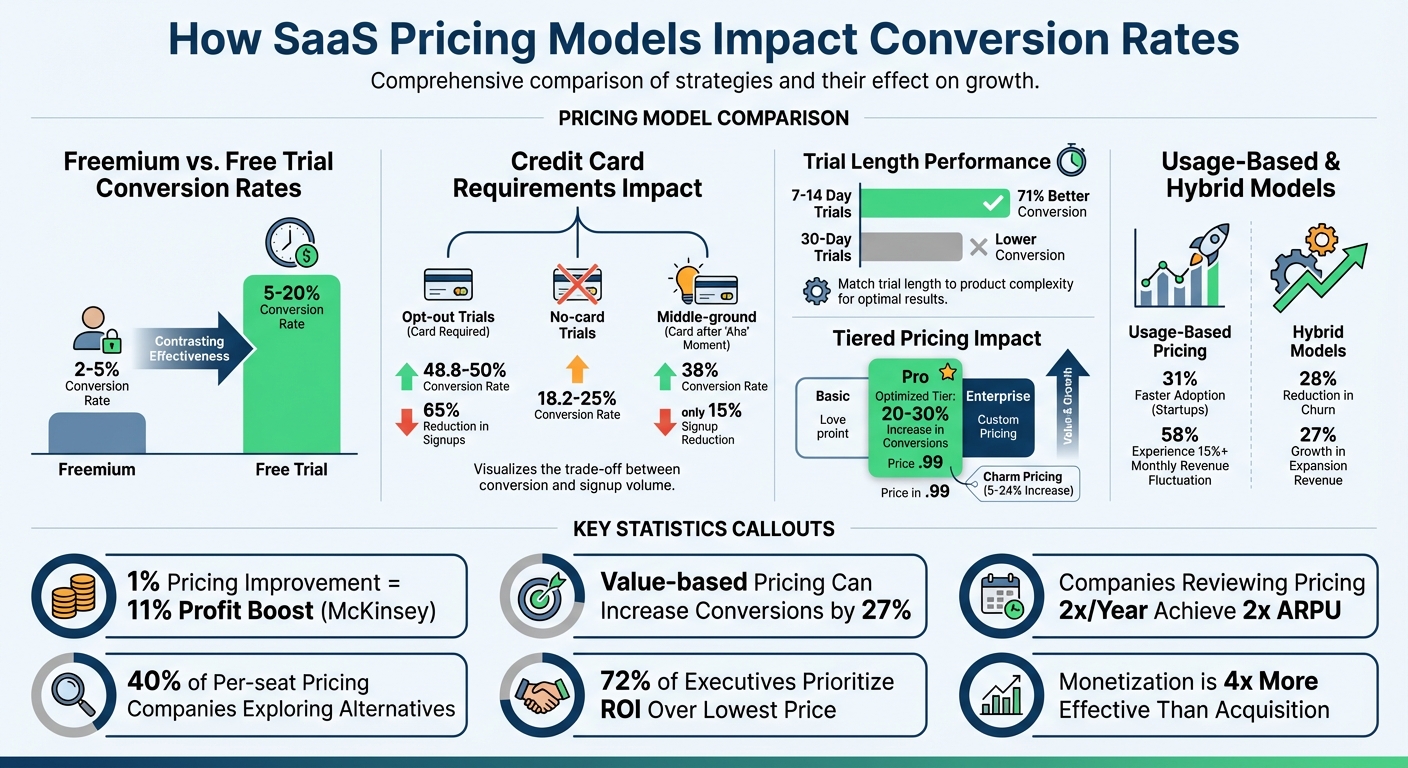
SaaS Pricing Models Conversion Rate Comparison Chart
How Different Pricing Models Affect Conversion Rates
Freemium and Free Trial Models
Freemium and free trial strategies are great for attracting users by eliminating financial barriers, but they deliver very different conversion results. Free trials often convert 5–20% of users into paying customers, while freemium models typically achieve just 2–5% conversion rates. The difference lies in urgency: trials have a built-in expiration date, pushing users to make a decision, whereas freemium users can stick to the free tier indefinitely.
Getting users to experience a product’s core value is critical. A 10% increase in exposing users to a product’s core features can lead to a 6–10% boost in trial-to-paid conversions. For instance, VoiceDrop managed to increase its conversion rate from 12% to 57% in just 30 days by slashing its Time to First Value from 45 minutes to 8 minutes and introducing behavioral payment prompts. Similarly, Rocketbots improved user activation from 15% to 30% by replacing generic product tours with interactive walkthroughs.
Payment card requirements also play a major role. Opt-out trials, where users must provide a credit card upfront, convert at rates between 48.8–50%, but they cut trial signups by 65% compared to no-card trials, which convert at 18.2–25%. A middle-ground approach – asking for payment details only after users hit their "aha" moment – achieves a 38% median conversion rate while limiting trial volume drops to just 15%.
The length of the trial also matters. Shorter trials (7–14 days) outperform 30-day trials by 71% in driving conversions. However, longer trials can lead to "delayed conversions", where users subscribe weeks after the trial ends because they’ve developed a stronger attachment to the product. The ideal trial length depends on the product’s complexity: simple tools may only need 7 days, while B2B SaaS products often work best with 14 days. For enterprise solutions requiring complex setups, 30 days or more might be appropriate.
"The freemium model isn’t about giving your product away; it’s about efficiently acquiring customers at scale."
- Patrick Campbell, CEO, ProfitWell
Next, let’s look at how tiered, per seat, and flat-rate pricing strategies shape conversion rates.
Tiered, Per Seat, and Flat-Rate Pricing
These pricing models strike different balances between simplicity and revenue potential. Flat-rate pricing, like Basecamp’s $99/month plan, simplifies decision-making for customers but may leave money on the table by not catering to diverse customer needs.
Tiered pricing, which typically offers 3–4 clearly defined packages, creates opportunities for upselling while avoiding decision fatigue. When optimized, this structure can boost conversion rates by 20–30%. Using the "Goldilocks Effect" – designing an appealing middle tier that makes the basic option seem too limited and the premium option too expensive – can guide customers toward the desired choice.
Per-seat pricing, where users pay based on the number of users or licenses, makes costs predictable for both customers and businesses. However, it can discourage widespread adoption within organizations, as teams may share logins to save on costs. About 40% of software companies using per-seat pricing are now exploring more flexible alternatives.
Even small pricing tweaks can impact conversions. For example, charm pricing – ending prices in "9" – can increase conversion rates by 5–7% and sometimes as much as 24% compared to rounded numbers. Additionally, McKinsey research shows that a 1% improvement in pricing strategies can lead to an 11% boost in profits.
Now, let’s explore how usage-based and hybrid pricing models align customer spending with value delivered.
Usage-Based and Hybrid Pricing Models
These models influence conversions by linking costs directly to usage, which can lower the barrier to entry for new customers. Usage-based pricing, where customers pay based on consumption, drives 31% faster adoption among startups compared to fixed pricing plans. This approach feels logical to customers, as they only pay for the value they receive – Stripe’s model of charging 2.9% + $0.30 per transaction is a great example.
However, the unpredictability of costs can be a drawback. Customers may hesitate to commit if they can’t estimate their monthly expenses. About 58% of businesses using pure usage-based pricing experience revenue fluctuations of more than 15% month-to-month. Hybrid models, which combine a base subscription with usage credits, address this issue by reducing churn by 28%.
Hybrid pricing offers the stability of subscriptions with the scalability of usage-based models. This approach is particularly effective for driving expansion revenue, which can grow by 27% when usage-based components are included. These models also automate upselling, as increased customer usage naturally leads to higher revenue.
To improve conversions and manage customer expectations, consider implementing strategies like price caps, alerts for unusual usage spikes, or volume discounts. For revenue stability, baseline commitments or minimum spend thresholds can be useful. The key is selecting the right usage metric – one that aligns with your product’s core value so that higher usage reflects customer success.
How to Optimize Pricing for Better Conversion Rates
Using Analytics to Spot Pricing Issues in Your Funnel
Analytics can uncover where your pricing strategy might be falling short. For example, if your pricing page has a high bounce rate, it could mean the pricing or how it’s presented isn’t resonating with visitors.
Another key metric to watch is the trial-to-paid conversion rate. If users try your product but don’t convert, it might indicate that the price doesn’t match the value they experienced, or the leap from a free trial to a paid plan feels too steep. Monitoring this closely can help you determine if your product met user expectations during the trial period.
Retention metrics are equally important. High churn rates or frequent downgrades may signal that your pricing model doesn’t align with how customers actually use your product. To dig deeper, cohort analysis is a great tool. By grouping customers based on when they signed up, you can see how different pricing models impact long-term retention. Another useful approach is segmenting data by audience type – such as new versus returning visitors. Interestingly, tests with returning visitors can yield results 40% faster than those with new users.
Tracking win rates by pricing tier can also provide valuable insights. If certain tiers convert poorly, it might mean those segments feel priced out or don’t see enough value. And don’t overlook unexpected costs – these account for about 25% of checkout abandonments in SaaS. Mapping out where these surprises occur in your funnel can help reduce drop-offs.
Once you’ve identified potential issues, use these insights to run targeted pricing experiments.
How to Test Different Pricing Models
Testing pricing models effectively requires a structured approach. Start with a 7-step framework: define your hypothesis, set KPIs, design the test, prepare the infrastructure, execute, analyze the results, and iterate. It’s crucial to isolate variables – focus on testing just one element at a time, like a specific price point, feature bundle, or trial structure.
Small changes can lead to big results. In 2025, Going (formerly Scott’s Cheap Flights) changed the wording on its pricing page from "Sign up for free" to "Trial for free." This simple adjustment boosted trial starts by 104%.
Timing matters, especially for B2B SaaS. Tests should typically run for 4–8 weeks to account for the full customer decision-making cycle. For early-stage companies with less than $1 million in ARR, aim for 6–8 week tests with 600–1,000 unique visitors per variation. Don’t rush decisions based on early trends – wait for a 95% statistical confidence level to ensure the results are reliable.
Real-world examples highlight the value of testing. In 2019, Slack introduced its "Fair Billing Policy", which charged customers only for active users instead of a per-seat model. This change increased conversion rates by 30%. Similarly, Zoom discovered through testing that video recording was a high-value feature. By moving it to higher-priced tiers, they boosted ARPU by 15% without slowing growth.
Adjustments don’t always have to involve changing the price itself. For instance, DocuSign improved mobile conversion rates by 59% simply by optimizing its pricing page for mobile users, adding swipeable tables and touch-friendly buttons. In fact, 68% of A/B tests on pricing pages lead to statistically significant changes, and 41% of companies report a 10–30% revenue boost after running pricing tests.
Use the results of these tests to project the financial impact of pricing changes.
Forecasting the Financial Impact of Pricing Changes
To ensure pricing changes are worthwhile, you need to forecast their financial impact. A basic formula is: Expected Revenue = Signup Rate × Expected Lifetime × Price. Keep an eye on metrics like ARPU, LTV, MRR, and gross margins to gauge the overall effect.
Price increases can sometimes lower conversion rates, so it’s important to assess the trade-offs by monitoring key revenue metrics and customer behavior. For example, Appcues tested a new pricing structure with 4,000 monthly visitors and identified a minimum detectable effect of a 15% increase in trial starts. After an 8-week test with 2,200 visitors per variation, they implemented a pricing model that boosted annual contract value by 25% while maintaining stable conversion rates.
Using 95% confidence intervals to model uncertainty in revenue forecasts is a smart move. Set guardrail metrics to pause experiments if revenue drops or churn spikes. When testing price increases, consider scenarios like grandfathering existing customers or migrating them to new rates. Done correctly, such migrations can increase LTV by over 30%.
HubSpot’s launch of Sales Hub is a great example. Under the leadership of Christopher O’Donnell, the team tested five price points with new prospects. They ultimately chose a price 20% higher than initially planned, based on conversion and usage data. Similarly, Dropbox experimented with country-specific pricing based on purchasing power parity, which boosted global conversion rates by more than 20%.
Companies that regularly revisit their pricing strategies grow 30% faster than those that adjust prices less than once a year. Always translate percentage gains into actual dollar amounts for stakeholders – a 5% increase in revenue per visitor, for example, can mean millions in additional annual revenue. Plus, pricing optimization has a greater impact on operating profit – an 11% boost from just a 1% improvement – compared to gains in customer acquisition (7.8%) or retention (6.7%).
Improving Value Communication and Pricing Page Design
Matching Pricing to Customer Value
When your pricing reflects the value customers actually receive, it’s a game-changer for conversions. Value-based pricing works because it ties what you charge directly to the results your product delivers. For instance, focusing on ROI and measurable outcomes resonates with decision-makers – 72% of senior executives prioritize clear ROI over simply finding the lowest price.
How you present your pricing also matters. Highlighting value instead of cost can boost conversions by up to 27%. One effective tactic? Break down larger costs into smaller, more digestible amounts. For example, instead of saying "$730 annually", present it as "$2 per day" – this reframing makes the price feel more approachable.
Psychological anchoring is another effective strategy. Start by showcasing your most expensive plan first. This creates a reference point, making mid-tier options seem more affordable. Also, keep your pricing options limited – ideally three to four tiers. Too many choices can overwhelm potential buyers, reducing conversions. Clear value propositions can also have a dramatic impact, increasing conversion rates by as much as 90%.
Social proof plays a key role, especially for higher-priced plans. Adding customer testimonials or logos from well-known companies near your pricing tiers builds trust and reinforces the value of your offering. This approach is particularly effective for enterprise plans, where decisions are often driven more by emotion (64%) than logic (36%).
Next, let’s dive into how design choices can further enhance the performance of your pricing page.
Best Practices for Pricing Page Design
Your pricing page isn’t just about numbers – it’s about guiding users toward making a confident decision. Thoughtful design can significantly boost conversions. For example, using visual hierarchy to emphasize your "Recommended" or "Most Popular" plan can increase conversions by up to 35%. Highlighting these plans with contrasting colors or larger text draws attention, with users spending 42% more time focusing on the highlighted option. A majority of tests – 64% – show that emphasizing a recommended plan improves conversions by 27%.
Transparency is key. Clearly display all costs in U.S. dollars and include any additional fees upfront. Hidden costs are a major turnoff, with 25% of users abandoning checkout due to unexpected fees, and 81% citing this as their main reason for not completing a purchase. Sticky headers that keep plan names and "Buy" buttons visible as users scroll through feature comparisons can also reduce friction.
Don’t overlook mobile optimization. With 50% of B2B search queries coming from mobile devices, ensuring a seamless mobile experience is critical. DocuSign, for instance, saw a 59% increase in mobile conversion rates by introducing swipeable pricing tables and touch-friendly buttons. For mobile users, consider stacking pricing tiers vertically and using collapsible feature lists to maintain clarity.
Interactive tools can also enhance the user experience. For usage-based pricing, calculators that estimate monthly costs and ROI can help potential buyers understand what they’re paying for. Naming your pricing tiers based on buyer personas – like "Freelancer", "Growth", or "Enterprise" – makes it easier for users to identify the plan that fits them.
"The most effective pricing pages don’t just list prices – they tell the story of your product’s value in a way that makes the investment decision both clear and compelling." – Monetizely
Simplify feature comparisons. Highlight 3–5 key features at the top and tuck detailed lists behind an "Expand" or "Compare all features" button. Using clear visual cues, like checkmarks, to indicate included features can improve conversion rates by 20%. Additionally, for products with fewer than four pricing tiers, horizontal layouts outperform vertical ones by 10–15%, as they make side-by-side comparisons easier.
sbb-itb-2ec70df
Conclusion
Summary: How Pricing Models Affect Conversion Rates
Your pricing model plays a key role in shaping every stage of the sales funnel. Whether you opt for freemium, tiered, or hybrid models, each approach comes with its own set of hurdles and advantages. The key is to ensure your pricing strategy reflects the real value your customers derive from your product.
Here’s a striking fact: monetization is four times more effective than acquisition and twice as effective as retention when it comes to driving growth. Yet, only 39% of SaaS companies adopt a value-based pricing approach . These numbers highlight the untapped potential in refining pricing strategies to align with customer needs and expectations.
Next Steps for Optimizing Your SaaS Pricing
To keep your pricing strategy aligned with market trends and customer behavior, review it every six months. Companies that adjust their pricing at least twice a year achieve nearly double the Average Revenue Per User (ARPU) compared to those that update less frequently. Analyze your sales funnel to pinpoint where users drop off on your pricing page, and conduct controlled experiments to test new models. Keep your pricing tiers limited to three or four options to avoid overwhelming potential customers, and ensure your pricing page is mobile-friendly to cater to users on any device.
As we’ve covered, aligning pricing with customer value is key. Aim for a 10:1 value-to-price ratio to boost retention and encourage customer advocacy. Take advantage of psychological anchoring by positioning a high-priced premium tier first, making mid-tier options feel more appealing. If you need to raise prices, consider grandfathering existing customers into their current rates to maintain loyalty while introducing new pricing to future sign-ups . Transparency is also critical – unexpected fees account for roughly 25% of checkout abandonments.
How Growth-onomics Can Help
Growth-onomics specializes in data-driven strategies designed to fine-tune your pricing for maximum revenue. By mapping the customer journey, they identify where prospects hesitate or abandon the process, then develop targeted experiments to improve conversion rates.
Whether you need help determining which features justify a higher price, testing new pricing models, or optimizing your pricing page design, Growth-onomics brings the expertise to deliver results. Their advanced analytics can even forecast the financial impact of pricing changes before they’re implemented, helping you minimize risk and maximize returns. Want to turn your pricing into a powerful growth driver? Visit Growth-onomics to see how their strategies can help you achieve scalable success through smarter monetization.
7 SaaS Pricing Page Strategies That Convert EXTREMELY Well
FAQs
How do I choose the right pricing model for my SaaS product?
Choosing the right pricing model for your SaaS product starts with a clear understanding of your business objectives and the value your product delivers to customers. Are you aiming to drive growth, boost revenue, or reduce churn? Define measurable goals, like reaching $100,000 in monthly recurring revenue or keeping customer acquisition costs under $500, to guide your strategy.
Once your goals are set, focus on how your product creates value for customers. Does it help them save money, improve efficiency, or achieve other meaningful outcomes? Align your pricing with what your target audience is willing to pay for these benefits. To find the best fit, experiment with different models – such as subscription-based, usage-based, or tiered pricing. Run small-scale tests over 30 to 60 days, tracking key metrics like conversion rates, churn, and average revenue per user. Use the data to refine your approach and identify a model that supports steady growth and profitability.
If you’re unsure where to start or need expert advice, Growth-onomics can assist with evaluating your options, testing strategies, and fine-tuning your pricing to drive conversions and long-term success.
What are the potential downsides of a usage-based pricing model in SaaS?
Usage-based pricing has its perks, but it’s not without challenges. One major concern is sticker shock – when customers see unexpected spikes in their bills due to increased usage, they might reconsider sticking around. This can lead to higher churn rates. Another downside? It lowers the barriers for customers to switch to competitors, reducing loyalty. On top of that, revenue becomes harder to predict, which can complicate budgeting and forecasting. Striking the right balance between flexibility for customers and stability for your business is key when shaping your pricing strategy.
How often should I revisit and update my SaaS pricing strategy?
It’s tough to pin down an exact timeline for reviewing your SaaS pricing strategy, as it largely depends on your business and market dynamics. However, many companies find it beneficial to revisit their pricing every 6 to 12 months. This regular check-in helps ensure your pricing stays competitive and aligned with your goals. You might also want to reassess whenever there’s a notable shift – like changes in market trends, customer preferences, or your product lineup.
Why is this so important? Regular reviews can uncover ways to boost both conversion rates and revenue. Pay close attention to customer feedback, competitor pricing, and your key metrics. These insights will help you fine-tune your pricing model to keep delivering value while fueling growth.