

Predictive models are transforming how B2B marketers segment accounts by using AI and machine learning to analyze real-time and historical data. Unlike static methods, these models dynamically prioritize high-potential accounts, delivering better precision and efficiency. Here’s what you need to know:
- Why It Matters: Static segmentation often relies on outdated data and subjective judgment, missing shifts in buyer behavior. Predictive models address this by processing diverse signals like website activity, intent data, and engagement trends.
- Key Benefits:
- Boosts conversion rates by 22.66%.
- Improves account selection efficiency by 42%.
- Reduces outdated CRM data issues (up to 30% annually).
- How It Works: Models analyze behavioral signals, assign propensity scores, and integrate intent data to identify accounts ready to buy. Real-time updates ensure accurate targeting and resource allocation.
- Real Examples: Companies like Comcast Business and Snowflake have achieved higher meeting acceptance rates (+24%) and reduced costs (-38%) using these methods.
Predictive segmentation isn’t just about better targeting – it’s about smarter decisions. By integrating these models into your CRM and marketing tools, you can prioritize the right accounts, improve lead scoring, and drive measurable growth.
Grow Customer Revenue With Predictive AI | Gartner TGI Conference
How Predictive Models Work in Segmentation
Predictive systems address the limitations of static models by utilizing real-time behavioral signals. These models transform raw data into actionable insights by processing hundreds of signals – like website visits, email interactions, product usage, and social media activity – to uncover buying intent through complex, non-linear patterns. Unlike traditional scoring systems, which rely on static rules (e.g., "+10 points for a download"), predictive models evaluate each signal based on its real-world correlation to successful outcomes. By integrating diverse data sources, these systems refine account segmentation with greater precision.
Propensity Scoring and Behavioral Signals
Propensity scoring predicts the likelihood of an account converting, churning, or expanding. By analyzing historical data with methods like logistic regression and machine learning, these models identify which combinations of behaviors best signal conversion. For example, Comcast Business deployed a dynamic propensity engine that boosted meeting acceptance rates by 24% while reducing the number of required touches per meeting by 22%.
Modern propensity models often include a "Fit vs. Intent" matrix, which categorizes accounts based on firmographic data (e.g., company size, industry) and behavioral signals. Accounts that rank high in both fit and intent become top priorities, while accounts with strong fit but low intent might be placed in nurturing campaigns until their behavior evolves. These systems also adjust dynamically – actions like visiting a pricing page today carry more weight than a webinar view from months ago, thanks to time-decay algorithms.
Intent Data Integration
Intent data provides insight into the 70% of the buying journey that typically happens before prospects ever contact sales. When multiple stakeholders from the same company research similar solutions, predictive models can detect a buying group pattern. Research shows that 84% of B2B buyers choose their preferred vendor before reaching out to sales.
Zywave’s marketing operations team illustrates the power of intent data integration. By identifying which accounts were actively searching for solutions, they redirected resources toward high-opportunity targets.
"Knowing which accounts are in-market has allowed us to shift and be more agile in our marketing strategy. 6sense helps us focus on accounts that will move the needle." – Megan Landisch, Marketing Ops Team Lead, Zywave
The system combines first-party signals (e.g., pricing page visits, trial logins) with third-party data (e.g., competitor reviews, keyword searches) to classify accounts into buying stages: Awareness, Consideration, Decision, or Purchase. By pinpointing high-intent accounts, these systems enable real-time segmentation and resource allocation.
Dynamic, Real-Time Segmentation
Real-time segmentation relies on the continuous integration of data from CRM history, website analytics, email engagement, and product usage logs. Through trigger-based automation, when an account’s propensity score surpasses a predefined threshold – say, 80 out of 100 – the system automatically notifies a Business Development Representative or elevates the account to a high-priority outreach tier.
A great example of this is Userpilot’s 2024 integration of LinkedIn ad engagement data into their HubSpot CRM. By incorporating account-level intent signals, they generated a $650,000 pipeline in just 90 days. Unlike manual quarterly reviews, real-time systems update segmentation continuously as accounts exhibit new behaviors. Companies using this approach report a 68% higher win rate compared to basic targeting methods. Additionally, AI-powered prediction models can forecast account engagement with up to 80% accuracy.
| Capability | Static Segmentation | AI-Driven Dynamic Segmentation |
|---|---|---|
| Data Foundation | Fragmented signals | Identity graph + governed taxonomy |
| Signal Engineering | Simple clicks & opens | Role-aware, time-decayed multisignals |
| Learning Loop | Annual/Manual tweaks | Weekly champion–challenger retraining |
| Update Frequency | Periodic/Batch | Real-time/Trigger-based |
| Explainability | Opaque/Hidden | Reason codes + confidence levels |
Research Findings and Use Cases
Traditional vs Predictive Account Segmentation Performance Metrics
Studies have shown that predictive models bring measurable improvements in three key areas: identifying the right accounts, scoring leads with greater precision, and crafting targeted messaging. Companies using account-based marketing alongside predictive analytics report 6% higher financial performance and more consistent outcomes compared to those relying on traditional methods. This shift from intuition-based segmentation to a data-driven approach has reshaped how B2B marketers allocate resources and engage with potential clients.
Identifying High-Potential Accounts
Lookalike modeling has become a powerful tool for uncovering new prospects by analyzing the traits of a company’s best existing customers. Take Trifacta, for example – a big data solutions provider. They started with a broad list of 650 target accounts but used lookalike modeling to narrow it down to 180 accounts with high potential, based on patterns drawn from their existing customer base. By focusing their retargeting efforts and messaging on these predictive segments, they generated 2.5 million impressions among key stakeholders in just two months.
Predictive models also dive deep into B2B data to score accounts based on how well they match an ideal customer profile, their level of engagement, and revenue potential. For instance, a B2B software company targeting 1,000 enterprise accounts used predictive propensity models in 2024. The results? A 42% improvement in target account selection efficiency and a 53% higher conversion rate from marketing-qualified leads to opportunities. This approach influenced $24.3 million in pipeline, marking a 68% increase compared to their earlier methods. With refined account selection, businesses naturally pave the way for more effective lead scoring strategies.
Better Lead Scoring and Prioritization
Building on the same data signals, predictive models take lead scoring to the next level. While traditional methods rely on basic point systems, machine learning algorithms – like the Gradient Boosting Classifier – analyze historical conversion patterns to pinpoint high-quality leads with far greater accuracy. This shift means sales teams can focus their energy on prospects who are actually ready to buy, rather than wasting time on dead ends.
Another game-changer? Recognizing buying groups instead of individual leads. Research reveals that 72% of high-performing B2B organizations now prioritize accounts showing multiple leads from the same company, up from 61% in 2022. These groups typically involve about 10 members. When predictive models detect several stakeholders from one account exploring similar solutions, it signals a strong sales opportunity. Account-based teams using this approach track 7 to 8 distinct buying signals – such as intent data, ad clicks, and web visits – compared to fewer signals used by traditional teams. Businesses leveraging predictive analytics see a 73% increase in sales performance and a 75% boost in click-through rates.
Personalized Messaging Through Micro-Segments
Predictive models also make it possible to deliver hyper-targeted messaging through what’s known as "A/B selection." Rather than sending the same message to everyone, these systems dynamically choose the specific promotion or content that each account is most likely to respond to. This goes a step beyond simple personalization by using "theme resonance prediction" to determine which topics, value propositions, or pain points will resonate most with a given micro-segment.
This advanced level of micro-segmentation has led to a 20% increase in conversion rates. By identifying the right level of customization for different roles or segments, marketers can break down their Total Addressable Market into highly specific sub-segments, uncovering hidden commonalities between target accounts. This strategy has improved campaign ROI by 35% to 40% through more precise targeting. The result? Not only higher engagement but also stronger business outcomes overall.
sbb-itb-2ec70df
Measurable Business Outcomes
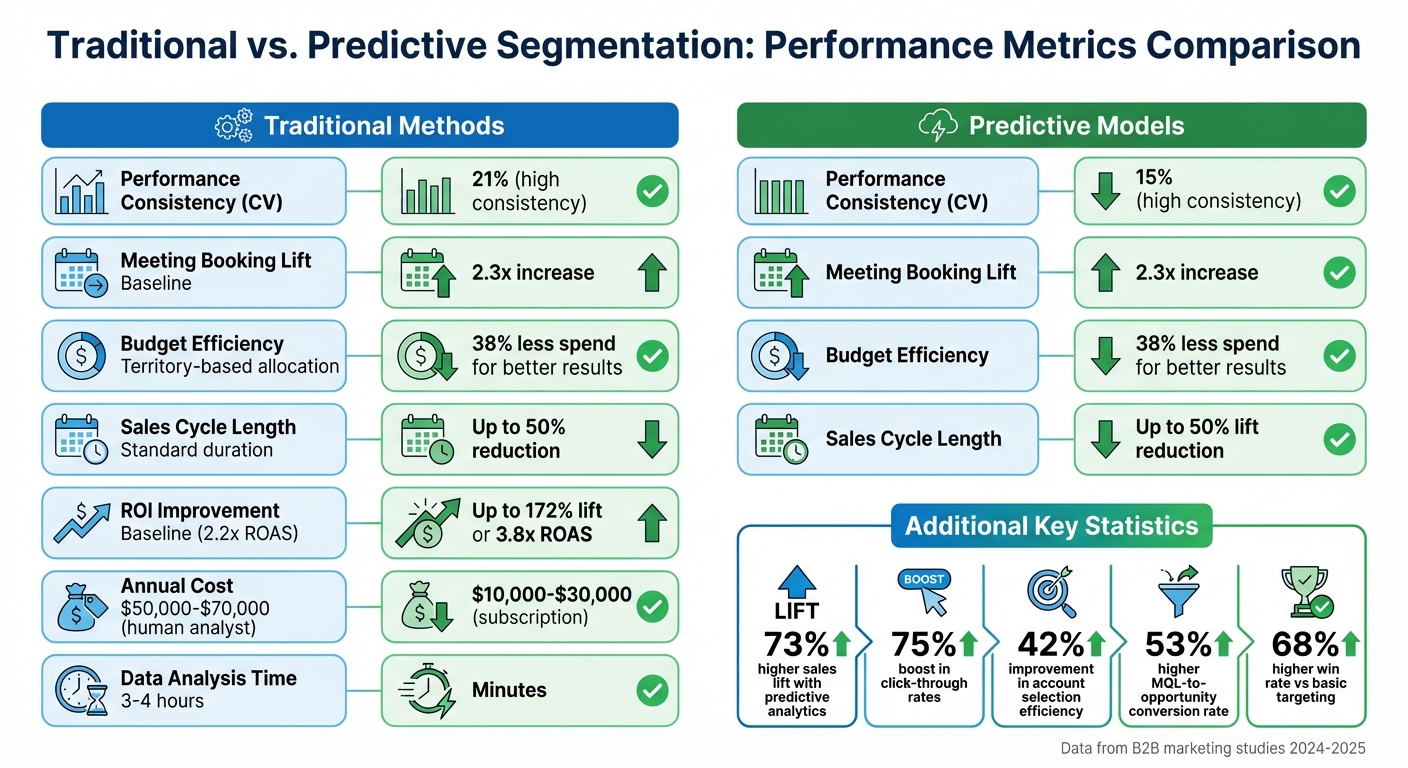
Predictive models are proving to be game-changers for businesses, delivering measurable financial benefits. Companies leveraging predictive analytics report a 73% higher sales lift and a 75% boost in click-through rates compared to traditional approaches. These models also ensure greater performance consistency, with a coefficient of variation (CV) of 15% compared to 21% for traditional methods, translating into more reliable revenue streams. These results highlight the tangible advantages of predictive analytics, setting the stage for real-world success stories.
Key Performance Improvements
Real-world examples bring these benefits to life. In April 2025, Snowflake’s Account-Based Marketing (ABM) team, headed by Breanna Cherman, introduced a "meeting propensity" AI model using Snowflake Cortex AI. This initiative delivered a 2.3x increase in meetings with high-potential accounts while cutting spending by 38%. On top of that, AI-generated ad copy achieved a 54% lift in click-through rates.
"Essentially, we found that this model can help us spend 38% less money for more engagement with our audience and more meetings in the right accounts." – Breanna Cherman, Snowflake
The World Wildlife Fund (WWF) experienced a similar leap in performance. In fall 2007, under the leadership of John Schwass, their Director of Strategic and Financial Analysis, WWF transitioned from traditional RFM (recency, frequency, monetary) analysis to predictive modeling. Their first predictive-based direct mail campaign delivered a 172% higher ROI, generated 25% more donations, and increased the average gift size by 28%.
Other industries have seen equally impressive results. For instance, in July 2024, a leading tech services company partnered with a major US telecom provider and used AI-driven account planning to cut their enterprise sales cycle by 50%. Another tech firm working with a prominent FMCG client saw a 25% boost in operational efficiency within just six months of implementing predictive tools. These real-world transformations highlight the clear benefits of predictive analytics over traditional methods.
Comparison: Traditional vs. Predictive Segmentation
When you compare traditional segmentation methods with predictive models, the difference is striking. Here’s a side-by-side look at key performance metrics:
| Metric | Traditional Methods | Predictive Models |
|---|---|---|
| Performance Consistency (CV) | 21% (moderate variability) | 15% (high consistency) |
| Meeting Booking Lift | Baseline | 2.3x increase |
| Budget Efficiency | Territory-based allocation | 38% less spend for better results |
| Sales Cycle Length | Standard duration | Up to 50% reduction |
| ROI Improvement | Baseline (e.g., 2.2x ROAS) | Up to 172% lift or 3.8x ROAS |
Predictive models not only outperform traditional methods in key metrics but also revolutionize resource allocation. For example, AI-powered lead scoring typically costs between $10,000 and $30,000 per year in subscription fees, compared to the $50,000 to $70,000 annually required for a human analyst to perform similar tasks. Additionally, automation slashes data analysis time from 3–4 hours to just minutes, allowing teams to prioritize strategy over manual data crunching.
"With AI, we no longer have to choose between efficiency and personalization – we can have both." – Maila Ruggiero, Account-Based Marketing Manager, Snowflake
The numbers speak for themselves: predictive segmentation not only enhances performance but also delivers unmatched cost efficiency in modern B2B marketing.
How to Implement Predictive Models in B2B Marketing
Before diving into predictive models, start with a clear business question. Many companies stumble by chasing advanced models without first building a solid data foundation. The process is simpler than you might think: define the decision you want to improve, clean your data, start with a basic model, and then expand from there.
Steps to Build Predictive Account Segmentation
The first step is to define a specific business decision you aim to enhance. Avoid vague goals like "better segmentation." Instead, ask targeted questions such as, "Which accounts should our SDRs prioritize?" or "Who is most likely to convert within 30 days?" Every model should have a clear decision owner and an associated KPI to measure success.
Next, focus on building a strong data foundation. This involves unifying data from your CRM, marketing automation tools, website analytics, and third-party intent feeds into a single account profile. It’s essential to clean this data – deduplicate accounts, standardize fields (e.g., ensuring "VP" and "Vice President" are treated the same), and fill in missing information using enrichment tools.
For model selection, keep it simple at first. Use interpretable models like logistic regression or rule-based scoring. Test these models for a few months to confirm that high-scoring accounts align with actual conversions. Once the basics are validated, you can explore more advanced techniques.
Activation is where the magic happens. Integrate predictive scores into systems like your CRM, marketing automation tools, and ad platforms. A model that sits unused in a dashboard won’t make an impact. Finally, establish a feedback loop to monitor changes in data and retrain models regularly to adapt to evolving market conditions.
A great example of this approach comes from Userpilot, a product management SaaS company. In 2025, they replaced unreliable anonymous website tracking with LinkedIn ad engagement data. By integrating campaign-level intent signals from ZenABM into HubSpot CRM, their BDRs gained valuable insights – like whether an account was interested in "analytics features" or "onboarding tools." The result? They generated $650,000 in pipeline within 90 days.
With these steps in place, you can tackle the organizational and technical challenges that often arise during implementation.
Common Challenges and Solutions
The biggest hurdles in implementing predictive models are often organizational rather than technical. Here are some common challenges and how to address them:
- Data silos: When ABM data is scattered across disconnected platforms, it’s tough to get a complete view of each account. The solution? Integrate everything into a Customer Data Platform (CDP) or data warehouse to create a single source of truth.
- Data quality issues: Poor data can derail your models. Automate daily lead scanning to flag spam and standardize categories. Use AI tools to merge duplicate accounts – like "Acme Co." and "Acme Corporation" – to ensure your model doesn’t treat them as separate entities.
- Skill gaps: Building machine learning models once required in-house data science expertise. Today, platforms like 6sense, Demandbase, and Karrot.ai simplify the process, offering advanced predictions without the need for specialized skills.
- Model drift: As market conditions and customer behaviors change, your model’s accuracy can decline. Combat this by scheduling regular validation checks – monthly or quarterly – and relying on stable features like server-side events and firmographics rather than volatile signals.
- Inactive models: Many models end up as unused reports. To avoid this, integrate predictive scores into daily operations. For example, use scores to adjust sales routing rules, trigger nurture sequences, or direct high-intent accounts to ad platforms.
"The goal is not to predict; the goal is to change behavior to change outcomes. Predictive analytics is meant to guide you into the right direction to make a more data-driven decision than just guessing." – Katie Robbert, CEO, Trust Insights
By addressing these challenges, you can ensure your predictive models drive real results.
Case Study: Achieving Growth with Predictive Models
In 2025, a B2B software company targeting 1,000 enterprise accounts implemented predictive models for their LinkedIn ABM campaigns. Using Karrot.ai, they optimized engagement sequencing and budget allocation, focusing on accounts that showed strong ICP fit and active buying signals.
The results were impressive. The company improved account selection efficiency by 42%, reducing time wasted on unqualified accounts. Their MQL-to-opportunity conversion rate jumped by 53%, and they generated $24.3 million in influenced pipeline, a 68% increase over previous results.
What made this possible? The team followed a disciplined approach. They unified data from multiple sources, established clear scoring criteria using the "FIRE" framework (Fit, Intent, Relationships, and Engagement), and, most importantly, activated their scores across sales and marketing channels. Sales reps received daily alerts about high-propensity accounts, while marketing automatically adjusted ad spend to focus on accounts showing the strongest buying signals.
This approach – combining predictive intelligence with systematic execution – is a prime example of how businesses can turn insights into measurable growth. Agencies like Growth-onomics specialize in helping companies implement similar strategies, blending data analytics, performance marketing, and customer journey mapping to create systems where predictions drive actions across the entire go-to-market process.
Conclusion
As explored earlier, predictive models have a transformative effect on account segmentation by analyzing a vast array of signals – such as behavioral patterns, firmographic data, and technographic insights. These models help businesses identify high-conversion opportunities, determine the best timing for outreach, and craft messaging that resonates. Companies leveraging predictive marketing have reported impressive results, including up to 500% higher profitability. Predictive lead scoring alone has been shown to increase opportunities by 25% and improve deal closure rates by 20%. This shift from static to dynamic segmentation represents the core of the insights discussed throughout this article.
For small and medium-sized businesses (SMBs), predictive segmentation offers a chance to compete on a more level playing field by uncovering niche, high-value segments that broader targeting strategies often overlook. What once required a specialized data science team can now be achieved through user-friendly platforms and expert partnerships.
"Predictive analytics for ABM… isn’t mainstream yet, and so it can be your edge!" – Yashasvi Saxena
Despite its potential, SMBs often encounter challenges in execution. Issues like data quality, model calibration, and seamless integration demand specific expertise. This is where collaboration with a data-focused agency becomes invaluable. Growth-onomics supports businesses by blending data analytics, performance marketing, and customer journey mapping, turning predictive insights into actionable strategies that drive growth.
FAQs
How do predictive models improve B2B account segmentation?
Predictive models use machine learning to sift through both historical and real-time data, giving businesses a clearer picture of which accounts are most likely to convert or bring in the most revenue. Unlike older segmentation techniques that depend on static demographic or firmographic data, these models craft dynamic, data-informed segments that spotlight high-value prospects.
By analyzing behavioral patterns and trends, predictive models allow businesses to target more precisely, allocate resources more effectively, and drive better returns on their B2B marketing efforts.
What data signals are used in predictive account segmentation?
Predictive account segmentation combines firm-level and behavioral data to pinpoint the best-fit accounts and assess their likelihood to make a purchase. Here’s a closer look at the key signals that drive this process:
- Firmographic data: Details like industry type, employee count, and annual revenue help paint a picture of the account’s size and market position.
- Technographic details: Information about the software and tools an account uses can reveal technological compatibility and needs.
- Historical purchase data: Past spending habits and long-term value provide insights into buying behavior and potential future investments.
- Intent data: Activities such as keyword searches, content consumption, and engagement with specific topics signal active research and interest.
- Engagement metrics: Real-time interactions, like website visits, email opens, and form submissions, show how an account is engaging with your brand.
- Relationship data: Connections like parent-subsidiary links or partnerships add context, offering a broader view of the account’s network.
Machine-learning models process these data points to deliver actionable insights, such as propensity scores and account prioritization. This allows businesses to zero in on high-potential opportunities and allocate resources more effectively.
How can small businesses use predictive models to improve account segmentation?
Small businesses looking to improve account segmentation can make great strides by adopting a data-focused approach. Start by gathering essential data points, such as transaction history, website interactions, firmographics, and CRM notes. Organize this data in a structured format – like a spreadsheet – and use tools like Excel or Tableau to identify patterns or groupings. Even a dataset with just a few hundred accounts can provide enough insights to build a basic predictive model.
From there, apply straightforward algorithms like decision trees or Random Forests. These methods are excellent for working with mixed data types and don’t require heavy-duty adjustments. The models can generate propensity scores, which estimate each account’s likelihood to convert or deliver high lifetime value. Use these scores to categorize accounts into tiers – such as high-priority, nurture, or low-priority – and adjust your outreach strategies accordingly. For example, high-priority accounts might receive personalized emails or targeted ads, while nurture accounts could benefit from regular check-ins.
To make the process seamless, integrate the model directly into your CRM or marketing platform. This way, scores will automatically update as new data flows in. Keep an eye on key performance indicators, like conversion rates, to evaluate the model’s effectiveness and fine-tune your strategy over time. If you need help getting started, Growth-onomics provides tailored, data-driven solutions to set up and refine predictive workflows – no in-house data science team required.