


Predictive analytics transforms budget planning by using data, machine learning, and statistical models to predict outcomes and optimize spending. This approach connects marketing investments to measurable ROI, helping businesses make smarter financial decisions. Key benefits include:
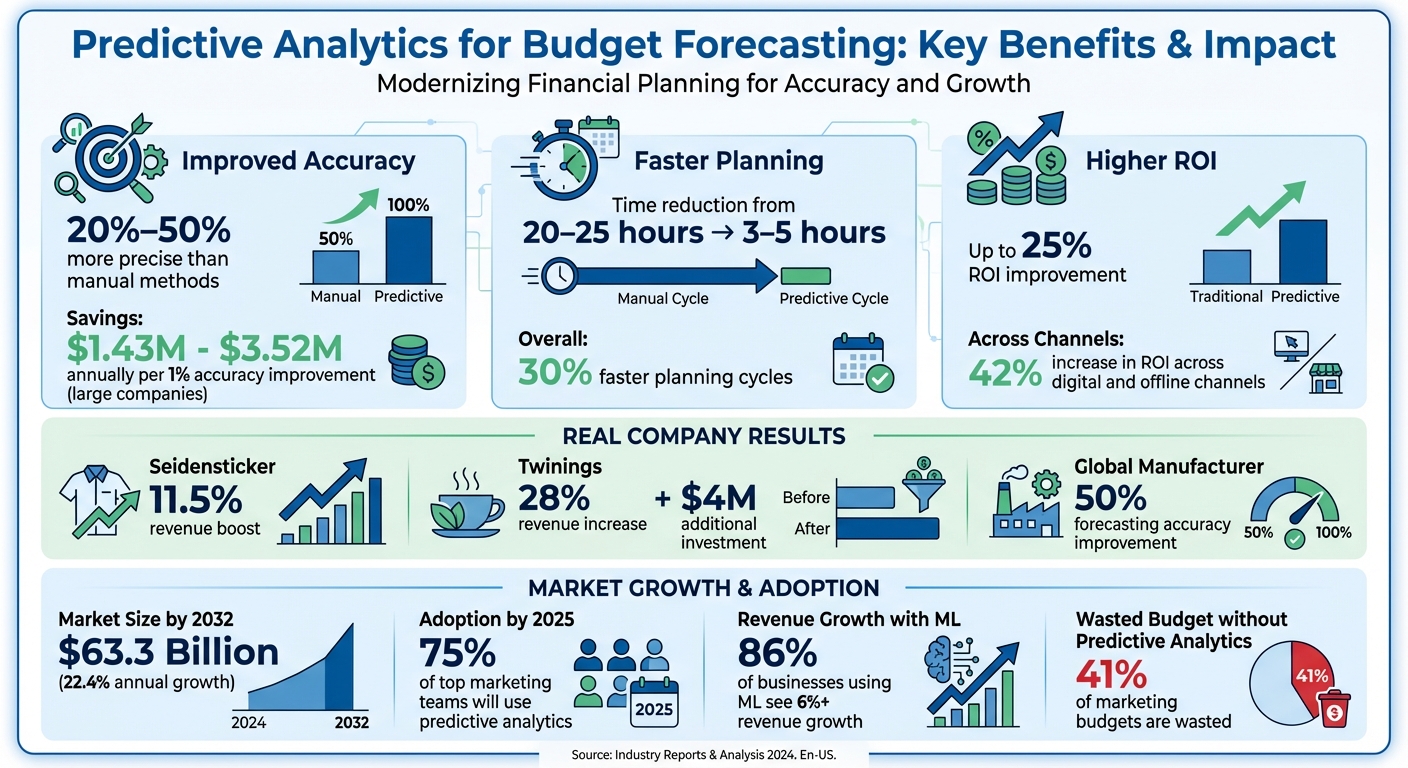
- Improved accuracy: Forecasts are 20%-50% more precise than manual methods, saving millions annually for large companies.
- Faster planning: Automating budget processes reduces time from 20-25 hours to 3-5 hours.
- Higher ROI: Businesses report up to 25% ROI improvement through better budget allocation.
For example, companies like Seidensticker and Twinings used predictive tools to boost revenue by 11.5% and 28%, respectively, while cutting costs. By integrating predictive analytics into your financial planning, you can simulate "what-if" scenarios, adjust budgets dynamically, and achieve data-driven growth.
Next Steps: Start with a data audit, run pilot tests, and scale models with continuous monitoring. Predictive analytics is no longer optional – it’s the future of effective budget forecasting.
Predictive Analytics ROI: Key Statistics and Benefits for Budget Forecasting
ROI Forecasting for Strategic Decisions with Python
Benefits of Predictive Analytics for Budget Forecasting
Predictive analytics is reshaping budget forecasting by offering practical advantages that go beyond traditional methods.
Better Forecast Accuracy
Predictive analytics takes the guesswork out of budget planning by tapping into multiple data sources that conventional approaches often miss. Instead of relying solely on historical averages, these systems integrate real-time factors like consumer sentiment, weather patterns, geographic data, and economic trends to create more dependable projections.
The results are impressive. AI-powered financial forecasts are generally 20% to 40% more accurate than manual methods. For large organizations, even a modest 1% improvement in forecast accuracy can lead to annual savings between $1.43 million and $3.52 million. This boost in precision comes from machine learning algorithms that uncover complex, non-linear patterns across numerous variables – connections that human analysts might overlook. Advanced techniques further enhance reliability by reducing biases and inconsistencies.
Faster Decision-Making
In fast-changing markets, speed is everything. Companies adopting AI-driven planning tools report 30% faster planning cycles. This efficiency frees finance teams from tedious spreadsheet updates and lets them focus on strategic priorities. For example, leaders can simulate the effects of reallocating 10% of their social media budget to streaming platforms and evaluate the financial impact before making final decisions.
One standout example comes from a global industrial goods manufacturer that, in 2025, implemented an AI-powered forecasting system to predict supply chain demand. This upgrade boosted forecasting accuracy by 50%, improving labor planning and plant scheduling. Additionally, companies with agile budget governance based on predictive insights achieved 33% faster campaign turnaround times.
These quicker decisions allow businesses to act with precision, aligning strategies to maximize returns.
Higher ROI Through Data-Driven Strategies
Predictive analytics also optimizes how resources are allocated. By aligning budgets with strategic KPIs instead of outdated habits, organizations have seen a 42% increase in ROI across both digital and offline channels.
Take Twinings, the tea company, as an example. In 2025, they teamed up with analytics firm Keen to adopt a Bayesian-based predictive model. This approach helped them optimize weekly spending across digital and trade channels, leading to a 16.5% jump in sales volume and a 28% revenue boost – adding $4 million to their marketing investments.
"Maximizing ROI doesn’t begin with spending less – it begins with spending smarter."
– Webolutions
The statistics underline the impact: roughly 41% of marketing budgets are wasted due to redundant channels, underused technology, and misaligned vendor strategies. Predictive analytics helps businesses spot these inefficiencies early, allowing them to redirect funds toward high-performing areas. Companies leveraging predictive models for channel allocation have reported year-over-year ROI improvements of 45%.
How to Implement Predictive Analytics in Budget Forecasting
To make predictive analytics work for budget forecasting, you need a structured plan that combines precision with efficiency. The first step? Establishing a strong foundation for your data.
Phase 1: Data Preparation and Governance
The accuracy of forecasting models hinges on the quality of your data. Start by gathering data from all relevant sources: ad performance from platforms like Google and Facebook, web analytics, CRM data (customer lifetime value, purchase history), financial systems tracking actual spending, and external factors such as market trends or economic indicators.
Next, audit your data. Check CRM exports, API connections, and manual uploads for errors like mismatched fields, missing data, or timestamp issues. Clean, well-organized data can lead to a 15–30% boost in forecasting accuracy within just one quarter – especially if you have at least six months of reliable campaign data. Deduplicate records, fill in missing values, and standardize naming conventions, date formats, and measurement units across all platforms. Misaligned time zones? Fix those too.
Set up tiered validation checks at three critical points: data collection, transformation, and post-integration into reporting dashboards. Use role-based access controls to secure sensitive data and ensure compliance with regulations like GDPR or CCPA. Your ultimate goal is a single, validated dataset that eliminates fragmented inputs, which can weaken your forecasts.
"The success of ML models hinges on the quality, quantity, and relevance of the data you feed them." – OmniFunnel Marketing
Once your data is ready, it’s time to test your model on a smaller scale.
Phase 2: Pilot Testing and KPI Definition
Start with pilot programs in specific channels. Divide historical data into training, validation, and testing sets to evaluate your model’s performance. Use back-testing and walk-forward validation to mimic real-world scenarios. Want to see what happens if you reallocate 10% of your social media budget to streaming platforms? Run "what-if" simulations before committing to any changes.
Set clear benchmarks for success. For instance, aim for at least 85% prediction accuracy and 90% goal achievement before rolling out the model fully. Track metrics like Mean Absolute Error (MAE), Mean Absolute Percentage Error (MAPE), and incremental ROI. Predictive analytics can cut budget analysis time from 12–18 hours down to just 2–3 hours. However, human oversight is still essential – market anomalies like a competitor exiting the market or a new product launch can skew historical data. Build in override mechanisms to account for these unpredictable factors.
Once the pilot proves effective, you’re ready to scale up and refine your approach.
Phase 3: Scaling and Continuous Improvement
After a successful pilot, integrate model outputs into your regular planning and campaign evaluation processes. Automate data pipelines to feed updated performance data into your models daily or weekly, ensuring recommendations stay aligned with current market conditions.
Collaboration is key. Marketing, finance, and analytics teams need to align their objectives and operate from a shared data source to avoid silos that can undermine the model’s effectiveness. Use real-time monitoring to spot performance issues early and test new budget scenarios for quick adjustments.
Keep in mind, models naturally degrade over time as consumer behavior and market trends shift. To maintain accuracy, retrain and fine-tune your models monthly or quarterly. During high-spend periods, consider weekly reviews to ensure predictions stay within a 10% margin of actual outcomes. Regularly monitor metrics like MAE, MAPE, and Root Mean Squared Error (RMSE) to track model reliability. Organizations that treat machine learning as an ongoing process – not a one-time effort – report revenue growth of 6% or more in 86% of cases.
"Machine learning is not a one-time process, but a continuous cycle of learning and improvement." – OmniFunnel Marketing
sbb-itb-2ec70df
Metrics for Measuring Predictive Budget Forecasting Success
To truly gauge the effectiveness of predictive budget forecasting, it’s essential to rely on measurable outcomes. These metrics can be grouped into three key areas: accuracy, efficiency, and business impact. Together, they help validate the value of your investment.
Accuracy Metrics
Forecast accuracy is the cornerstone of effective budgeting. Top-performing sales organizations typically achieve forecasts within ±5% of actual revenue. In contrast, "good" performance falls within ±10%, and "average" results hover around a ±15% miss. Interestingly, only 15% of organizations consistently hit the elite accuracy mark. You can calculate absolute accuracy using this formula:
(Actual Revenue – Forecast Revenue) / Forecast Revenue × 100.
Variance percentage is another critical metric. It measures the size of the forecasting error, ignoring whether the error is positive or negative. The formula is:
|Actual Revenue – Forecast Revenue| / Forecast Revenue × 100.
This metric highlights the overall magnitude of error, while monitoring trends over time can reveal whether your forecasting is improving or if biases are creeping in. A balanced 50/50 ratio of directional accuracy – where errors are evenly distributed above and below actuals – is a healthy benchmark. Use a rolling four-quarter analysis to spot patterns.
"When the CFO asks ‘What are we closing this quarter?’ and you’re off by 20%, that’s not a forecasting problem. That’s a credibility problem." – Tara Minh, Operation Enthusiast, Rework.com
Out-of-sample accuracy is particularly important for machine learning models. It measures how well the model performs on unseen data, ensuring it identifies meaningful patterns rather than overfitting historical trends. For example, a Microsoft study found that machine learning forecasts were 70% more accurate than traditional human-led financial forecasts.
While accuracy is key, efficiency metrics provide another lens to evaluate the benefits of predictive forecasting.
Efficiency Metrics
Cycle-time reduction measures how much faster your planning process becomes. Companies leveraging AI in budgeting and forecasting have shortened their planning cycles by 30% on average. Tracking the time from data collection to final approval can reveal how much your workflow has improved.
Finance productivity sees a boost when teams move away from manual tasks to focus on generating insights. AI-powered systems can improve finance team productivity by 20% to 30%. For instance, a global industrial goods manufacturer integrated AI and machine learning into its forecasting system, achieving a 50% accuracy improvement. This allowed for better labor planning, plant scheduling, and procurement, freeing up working capital.
Resource allocation efficiency tracks how well you’re optimizing spending across channels. It also measures your ability to adjust strategies in real time, avoiding wasteful overinvestment. One global manufacturer used machine learning to cut inventories and reduce product obsolescence by 20% to 40%. Another organization increased sales by 5% by better aligning supply with demand through improved forecasting.
These efficiency gains pave the way for measurable business outcomes.
Business Impact Metrics
ROI improvement is often the ultimate goal. Predictive analytics can lead to up to a 25% boost in ROI for marketing decisions compared to traditional methods. For example, Twinings partnered with Keen to implement predictive models that optimized spending across digital, online, and trade channels. The result? A 16.5% increase in sales volume, a 28% jump in revenue, and an additional $4 million unlocked for marketing investment.
Tracking customer lifetime value (CLV) ensures your budget focuses on areas with the highest long-term returns. Similarly, monitoring customer acquisition cost (CAC) is crucial. Predictive models can reduce acquisition costs by about 15% while driving a 20% increase in retail campaign conversion rates. Companies using forecasting frameworks often see a 15% to 25% improvement in overall marketing performance.
Planning confidence, though harder to quantify, is just as important. Predictive models help identify early signs of financial distress or market volatility, enabling proactive adjustments. For example, controllers can forecast downturns up to six months in advance and prepare by scaling back production or increasing cash reserves.
"Investors value predictability over pure growth rate. A company growing 50% annually with ±20% quarterly swings is worth less than one growing 40% with ±5% variance." – Rework.com
Conclusion: Growing Your Business with Predictive Analytics
Key Takeaways
Predictive analytics is changing the game for budget forecasting. By allowing businesses to test scenarios before allocating resources, it shifts the focus from analyzing past performance to anticipating future outcomes. Machine learning models, for instance, can boost forecasting accuracy by 20% to 50% compared to traditional methods, while also cutting planning cycle times by about 30%.
The financial benefits are hard to ignore. Companies using predictive analytics have reported marketing ROI improvements of 15%–20%, thanks to smarter budget allocation. For large organizations, even a modest 1% boost in forecasting accuracy can lead to annual savings ranging from $1.43 million to $3.52 million. Moreover, 86% of businesses leveraging machine learning in financial forecasting have seen revenue growth of 6% or more.
But technology alone isn’t enough. Success hinges on building dynamic forecasting teams and centralizing data. The best results come from blending automated algorithms with human insights – a practice often referred to as "dynamic steering." Centralized, high-quality data is the cornerstone, while collaboration across marketing, finance, and analytics teams ensures everyone is aligned. Boston Consulting Group emphasizes this point: “The digital aspects of a digital transformation only account for about 30% of the value and effort. The remaining 70% lies in change management across people, processes, and organization”.
These strategies provide a roadmap for incorporating predictive analytics into your business.
Next Steps for Your Business
Start with a data audit. Consolidate CRM, financial, and media data into a single, validated dataset. Launch pilot projects in specific channels or product categories to test the waters before scaling up. Use "what-if" simulations to explore the impact of budget shifts – like reallocating 10% of your social media budget to streaming platforms.
The predictive analytics market is expected to hit $63.3 billion by 2032, growing at an annual rate of 22.4%. By 2025, 75% of top-performing marketing teams are anticipated to integrate predictive analytics into their strategies. The real question isn’t whether to adopt these tools, but how soon you can get started. Growth-onomics offers tailored, data-driven strategies to help businesses use predictive analytics for smarter marketing and budget planning, setting the stage for proactive growth.
FAQs
How can predictive analytics improve ROI in budget forecasting?
Predictive analytics takes budget forecasting to the next level by leveraging historical data, current trends, and external factors to produce accurate, data-backed projections. Instead of relying on static models, it taps into advanced techniques like machine learning, regression analysis, and time series forecasting to identify patterns and predict outcomes with improved accuracy.
This method allows businesses to fine-tune their marketing budgets by simulating various scenarios, experimenting with different allocations, and preparing for potential market shifts. With the actionable insights it provides, predictive analytics helps allocate resources more effectively, cut down on waste, and achieve stronger financial results. It turns traditional forecasting into a smarter, more strategic process, giving businesses the tools they need to make confident decisions and maintain a competitive edge.
What are the first steps to start using predictive analytics for budgeting?
To start using predictive analytics for budgeting, the first step is to gather relevant historical data. This could include financial records, past market trends, and external factors that might influence your budget forecasts. Make sure to clean and organize this data to maintain accuracy and reliability.
Once your data is ready, apply advanced analytics techniques like regression analysis, time series forecasting, or machine learning. These methods help uncover patterns and trends in your data. After identifying these trends, choose a predictive model that aligns with your goals and test its performance. Calibration is key here – it ensures the model can reliably predict future financial outcomes based on your historical information.
The final step is to integrate the predictive model into your financial systems. Set up automated data pipelines to enable real-time forecasting, allowing you to adapt quickly and make well-informed decisions as market conditions shift.
How does predictive analytics support real-time budget adjustments?
Predictive analytics gives businesses the ability to adjust budgets in real time by analyzing current data, spotting trends, and anticipating future outcomes. By leveraging historical performance data alongside external factors, it can simulate various scenarios and suggest the best ways to reallocate budgets.
This method allows decision-makers to respond swiftly and with confidence, ensuring resources are directed toward areas that promise the highest return on investment (ROI).
