


Predictive analytics is transforming how businesses understand and engage with customers by improving Lifetime Value (LTV) strategies. Instead of relying on static data, companies now use AI-driven models to predict customer behavior, enabling smarter decisions about retention, acquisition, and personalized marketing.
Here’s what you need to know:
- What is LTV? It’s the estimated revenue a business earns from a customer over their entire relationship. High LTV means better returns on marketing spend.
- Why it matters: Selling to existing customers is 60–70% more likely to succeed than acquiring new ones. A 5% boost in retention can increase profits by 25%–95%.
- Predictive analytics uses AI to forecast customer behavior, helping businesses anticipate needs, prevent churn, and optimize marketing budgets.
- Key tools include:
- Churn prediction models: Spot at-risk customers early.
- Purchase propensity models: Predict when customers will buy next.
- Segmentation models: Group customers by future potential for tailored outreach.
Results speak for themselves: Automated LTV forecasts can increase revenue by 25%, achieve 90% prediction accuracy, and cut analysis time by 90%. However, success depends on clean, unified data and regular model updates.
Businesses leveraging predictive analytics can better allocate resources, engage customers at the right time, and drive long-term growth.
What is the Customer Lifetime Value (LTV)? Marketing Analytics For Beginners
Key Predictive Models for LTV Optimization
Businesses use various predictive models to calculate and optimize customer lifetime value (LTV). Each model addresses a specific goal, such as identifying customers likely to leave or predicting the timing of their next purchase. These tools replace guesswork with data-driven strategies, helping marketers better understand customer behavior and make informed decisions.
Churn Prediction Models
Churn prediction models focus on spotting behavioral patterns – like how often customers make purchases, the time between orders, and how they interact with products – to identify those who might leave. The idea is to catch at-risk customers before they disengage. For instance, if a customer who typically orders every 30 days hasn’t made a purchase in 45 days, the model could trigger a personalized email to win them back. This proactive approach ensures businesses can act early, rather than reacting after the customer is already gone.
Purchase Propensity Models
Purchase propensity models estimate both the likelihood and timing of future transactions. A common example is predicting when a customer will need to restock a product. Instead of sending reminders on a fixed schedule, marketers can time these messages to arrive about five days before the predicted purchase date. This makes the outreach feel helpful rather than intrusive, boosting both conversion rates and customer trust.
Customer Segmentation and Behavior Analysis
Modern segmentation models dive deeper than traditional demographic-based grouping. Using advanced neural networks, these models categorize customers based on lifecycle stages, engagement levels, and future potential.
"Calculating customer lifetime value is complex, and the use of familiar regression-type models – which attempt to forecast future behavior based only on observable measures – is problematic and inadequate. A better approach is to perform the calculations using a probability model".
With AI-powered segmentation, businesses can craft tailored marketing strategies for different groups. For example, high-value customers might be offered early access to new products or exclusive deals, while lower-value groups could receive cost-effective content like tutorials or reviews. This targeted approach not only optimizes marketing budgets but also improves returns. By combining segmentation with predictive insights, businesses can refine their strategies even further.
| Model Type | Function | Use Case |
|---|---|---|
| Churn Model | Identifies at-risk customers | Win-back campaigns and retention |
| Propensity Model | Predicts likelihood of purchase | Targeted promotions and replenishment |
| Segmentation Model | Groups customers by future potential | Tailored messaging and budget allocation |
Personalization Strategies Using Predictive Analytics
Using predictive models as a foundation, businesses can now fine-tune their marketing efforts to align with individual customer preferences. The goal? Deliver the right message at the right time, avoiding generic campaigns that waste resources or overwhelm customers.
Personalized Content and Offers
The most forward-thinking brands focus on what customers are likely to do next, rather than relying solely on past behavior. For example, high-value customers with a greater risk of churn might receive exclusive promotions, while loyal customers with low churn risk often respond better to perks like early access to new products, VIP benefits, or exclusive content. This approach avoids unnecessary discounts that could hurt profit margins.
"Predictive analytics allows e-commerce brands to act on data before a customer takes action." – Klaviyo
Timing is everything. Predictive models can identify the perfect moment to engage. For instance, a restock reminder sent about five days before a predicted purchase can make all the difference. A North American retailer demonstrated this by generating $400 million in value through pricing improvements and $150 million from targeted offers.
Omnichannel Targeting for Consistent Engagement
Today’s customers expect a seamless experience, no matter how they interact with a brand. Predictive analytics ensures this by constantly updating lifetime value (LTV) scores as customers engage across multiple channels. For example, if a high-value customer abandons their cart on mobile, the system can instantly send a personalized text, followed by a tailored email if they don’t complete the purchase.
A European telecommunications company took this a step further with a machine learning-powered "next-best-action" engine. This tool ranked over 2,000 potential actions for each customer, using data like age, gender, and usage patterns to personalize text messages. The result? A 10% boost in customer engagement compared to generic campaigns. A key factor in their success was maintaining a unified customer ID across platforms like POS systems, e-commerce sites, CRM tools, and social media. This setup allowed every interaction to inform the next, creating a seamless and personalized customer journey.
Dynamic Product Recommendations
Static recommendations are becoming a thing of the past. Predictive analytics enables dynamic suggestions that adapt in real-time as customers browse, shop, or engage with content. For instance, high-LTV customers might see premium products or curated bundles, while lower-LTV customers could receive educational content – like tutorials or reviews – to build trust and engagement without pushing for an immediate sale.
Unlike traditional systems that rely on fixed schedules (e.g., sending reminders 14 days after a purchase), predictive systems act when the customer’s specific replenishment window opens. Automated customer lifetime value (CLV) models boast around 90% accuracy and have been shown to increase revenue by 25%. However, platforms like Klaviyo typically require at least 500 customers and a year’s worth of consistent order data to achieve this level of precision.
sbb-itb-2ec70df
Recent Research on LTV and Predictive Analytics
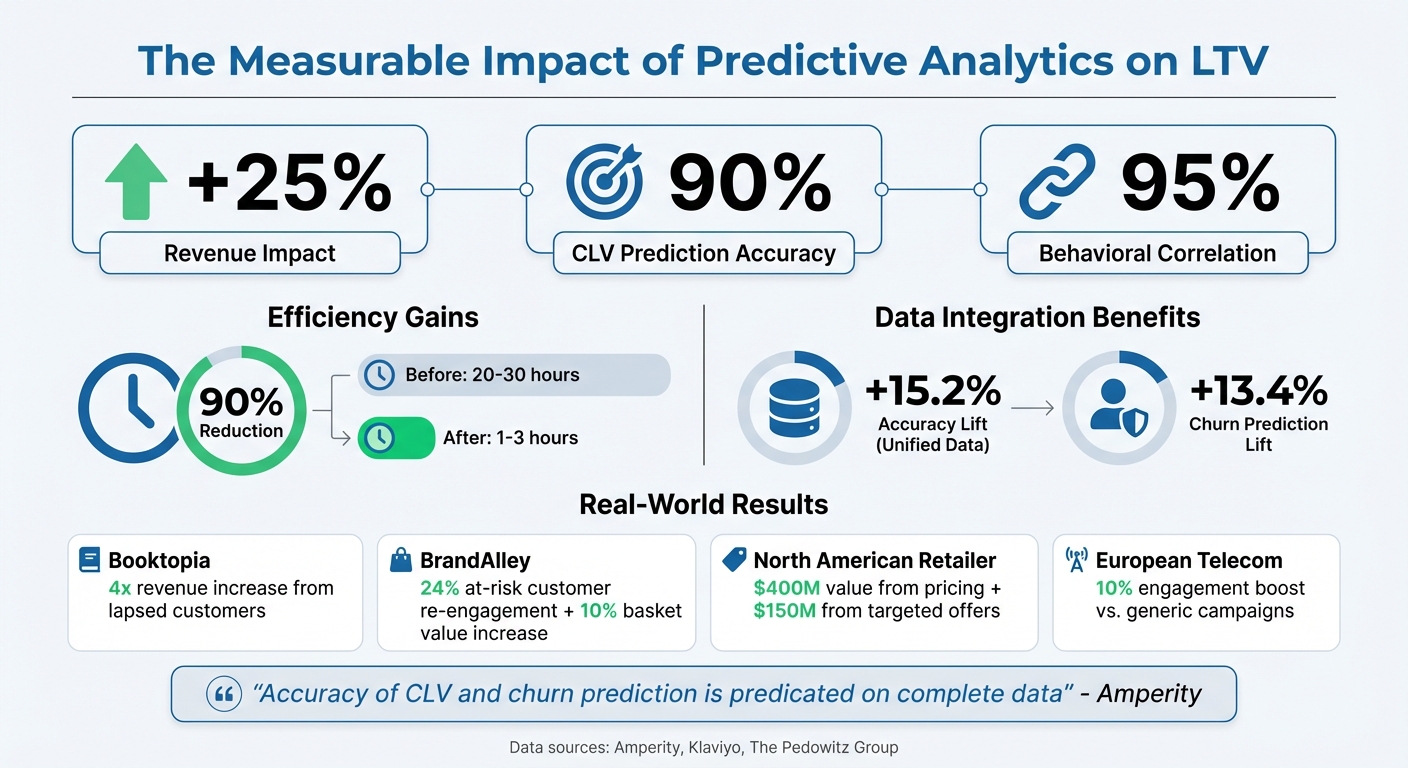
Predictive Analytics Impact on Customer Lifetime Value: Key Statistics and ROI Metrics
Evidence of LTV Improvement
Recent studies highlight how predictive analytics can significantly enhance Lifetime Value (LTV). For instance, automated Customer Lifetime Value (CLV) forecasting has been shown to boost revenue by 25% when businesses transition from static analysis to real-time, adaptive predictions. These modern systems dynamically update customer value scores as individuals browse, purchase, or interact across various channels.
Integrating both online and offline data sources increases model accuracy by 15.2% and enhances churn prediction by 13.4%. According to the same research, models that incorporate diverse raw and engineered features from multiple data streams outperform those relying on single-source inputs.
"Accuracy of CLV and churn prediction is predicated on complete data." – Amperity
AI-powered tools have also streamlined CLV modeling, cutting the time required from 20–30 hours down to just 1–3 hours – a remarkable 90% reduction. Current automated models achieve approximately 90% prediction accuracy and demonstrate a 95% match between predicted and actual customer behavior.
| Metric | Impact | Source |
|---|---|---|
| Revenue Impact | +25% | |
| CLV Prediction Accuracy | 90% | |
| Accuracy Lift (Unified Data) | +15.2% | |
| Churn Prediction Lift | +13.4% | |
| Time Savings | 90% reduction (30h to 3h) | |
| Behavioral Correlation | 95% |
These advancements in accuracy and efficiency are setting the stage for practical applications, which are explored in the next section.
Case Studies and Business Applications
The real-world impact of these models becomes clear when examining specific case studies. Between June 2020 and September 2022, Amperity tested a ready-to-use CLV prediction system across 12 retail brands. This system employed a multi-stage framework to predict churn, order frequency, and average order value separately. The result? It consistently outperformed benchmarks without requiring custom model development.
In January 2026, Mingyu Zhao and his team introduced the CC-OR-Net framework, which was tested on datasets containing over 300 million users. This approach addressed a common issue in traditional models: low-to-medium value customers often overshadow the high-value segment. By separating ranking and regression tasks, CC-OR-Net improved precision for identifying high-value customers while maintaining overall accuracy.
"Automated CLV forecasting replaces static, manual analysis with dynamic predictions that adapt to each customer’s latest actions." – The Pedowitz Group
Challenges in Implementing Predictive Analytics for LTV
Data Integration and Quality Issues
One of the biggest hurdles in predicting customer lifetime value (LTV) is dealing with fragmented data. Businesses often store customer information across multiple systems – like CRM platforms, website analytics tools, social media channels, point-of-sale systems, and e-commerce databases. Bringing all of this data together into a unified, cohesive view is no small task.
"Analysts and data scientists are always tuning their algorithms… citing the common wisdom of ‘garbage in, garbage out’." – Amperity
Another significant challenge is identity resolution. For instance, matching a customer’s online browsing history with their in-store purchases and social media activity requires advanced algorithms. Without a unified customer profile, predictive models are left working with incomplete data, leading to less reliable results.
On top of that, manual data collection is both time-consuming and inefficient, often taking 20–30 hours per cycle. This method not only slows down the process but also results in static LTV values that quickly become outdated. Ensuring accurate, scalable models depends heavily on having a unified and dynamic data structure, which adds another layer of complexity.
Model Accuracy and Scalability
As businesses grow, maintaining the accuracy of LTV predictions becomes increasingly challenging. Customer behaviors shift over time, making it harder for models trained on historical data to stay relevant. Issues like training-serving skew and inference drift can further misalign predictions with current trends.
"Customer behavior (and product funnels!) changes over time, so it is important to update your LTV models regularly." – Eran Birger, Voyantis
Scalability presents another obstacle. Generating real-time predictions for large user bases demands powerful infrastructure and highly efficient algorithms. Traditional linear models often fall short when trying to account for the diverse range of customer behaviors, from occasional buyers to high-value spenders.
Automated MLOps pipelines offer a promising solution. By leveraging AI-driven processes, businesses can cut analysis times from 20–30 hours down to just 1–3 hours – a reduction of 90%. These pipelines also ensure accuracy by continuously updating models and using confidence thresholds (e.g., ≥85%) along with holdout tests before scaling predictions further. Tackling these challenges is critical for creating dynamic, data-driven LTV models that enable personalized strategies.
Solutions with Growth-onomics
Growth-onomics provides a comprehensive approach to overcoming these challenges. Their Data Analytics services focus on building unified data architectures that integrate fragmented sources like CRM systems, social media platforms, and website analytics into flexible, scalable structures that support both real-time and batch processing.
They also implement automated data quality management protocols to ensure consistency. These protocols standardize formats, remove duplicates, and address inconsistencies that could undermine predictive accuracy. By creating a solid data foundation, Growth-onomics helps businesses move away from static, manual analysis and adopt dynamic, event-driven LTV calculations that evolve alongside customer interactions.
Conclusion and Key Takeaways
Benefits of Predictive Analytics
Predictive analytics has a proven track record of delivering measurable improvements in customer lifetime value (CLV). For example, automated CLV models can achieve up to 90% prediction accuracy while slashing analysis time from 20–30 hours down to just 1–3 hours. This efficiency translates into a 25% increase in revenue impact. These numbers highlight how predictive analytics can transform LTV (lifetime value) personalization into a powerful business strategy.
One of its biggest advantages is smarter resource allocation. Instead of spreading marketing budgets thinly across all customers, businesses can focus their investments on users with the highest projected value. Platforms like Google and Facebook allow for real-time bidding strategies informed by predicted LTV, ensuring every advertising dollar is spent wisely.
"Predictive LTV modeling is a powerful method that can help you improve your performance marketing ROI".
Predictive analytics also helps businesses take proactive measures, such as identifying and engaging at-risk customers before they churn. Take Booktopia, for instance – a leading online book retailer with over $200 million in annual revenue. By using predictive segmentation, they implemented multi-tiered win-back campaigns, driving a 4x revenue increase from lapsed customers and boosting email revenue to over 40% of their total revenue. Similarly, BrandAlley re-engaged 24% of at-risk customers and saw a 10% rise in average basket value with predictive AI tools.
These success stories show the potential of predictive analytics, but the first step is to build a strong data foundation.
Next Steps for Businesses
To make predictive LTV strategies work, businesses need to meet certain data thresholds – such as having at least 500 customers with 12 months of purchase history. Beyond that, integrating fragmented data sources (e.g., CRM systems, web analytics) into a unified, real-time structure is essential for accurate predictions.
This is where Growth-onomics comes in. They specialize in creating solid data frameworks and implementing high-quality management protocols to ensure precise predictions. Their Data Analytics services enable businesses to shift from static analysis to dynamic, event-driven LTV models that evolve alongside customer behavior. By leveraging these expert solutions, businesses can achieve a 95% correlation between customer signals and revenue trends, unlocking stronger, data-driven outcomes.
FAQs
How does predictive analytics help improve customer retention and lifetime value (LTV)?
Predictive analytics empowers businesses to boost customer retention and increase lifetime value (LTV) by leveraging data to forecast customer behavior and craft personalized strategies. By examining elements like purchase history, browsing patterns, and engagement trends, companies can pinpoint their most valuable customers and design marketing efforts that resonate on an individual level.
This method allows businesses to act proactively – whether it’s addressing potential churn or offering custom incentives to keep loyal customers engaged. Predictive models also enable real-time tweaks to marketing campaigns, ensuring they stay relevant and impactful. Companies using these tools often experience better customer loyalty, more efficient marketing, and notable revenue growth.
What are the main challenges in using predictive analytics for Customer Lifetime Value (LTV)?
Using predictive analytics to determine Customer Lifetime Value (LTV) isn’t without its challenges. One major obstacle is ensuring access to reliable and comprehensive data. Accurate predictions hinge on having detailed datasets that reflect customer behavior, purchase history, and engagement patterns. Unfortunately, gathering and maintaining such high-quality data can be a tough nut to crack.
Another issue lies in building models that truly capture customer differences. Traditional methods often fall short when it comes to personalization, pushing businesses to adopt more advanced machine learning techniques. These sophisticated approaches deliver better precision but come with their own set of complexities.
Then there’s the tricky balance between accuracy and interpretability. Advanced AI models, like deep learning, can boost prediction accuracy significantly. However, their lack of transparency can make it difficult for marketers to fully trust or even understand the results. Ethical concerns, such as data privacy and regulatory compliance, further complicate matters, as these factors can restrict how data is used.
Finally, integrating predictive models into existing workflows isn’t a one-and-done task. It requires continuous effort to keep the models updated and ensure they remain effective and relevant over time. This ongoing maintenance is essential but adds another layer of complexity to the process.
How does integrating data improve the accuracy of predictive analytics for Customer Lifetime Value (CLV)?
Integrating data from various sources can greatly enhance the accuracy of predictive models for Customer Lifetime Value (CLV) by offering a more comprehensive view of customer behavior. Research highlights that merging online and offline data – like transaction records, browsing patterns, and engagement metrics – can boost CLV prediction accuracy by an average of 15.2%. Similarly, churn predictions see a notable 13.4% improvement in precision.
When data is unified, predictive models are better equipped to capture a wider range of customer signals. This minimizes the chances of relying on incomplete or misleading information. By tapping into diverse data points, businesses can more effectively pinpoint high-value customers and make dependable forecasts. This approach not only supports better personalization but also drives smarter strategies for growth.