

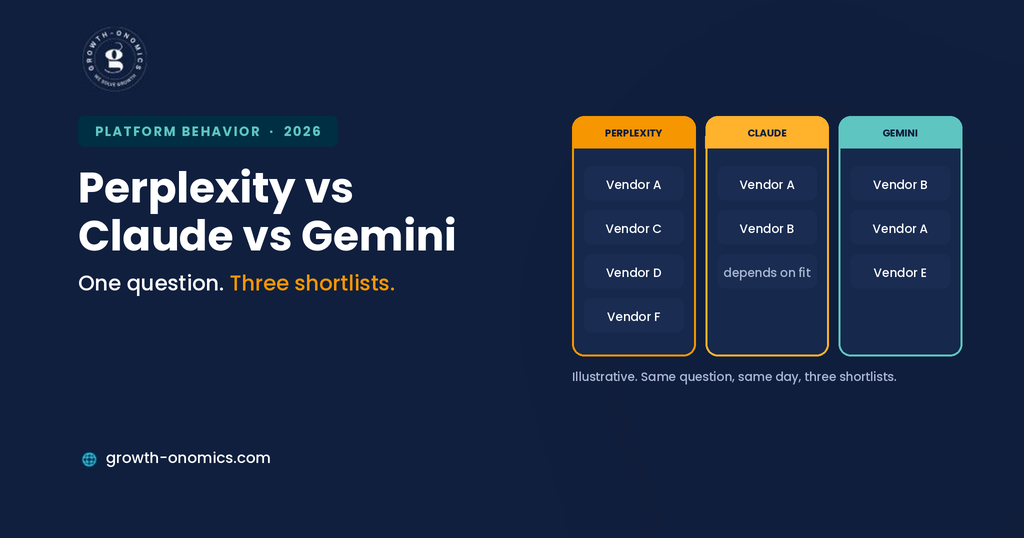
“I asked ChatGPT and it recommended you, but Perplexity didn’t mention you at all.”
That sentence gets said on sales calls now, usually as a passing remark, occasionally as an objection. It is a reasonable observation and an awkward one, because the honest answer; that the two systems source differently and neither publishes how; sounds evasive when a prospect is deciding whether to trust you.
The systems do source differently, and the differences are observable even if the mechanics are not. Perplexity cites densely from a wide range of sources.
Claude names fewer options and hedges toward relevance.
Gemini carries Google’s index and behaves accordingly.
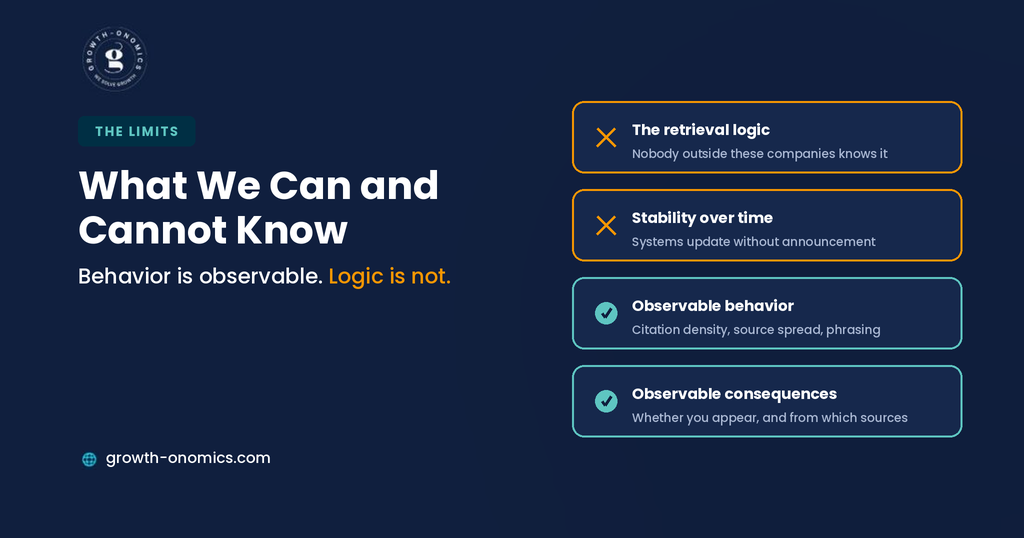
This article covers what could be said about that, and where the honest answer runs out. Nobody outside these companies knows the retrieval logic; the platforms update without announcement, and any article describing “the algorithm” is describing a guess. Behavior is observed. Mechanics are not. That distinction is the whole point.
What We Can and Cannot Know
Being precise about the epistemics here prevents most of the bad advice in this category.
We cannot know the retrieval logic. None of these companies publishes how sources are selected, scored, or weighted. Any article claiming to describe “the algorithm” is an assumption.
We cannot assume stability. These systems update frequently, and behavior observed last quarter may not hold this quarter. A tactic that appeared to work is at least as likely to have been a change in the platform as a result of your action.
We can observe behavior. How many sources an answer cites, what kinds of domains appear, how definitively a recommendation is phrased, whether a vendor’s own pages get used. These are directly testable and reasonably stable over weeks.
We can observe consequences. Whether your brand appears, how it is described, and which sources are credited. That is measurable against a frozen prompt set, and it is the only evidence that applies to your specific business.
The practical stance is to treat platform differences as observed patterns rather than mechanics, and to verify against your own category.
Growth-onomics tracks each platform separately rather than blending them into one visibility score for exactly this reason; an average across 3 systems with different behavior describes none of them.
One more caution before the profiles. Behavior varies by category as much as by platform. An assistant that leans on review platforms in a crowded software category may lean on documentation in a technical one, so the patterns below are a starting hypothesis for your own testing rather than a conclusion to adopt.
Quick Comparison
| Dimension | Perplexity | Claude | Gemini |
| Citation density | High, inline throughout | Moderate, fewer sources | Moderate, links alongside |
| Source spread | Wide, many domains | Narrower, more selective | Google index, broad |
| Recommendation style | Assembles from sources | Hedges toward “depends” | Confident, ecosystem-aware |
| Vendor page usage | Lower | Moderate | Higher for factual queries |
| Best optimized by | Quotable content, third-party presence | Depth, honest trade-offs | Classic SEO and entity clarity |
| Measurable referrals | Yes | Limited | Inside Google reporting |
Perplexity
Observed behavior: The most citation-dense of the three, surfacing many sources per answer with inline attribution throughout.
How It Appears to Source
Perplexity’s interface is built around showing its work. Answers pull from a wide spread of domains, and the citation density means more sources get included per response but each individual source competes with more alternatives for the reader’s attention.
Observed patterns suggest a lean toward editorial, comparative, and community sources over vendor product pages when answering evaluative questions. If you are cited by Perplexity, it is more often because a roundup or review mentioned you than because your feature page ranked.
What This Rewards
Being quotable. Content with clear, attributable claims such as original research, benchmarks, comparison pieces that take a position, documentation with specific figures gives it something to lift and credit. Vague positioning content gives it nothing.
It also rewards third-party presence more directly than others. Because Perplexity draws on a wide spread, the number of independent places that describe you accurately looms larger than the polish of any single owned page.
The Practical Read
Optimize for being cited by the sources Perplexity cites, not just for being cited directly. Your presence in roundups, review platforms, and active community threads is doing more work here than your homepage, which is an uncomfortable finding for teams whose entire AEO plan is a publishing calendar.
Claude
Observed behavior: More selective sourcing, more hedging, and a visible reluctance to declare a single winner in evaluative questions.
How It Appears to Source
Answers tend to cite fewer sources than Perplexity and frame recommendations more conditionally, describing which option suits which situation rather than naming a best choice. For a vendor, that means appearing in an answer is less about winning a ranking and more about being one of the options worth explaining.
That framing has a specific consequence: nuance gets rewarded. A product with a clearly articulated ideal use case is easier to place in a conditional recommendation than one positioned as best for everyone.
What This Rewards
Depth and honesty about fit. Content that states plainly who a product suits and who it does not gives a hedging assistant exactly the material it needs. A comparison page conceding where a competitor is stronger is more useful to this style of answer than one that does not.
Technical accuracy is also important here. Where an assistant is inclined to explain rather than assert, precise documentation and clear capability statements get more use than marketing copy.
The Practical Read
Write for the conditional recommendation. “Best for teams with X constraint” is a more useful positioning than “best overall,” both commercially and for how this assistant constructs answers. Measurable referral traffic is limited, so track presence through prompt testing rather than analytics.
Gemini
Observed behavior: Backed by Google’s index and ecosystem, with answers that draw on the same web understanding that powers Search.
How It Appears to Source
The distinguishing feature is the infrastructure. Gemini relies on the index Google has spent decades building, alongside entity understanding through the Knowledge Graph and integrations across the Google ecosystem.
Answers reflect that: broad sourcing, familiar-looking results, and stronger use of vendor pages for factual questions than the other two.
Google has also stated plainly that appearing in its AI features requires no special technique beyond being indexed, snippet-eligible, and useful, which is more guidance than any other provider offers.
What This Rewards
Classic search fundamentals, applied properly. Crawlable, well-structured, and authoritative pages perform here for the same reasons as in Search. Entity clarity is more important than all the rest, since the Knowledge Graph is part of the picture and being confused with a similarly named company has a direct cost.
Snippet eligibility is the specific technical check. A page carrying nosnippet or max-snippet:0 is ineligible for Google’s AI features and rich results, and those directives are frequently inherited rather than chosen.
The Practical Read
There is no separate Gemini program to run. Do technical and content SEO properly, verify snippet eligibility, and keep entity information consistent across your profiles. The work is identical to what Google Search rewards, which is either reassuring or dull depending on what you were hoping to hear, and it is the one platform where a vendor promising a proprietary methodology is contradicting the provider’s own published guidance.
What They Share
The differences are evident, and the overlap is larger, which is the more important finding.
All three need crawlable, parseable pages. Content that only appears after JavaScript executes is invisible to most of what feeds these systems. This is the prerequisite that invalidates every platform-specific tactic if it fails.
All three favor specificity. Attributable facts, named figures, stated constraints, and dated claims give any retrieval system something to credit. Generic content that could have come from anywhere gives none of them a reason to pick you.
All three draw on third-party sources for evaluative questions. The weighting differs, but none of them treats a vendor’s self-description as authoritative when comparing options.
All three favor recency for time-sensitive topics. Software categories move quickly, and stale content gets deprioritized everywhere.
None of them publishes its ranking logic. Any tactic sold as platform-specific is inference, and inference in this space has a short shelf life.
The practical implication is that roughly 80% of the work is shared. Technical health, answer-first structure, factual specificity, and third-party presence improve your position everywhere. Platform-specific effort operates at the margins, and treating it as the main event is how teams end up chasing behavior that changed last month.
Do I Need a Different Strategy for Each Assistant?
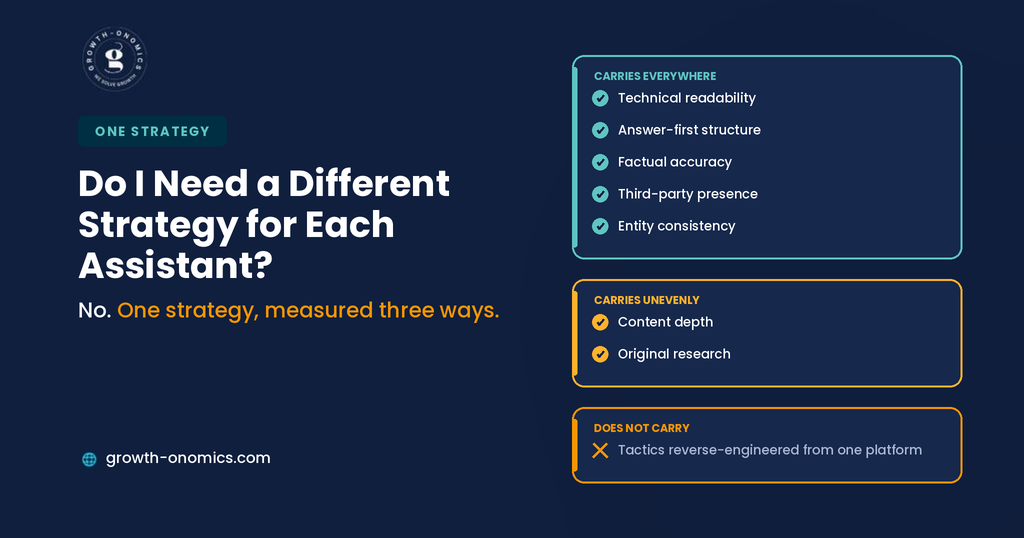
No, and building three is how teams waste a quarter. Almost everything that improves your position on one assistant improves it on the others; the question is only whether the return is equal or merely positive.
Fix once, benefits everywhere
Technical readability. If a page needs JavaScript to render, most of what feeds these systems never sees it. One engineering change unblocks all three at once.
Structure that answers directly. All three work with passages rather than whole pages, so a definition in the first two sentences beats the same definition in paragraph nine, whoever is reading.
Factual accuracy about your product. Correct pricing, current capabilities, functional integrations. An error here is quoted by all three, and correcting it at the source corrects it everywhere.
Third-party presence. Review profiles, roundups, and community threads feed all three. The weighting differs; some lean on independent sources harder than others, but the direction never reverses.
Entity consistency. Being described the same way across your site, profiles, and press coverage helps every system work out who you are. Inconsistency confuses all of them equally.
Helps everywhere, helps some more
Content depth. Rewarded across the board, but disproportionately where an assistant explains a recommendation rather than ranking one. Depth gives a hedging answer the material it needs to be specific about fit.
Original research. Valuable to all three, most directly rewarded where citation density is highest; more citations per answer means more room for an attributable claim.
Neither of these is a reason to build a separate strategy. They are a reason to expect uneven returns from the same work, which is a very different thing.
Does not transfer, and is not worth doing
Tactics reverse-engineered from one platform’s behavior. This is the only category on the list that genuinely does not carry across, and it is also the least durable work available; the first thing to break when a platform updates, which happens without notice.
So: one strategy, measured three ways. Build for the shared foundation, track each platform separately so you can see where you stand, and treat platform differences as a guide to emphasis rather than a reason to split the program.
What This Means for Positioning
Three platform behaviors translate into positioning decisions, and all three are defensible independent of any AI system.
1. Write for the conditional recommendation.
Where an assistant hedges toward “it depends,” a product with a clearly stated ideal customer is easier to place than one claiming to be best for everyone. “Best for engineering teams managing multi-cloud infrastructure” gives an explaining assistant something to work with; “the leading platform for modern teams” gives it nothing.
2. State limitations openly.
Comparison content that concedes where a competitor is stronger performs better across all three platforms than one-sided pages, which get discounted as marketing. It also happens to be what a skeptical buyer wants, which makes this a low-regret change.
3. Publish something only you know.
Original data, named benchmarks, and specific constraints give any retrieval system a reason to credit you rather than one of 50 sites saying similar things. Where citation density is high, the topic is most important; where answers are more selective, it is often the deciding factor in being included at all.
None of these are AI tactics. They are positioning improvements that happen to align with how these systems construct answers, which is the most durable kind of optimization available; it survives whatever the platforms change next.
Testing Each One Properly
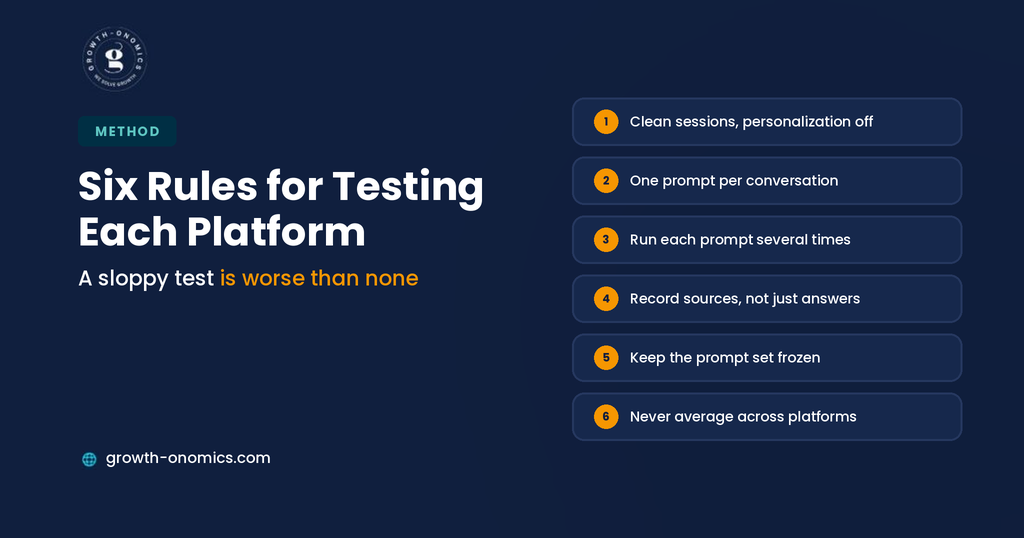
Method plays a larger role than platform differences, and a sloppy test produces conclusions you cannot act on.
Use clean sessions. Log out or disable memory and personalization. Your own account carries months of context a prospect does not have.
One prompt per conversation. Assistants carry context forward, so the third answer in a thread is shaped by the first two.
Run each prompt several times. Outputs vary between runs. A single result is noise; the same finding three times is a signal.
Record the sources, not just the answer. The source list is the actionable part. Classify each as yours, shared, or independent, and the remediation follows directly.
Keep the prompt set frozen. Changing prompts and measuring improvement at the same time produces a number nobody can interpret.
Test each platform separately and never average. This is the point of the exercise. A blended visibility score across three systems that behave differently hides the only information worth having, which is where the difference lies and what explains it.
How to Prioritize Across Three Platforms
Here are 4 decisions in order.
1. Fix the shared foundation first. Rendering, structure, factual accuracy, entity consistency. This is most of the available return and it applies everywhere.
2. Weight by where your buyers actually are. Run the same prompts across all three, then check your own referral data and self-reported attribution. If nobody in your pipeline mentions a platform, its share of your effort should reflect that regardless of its market position.
3. Address the weakest platform if the gap is diagnosable. If you appear on two and not the third, run the source audit for that platform specifically. The answer is usually a third-party gap rather than something platform-specific.
4. Then stop optimizing per platform. Beyond the foundation and the source mix, additional platform-specific effort has poor returns and a short half-life. Growth-onomics reports platform-level visibility separately but scopes remediation against the shared layer; for that reason, the fixes that work everywhere are also the fixes that survive an update.
Conclusion
The three assistants do behave differently, and the differences are worth knowing.
Perplexity cites densely and rewards being quotable and widely mentioned.
Claude hedges toward conditional recommendations and rewards depth and honest positioning.
Gemini carries Google’s index and rewards exactly what Google Search has always rewarded.
But the differences are the smaller part of the picture. All three need pages machines can read, content that answers directly, facts worth attributing, and independent sources describing you accurately. That shared foundation is most of the available return, and it is the only work that survives a platform update, which is guaranteed to happen and unlikely to be announced.
The honest advice is therefore unglamorous. Build for the overlap, measure each platform separately so you can see where you stand, and resist optimizing for behavior that might not exist next quarter. Anyone selling a Perplexity-specific or Gemini-specific methodology is selling inference about systems nobody outside those companies understands.
FAQs
Which AI assistant should B2B SaaS companies prioritize?
Start by measuring where your own buyers are rather than adopting a market-share ranking. Run the same prompt set across all three, check your referral data for identifiable AI sources, and add a self-reported attribution field to demo forms with an explicit AI assistant option. Most B2B teams find their traffic concentrated in one platform and their sales conversations mentioning another. That gap is useful information. Beyond prioritization, the shared foundation is more important than a particular choice; work that helps your top platform helps others, too.
Do these platforms use different ranking algorithms?
Almost certainly, and none of them publishes how. What can be observed is behavior: citation density, source spread, how confidently recommendations are phrased, whether vendor pages get used, and those patterns are reasonably consistent over weeks. What cannot be observed is why. Anyone describing the retrieval logic of these systems is inferring, and inference in this space has a short shelf life because the platforms update without notice. Treat observed behavior as a guide to emphasis, not as a mechanism to optimize against.
Is optimizing for one platform wasted effort on the others?
Mostly no, which is the useful part. Technical readability, answer-first content structure, factual accuracy, entity consistency, and third-party presence improve your position on all three. That covers most of the available work. What does not transfer is tactical guessing based on observed platform behavior which is also the least durable work available, since it breaks whenever a platform changes. Build for the shared foundation and treat platform-specific adjustments as marginal refinements rather than separate programs.
Why does Claude recommend fewer vendors by name?
Observationally, Claude tends toward conditional framing, describing which option suits which situation rather than declaring a winner. For a vendor that changes what good positioning looks like: a clearly stated ideal use case is easier to place in a conditional recommendation than a claim to be best for everyone. Content that concedes where a competitor is stronger and states plainly who the product does not suit gives this style of answer exactly what it needs. That is also better positioning commercially, which makes it a low-regret adjustment.
What if my brand appears on one platform and not the others?
Run the source audit for the platform where you are absent, because the answer is almost always visible there. If the platform citing you draws on your own documentation and the one ignoring you draws on roundups and review platforms, the gap is third-party presence rather than anything platform-specific. If the pattern is reversed, you likely have a content or technical gap on your own site. Uneven visibility across platforms is usually a symptom of an uneven source mix, not evidence that one platform dislikes you.
How often should I test all three platforms?
Monthly for a small set of your most commercially important prompts, quarterly for the full set. Run each prompt several times per session because outputs vary, use clean sessions with personalization disabled, and keep the prompt set frozen so comparisons hold. Record the source lists rather than just the answers, since that is the part you can act on. Test each platform separately and never average the results; a blended score across three systems that behave differently conceals the only useful finding, which is where the difference sits.