


A/B testing is critical for making decisions backed by real user data. Open-source A/B testing platforms have grown in popularity due to their flexibility, cost savings, and control over data. Businesses can self-host these tools, ensuring compliance with privacy laws like GDPR and CCPA while avoiding vendor lock-in. If you would rather have the testing programme run for you, see our performance marketing services.
Here are the 7 best open-source A/B testing tools in 2025:
- GrowthBook: Combines feature flagging, analytics, and A/B testing. Offers self-hosting, broad SDK support, and advanced analytics.
- PostHog: All-in-one platform for product analytics and A/B testing. Strong self-hosting options and real-time dashboards.
- Statsig: Built for enterprise-scale experimentation with real-time analytics and data warehouse integration.
- Unleash: Focused on feature flagging with basic A/B testing capabilities. Privacy-first with robust self-hosting.
- Wasabi: API-driven platform designed for enterprise experimentation. Offers deterministic user assignment and data export.
- OpenFeature: Standardized framework for feature flag management. Works with multiple backends and supports vendor independence.
- Flagd: Lightweight feature flag daemon for managing flags across languages. Integrates with external analytics tools.
Quick Comparison
| Tool | Feature Flagging | Experiment Analytics | SDK Support | Self-Hosting | Privacy Controls | Monthly Pricing |
|---|---|---|---|---|---|---|
| GrowthBook | ✅ Full | ✅ Advanced | JavaScript, Python | ✅ Yes | Strong GDPR/CCPA | Free/$20+ |
| PostHog | ✅ Full | ✅ Advanced | JavaScript, Go | ✅ Yes | Good privacy controls | Free/Paid tiers |
| Statsig | ✅ Full | ✅ Advanced | JavaScript, Python | ✅ Yes | Strong enterprise-level | Free/Custom |
| Unleash | ✅ Full | ⚠️ Basic | Java, Python | ✅ Yes | Excellent privacy-first | Free/$80+ |
| Wasabi | ✅ Limited | ⚠️ Basic | Java, Python | ✅ Yes | Basic compliance | Free only |
| OpenFeature | ✅ Full | ❌ None | Multi-language | ✅ Yes | Standards-based | Free only |
| Flagd | ✅ Full | ❌ None | Go, JavaScript | ✅ Yes | Good privacy controls | Free only |
These tools empower businesses to test, learn, and grow by offering control over data and integration with analytics systems. Choose based on your team’s needs, compliance requirements, and technical expertise.
Product Analytics: A/B testing my next.js site for MAXIMUM GROWTH growth with @PostHog
What to Look for in an Open-Source A/B Testing Platform
Choosing the right open-source A/B testing platform involves more than just checking off basic features. It’s about finding a tool that aligns with your business needs – whether that’s data control, compliance, or the ability to grow with your organization. Let’s dive into the key factors to consider.
SDK and API Coverage is the backbone of any testing platform. Strong support for SDKs and APIs ensures you can run experiments across web, mobile, and backend systems in multiple programming languages. This flexibility becomes even more critical as your tech stack evolves and your business scales.
For U.S. businesses handling sensitive customer data, self-hosting capabilities are a game-changer. Self-hosting gives you complete control over your data infrastructure, which is essential for meeting privacy regulations and internal security standards. Platforms like GrowthBook and Unleash provide robust self-hosting options under open-source licenses, making it easier to address compliance needs or specific data residency requirements.
Your platform’s analytics features will determine how effectively you can turn experiment results into actionable insights. Look for tools that offer advanced analytics like statistical significance, multivariate testing, cohort segmentation, and event tracking. For example, PostHog includes Bayesian analysis and user path visualization, while GrowthBook integrates with SQL for detailed reporting. These capabilities help transform raw data into meaningful business intelligence.
An active community is another factor that can’t be ignored. A strong community ensures regular updates, quick bug fixes, and access to shared best practices. To gauge community health, check GitHub activity, forum discussions, and the frequency of software releases. Both GrowthBook and PostHog have thriving communities that contribute to their ongoing development and provide valuable peer support.
For U.S.-based businesses, privacy law compliance is non-negotiable. Your platform needs to support regulations like the California Consumer Privacy Act (CCPA) and, for healthcare-related sectors, HIPAA. Features such as data anonymization, user consent management, and secure data storage are crucial. Self-hosting options and customizable data retention policies also help businesses stay compliant without sacrificing flexibility.
Seamless integration with American analytics tools is another critical feature. Platforms like GrowthBook and Unleash integrate easily with popular tools like Google Analytics, Segment, and Mixpanel. This compatibility allows you to use your existing analytics setup for tracking and reporting, avoiding disruptions to your workflows.
If you’re running experiments on high-traffic sites, performance and scalability are key. The platform should handle large traffic volumes and multiple experiments simultaneously without slowing down. Wasabi, for instance, has a proven track record of reliability under heavy traffic, as demonstrated by its use among major U.S. brands.
Lastly, don’t underestimate the importance of ease of use. Platforms with intuitive interfaces, visual editors, and simple setup processes can significantly reduce the learning curve. This is especially helpful when onboarding new team members or scaling experimentation efforts across your organization.
When evaluating platforms, focus on how well they handle data control, compliance, and integration with your existing tools. For additional guidance, performance marketing agencies like Growth-onomics can help you choose and implement the right A/B testing platform to meet your specific needs.
1. GrowthBook
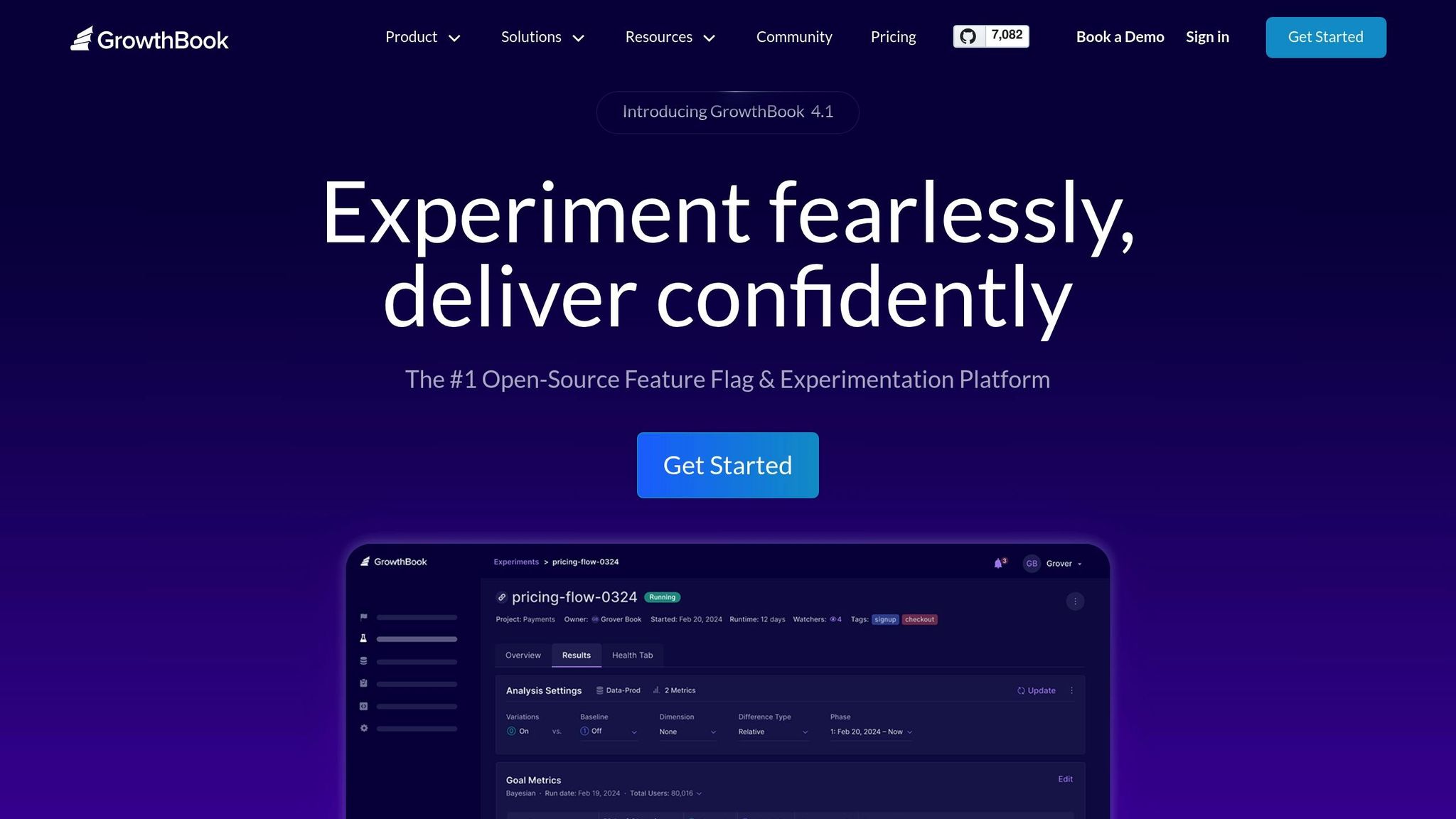
GrowthBook is a versatile full-stack experimentation platform that combines feature flagging, analytics, and A/B testing into one package. It’s gained attention as a go-to solution, especially for teams seeking alternatives after the discontinuation of Google Optimize. One standout feature is its ability to act as a kill switch, allowing teams to quickly disable features that aren’t performing as expected. This flexibility makes it a strong choice for managing experiments and feature rollouts.
SDK and API Coverage
GrowthBook offers broad SDK support, including for JavaScript, Python, Ruby, Go, PHP, and Java. This makes it a practical option for a wide range of applications, from web platforms and backend systems to mobile apps. Additionally, its RESTful API ensures smooth integration with custom tech stacks and automation workflows, making it adaptable to different development environments.
Self-Hosting and Privacy Controls
For teams prioritizing security and privacy, GrowthBook provides self-hosting capabilities paired with enterprise-level protections. These include role-based access controls, audit logs, and encryption, ensuring sensitive data remains secure.
Analytics and Reporting Capabilities
GrowthBook integrates seamlessly with popular tools like SQL databases, Google Analytics, Segment, and Sentry. This means you can tap into your existing data infrastructure without any major adjustments. Its analytics engine uses both Bayesian and frequentist statistical methods to calculate statistical significance and confidence intervals automatically. Real-time experiment tracking and intuitive visual dashboards make it easier to monitor key performance metrics and make data-driven decisions.
Community Support and Documentation
Even as a newer player in the space, GrowthBook has cultivated an engaged community on platforms like GitHub and Discord, where users praise its responsive support and frequent updates. Comprehensive documentation – ranging from onboarding guides and API references to video tutorials and community forums – ensures teams can quickly get up to speed and troubleshoot effectively.
2. PostHog
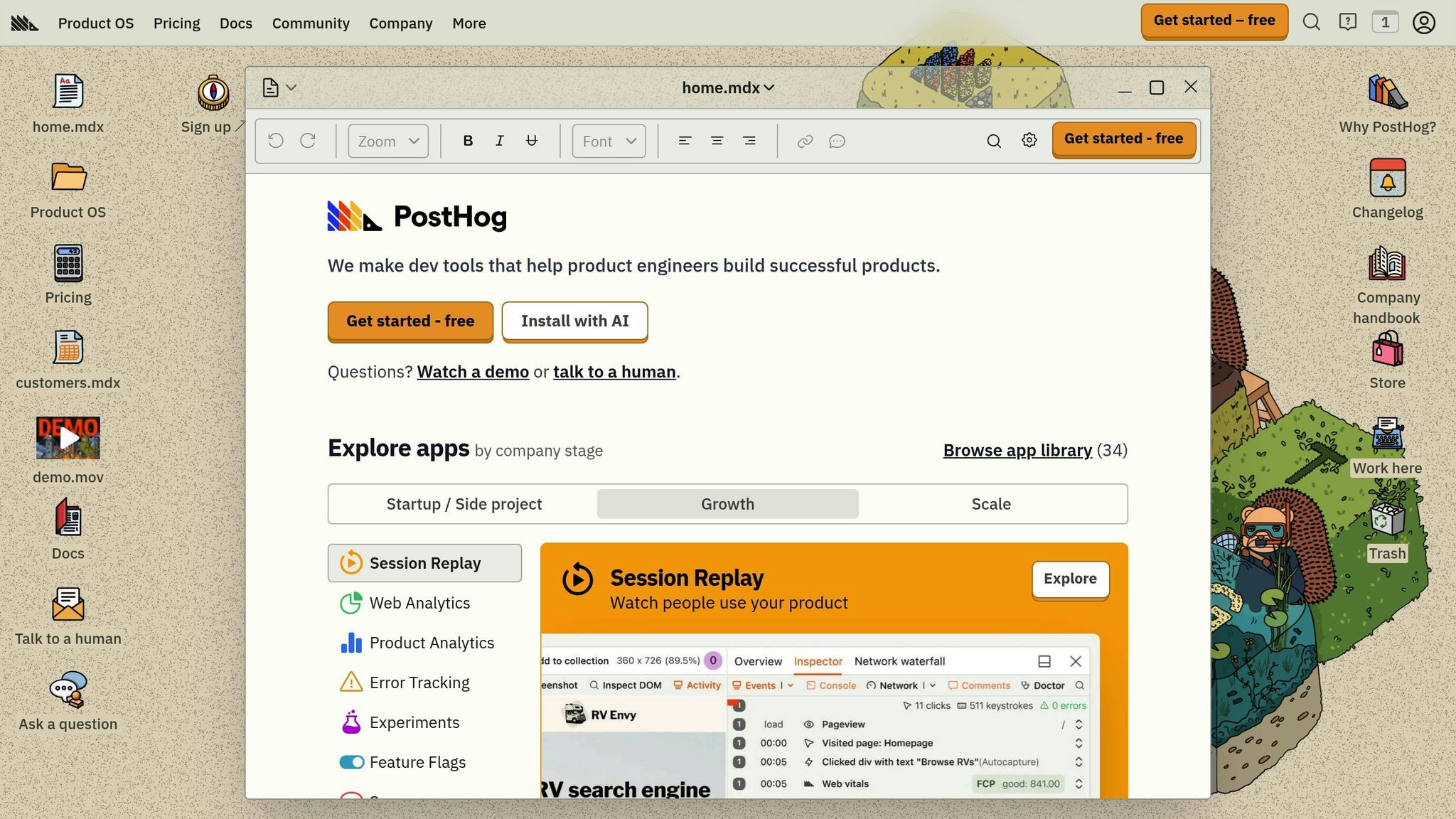
PostHog is a robust all-in-one platform that combines product analytics with A/B testing, making it a popular choice for teams looking to streamline their workflows. With over 12,000 stars on GitHub and adoption by more than 10,000 organizations worldwide, PostHog eliminates the need to juggle multiple tools by offering both experimentation and analytics in one place. This integration helps reduce data silos and simplifies processes. Let’s dive into its key features.
SDK and API Support
PostHog provides a wide range of SDKs for major programming languages and frameworks, including JavaScript, Python, Ruby, Go, and Node.js. This flexibility makes it easier to integrate with web and mobile applications. Its API allows for custom event tracking, experiment assignment, and result retrieval, enabling teams to embed testing directly into their product’s codebase. On top of that, PostHog supports secure self-hosting options, ensuring a high level of data control.
Self-Hosting and Privacy Features
For organizations with strict data governance requirements, PostHog offers self-hosting capabilities, giving teams full control over their infrastructure. Whether deployed on private servers or in a private cloud, this setup ensures that sensitive data stays within the organization’s environment. Additionally, PostHog includes tools for managing user permissions and anonymizing data, adding extra layers of privacy protection.
Advanced Analytics and Reporting
PostHog’s analytics tools go far beyond standard A/B testing metrics. Features like real-time dashboards, cohort analysis, funnel tracking, and user path visualization provide deeper insights into user behavior. The platform uses Bayesian analysis to estimate the success probability of each variant, offering a more intuitive alternative to traditional p-value-based methods. Teams can segment results by geography, user attributes, or custom cohorts and even export data to external warehouses like Snowflake, BigQuery, and Redshift for deeper analysis. For instance, a SaaS company used PostHog to optimize its signup flow through multivariate experiments. By leveraging feature flags and cohort analysis, they identified a variant that boosted conversion rates by 12%.
Community and Documentation
PostHog benefits from an active open-source community on GitHub, forums, and Slack. Its detailed documentation covers everything from setup and SDK integration to advanced experimentation techniques. The team behind PostHog frequently incorporates user feedback into updates, ensuring the platform evolves to meet real-world needs. Community-driven resources, including guides and case studies, help teams apply best practices and address challenges effectively.
3. Statsig
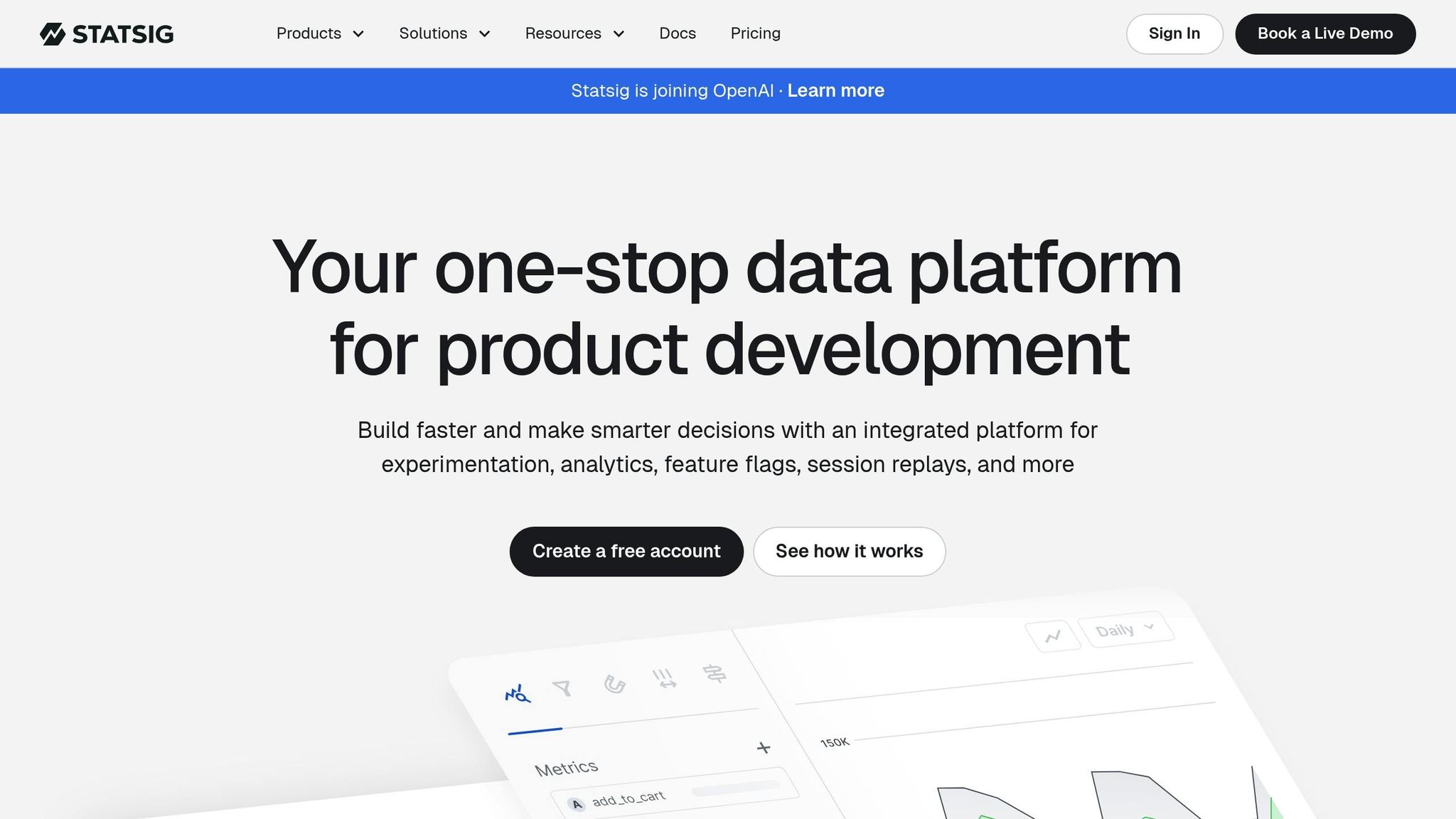
Statsig is a cutting-edge experimentation platform created by a team of former Facebook engineers who have firsthand experience with the complexities of running large-scale, fast-paced product experiments. Designed specifically for product-led growth teams, Statsig combines developer-friendly tools with advanced statistical analysis. It supports millions of users and events daily in production environments, making it a trusted choice for companies that need enterprise-level experimentation capabilities.
SDK and API Coverage
Statsig offers a wide range of SDKs, including support for JavaScript, Python, Java, Go, iOS, and Android. Its implementation process is straightforward, thanks to well-documented APIs that allow teams to set up A/B tests with just a few lines of code. The platform simplifies the developer experience by managing tasks like feature flagging and experiment result retrieval, making it accessible even for teams new to experimentation. This streamlined process ensures smooth integration and sets the foundation for real-time analytics.
Analytics and Reporting Capabilities
Statsig provides real-time dashboards that use both frequentist and Bayesian statistical methods to automatically determine significance levels. Teams can customize metrics and segment them by user attributes, geographic location, or custom cohorts. This flexibility allows growth teams to dig deeper into experiment outcomes and understand how different user groups react to changes.
The platform’s visualization tools are designed for efficiency, offering clear views of conversion rates, key metrics, and the impact of experiments. Teams can also export data for further analysis or generate reports directly within the platform, making it easier to share insights with stakeholders.
Self-Hosting and Privacy Controls
While Statsig primarily functions as a managed cloud service, it also provides self-hosting options for organizations with stringent data governance requirements. This feature allows enterprise customers to manage data residency and implement detailed privacy controls to meet regulations like GDPR. Role-based access management is included to ensure secure handling of sensitive data.
For U.S.-based companies dealing with sensitive user information, the self-hosting option offers complete control over experiment data, ensuring compliance with local privacy laws. This setup eliminates concerns about third-party data handling while maintaining access to Statsig’s full suite of experimentation tools.
Community Support and Documentation
Statsig stands out not just for its features but also for its strong community backing. It offers comprehensive documentation covering everything from initial setup to advanced experimentation techniques. An active open-source community on GitHub contributes code, reports issues, and shares best practices, while official support channels and forums provide additional resources for troubleshooting and collaboration.
The documentation includes detailed API references, integration guides, and practical examples. Regular updates from the development team ensure the platform continues to adapt to user feedback and the evolving needs of experimentation teams.
4. Unleash
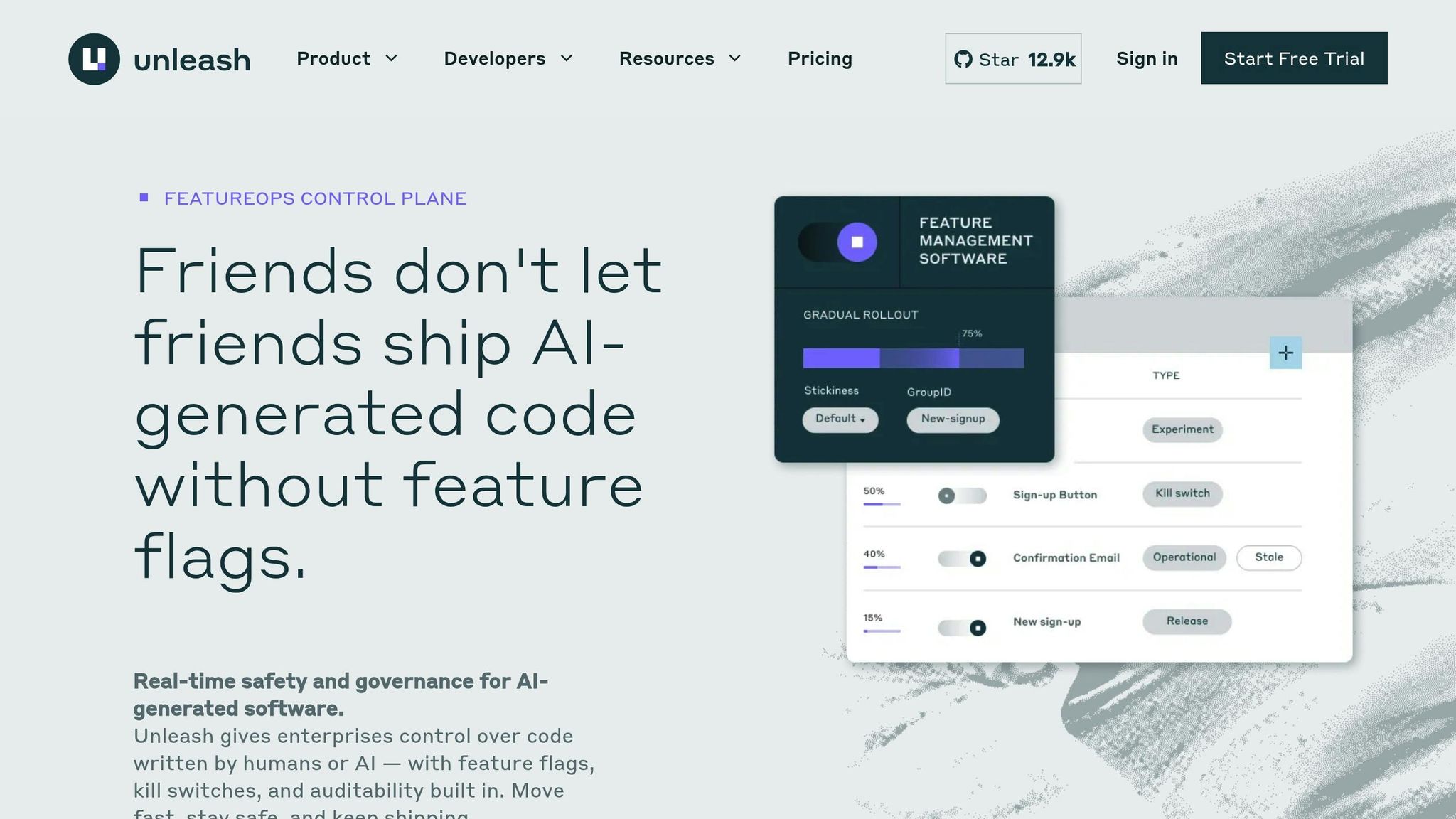
Unleash is a privacy-focused platform built with strict data governance in mind. While it started as a tool for feature flagging, it has grown into a full-fledged A/B testing solution. It’s particularly popular among industries like finance and healthcare, where handling sensitive data with care is non-negotiable.
What sets Unleash apart is its modular design. Teams can begin with straightforward feature toggles and gradually expand to handle complex, multivariate experiments. This scalability makes it a preferred choice for mid-sized and enterprise organizations that need secure and flexible experimentation workflows. Plus, its strong SDK and API support ensures smooth integration into existing systems.
SDK and API Coverage
Unleash supports over a dozen programming languages, including JavaScript, Java, Go, Python, .NET, and Ruby. This broad SDK coverage makes it easy to integrate A/B testing into various tech stacks. Its RESTful API further enhances flexibility, enabling custom integrations and automation. Teams can embed experimentation directly into their CI/CD pipelines with minimal effort.
Self-Hosting and Privacy Controls
For organizations that prioritize data control, Unleash offers a fully self-hosted, open-source version, free for up to two environments. This option allows businesses to manage data residency and privacy entirely. For instance, a U.S.-based financial company can deploy Unleash on domestic AWS servers, ensuring data stays within the country. Additionally, robust access controls and user permissions safeguard sensitive information by restricting access to authorized personnel only.
Analytics and Reporting Capabilities
Unleash takes a unique approach to analytics by delegating reporting to external tools like Google Analytics or Mixpanel. It complements this with precise user segmentation, enabling controlled rollouts based on user attributes or specific cohorts. This combination provides teams with the flexibility to tailor their experimentation strategies while leveraging familiar analytics platforms.
Community Support and Documentation
Unleash benefits from an active GitHub community and well-crafted documentation. These resources provide clear guidance on onboarding, SDK usage, and integration processes. Community channels, such as GitHub issues, Slack, and forums, create spaces for sharing best practices and resolving challenges. Additionally, detailed migration guides help teams transition smoothly from other A/B testing platforms.
The platform continues to evolve thanks to contributions from its community. Regular updates and feature additions, informed by real-world feedback, ensure Unleash remains aligned with the needs of modern experimentation teams.
sbb-itb-2ec70df
5. Wasabi

Wasabi is an API-driven platform designed for A/B testing, tailored specifically for enterprise-level experimentation and data management. Initially developed by Intuit for products like TurboTax and QuickBooks, its API-first approach allows engineering teams to design custom workflows instead of relying solely on visual interfaces. This flexibility makes it an excellent choice for integrating into complex systems, offering enterprises precise control over their experiments.
SDK and API Coverage
Wasabi features a RESTful API that supports integration across a wide range of programming languages, including Python, Java, and Node.js. Through this API, teams can handle experiment configurations, user assignments, and data collection using simple HTTP requests. One standout feature is its deterministic assignment, which ensures users remain consistently grouped in the same experiment across multiple sessions, preserving the integrity of test results.
The platform is versatile enough to integrate seamlessly into various architectures, whether you’re working with microservices, serverless functions, or traditional web applications. This adaptability makes it a strong fit for diverse engineering environments.
Self-Hosting and Privacy Controls
Wasabi stands out for its self-hosting capabilities, giving organizations the ability to deploy the platform entirely on their own infrastructure. Whether on-premises or in private cloud setups, this feature is particularly useful for meeting strict compliance needs.
By self-hosting, companies gain full control over data residency, user information, and access permissions. Teams can implement privacy measures like user data anonymization and set granular access controls to align with regulatory frameworks such as GDPR and HIPAA. This level of customization is especially valuable for businesses handling sensitive data.
Analytics and Reporting Capabilities
Wasabi provides real-time analytics through its API, enabling teams to track experiment assignments and monitor custom metrics. Instead of being limited to built-in reporting tools, Wasabi focuses on data export, allowing integration with platforms like Tableau, Looker, or custom-built dashboards. This approach gives teams the flexibility to merge experiment data with other business metrics for deeper analysis.
Many organizations connect Wasabi to their existing business intelligence tools or data warehouses for advanced reporting. This capability makes it easier to draw actionable insights and make data-driven decisions quickly. The platform’s technical strengths are further supported by a dedicated community and thorough documentation.
Community Support and Documentation
Wasabi’s open-source community, though relatively small, is highly focused on enterprise needs and advanced scalability. Its GitHub repository provides detailed documentation, including API references, deployment instructions, and integration examples. Support is available through GitHub issues and discussion forums, where discussions often revolve around solving complex use cases.
While the community may not be as large as some other platforms, its enterprise focus ensures that resources are tailored to solving scalability and advanced integration challenges. Additionally, third-party tutorials and case studies offer additional guidance, particularly for teams looking to integrate Wasabi with popular analytics tools and data infrastructure.
6. OpenFeature
OpenFeature provides a vendor-neutral standard for managing feature flags. While it’s not a complete testing solution, it offers a unified API that works with multiple experimentation backends. This approach eliminates vendor lock-in, giving engineering teams the freedom to switch between A/B testing providers without needing to rewrite their application code.
Governed by the Cloud Native Computing Foundation (CNCF), OpenFeature emphasizes standardization. Drawing inspiration from OpenTelemetry, it sets a consistent framework for feature flag management. By late 2025, OpenFeature had gained considerable traction, boasting over 2,000 GitHub stars and contributions from more than 100 organizations, including major cloud providers and SaaS companies. Its focus on flexibility and standardization makes it a strong complement to other solutions in this space.
SDK and API Coverage
OpenFeature stands out by offering extensive developer support. It provides official SDKs for over 10 programming languages, including JavaScript, Go, Java, Python, and .NET. The API is consistent across these languages, ensuring developers can manage feature flags in a uniform way regardless of their tech stack or backend provider.
One of its key features is context-aware flag evaluation, which allows for precise user targeting. This enables teams to implement detailed user segmentation and targeting rules while maintaining the ability to switch between backends – like GrowthBook, Statsig, or custom solutions – without altering their application code.
The framework’s architecture separates application logic from specific feature flag vendors. This makes it especially useful for organizations using multiple tools or planning to migrate between platforms. In cloud-native environments, particularly among Kubernetes users, this standardized approach aligns with the industry’s broader shift toward open standards.
Self-Hosting and Privacy Controls
OpenFeature, like other open-source tools, prioritizes user control over data and deployment flexibility. It doesn’t store or manage feature flag data itself but acts as a bridge, enabling you to self-host your chosen provider while still benefiting from a standardized interface.
The framework also supports detailed privacy controls, such as user data anonymization and restricted access. This allows organizations to enforce their own data policies and comply with regulations like GDPR and HIPAA, making it a solid choice for businesses with strict privacy and compliance needs.
This architecture is particularly advantageous for companies operating in multi-cloud or hybrid environments, as it simplifies feature flag management across varied systems while meeting data residency requirements.
Analytics and Reporting Capabilities
OpenFeature takes a different route when it comes to analytics. Unlike integrated platforms, it doesn’t include built-in analytics or reporting tools. Instead, it’s designed to work with external analytics platforms, allowing teams to integrate with their preferred tools.
While this approach might require more setup compared to all-in-one solutions, it gives organizations more control over data analysis. Teams can combine experiment data with other business metrics using existing business intelligence tools or data warehouses, creating a more comprehensive view of their performance.
Community Support and Documentation
As a CNCF project, OpenFeature benefits from a strong and active community. It offers detailed documentation that covers everything from basic setup to advanced use cases, complete with examples and tutorials to guide developers.
The community is active on platforms like GitHub and Slack, where users can exchange best practices, solve problems, and contribute to the project’s evolution. Regular updates and input from a wide range of contributors ensure that OpenFeature remains a sustainable and reliable option, making it easier for organizations to adopt with confidence.
7. Flagd
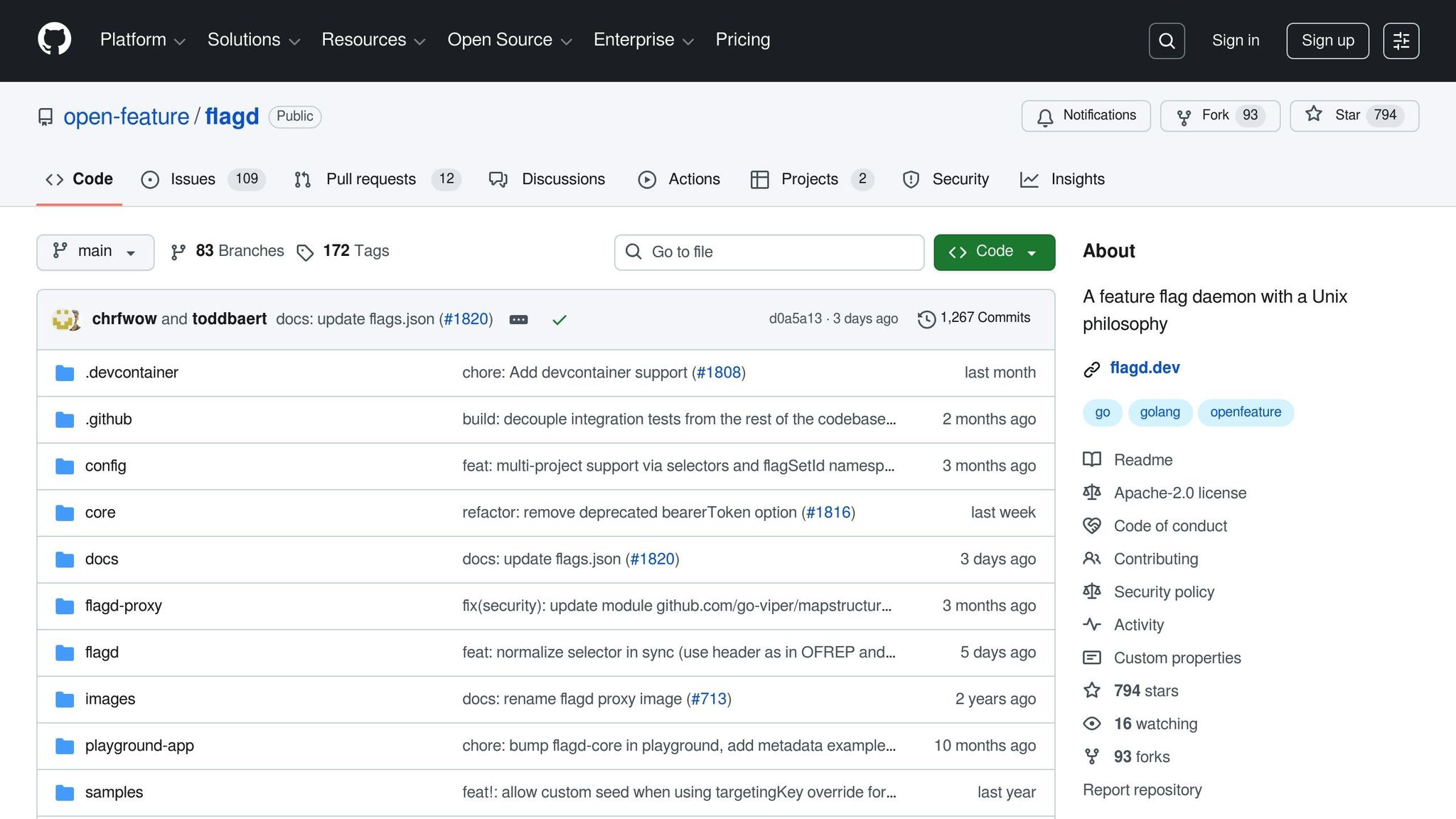
Flagd is a lightweight, language-independent feature flag daemon created by the OpenFeature community. Its primary goal is to separate feature flag logic from application code. Unlike a full A/B testing platform, Flagd zeroes in on managing and evaluating feature flags. This makes it a great choice for organizations that prefer a modular setup for experimentation.
Flagd is especially favored by teams that need a fast and consistent way to serve feature flags. Let’s take a closer look at how its SDK support and API options make it adaptable to various tech setups.
SDK and API Coverage
Flagd provides SDKs for a variety of programming languages, maintained by the OpenFeature community. These include Go, Java, JavaScript, Python, and .NET, making it easy to integrate with different tech stacks. Its APIs are designed for simplicity and flexibility, supporting both REST and gRPC protocols for flag resolution. This gives teams the freedom to choose the method that works best for their specific requirements.
Self-Hosting and Privacy Controls
Built with self-hosting in mind, Flagd allows organizations to maintain full control over their feature flag environment. This setup ensures that sensitive user data and experiment configurations remain within their own infrastructure, addressing privacy concerns effectively. Additionally, Flagd includes features like granular access controls and audit logs, which help teams manage permissions and track changes for compliance purposes.
Analytics and Reporting Capabilities
Instead of offering built-in analytics, Flagd focuses solely on feature flag management and integrates easily with external reporting tools. Teams often pair it with platforms like PostHog, GrowthBook, or custom data pipelines to analyze experiments and extract insights. This modular approach to analytics, combined with strong community support, adds to Flagd’s dependability.
Community Support and Documentation
As part of the OpenFeature ecosystem, Flagd benefits from an active community that contributes to its development and regular updates. Comprehensive documentation, including setup guides, integration instructions, and best practices, is readily available through community-maintained GitHub repositories and forums. This support network ensures that Flagd continues to grow and improve based on user feedback and practical use cases.
Feature Comparison Table
This table outlines a comparison of seven prominent open-source A/B testing tools, focusing on features, deployment options, and compliance standards.
| Tool | Feature Flagging | Experiment Analytics | SDK Support | Self-Hosting | Key Integrations | Privacy/Compliance | Community Activity | Monthly Pricing (USD) |
|---|---|---|---|---|---|---|---|---|
| GrowthBook | ✅ Full | ✅ Advanced | Node, Python, Java, React, PHP | ✅ Yes | GA4, Mixpanel, Segment, Warehouses | Strong GDPR/CCPA | 5,000+ GitHub stars | Free / $20+ cloud |
| PostHog | ✅ Full | ✅ Advanced | JavaScript, Python, Go, Ruby, PHP | ✅ Yes | Product analytics, session replay | Good privacy controls | Used by over 10,000 companies | Free / Paid tiers |
| Statsig | ✅ Full | ✅ Advanced | JavaScript, React, Python, Java, Go | ✅ Yes | Data warehouses, analytics platforms | Strong enterprise compliance | Active development | Free / Custom enterprise |
| Unleash | ✅ Full | ⚠️ Basic | Node, Java, Python, Go, .NET | ✅ Yes | API integrations, webhooks | Excellent privacy-first | 7,000+ GitHub stars | Free / $80+ enterprise |
| Wasabi | ✅ Limited | ⚠️ Basic | Java, JavaScript, Python | ✅ Yes | REST API | Basic compliance | Low activity | Free only |
| OpenFeature | ✅ Full | ❌ None | Multi-language standard | ✅ Yes | Pluggable providers | Good standards-based | Growing CNCF project | Free only |
| Flagd | ✅ Full | ❌ None | Go, Java, JavaScript, Python, .NET | ✅ Yes | External analytics tools | Good with audit logs | Active CNCF community | Free only |
This breakdown highlights differences in performance, integration, and deployment capabilities.
Performance and Technical Capabilities
GrowthBook shines with its experiment version-control through Git integration and CI/CD pipelines. On the other hand, PostHog consolidates A/B testing and product analytics into a single platform, which simplifies tool management but might feel overwhelming for teams focused solely on experimentation.
Statsig takes a warehouse-native approach, enabling experiments to run directly on existing data warehouses. This avoids the need for transferring data, reducing discrepancies in test results. Unleash, meanwhile, focuses on feature flagging with basic experimentation support, making it a good fit for teams prioritizing feature rollouts over detailed analytics.
Integration and Data Alignment
Integration options differ widely among these tools. GrowthBook and PostHog provide robust analytics integrations, working seamlessly with tools like Google Analytics 4, Mixpanel, and major data warehouses. These integrations ensure consistent metrics across platforms.
Statsig simplifies alignment further by running experiments directly within your data warehouse. In contrast, OpenFeature and Flagd depend on external analytics solutions. While this adds flexibility for teams with established analytics setups, it also introduces additional steps for comprehensive experimentation.
Deployment and Privacy Considerations
All tools support self-hosting and are designed to meet GDPR and CCPA compliance requirements. GrowthBook offers equal functionality across its cloud and self-hosted versions, while PostHog provides deployment flexibility through Docker and Kubernetes.
Unleash takes a privacy-first approach, offering detailed access controls and audit logs, which is particularly appealing for organizations with strict data security needs. Similarly, Statsig and GrowthBook emphasize strong compliance measures. Wasabi, however, offers only basic privacy protections, which may not suit privacy-sensitive applications.
Community Support and Long-term Viability
Community engagement varies significantly. PostHog, adopted by over 10,000 companies, boasts a large user base, while GrowthBook and Unleash have garnered 5,000+ and 7,000+ GitHub stars, respectively. These metrics reflect active communities and ongoing development.
On the other end, Wasabi has a smaller, less active community, while OpenFeature and Flagd benefit from CNCF backing, ensuring steady development and industry support.
Key Strengths and Limitations
GrowthBook stands out with its robust analytics and flexibility in hosting options. PostHog’s unified platform is powerful but may pose challenges for teams needing extensive customization. Statsig’s warehouse-native design is ideal for engineering teams, though advanced features may require paid plans.
Unleash is a strong choice for secure feature flagging but offers limited analytics capabilities. Wasabi remains simple and reliable but suffers from an outdated interface and infrequent updates. Emerging tools like OpenFeature and Flagd provide vendor independence and cloud-native flexibility but rely on external analytics tools for deeper experimentation capabilities.
How to Pick the Right Platform for Your Growth Stack
Selecting the right A/B testing platform means finding one that aligns with your workflows and long-term goals. It’s also crucial to consider factors like team size, technical expertise, and compliance needs.
Team Size and Technical Expertise
The size of your team and its technical capabilities play a major role in choosing the right platform. Smaller teams with limited engineering resources benefit from tools like GrowthBook or PostHog. These platforms are designed to be user-friendly, with straightforward setup processes and clear documentation, making them ideal for minimizing technical overhead while still enabling effective experimentation.
On the other hand, larger organizations with dedicated engineering and data teams can explore more advanced platforms like Statsig or Wasabi. These tools offer extensive customization options, self-hosting capabilities, and seamless integration with large-scale data pipelines. However, they require significant technical resources for setup and ongoing maintenance. For these organizations, features like role management and permission controls are essential when running multiple experiments simultaneously.
Compliance and Privacy Needs
For organizations operating under strict data privacy regulations, selecting a platform with strong compliance features is non-negotiable. Platforms like Unleash offer self-hosting options, ensuring sensitive data stays within your infrastructure and meets privacy requirements.
Industries subject to regulations like GDPR must prioritize tools that help maintain compliance. Failing to do so can lead to costly penalties and erode customer trust. Experts recommend building privacy-focused data systems to meet regulatory standards while enhancing customer confidence.
Integration and Data Alignment
Seamless integration with your existing analytics stack is another critical factor. Look for platforms that offer robust SDKs, APIs, and compatibility with tools like Google Analytics 4 or BigQuery. This ensures your experimentation data aligns with your broader analytics efforts.
Platforms like GrowthBook and PostHog excel in allowing teams to use their own metrics and KPIs for experiment analysis. Statsig, for example, enables experiments to run directly within your data warehouse, reducing data transfer issues and ensuring consistency in test results. This level of integration helps teams align their experimentation efforts with broader growth objectives.
Experimentation and Growth Goals
A/B testing isn’t just about running isolated experiments – it should tie directly to your business metrics and long-term growth plans. Successful experimentation involves integrating results with broader strategies, such as customer journey analytics or performance marketing data.
For instance, Growth-onomics combines A/B testing with SEO, UX improvements, customer journey mapping, and analytics to create a comprehensive approach to growth. This holistic strategy allows businesses to make informed decisions that impact revenue, user engagement, and retention.
Testing Long-term Viability
Before committing to a platform, run a small-scale experiment to evaluate its ease of use, integration capabilities, and reporting features. It’s also worth reviewing the platform’s development roadmap, GitHub activity, and support options to ensure it will meet your needs in the long run.
Platforms with active communities, such as PostHog (adopted by over 10,000 companies) or GrowthBook (with 5,000+ GitHub stars), often indicate ongoing development and strong support ecosystems. Avoid platforms with limited updates or low community engagement, as these can pose challenges for troubleshooting and scalability.
Costs Beyond Licensing Fees
When evaluating costs, don’t just focus on licensing fees. Consider hidden expenses like infrastructure, maintenance, and the engineering time required for implementation. For example, GrowthBook’s Pro plan starts at $20 per user per month, while Wasabi offers its services for free but may require significant internal resources to set up and maintain.
Weigh the trade-offs between platforms that require extensive internal setup and those offering managed services. This will help you balance costs with the benefits of a streamlined implementation process.
Finalizing Your Decision
Ultimately, your decision should align with your team’s capabilities and the platform’s complexity. Pilot a tool that integrates smoothly with your analytics and CRM systems to ensure unified insights. Use A/B testing to validate changes that drive key metrics like conversion rates, retention, and engagement. Then, incorporate those insights into your overarching marketing and product strategies to maximize business impact.
Conclusion
Open-source A/B testing tools are shaping the way businesses approach growth in 2025, offering flexibility, transparency, and a cost-effective way to experiment without the constraints of vendor lock-in or hefty licensing fees.
The seven platforms discussed – GrowthBook, PostHog, Statsig, Unleash, Wasabi, OpenFeature, and Flagd – show that open-source tools can now stand toe-to-toe with commercial options in terms of core functionality.
What truly makes these tools stand out is the control they offer. Companies can tailor workflows, seamlessly integrate them with existing data ecosystems, and expand their capabilities to meet specific business needs. This level of customization is particularly valuable in a world where privacy regulations are tightening, and maintaining ownership of experimentation data is critical. These tools address key challenges like data privacy and system compatibility, giving organizations the flexibility they need to adapt.
This approach fits perfectly within the modern, API-driven framework of growth experimentation. By connecting with analytics platforms, data warehouses, and marketing tools, these solutions enable businesses to conduct in-depth experiment analysis and make decisions that drive impactful results. Companies using open-source tools often report faster testing cycles, better decision-making, and lower costs compared to proprietary alternatives.
However, success with these platforms goes beyond just picking the right tool. It requires a solid data infrastructure, collaboration across teams, and clear experimentation processes. Businesses that incorporate these tools into a broader strategy – covering areas like SEO, user experience, customer journey optimization, and performance marketing – see the biggest gains in revenue, engagement, and customer retention.
As data-driven growth takes center stage in 2025, these tools are becoming essential for staying competitive. With active developer communities, continuous updates, and powerful features, they empower organizations to innovate and optimize continuously.
For those aiming to integrate these tools into a larger growth strategy, expert support from Growth-onomics can ensure a smooth and effective implementation.
FAQs
What should I consider when selecting an open-source A/B testing tool for my business?
When selecting an open-source A/B testing platform, there are a few essential factors to keep in mind to ensure it meets your business requirements. Scalability should be a top priority – choose a tool that can handle your current website traffic and accommodate growth over time. Look closely at the features it offers, such as multi-variant testing, real-time analytics, and seamless integration with tools you already use. A platform that’s easy to use is equally important; it should be intuitive enough for your team, even if they aren’t highly technical.
You’ll also want to assess the platform’s community support and the quality of its documentation. These resources can be incredibly helpful when you’re troubleshooting issues or tailoring the platform to your needs. Finally, confirm that the platform adheres to data privacy regulations like GDPR or CCPA, ensuring user data is handled responsibly and your business maintains trust with its audience.
How do open-source A/B testing tools stay compliant with privacy regulations like GDPR and CCPA?
Open-source A/B testing tools can help businesses align with privacy laws like GDPR and CCPA by providing features such as data anonymization, user consent options, and flexible data storage settings. These tools often allow teams to tailor privacy configurations to meet specific legal requirements.
Because these platforms are open-source, developers have the ability to review and adjust the code to match their organization’s privacy standards. That said, staying compliant depends heavily on how these tools are implemented and integrated into your workflows. It’s always a good idea to consult a legal professional to ensure your practices meet all relevant regulations.
Can open-source A/B testing tools work with my current analytics platforms, and how can this help my business?
Many open-source A/B testing tools work effortlessly with popular analytics platforms. These integrations let you merge A/B testing data with your existing analytics, offering a clearer picture of user behavior and test outcomes.
With these combined insights, you can make smarter, data-backed decisions to refine your website or app, enhance user experience, and achieve stronger business results. This efficient setup not only saves time but also ensures your marketing efforts are rooted in dependable data.