


Multi-touch attribution (MTA) helps marketers distribute credit across all interactions that contribute to a conversion, rather than focusing on just the first or last touchpoint. While it offers a more detailed view of the customer journey, implementing MTA is far from simple. Businesses face five major challenges:
- Data Silos and Fragmentation: Customer data is often scattered across platforms, making it hard to track the full journey.
- Tracking and Privacy Limitations: Privacy laws and the decline of third-party cookies make user tracking increasingly difficult.
- Model Selection and Complexity: Choosing the right attribution model requires balancing accuracy with resource constraints.
- High Costs and Resource Demands: MTA requires significant investment in tools, talent, and infrastructure.
- Lack of Standardization: Different platforms and teams use inconsistent metrics, complicating measurement.
Addressing these issues requires centralizing data, prioritizing first-party tracking, starting with simpler models, and aligning teams on shared definitions and goals. MTA isn’t a perfect solution, but when used as a directional tool, it can help guide better marketing decisions.
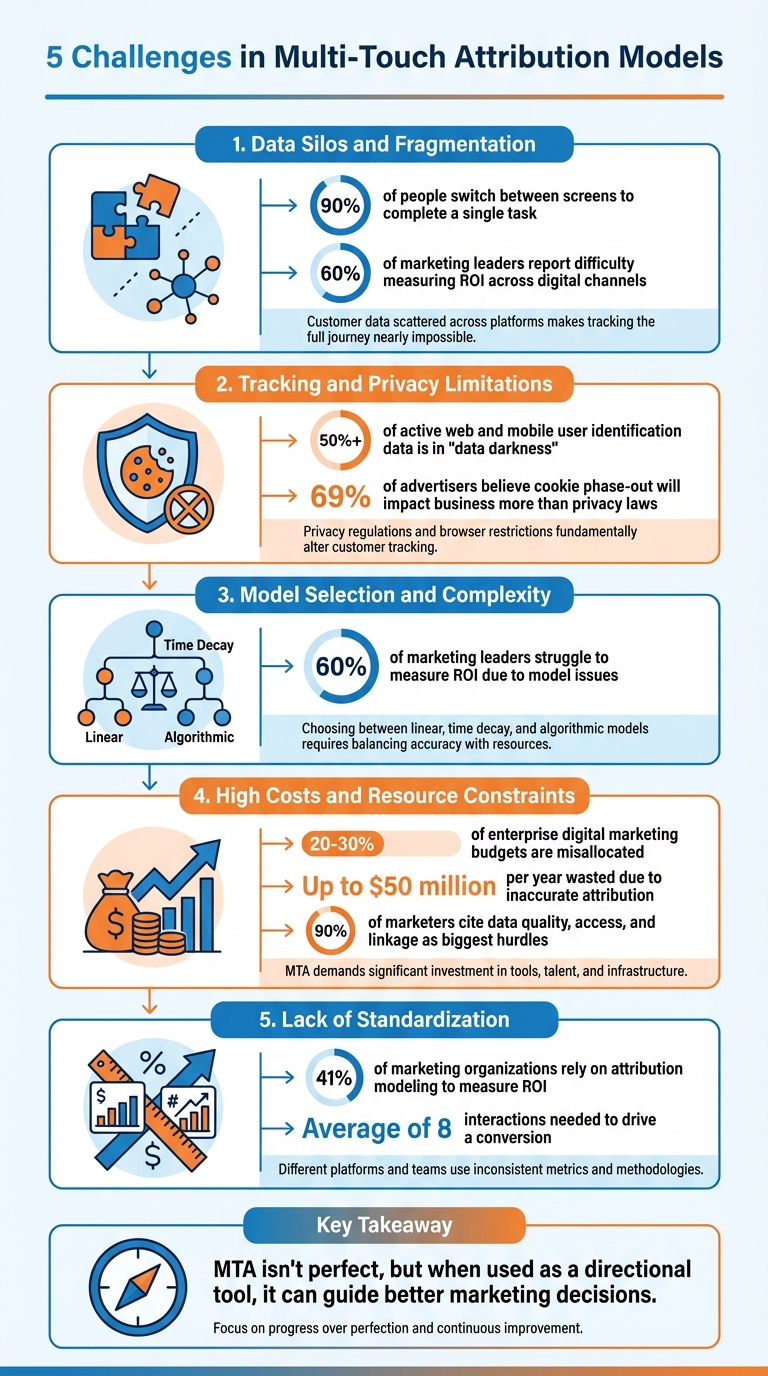
5 Key Challenges in Multi-Touch Attribution Models for Marketers
Digital Marketing Attribution in 2025: Challenges and Solutions
1. Data Silos and Fragmentation
When data is scattered across tools like CRM systems, web analytics, ad platforms, and offline systems, it becomes nearly impossible to get a full picture of the customer journey. As Jamie-Isabel from MetricMaven explains:
"When your data is all over the place, it’s especially challenging… even the most innovative attribution model ends up sitting atop incomplete or conflicting data".
The problem grows worse with disconnected identity signals. Imagine this: a customer clicks on a LinkedIn ad at work, researches the product on their phone during lunch, and finally makes the purchase on their home laptop. Without integrated data, these interactions look like three unrelated journeys. This isn’t a rare occurrence – 90% of people who own multiple devices switch between screens to complete a single task.
Adding to the complexity are "walled gardens" like Meta, Google, and Amazon. These platforms limit data sharing, making it easy for each to claim full credit for a single conversion. Essentially, one conversion can be attributed 100% to multiple platforms. Unsurprisingly, nearly 60% of marketing leaders report difficulty measuring ROI across digital channels because of these fragmented paths.
This lack of unified data also leaves some channels completely unaccounted for. Offline interactions, like phone calls or in-store visits, often go unnoticed, making digital channels look more impactful than they really are. These blind spots lead to inaccurate attribution and, ultimately, flawed marketing strategies.
So, how can businesses fix this? Start by centralizing data in a unified storage system like Snowflake, BigQuery, or Redshift. Implement identity resolution using login-based IDs and hashed signals to connect customer interactions across devices. Standardize UTM parameters to avoid unnecessary fragmentation. By addressing these silos, companies can achieve more accurate attribution and develop smarter marketing strategies. This foundational step also helps in tackling other challenges like tracking limitations and the growing complexity of attribution models.
2. Tracking and Privacy Limitations
Centralizing data is just one part of the equation – gathering that data has become a challenge in itself. With stricter privacy regulations and browser restrictions, the way marketers track customer journeys has been fundamentally altered. These changes have led to a decline in the effectiveness of traditional tracking tools.
One major shift is the disappearance of third-party cookies, which have long been a cornerstone of cross-site tracking. Now, browsers like Safari, Firefox, and Edge block these cookies by default. Safari, for instance, uses Intelligent Tracking Prevention to delete cookies within seven days, meaning conversions beyond that window often lose attribution. While Google initially planned to phase out third-party cookies in Chrome, the company adjusted its approach in July 2024, allowing users to decide on their tracking preferences. This is significant given Chrome‘s dominance, with over 60% of the browser market.
These restrictions have plunged more than 50% of active web and mobile user identification data into what’s being called "data darkness". Apple’s iOS 17 has added another layer of complexity with its Link Tracking Protection, which removes tracking parameters from URLs, making it harder for ad networks to track users across sites. As attribution expert Ram Prabhakar explains:
"For Attribution models to be effective, they need for users to be uniquely identified [and] for user interaction to be tracked across cross-site, cross-platform, and cross-device touchpoints".
Adding to the challenge, regulations like GDPR and CCPA have pushed media agencies to scale back on data collection. Interestingly, 69% of advertisers believe that the phase-out of third-party cookies will have a greater impact on their business than these privacy laws. Eddie Drake, SVP of Marketing Data Strategy at Bank of America, sums it up:
"With data deprecation and constant change on the privacy horizon, MTA will not survive in its traditional form".
So, how can businesses navigate this new landscape? The answer lies in embracing alternative tracking methods, especially by focusing on first-party data. This includes data collected directly from customers through email sign-ups, account logins, and website interactions. Shifting to first-party data and server-side tracking offers a way to fill the gaps caused by privacy restrictions. Server-side tracking, for example, can deliver over 95% data accuracy compared to the 60%-70% typical of browser-based methods.
Some companies are already seeing success with this approach. Windstar Cruises implemented a closed-loop measurement system that ties digital impressions directly to verified bookings. The result? Over 6,500 bookings, $20 million in revenue, and a return on ad spend of 13:1. In today’s privacy-conscious world, building direct relationships with customers is no longer optional – it’s essential.
3. Model Selection and Complexity
After gathering your data, the next challenge lies in selecting the right multi-touch attribution model. Each model has its strengths and weaknesses. For instance, linear attribution splits credit equally across all touchpoints. While straightforward, this approach may overemphasize less impactful interactions. On the other hand, time decay models give more credit to touchpoints closer to the conversion, making them ideal for short campaigns. However, they often undervalue earlier interactions that build awareness at the top of the funnel. The most advanced option, algorithmic (or data-driven) models, leverages machine learning to calculate the true incremental value of each touchpoint. While highly accurate, they demand extensive data and technical investment. Choosing the right model means balancing precision with practical constraints.
Striking this balance is crucial. As Marcus Akerland, Former Senior Digital Marketing Manager at Amplitude, explains:
"Algorithmic models… incur higher investment in terms of time, money, and data collection. So if your company is restricted in data science capabilities… you’re better off with rules-based models."
For businesses with limited resources or expertise in data science, rules-based models are often the better choice. This is especially relevant given that 60% of marketing leaders struggle to measure ROI across digital channels, often because their models are either too basic or overly complex.
The model you choose also impacts how you allocate your budget. Linear models are great for brand-building efforts, time decay models focus on bottom-of-funnel actions, and algorithmic models maximize ROI – provided your data pipelines are unified and reliable. As The Pedowitz Group points out:
"No model is perfectly accurate. The goal is a useful simplification of reality, not a perfect reflection of every touch".
To navigate these challenges effectively, consider a "crawl-walk-run" approach. Start with simpler, transparent rules-based models, like W-shaped attribution, and only move to algorithmic models when you have enough data and organizational trust. Clearly define your model’s goals – whether it’s optimizing your channel mix or fine-tuning campaign spending – to avoid unnecessary complexity. Treat the model’s output as a guide, and validate its insights with controlled experiments.
Before diving into complex models, ensure your data is centralized and accurate. Audit your data for issues like missing UTM parameters or weak identity resolution strategies, as these can lead to flawed conclusions. A common mistake is focusing too much on fractional credit instead of evaluating the overall quality of your audience and messaging. Ultimately, the best model aligns with your organization’s data maturity, sales cycle, and decision-making needs.
4. High Costs and Resource Constraints
Implementing multi-touch attribution isn’t just technically challenging – it’s also a significant drain on financial and human resources. To make it work, you’ll need a team skilled in data science, marketing technology, and analytics, along with a solid infrastructure. This includes tools like CDPs (Customer Data Platforms), unified analytics software, and systems that consolidate data from CRMs, ad platforms, and web analytics. These tools don’t come cheap, and deploying them can take weeks (usually three to four). Plus, there’s ongoing upkeep like model validation, data reconciliation, and ensuring privacy compliance. All of this builds on earlier efforts to break down data silos and address tracking limitations.
Here’s a startling stat: 20-30% of enterprise digital marketing budgets are misallocated, which can amount to as much as $50 million per year. Why? Outdated or inaccurate attribution models are often to blame. And it’s not just a small issue – 90% of marketers point to data quality, access, and linkage as their biggest hurdles. Bill Macaitis, former CMO at Slack and Zendesk, sums it up perfectly:
"Good multi-touch attribution is expensive and hard to implement. It can struggle with offline vs online, mobile vs desktop, and impressions vs clicks".
Strategies to Manage Costs
To ease the financial burden, start small. Test the model on a single campaign or brand to uncover data gaps and technical challenges before rolling it out across the board. Brad Feinberg, North American VP of Media and Consumer Engagement at Molson Coors, suggests:
"For companies that have multiple brands in their portfolio… it’s vitally important to roll out MTA slowly. Prioritize which brands can benefit the most from MTA first, analyze the results then apply the learnings to other brands as needed".
Another way to cut costs? Don’t default to real-time processing unless absolutely necessary. Real-time attribution is pricey and only crucial for tasks like automated bidding or intra-day optimizations. For most strategic planning and reporting, batch processing (daily or even hourly) is more than enough – and far more budget-friendly.
If your team lacks in-house expertise, consider outsourcing specialized talent. Partnering with external marketing analytics experts can help you build a robust attribution framework without the long-term expense of hiring full-time staff.
Centralizing Data: A Key First Step
Setting up a strong attribution model starts with centralizing your data. Michael Schoen, SVP and GM at Neustar Marketing Solutions, stresses:
"Getting your data house in order now is the critical first step to establishing a mature and effective marketing analytics practice".
By consolidating CRM, website, and ad platform data into a unified source – using tools like Snowflake, BigQuery, or Redshift – you make your attribution process reproducible and easier to audit. Standardizing UTM parameters and form fields across all channels also helps. Fixing data quality issues at the source is far more cost-effective than cleaning up messy data later.
Once you’ve tackled the financial and resource challenges, the next hurdle is creating industry-wide consistency in measurement and standardization.
5. Lack of Standardization and Measurement Issues
Even with centralized data, the world of multi-touch attribution (MTA) struggles with a major hurdle: there’s no universal playbook. Vendors use different methods, which means reports can vary wildly across platforms. Sumair Seth from Ipsos MMA highlights this challenge:
"The current MTA landscape lacks standardization, as different vendors and platforms employ different methodologies and definitions".
This inconsistency isn’t just external – it’s internal too. A whopping 41% of marketing organizations rely on attribution modeling to measure ROI. But when campaigns are evaluated using different benchmarks, it’s like comparing apples to oranges.
The issue gets messier when you consider the conflicting metrics within organizations. Different teams prioritize different goals: the paid search team tracks clicks, the demand generation team focuses on installs, and the CMO cares about revenue. Sally Wills, Senior Content Strategy Manager at Braze, points out:
"Attribution reports end up reflecting organizational structure as much as customer behavior".
When each team defines success differently, attribution models often reveal more about internal silos than actual customer behavior. Just as data silos obscure the customer journey, mismatched metrics distort the bigger picture.
On top of that, many attribution models rely on arbitrary rules. Take the U-shaped model, for example – it assigns 40% credit to the first and last touchpoints and splits the remaining 20% among everything in between. These fixed allocations (like 40-10-10-40) lack any real causal justification. Clay Cohen, VP of Marketing at Measured®, sums it up well:
"Each model has its own assumptions and limitations, and marketers may struggle to determine which one best reflects their desired customer journeys".
To navigate this maze, start with a unified data foundation and define KPIs that reflect your actual business objectives – not just vanity metrics tied to specific channels. Bring together your marketing, sales, finance, and IT teams to agree on what terms like "conversion", "lead", and "opportunity" mean for your organization. Create a data dictionary to document these standards and establish clear rules for weighting touchpoints. Use dashboard ranges and scenario views to focus on trends rather than rigid numbers. And keep in mind: it takes an average of 8 interactions to drive a conversion. Your framework should embrace this complexity while staying aligned with your core business goals.
Conclusion
Multi-touch attribution offers the promise of clarity, but it comes with its own set of hurdles – data silos, privacy restrictions, complex models, limited resources, and inconsistent measurements. These issues can muddy the waters, making it harder to gain confidence in the results. Challenges like fragmented identity resolution and untracked offline interactions distort the perceived impact of digital channels, often leading to underfunded relationship-building efforts. Meanwhile, the standard 30–90 day lookback windows tend to ignore the importance of long-term brand-building, pushing investments toward short-term, bottom-funnel tactics. When financial bookings don’t align with attribution totals, Finance teams may dismiss marketing reports altogether, complicating or delaying budget approvals.
The stakes are high: nearly half of brands could face cuts to their paid search budgets due to multi-touch attribution’s focus on the bottom of the funnel. Adding to the complexity, 73% of consumers using incognito modes further erode data accuracy. Jason McNellis from Analytic Partners highlights the shifting landscape:
"MTA’s legacy, in five years, will be as a catalyst, accelerating the development of more granular and faster Marketing Mix Models (MMM)".
Understanding these challenges is just the beginning. The goal isn’t to find a flawless model – it’s about using multi-touch attribution as a directional tool rather than an absolute answer. Combining attribution insights with methods like holdout tests and geo-experiments can help validate actual performance impact. Before diving into complex model adjustments, focus on strengthening your data foundation by standardizing UTMs, account IDs, and campaign structures. Address internal discrepancies by working closely with Finance to align on revenue definitions and conducting regular reconciliations to ensure trust in your insights at the executive level.
To navigate these complexities, expert assistance can make all the difference. Growth-onomics supports businesses by providing specialized guidance in Data Analytics and Customer Journey Mapping. Their approach includes centralizing fragmented data into a single warehouse, implementing privacy-compliant server-side tracking, and tailoring models to fit your unique sales cycle. With the right expertise, multi-touch attribution shifts from being a technical challenge to a strategic advantage. By treating it as a directional guide, it becomes a valuable tool for revenue planning.
Ultimately, technology alone won’t solve these issues. Success depends on clean, reliable data, aligned teams, and a realistic understanding of what attribution can – and cannot – reveal about your customer journey.
FAQs
What’s the best way to centralize customer data from multiple sources?
To bring all customer data together in one place, businesses need to focus on breaking down data silos and merging them into a single system. This means setting up a centralized data infrastructure – like a data warehouse or unified platform – that pulls in information from various sources, including CRM systems, web analytics, and even offline channels.
Another key step is using identity resolution techniques. By assigning persistent customer IDs that work across devices and platforms, businesses can connect scattered data points into a cohesive profile. This approach ensures accurate, high-quality data, which is essential for better marketing attribution and deeper customer insights. When silos are eliminated, teams can make smarter, data-driven decisions, leading to improved marketing results and a smoother customer experience.
What are some privacy-friendly alternatives to traditional tracking methods in multi-touch attribution?
As privacy regulations become stricter and third-party cookies fade into the past, businesses are turning to privacy-conscious alternatives for multi-touch attribution. These methods aim to respect user privacy while still delivering valuable insights for marketing strategies.
One popular option is leveraging aggregated and anonymized data. Instead of depending on personal identifiers like cookies or device IDs, this approach provides a way to analyze marketing performance broadly without compromising individual privacy. It’s a win-win for compliance with privacy laws and understanding campaign results.
Another method gaining traction is contextual tracking. Rather than following individual users, this technique focuses on analyzing the context – such as the type of content or environment – where interactions take place. It shifts the focus from "who" to "where", offering insights without invasive tracking.
Some businesses are also embracing unified measurement strategies. By blending offline data with aggregated digital signals, companies can get a fuller picture of marketing effectiveness without relying on intrusive tracking methods.
These privacy-friendly approaches allow marketers to align with evolving standards while continuing to refine and enhance their campaigns.
What’s the best way to choose the right multi-touch attribution model for your business?
Choosing the right multi-touch attribution (MTA) model boils down to your business goals, the complexity of your customer journey, and the quality of your data. For quick insights, simpler models like last-touch attribution might work, but they tend to overvalue the final interaction. If you’re looking for a deeper understanding, more advanced models – like those powered by machine learning or probabilistic methods – can reveal how various touchpoints contribute to conversions.
Before making a decision, take a close look at your data infrastructure and tracking systems. If your data is incomplete or biased, the results will likely be unreliable. That’s why it’s essential to view MTA outputs as directional guidance rather than definitive answers. The process often requires testing and refining to find a model that aligns with your goals and delivers actionable insights into your customer journey.