


Keeping your best customers is far cheaper than finding new ones. Retaining a customer costs 5–25 times less than acquiring one, and boosting retention by just 5% can increase profits by 25–95%. For high-value customers, the stakes are even higher – losing one can cost as much as losing several smaller accounts. To protect your revenue, focus on these seven key metrics:
- Customer Lifetime Value (CLV): Measures the total revenue a customer generates over their relationship with your business.
- Customer Retention Rate (CRR): Tracks the percentage of customers who stay with you over time.
- Repeat Purchase Rate (RPR): Shows how often customers return to buy again.
- Customer Churn Rate: Identifies the percentage of customers lost within a specific period.
- Net Promoter Score (NPS): Assesses customer loyalty and likelihood to recommend your product.
- Revenue Retention Rate (Gross & Net): Tracks how much revenue you retain and grow from existing customers.
- Customer Satisfaction Score (CSAT): Gauges how satisfied customers are with specific interactions or services.
Each metric offers unique insights into customer behavior and retention risks. Tracking these metrics helps you identify issues early, prioritize high-value clients, and refine strategies to maximize long-term revenue.
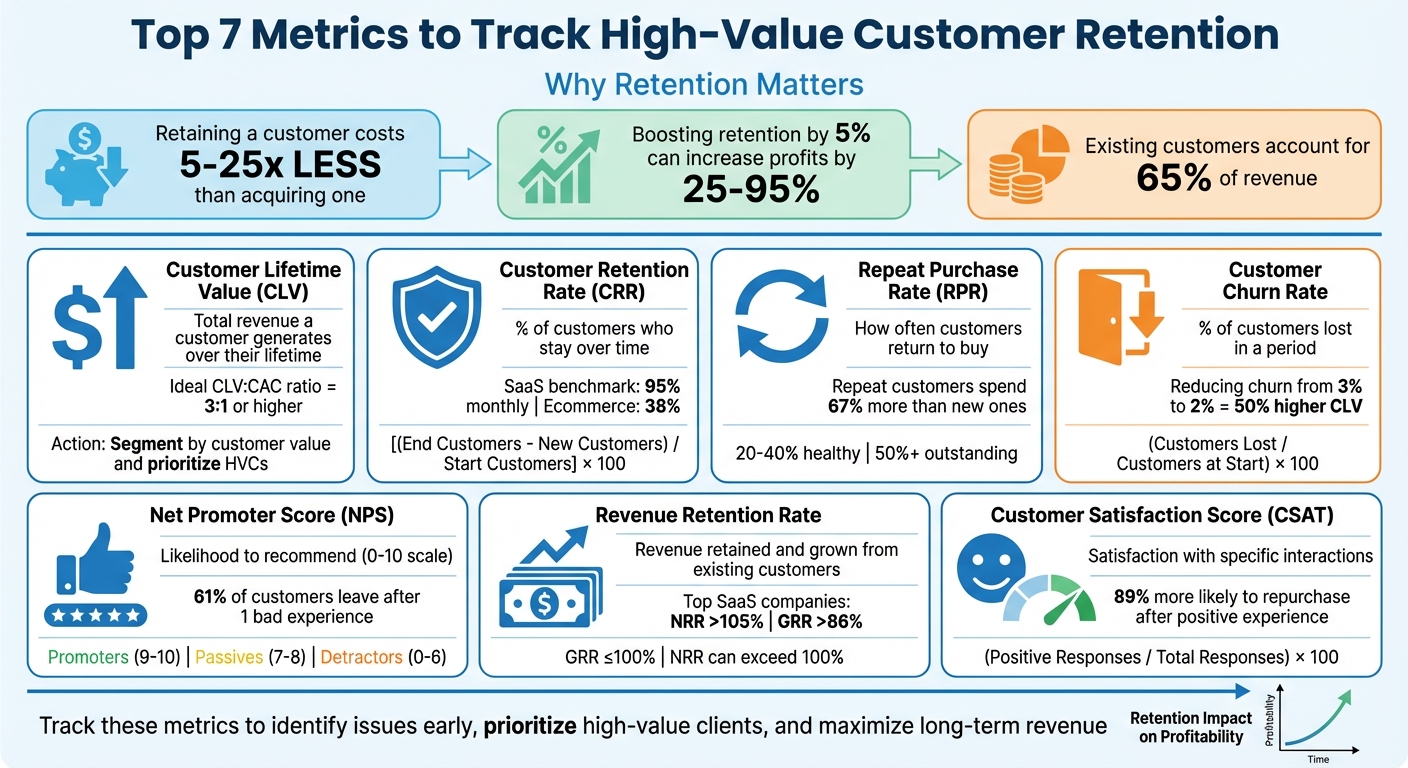
7 Essential Customer Retention Metrics for High-Value Customers
How to Tackle Your Retention Problem | SaaS Metrics School | Retention
1. Customer Lifetime Value (CLV)
Customer Lifetime Value (CLV) represents the total revenue a business can expect to earn from a single customer throughout their relationship with the company. This metric is crucial for predicting long-term profitability and deciding where to focus retention efforts. Let’s break down how to calculate CLV and use it to zero in on your most valuable customer segments.
How to Measure CLV Quantitatively
To calculate CLV, start with four key data points:
- Average Purchase Value: Divide total revenue by the number of purchases.
- Average Purchase Frequency Rate: Divide the number of purchases by the number of unique customers.
Multiply these two figures to determine Customer Value. Then, multiply Customer Value by the Average Customer Lifespan (in years).
Finally, subtract your Customer Acquisition Cost (CAC) and operational expenses from the revenue figure. A strong CLV to CAC ratio is typically 3:1 or higher, meaning each customer generates three times the cost of acquiring them.
Application to High-Value Customer Segments
Avoid relying on a single, company-wide CLV metric. High-value customers – those who spend more, buy more often, and stay loyal longer – naturally have a much higher CLV. Calculate CLV separately for these top-tier customers and tag them as "HVC" (High-Value Customers) in your CRM. This lets your team prioritize their needs, ensuring they receive personalized attention and proactive support to prevent churn.
"Acquiring a new customer costs 5 to 25 times more than keeping an existing one. So, CLV is the key to long-term revenue growth and lower churn." – Ashley Valadez, Customer Success Leader, HubSpot
How to Use CLV to Improve Retention Strategies
CLV can act as an early warning system for retention issues. If you notice a decline in CLV due to shorter customer lifespans, focus on improving onboarding processes. If the drop is tied to lower purchase values, consider launching upselling and cross-selling campaigns. For subscription-based businesses, encourage annual billing over monthly plans to extend customer lifespans and boost cash flow.
Take cues from your highest CLV segments. Analyze their customer journey, pinpoint what keeps them engaged, and apply those strategies to other groups. By using CLV as a guide, you can refine retention efforts and maximize long-term revenue.
2. Customer Retention Rate (CRR)
Customer Retention Rate (CRR) shows the percentage of customers who stick with your product or service over a set time frame. While metrics like Customer Lifetime Value (CLV) focus on revenue potential, CRR directly reflects how well your product fits the market and how satisfied your customers are.
How to Measure Customer Retention
To calculate CRR, follow this formula: subtract the number of new customers gained during the period from the total customers at the end of the period, divide that by the number of customers at the start, and multiply by 100. Here’s an example: if you start January with 500 customers, gain 100 new ones, and end the month with 550, your CRR would be ((550 – 100) / 500) × 100 = 90%. This method focuses on loyalty, separating it from growth through new customer acquisition.
CRR benchmarks differ depending on the industry. SaaS companies often aim for a monthly retention rate of 95%, while ecommerce businesses typically see around 38%. It’s especially important to track CRR for high-value customer segments separately. Why? A steady overall CRR can hide major revenue losses if a high-value client is replaced by several lower-value ones.
Impact on Revenue and Profitability
CRR isn’t just a number – it’s a key driver of profitability. On average, existing customers account for about 65% of a company’s revenue. Selling to an existing customer has a success rate of 60–70%, compared to just 5–20% for new prospects. Even a small improvement in retention – just 5% – can lead to a profit increase of 25% to 95% .
"A 5 percent increase in customer retention yields – at a minimum – a 25 percent increase in profit."
- Bain & Company
Focusing on High-Value Customers
CRR averages can sometimes be misleading, particularly when high-value customers are involved. Losing a single high-value client and replacing them with several lower-value ones might not affect the overall CRR much, but it can significantly hurt revenue. To avoid this, analyze CRR by customer value. High-value customers often expect more, and 61% of them will leave for a competitor after just one bad experience.
Segmenting customers by value, industry, or acquisition channel can help you identify which groups are most loyal and which are at risk. If retention dips in a high-value segment, dig into exit surveys, support logs, or customer interviews to uncover the root cause. Proactively addressing these issues can prevent further losses.
Using CRR to Strengthen Retention Strategies
Measuring CRR by customer cohorts, rather than as a single company-wide figure, is a great starting point. By grouping customers based on factors like contract size or acquisition source, you can pinpoint which segments are thriving and which need attention. If a high-value segment shows a decline in CRR, it’s time to act. Review feedback, identify pain points, and intervene before renewal periods.
"If you have a good retention rate, then you don’t have to work as hard to acquire customers over and over again."
- Veronica Saha, Head of Analytics, Zoopla
Use CRR insights to highlight features that high-value customers appreciate and promote them to at-risk groups. For these high-value clients, consider loyalty programs offering perks like dedicated support or early access to new features. These benefits can shorten the time it takes for them to see value and reinforce their decision to stick with your product .
3. Repeat Purchase Rate (RPR)
How to Measure Repeat Purchase Rate
The Repeat Purchase Rate (RPR) is calculated using the formula:
(returning customers ÷ total customers) × 100.
For example, if 280 out of 1,000 customers in December made another purchase, the RPR would be 28%.
Unlike the Customer Retention Rate, which typically focuses on a specific group of existing customers and excludes new ones, RPR includes all customers. This provides a broader view of how well a business turns first-time buyers into repeat customers. For most ecommerce businesses, a healthy RPR typically ranges between 20% and 40%, while an RPR above 50% is considered outstanding. This metric is crucial because it directly impacts both revenue and profitability.
Effect on Revenue and Profitability
RPR plays a significant role in driving revenue. On average, repeat customers spend 67% more than new ones. In the ecommerce space, a small group of loyal customers can account for a large portion of revenue – 8% of customers can generate 41% of revenue, and the top 5% of repeat buyers can contribute 35%.
Additionally, acquiring new customers is estimated to be 5 to 25 times more expensive than retaining existing ones. Fred Reichheld, the creator of the Net Promoter Score, highlighted this in his statement:
"Increasing customer retention by as little as 5% can increase profits by 25% or more".
This underscores the importance of RPR as a metric. It provides insight into whether the business is successfully retaining high-value customers, ensuring the initial investment in acquiring them pays off.
Application to High-Value Customer Segments
For high-value customer groups, a strong RPR signals loyalty and potential for long-term revenue. RPR is closely tied to Customer Lifetime Value (CLV). By segmenting RPR data based on acquisition channels or product categories, businesses can identify their most loyal and profitable customer segments. This helps refine buyer personas and focus acquisition efforts on attracting similar high-value customers.
Regularly monitoring RPR within these key segments is essential. A drop in repeat purchases among high-value customers can act as an early warning sign of potential issues, even before overall revenue is affected. If specific products have low repeat purchase rates, it may point to problems with product quality or customer satisfaction that need to be addressed.
Using RPR to Improve Retention Strategies
To make the most of repeat purchase trends, combine RPR with other metrics like "Time Between Purchases." This can help businesses time automated re-engagement emails to reach customers just before they’re likely to buy again, boosting marketing efficiency. For high-value customers with strong RPR, strategies like exclusive offers, loyalty programs, or personalized product recommendations can further increase purchase frequency.
Analyzing RPR by acquisition channel can also reveal which channels bring in customers with higher long-term loyalty. This data can inform strategies for cross-selling and upselling, helping businesses maximize the value of repeat customers.
4. Customer Churn Rate
How to Measure Customer Churn Rate
Customer churn rate reflects the percentage of customers who stop doing business with your company within a specific period. To calculate it, use the formula: (Customers Lost ÷ Customers at Start) × 100.
But not all customers are equal. Losing a large enterprise client carries far more weight than losing a smaller account. To get a clearer picture, businesses should calculate churn for different customer tiers or segments. For high-value customers, Revenue Churn Rate is key. This metric tracks the percentage of Monthly Recurring Revenue (MRR) lost, giving a better sense of the financial impact when a major account churns.
Some companies take it a step further by using AI to predict retention risks for high-value accounts. By analyzing patterns like fewer logins, more support tickets, or negative feedback, businesses can identify accounts that may be on the verge of leaving.
Effect on Revenue and Profitability
Customer churn directly impacts revenue, especially when it involves high-value accounts. The loss goes beyond the current revenue – it also includes any future upsell or expansion opportunities. As one Customer Success Lead at Scribe put it:
"Churn is the ultimate indicator of a failure to retain customers. The impact of a customer churning is not just the loss of current revenue, but also all of their potential expansion revenue."
On average, retained customers spend 67% more than new ones. If a customer leaves before you’ve recovered their Customer Acquisition Cost (CAC), the loss becomes even more painful.
Even small reductions in churn can have a big payoff. For instance, cutting monthly churn from 3% to 2% can boost customer lifetime value by 50%. Similarly, increasing customer retention by just 5% can lead to a 25% to 95% jump in profits. That’s why top-performing B2B SaaS companies prioritize protecting their most valuable accounts, often achieving 10%–30% lower churn rates.
Application to High-Value Customer Segments
For high-value customers, a one-size-fits-all approach to churn tracking doesn’t work. Instead, segmenting churn by customer value, subscription tier, or plan type helps pinpoint the true financial impact. Revenue churn becomes especially important here – it highlights whether your most profitable customers are leaving while lower-value users stay.
Pay attention to warning signs. For example, a 20% month-over-month drop in product usage often signals that a high-value account is at risk of churning. Revenue churn from actions like plan downgrades can also be an early indicator of deeper dissatisfaction. Tracking metrics like "Expansion MRR" and "Contraction MRR" can help identify accounts that are scaling back before they churn completely.
It’s also essential to distinguish between voluntary churn (caused by dissatisfaction) and involuntary churn (due to failed payments). Each type requires a different approach.
Using Churn Rate to Improve Retention Strategies
Engagement scores are a powerful tool for identifying high-value accounts at risk of leaving. When these accounts show signs of trouble, escalate the situation. A VP-level check-in can often help rebuild the relationship.
For at-risk high-value customers, consider proactive measures like offering free upgrades, loyalty perks, or extended trials. These strategies can re-establish value without resorting to price cuts. During onboarding, provide tailored tutorials and direct support to ensure these customers quickly see the benefits of your product – early churn often stems from poor onboarding.
Exit surveys with churned high-value customers can uncover underlying issues, whether it’s pricing, product fit, or service quality. As the Senior Vice President of Customer Experience at Extend remarked:
"Customer experience is our North Star, and we focus on reducing friction and making it easy for our customers."
sbb-itb-2ec70df
5. Net Promoter Score (NPS)
How to Measure Net Promoter Score
Net Promoter Score (NPS) is a simple yet powerful way to measure customer loyalty. It’s based on a single question: "How likely are you to recommend our product on a scale of 0–10?" Here’s how the responses break down:
- Promoters (9–10): Loyal enthusiasts who fuel growth through referrals.
- Passives (7–8): Satisfied but unenthusiastic customers who are vulnerable to competitors.
- Detractors (0–6): Unhappy customers who can harm your brand through negative word-of-mouth.
To calculate NPS, subtract the percentage of Detractors from the percentage of Promoters. The score ranges from –100 to +100. Any score above 0 is generally considered a positive indicator. Companies often pair this question with a follow-up to uncover the reasons behind customer ratings. This simple metric not only measures loyalty but also provides a foundation for assessing its impact on revenue.
Effect on Revenue and Profitability
NPS offers an early glimpse into customer retention trends. A drop in NPS can signal increasing churn risks before they show up in revenue reports. As Rami El-Abidin from HubSpot explains:
"NPS is one of the strongest early warning signs of retention health. It helps teams uncover the specific drivers behind churn and identify opportunities to improve the customer journey."
Promoters, especially those with high customer lifetime value, are more likely to embrace new features, make additional purchases, and refer others – boosting revenue growth.
Application to High-Value Customer Segments
Taking NPS analysis a step further, segmenting the data by customer value can highlight high-value Detractors who need immediate attention. This approach helps prevent significant revenue loss. Just like Customer Lifetime Value (CLV) and Customer Retention Rate (CRR), analyzing NPS by segment pinpoints retention risks among your most important clients. This is critical when you consider that 61% of customers are willing to switch to a competitor after just one bad experience.
Monitoring NPS at critical touchpoints – such as post-onboarding or after customer support interactions – can reveal friction points in the customer journey. For top-tier customers, these insights are invaluable, helping you determine whether they’re satisfied or at risk.
Using Net Promoter Score to Improve Retention Strategies
Addressing the pain points of high-value Detractors should be a top priority to minimize churn. A low NPS score can act as a signal for customer success teams to step in with proactive support. Additionally, keeping customers informed about changes based on their feedback builds trust and strengthens loyalty. On the flip side, recognizing high-value Promoters with perks like VIP events, early access to new features, or referral rewards can deepen their connection to your brand.
6. Revenue Retention Rate (Gross & Net)
How to Measure Revenue Retention
Revenue retention metrics tell you whether you’re keeping and growing revenue from your existing customers. Gross Revenue Retention (GRR) measures the percentage of recurring revenue you retain from current customers – excluding any expansion revenue. This metric focuses purely on maintaining the original contract value. On the other hand, Net Revenue Retention (NRR) factors in upsells, cross-sells, and expansion revenue, while subtracting losses from churn and downgrades.
Here’s an important distinction: GRR cannot exceed 100%, but NRR can go over 100% when expansion revenue is included. The formulas are simple:
- GRR = [(Starting MRR – Churn – Contractions) ÷ Starting MRR] × 100
- NRR = [(Starting MRR + Expansions + Upsells – Churn – Contractions) ÷ Starting MRR] × 100.
Now let’s explore how these metrics influence overall revenue and profitability.
Effect on Revenue and Profitability
Revenue retention has a direct impact on profitability. For instance, increasing revenue retention by just 1% can raise a SaaS company’s valuation by 12% over five years. Top-tier SaaS companies with $15–30 million in ARR often report NRR above 105%, while maintaining GRR levels higher than 86%.
Phil Bryant from SKOUT Cybersecurity underscores the importance of NRR:
"While I look at several customer retention metrics including gross revenue churn, logo churn, and subscription renewal rates, if I had to pick only one metric it would be net revenue retention. It immediately tells me if our overall customer base is healthy."
High expansion revenue can sometimes mask churn, which is why tracking both GRR and NRR provides a balanced view of customer health.
Application to High-Value Customer Segments
Revenue retention metrics become even more critical when analyzing high-value customer segments. These metrics weigh customers based on their financial contribution, offering insights that logo retention rates might miss. For example, losing a single enterprise contract could heavily impact revenue, even if the overall logo retention rate looks strong. Breaking down metrics like MRR and churn by customer value helps identify which high-value groups have the greatest effect on your revenue. In fact, in 2022, nearly 70% of Customer Success teams that reported growth maintained an NRR of 111% or higher.
Using Revenue Retention to Improve Retention Strategies
Revenue retention metrics aren’t just for tracking – they’re tools to refine your retention strategies. Focus on high-value customer segments, as losses in these accounts can hit harder for companies with high NRR. Use real-time health scores, such as license utilization, feature usage, and customer engagement, to guide expansion efforts and reduce churn. Companies that implement advanced value-realization and adoption strategies typically achieve NRR rates about seven percentage points higher than those using basic methods.
Additionally, incentivize your Customer Success Managers with variable pay tied to identifying upsell and growth opportunities. Automating CRM notifications can also help your team act quickly when high-value accounts show warning signs, like no logins for 14 days or a sharp drop in engagement. By combining proactive monitoring with targeted retention efforts, you can strengthen your customer relationships and revenue streams.
7. Customer Satisfaction Score (CSAT)
Understanding customer satisfaction goes beyond just tracking revenue or behaviors. It offers a direct window into the customer experience, which is critical for retaining high-value clients.
How to Measure Customer Satisfaction Quantitatively
CSAT gauges how customers feel about a specific interaction, product, or service. The calculation is straightforward: divide the number of positive responses (ratings of 4 or 5 on a 5-point scale) by the total survey responses, then multiply by 100 to get a percentage . For instance, if 85 out of 100 high-value customers rate their onboarding as 4 or 5, your CSAT would be 85%.
Timing is everything when deploying surveys. Send them at key moments: after onboarding, following feature updates, or about six months before renewals . This allows you to address issues before they impact renewal decisions. Including open-ended questions can also uncover the reasons behind customer ratings.
Effect on Revenue and Profitability
High CSAT scores often lead to repeat business and stronger revenue streams. In fact, 89% of customers are more likely to buy again after a positive service experience. Companies that focus on customer experience see 41% greater revenue growth and 49% faster profit increases.
On the flip side, poor experiences can drive customers away. Over half (52%) of consumers have switched brands after just one bad experience, and 61% would leave after a single negative interaction. For high-value customers – those who contribute significantly through upgrades and expanded services – keeping CSAT scores between 75% and 85% (or above 90% for top-tier performance) is critical to safeguarding your most profitable revenue streams .
Application to High-Value Customer Segments
Analyzing CSAT scores by customer tier and revenue contribution helps pinpoint unique challenges faced by high-value accounts . For example, enterprise clients may have distinct pain points compared to mid-market customers. Since even one dissatisfied high-value client can significantly impact revenue, consider calculating separate CSAT scores for these groups.
| CSAT Rating | Risk Level | Action for High-Value Customers |
|---|---|---|
| 1–2 (Unsatisfied) | Critical/High Risk | Immediate personal outreach to resolve underlying issues |
| 3 (Neutral) | Passive | Send follow-up surveys to identify missing value drivers |
| 4–5 (Satisfied) | Loyal/Advocate | Monitor for consistency; invite to VIP programs or early feature access |
These insights enable targeted actions that directly improve retention.
Using CSAT to Improve Retention Strategies
Low CSAT scores from high-value customers require immediate attention. Personal outreach can help address concerns before they escalate. Use trends in CSAT data to guide product improvements or reassess recent changes. Pairing CSAT with behavioral analytics can also uncover whether low engagement with certain features is tied to declining satisfaction.
To encourage feedback, consider offering small rewards to high-value customers. Additionally, combine CSAT with other metrics like Net Promoter Score (for loyalty) and Customer Effort Score (for ease of use) to get a fuller picture of customer health . If patterns emerge, such as consistently low scores after support interactions, set up automated alerts to trigger proactive outreach. This approach can help you address issues before customers decide to leave.
Conclusion
Keeping track of these seven metrics isn’t just about numbers – it’s about protecting your most valuable customers. Metrics like Customer Lifetime Value (CLV) and Revenue Retention Rate highlight where profits are coming from, while Churn Rate and Retention Rate help you spot potential risks before they escalate.
Here’s a quick reminder of why this matters: Bringing in a new customer can cost anywhere from 5 to 25 times more than keeping an existing one. Plus, increasing retention by just 5% can drive profits up by at least 25%. And don’t forget, existing customers contribute a hefty 65% of revenue. Clearly, retention isn’t just a nice-to-have – it’s a growth engine.
The key is to move from firefighting to a proactive approach. Segment your customers into cohorts and value tiers, set up automated alerts to catch dips in engagement early, and focus on turning detractors into advocates. By doing this, you’re building a foundation for long-term success.
As Veronica Saha from Zoopla explains, “If you have a good retention rate, then you don’t have to work as hard to acquire customers repeatedly. Positive brand interactions create a flywheel”. Regularly monitoring these metrics can lead to smarter decisions and stronger customer relationships.
If pulling scattered data together or creating a retention strategy feels overwhelming, Growth-onomics can help. They specialize in Customer Journey Mapping and Data Analytics, turning insights into actionable strategies that drive growth.
FAQs
What’s the best way to calculate Customer Lifetime Value (CLV) for high-value customers?
To figure out Customer Lifetime Value (CLV) for your top-tier customers, it’s crucial to first grasp what it represents: the total revenue a customer is expected to generate over the course of their relationship with your business. This metric isn’t just a number – it’s a tool for identifying your most valuable customers and shaping strategies to keep them engaged while boosting their profitability.
CLV is typically calculated using three main factors: average purchase value, purchase frequency, and customer lifespan. By diving into historical data and analyzing these metrics, businesses can estimate CLV and figure out how much they should spend on acquiring and retaining these high-value customers. When you compare CLV to Customer Acquisition Costs (CAC), it gives you a clear picture of profitability and helps guide smarter marketing and investment decisions.
Getting accurate CLV numbers requires a data-driven approach. This means tracking customer behavior, purchase trends, and profit margins. With this information, businesses can craft targeted strategies to reduce churn, improve retention, and unlock more long-term revenue potential.
How can businesses retain high-value customers more effectively?
To keep your most valuable customers coming back, it’s all about tailoring your approach to fit their specific needs and preferences. Start by keeping an eye on key retention metrics like customer lifetime value (CLV), churn rate, and Net Promoter Score (NPS). These numbers help you pinpoint your top clients and better understand what drives their loyalty – or their departure.
Building strong relationships requires going beyond the basics. Focus on delivering outstanding customer service, addressing issues before they escalate, and offering perks like exclusive benefits or premium support. Loyalty programs, personalized messages, and regular check-ins can also go a long way in showing your customers they matter. When you make these strategies a priority, you create a sense of trust and connection that keeps high-value customers engaged and coming back for more.
What is Repeat Purchase Rate (RPR), and how does it impact profitability and customer loyalty?
Repeat Purchase Rate (RPR) tracks how frequently your customers come back to make more purchases. A higher RPR reflects strong customer trust, satisfaction, and engagement – key ingredients for building loyalty.
Focusing on repeat purchases can lead to increased revenue, lower customer acquisition costs, and stronger long-term relationships. Keeping an eye on RPR allows businesses to spot trends and refine retention strategies, which can have a big impact on overall profitability.