


The Meta Ads API (Conversions API) helps advertisers overcome the limitations of browser-based tracking, like ad blockers and cookie restrictions, by sending data directly from their servers to Meta. This ensures more accurate tracking of conversions, including offline events, and provides a clearer understanding of ad performance.
Here’s what you need to know:
- Direct Data Sharing: Bypasses browser issues to reliably track events.
- Improved Attribution Models: Tracks offline purchases, CRM data, and more for a complete picture.
- Better Ad Targeting: Creates detailed audience segments using accurate data.
- Boosted ROAS: Studies show up to a 94% increase in incremental ROAS.
Marketers can use the API alongside the Meta Pixel to capture more data, reduce errors, and allocate ad budgets effectively. By addressing attribution gaps, the Meta Ads API is a powerful tool for improving campaign results.
Improve your Meta Ads with Meta Conversions API

Attribution Challenges in Digital Marketing
Today’s marketers are grappling with fragmented measurement systems that make it incredibly difficult to pinpoint what’s truly driving conversions. On average, businesses rely on nearly four different measurement tools just to piece together campaign performance. This tangled web of data stems from a mix of tightening privacy regulations and disconnected platforms, creating a perfect storm for attribution headaches.
One major issue is the narrow focus of platform-specific attribution models. For example, Meta’s ecosystem often struggles to account for conversions influenced by external channels like Google Ads, email campaigns, or even offline interactions. These models typically lean on short attribution windows – like a 7-day click or 1-day view – which can misattribute success to the wrong channels. This is especially problematic when you consider that Gen Z shoppers are twice as likely to buy a product without ever clicking on an ad. Click-heavy models simply don’t capture the full story.
Then there’s the growing impact of ad blockers and tracking prevention technologies, which disrupt browser-based tracking. These tools often block the Meta Pixel, leading to significant gaps in attribution data. Without this data, marketers lose visibility into key user interactions.
Another thorny issue is the over-crediting of retargeting campaigns. These campaigns often take credit for conversions that would have happened organically. A study of 46 direct-to-consumer brands revealed that Meta’s standard 7-day click/1-day view attribution overstated incremental revenue by 21%. As Brenden Delarua, CMO & Co-Founder at Stella, puts it:
"Platform-reported ROAS doesn’t answer the most important question: How much of that revenue actually required paid media to happen?"
Adding to the complexity, data quality issues can severely hamper ad platforms’ performance. These platforms rely on enriched first-party data to fuel their machine learning algorithms. When fed low-quality or incomplete data, their ability to optimize ad delivery takes a hit. Consider the case of Pom Pom London: by leveraging Meta’s Robyn and Conversion Lift studies, they achieved a 57% better ROAS and a 94% increase in incremental ROAS. This highlights how traditional attribution methods can downplay campaign impact and obscure opportunities for improvement.
These challenges emphasize the importance of solutions like the Meta Ads API, which aims to tackle data quality and measurement issues, helping marketers bridge attribution gaps and make sense of their performance data.
How Meta Ads API Improves Attribution Accuracy

The Meta Ads API, officially called the Conversions API (CAPI), establishes a direct server-to-server connection between your systems and Meta. By bypassing the browser entirely, it sidesteps common issues like ad blockers, cookie restrictions, and browser crashes that can interfere with traditional tracking methods. This direct connection ensures conversion data flows seamlessly from your systems, avoiding limitations tied to browser-based tracking.
This approach is also incredibly reliable. Unlike the Meta Pixel, which can falter due to slow page loads, dropped connections, or tracking prevention, the API remains unaffected by these challenges. Meta even suggests using both the Pixel and the API in tandem – this "redundant setup" ensures that if one method misses an event, the other can capture it, helping you collect as much data as possible.
The API also extends tracking beyond what the Pixel can handle. It captures offline conversions like in-store purchases, phone call leads, CRM-recorded interactions, and post-purchase activities such as subscription renewals. This broader tracking capability paints a more complete picture of customer behavior, going far beyond simple click data.
Another key benefit is greater control over your data. With server-to-server transmission, you decide what information to send to Meta. For example, you can include extra details like customer lifetime value or product margins to enhance Meta’s data insights. Timing is crucial here – events sent in real time or within an hour are the most effective, while delays of more than two hours can significantly reduce their value. The API helps maintain this timeliness by sending data directly from your systems, avoiding delays caused by browser-based tracking.
Benefits of Accurate Attribution for Ad Performance
Accurate attribution, powered by the Meta Ads API, simplifies fragmented data and delivers a clearer picture of ad performance. By providing cleaner signals, it identifies which ads are driving results, leading to a higher return on ad spend and smarter budget allocation. This solid data foundation also sharpens audience segmentation, ensuring campaigns reach the right people.
Improved Ad Targeting and Lookalike Audiences
The Meta Ads API captures a wide range of customer data, including offline purchases, CRM updates, and cross-device behavior. This enables the creation of Custom and Lookalike Audiences based on actual conversions. For instance, you can target lookalike audiences modeled after customers who made in-store purchases or placed phone orders, helping you connect with people who share traits with your most valuable buyers. High EMQ scores further enhance Meta’s data matching capabilities, leading to better ad delivery and more precise targeting.
Detailed Reporting for Better Decision-Making
Accurate attribution goes beyond targeting – it also provides marketers with detailed insights to make smarter decisions. The Meta Ads API offers access to over 70 performance metrics, covering delivery, engagement, conversion, and video performance. This level of detail ensures you can track how campaigns perform and avoid common pitfalls like misallocating ad budgets due to missed signals from ad blockers or connectivity issues.
"Incrementality is everything. Incrementality reveals the true impact of your marketing, helping you invest in channels and tactics that actually drive results." – Alex Schultz, VP of Analytics and CMO, Meta
Optimizing Retargeting Campaigns
Effective retargeting relies on knowing exactly where users drop off in their journey. The Conversions API tracks specific actions, like "Initiate Checkout" or "Add to Cart", more reliably than browser-based methods. This allows you to create precise retargeting lists of warm leads who abandoned their purchase. By bypassing ad blockers and cookie restrictions, the API keeps these lists updated with high-intent users.
Take the example of Diptyque, a luxury brand that implemented the Meta Conversions API in 2026. By capturing more accurate signals and overcoming browser limitations, the brand saw a 67% increase in reported purchases. Additionally, accurate attribution prevents ad fatigue by excluding users who have already converted – whether online or offline – from seeing irrelevant retargeting ads. Brands using Meta CAPI typically report a 15-20% boost in campaign performance and ad efficiency.
sbb-itb-2ec70df
Case Studies and Research Findings
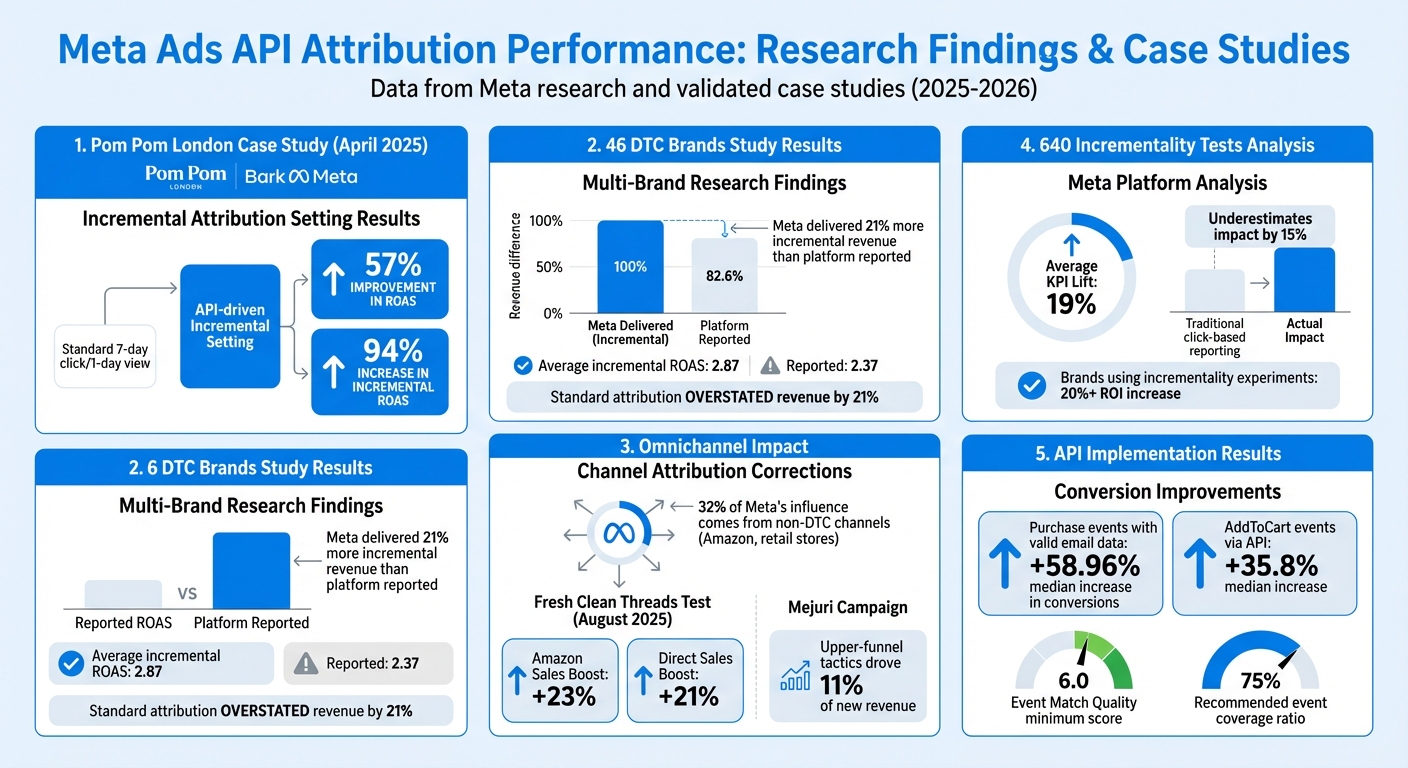
Meta Ads API Impact: Key Performance Metrics and Attribution Improvements
Real-world data continues to highlight the Meta Ads API’s measurable impact, especially when compared to traditional click-based attribution models. The following case studies and metrics provide a closer look at how the API has redefined performance tracking and improved campaign outcomes.
Case Study: Boosting ROAS with Enhanced Data Signals
In April 2025, global retailer Pom Pom London partnered with Bark and Meta to test the "Incremental Attribution" setting powered by the Meta Ads API. The study, led by Bark co-founder Daniel Watts and Pom Pom London co-founder Harry Griffiths, compared standard 7-day click/1-day view campaigns to those optimized with the API-driven incremental setting. Using advanced modeling validated by Conversion Lift studies, the test revealed a 57% improvement in ROAS and a 94% increase in incremental ROAS (iROAS).
"BARK’s research has revealed powerful insights about our campaign performance and provided a clear framework for making more informed decisions about digital ad spend allocation." – Harry Griffiths, Co-Founder, Pom Pom London
This success wasn’t an isolated case. Research spanning 46 direct-to-consumer brands found that Meta delivered 21% more incremental revenue than the platform itself reported, with an average incremental ROAS of 2.87 compared to a reported 2.37.
Beyond improving ROAS, the API also addresses attribution errors, shedding light on previously unseen performance metrics.
Metrics: Correcting Attribution Errors Across Channels
The Meta Ads API plays a pivotal role in reducing attribution errors across multiple channels. For instance, it helps correct over-attribution in retargeting campaigns, where ads often take credit for purchases that might have happened anyway, and under-attribution in prospecting campaigns, which are critical for acquiring new customers.
For omnichannel businesses, this correction is even more impactful. Approximately 32% of Meta’s influence stems from non-direct-to-consumer channels, such as Amazon and physical retail stores – sales that traditional attribution methods often overlook entirely.
In August 2025, Fresh Clean Threads conducted a Haus incrementality test to measure Meta’s impact on external sales channels. The results were striking: Meta ads boosted Amazon sales by 23% and direct sales by 21%, addressing prior under-attribution of social ad spend on marketplace performance. Similarly, jewelry brand Mejuri shifted its focus to upper-funnel tactics and used incrementality testing to confirm that these campaigns alone drove 11% of their new revenue during the test period. This highlighted how traditional last-click metrics undervalue non-conversion-optimized campaigns.
Meta’s internal analysis of 640 incrementality tests further supports these findings. On average, the platform drives a 19% lift in a brand’s primary KPI, yet traditional click-based reporting underestimates this impact by 15%. Brands that consistently implement incrementality experiments often experience ROI increases of 20% or more.
Best Practices for Implementing Meta Ads API
Ensuring Data Consistency
For accurate attribution, it’s crucial to rely on consistent and reliable data. To achieve this, run the Meta Pixel alongside the Conversions API (CAPI) to capture all events effectively. Use matching deduplication keys – such as event_id, event_name, or a combination of external_id with fbp – to ensure duplicates are avoided.
Meta advises sending events in real-time or within a two-hour window to maintain optimal performance. Aim for a 75% event coverage ratio, meaning at least three-quarters of the events tracked by your Pixel should also be captured by CAPI. Regularly updating fbp and fbc cookies is another key step to ensure accurate identity matching.
Once your data collection setup is consistent, it’s essential to monitor system performance and address any discrepancies as they arise.
Monitoring and Troubleshooting
The Events Manager is your primary tool for monitoring the health of your Meta Ads implementation. Within 20 minutes of setup, check the Overview tab to confirm that events are being received. Use the Event Deduplication tab to track metrics such as the "Rate of Events Deduplicated" and the "Rate of Deduplication Key Usage". These insights will help you determine if your Pixel and API events are syncing properly or if duplicates are being created.
Keep an eye on your Event Match Quality (EMQ) score and ensure it stays at a minimum of 6.0. A low EMQ score signals weak matching between your customer data and Meta accounts, which can drive up your cost per action. Before launching campaigns, test your setup using the Test Events Tool in Events Manager. This tool allows you to send test payloads to verify they’re received and deduplicated correctly without impacting actual reporting.
For businesses managing multiple pixels, the Dataset Quality API is a valuable tool for programmatically monitoring EMQ scores, event coverage, and data freshness at scale. Additionally, the Payload Helper tool can validate your JSON structure and suggest parameters to include for specific event types. By using these tools regularly, you can identify and resolve issues before they affect your campaign performance.
Using First-Party Data for Long-Term Success
Once data consistency and monitoring are in place, focus on leveraging high-quality first-party data to boost long-term ad performance. As browser restrictions and cookie limitations grow, robust first-party data provides a reliable foundation for accurate tracking.
Prioritize collecting key customer details such as email (em), phone (ph), first name (fn), and last name (ln). To protect privacy, hash all personally identifiable information using SHA-256. Assign a unique external_id to each customer in your CRM and include it in API payloads to maintain consistent identity matching across sessions.
You can further enhance campaign optimization by appending insights like product margins or historical customer values to each event. For the best results, ensure data sharing complies with all legal permissions and user consent requirements. Sending data in real-time – or within one hour – enables Meta’s algorithms to optimize ad delivery more effectively.
Conclusion
The Meta Ads API tackles the challenges of browser-based tracking by using server-to-server transmission, ensuring that every valid conversion is captured without the limitations of browser restrictions. This direct data connection provides a clearer understanding of customer behavior throughout the entire sales funnel. With this level of precision, campaigns can achieve measurable improvements in performance.
For example, a 2025 case study by Pom Pom London highlighted impressive results: implementing Incremental Attribution through the Meta Ads API led to a 57% increase in ROAS and a 94% boost in incremental ROAS.
Key features like Event Match Quality and proper deduplication play a crucial role in ensuring that conversions are accurately attributed to the right Meta users without duplication. Advertisers who sent valid email data for "Purchase" events via the API saw a median increase of 58.96% in additional conversions. Similarly, those using the API for "AddToCart" events experienced a median increase of 35.8%. These advancements allow for smarter budget allocation and more effective audience targeting.
Accurate attribution is the backbone of strategic decision-making. When your data mirrors real-world outcomes, Meta’s algorithms can fine-tune ad delivery, lowering acquisition costs and identifying audiences most likely to convert. As privacy regulations evolve, the Meta Ads API offers a dependable, privacy-compliant solution for maintaining the data quality essential to modern marketing. By combining precise data collection with optimized ad delivery, the Meta Ads API supports sustainable growth while respecting privacy requirements.
FAQs
How does the Meta Ads API enhance attribution accuracy?
The Meta Ads API improves attribution accuracy by using advanced machine learning and holdout testing methods. These tools help pinpoint and measure conversions influenced by ads, reducing the uncertainty that often comes with traditional attribution models.
Rather than relying on rigid attribution windows, the API offers a more detailed and accurate view of ad performance. This enables businesses to make better-informed decisions, fine-tune their campaigns, and gain a clearer understanding of their return on investment (ROI).
What additional types of data can the Meta Ads API track compared to browser-based methods?
The Meta Ads API enables businesses to track a wider array of data that browser-based tracking methods often overlook. This includes server-side events, app interactions, offline conversions, and messaging events. By gathering data from various sources, it offers a fuller picture of user activity and boosts the accuracy of attribution.
With this improved tracking, businesses can capture conversions and customer interactions happening beyond standard browser environments, providing deeper insights into how their marketing efforts are performing.
How can businesses maintain accurate and reliable data with the Meta Ads API?
To ensure data accuracy and reliability when using the Meta Ads API, businesses can leverage tools like the Dataset Quality API. This tool is designed to monitor the quality of server events and shared data, helping to pinpoint and address any discrepancies that might disrupt attribution accuracy. By doing so, it ensures a steady and consistent flow of data.
In addition to using such tools, it’s crucial to follow key practices. These include proper event deduplication, verifying that the API setup is correctly configured, and adhering to established data transmission guidelines. Routine checks and troubleshooting are also vital to ensure that attribution insights genuinely represent customer interactions and campaign performance.