

The awareness stage is where potential customers first encounter your brand while searching for solutions to their problems. Measuring performance at this stage is key to understanding how well your brand is resonating and driving long-term growth. Here’s a quick guide:
Key Metrics to Track:
- Reach & Impressions: Gauge audience size and visibility. Track separately for organic and paid campaigns.
- Engagement Rates: Measure likes, shares, and comments. A healthy impression-to-engagement ratio is 50:1 to 100:1.
- Branded Search Volume: Indicates growing interest in your brand. For newer brands, aim for 50–500 searches/month with 10–20% monthly growth.
- Direct Traffic: Reflects brand recall. Established brands should see 25–40% of traffic from direct sources.
- Share of Voice (SoV): Compare your brand’s market presence to competitors using tools like SEMrush.
Tools and Methods:
- Google Analytics 4 (GA4): Analyze website traffic and audience behavior.
- SEMrush: Track SoV and keyword performance.
- SurveyMonkey: Conduct awareness surveys for qualitative insights.
- Brand Lift Studies: Use surveys and ad platforms to measure ad recall and brand consideration.
- Geo-Testing: Evaluate regional campaign impacts with controlled tests.
Connecting Metrics to Business Outcomes:
Tie awareness metrics to revenue-driving KPIs:
- Branded Search Volume → Lower acquisition costs
- Direct Traffic → Faster sales cycles
- Engagement Rates → Improved content ROI
Awareness campaigns take time to show results (90–180 days). Use tools like cohort analysis and regression models to link metrics to conversions and refine strategies. Start by setting benchmarks and tracking weekly trends to ensure long-term success.
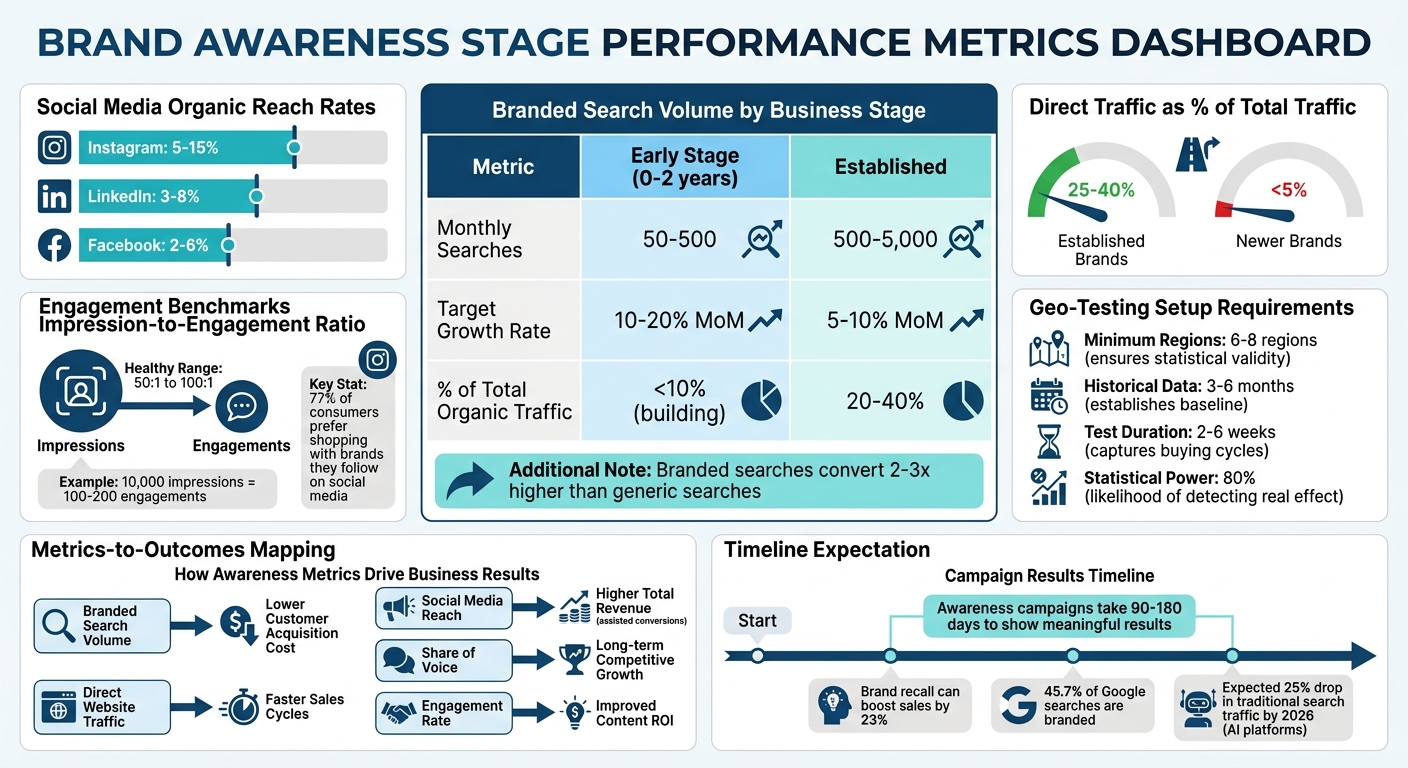
Brand Awareness Metrics Benchmarks and Performance Targets by Business Stage
How To Measure Brand Awareness | 6 Ways To Track Brand Awareness Growth
Measuring these metrics is a core component of a successful performance marketing strategy.
sbb-itb-2ec70df
Key Metrics for Awareness Stage Performance
Metrics help transform the concept of awareness into something measurable and actionable. They show whether your brand is standing out and making an impact. Let’s explore how reach and impressions provide the foundation for assessing your performance.
Reach and Impressions
Reach represents the number of unique individuals who see your content, while impressions count how many times your content is displayed, including repeat views. Think of reach as the size of your audience and impressions as how often your message is seen. For instance, if your content has a reach of 10,000 and 25,000 impressions, the average viewer sees it 2.5 times.
Each metric serves a distinct purpose. Reach indicates whether your audience is growing, while impressions show if you’re staying visible enough to make an impression. To get a clearer picture, track organic and paid reach separately. This way, you can differentiate between the impact of your content and the influence of your ad spend.
Platform benchmarks can help you understand how your performance stacks up:
- Instagram: Organic reach rates are typically 5–15%.
- LinkedIn: Organic reach rates hover between 3–8%.
- Facebook: Organic reach rates range from 2–6%.
If your numbers are within these ranges without paid promotion, your content is likely resonating. If not, it may be time to revisit your creative strategy.
Engagement Rate
Engagement rate measures how actively people interact with your content – through actions like likes, shares, and comments. If you’re seeing high impressions but low engagement, it means people notice your brand but aren’t compelled to act.
A helpful benchmark is the impression-to-engagement ratio, which often falls between 50:1 and 100:1. For example, if your content generates 10,000 impressions, you should aim for 100 to 200 engagements. Falling below this range might indicate your message isn’t connecting.
Engagement also plays a direct role in how algorithms rank your content. Platforms like Instagram and LinkedIn prioritize posts that spark interaction, which can further amplify your reach.
This interaction matters because 77% of consumers prefer to shop with brands they follow on social media. Engagement shows that your audience cares enough to interact with your brand, laying the groundwork for building preference and generating quality leads. Once engagement confirms your message resonates, you can look to branded search volume to gauge deeper audience intent.
Branded Search Volume
As awareness grows through visibility and interaction, branded search volume measures whether people are actively seeking out your brand. This metric tracks how often users search for your brand name or products, signaling a shift from passive exposure to intentional interest. When someone types your brand into a search engine, it’s a clear sign they’re curious and engaged.
"Branded search isn’t random. It’s a byproduct of awareness, credibility, and relevance that social content is especially good at creating." – SEO for News
For newer brands (0–2 years), 50–500 branded searches per month is typical, with a growth rate of 10–20% month-over-month reflecting strong performance. Established businesses should aim for branded searches to account for 20–40% of their total organic traffic. Falling short of this range could mean your brand isn’t as memorable, and users are relying more on generic search terms.
To track branded search volume, use Google Search Console to filter queries containing your brand name. Look at impressions as well as clicks – this helps you see demand even if users don’t immediately visit your site. Don’t forget to include common misspellings and variations of your brand name for a complete picture. Branded searches tend to convert 2–3 times higher than generic searches because they reflect stronger intent and familiarity.
| Metric | Early Stage | Established |
|---|---|---|
| Branded Search Volume | 50–500 searches/month | 500–5,000 searches/month |
| Target Growth Rate | 10–20% month-over-month | 5–10% month-over-month |
| Healthy Traffic Ratio | <10% (building phase) | 20–40% of total organic traffic |
Tools and Techniques for Tracking Awareness Metrics
To turn brand awareness into measurable data, you need the right tools and strategies in place.
Using Google Analytics to Track Website Traffic
Google Analytics 4 (GA4) is a great way to break down traffic by channel and see how people are discovering your brand and map your customer journey. One of the strongest indicators of brand awareness is direct traffic – when someone types your URL directly or uses a bookmark. This shows they already know who you are. Established brands often see 25–40% of their traffic coming from direct sources, while newer brands may see less than 5%.
To dive deeper, check out the Acquisition reports in GA4. Focus on four main traffic channels: Direct (brand recall), Organic Search (discovery), Referral (mentions), and Organic Social (engagement). Make sure to filter out paid traffic so you can get a clear picture of your organic growth. Pay attention to metrics like "New users", engagement rate, and average engagement time per session to determine if visitors are finding your content worthwhile. You can also use the date comparison tool in the Acquisition Overview report to track how your traffic grows over time – whether month-over-month or year-over-year.
To keep your data accurate, avoid miscategorizing links as "Direct" traffic. Use UTM parameters (utm_source, utm_medium, utm_campaign) on links shared in emails, social media, and offline campaigns.
Next, let’s look at how to measure your share of the market conversation.
Monitoring Share of Voice with SEMrush
While GA4 focuses on your website’s direct interactions, SEMrush helps you understand how your brand compares to competitors in broader market discussions. Share of voice (SoV) measures how much of the conversation your brand owns compared to others. SEMrush’s Position Tracking tool calculates SoV by analyzing the organic traffic you get from specific keywords versus the total search volume for those keywords.
To get started, create a project in SEMrush, enter your domain, and choose your target search engine, device type, and location (you can even narrow it down to a ZIP code). Add your keywords manually, upload them via a file, or import them from GA or Search Console. Then, in the Overview tab, switch on the "Share of Voice" feature to see daily trends in your SoV percentage. You can even group keywords into tags to compare performance across different categories – like "pricing" versus "features" – to uncover areas where your visibility might need improvement.
For example, in May 2025, Amerisleep used keyword tags in SEMrush to analyze its performance in different content categories. By grouping keywords into "bed sizes" and "mattress differences", they found they dominated the "mattress differences" category but had a gap in "bed sizes", prompting them to invest in new content. SEMrush also offers an AI Visibility Toolkit to monitor how often your brand appears on AI-driven platforms like ChatGPT and Perplexity, which is becoming increasingly important as traditional search traffic is expected to drop by 25% by 2026.
For a more personal touch, you can also gather direct feedback from your audience.
Conducting Awareness Surveys with SurveyMonkey
Surveys are a great way to add qualitative insights to your data. They help you understand whether people recognize your brand and what they associate with it. SurveyMonkey makes it easy to create surveys with options like Build with AI (using prompts), Start from a template (choose from over 500 pre-designed frameworks), or Start from scratch.
When designing your survey, mix in unaided recall questions (e.g., "What brands come to mind when you think of laundry detergent?") with aided recognition questions (e.g., "Which of the following brands have you heard of?"). Use Skip Logic to guide respondents past irrelevant sections. To keep completion rates high, limit your survey to 10 or fewer questions on a single page.
Before launching, preview your survey on desktop, tablet, and mobile devices to ensure it looks good everywhere. If you don’t have a list of respondents, you can use SurveyMonkey Audience to purchase responses from specific demographics. Just remember, surveys must stay under 80 questions and avoid asking for personal information. For most brands, tracking awareness quarterly works well, but fast-moving consumer goods may need monthly surveys.
Experiment-Based Approaches to Validate Awareness Impact
Relying solely on metrics often falls short when trying to gauge the full effect of awareness campaigns. Experiments, however, allow you to pinpoint the actual impact of your efforts by isolating marketing activities through controlled testing.
Running Brand Lift Studies
Brand lift studies involve dividing your audience into two groups: one that sees your ads (treatment) and one that doesn’t (control). Start by assessing baseline metrics like brand awareness and ad recall. Once your campaign concludes, survey both groups with the same set of questions to measure the changes your ads achieved.
Platforms like Meta, Google, TikTok, and Spotify offer built-in tools for these studies, though they often require a hefty ad budget to gather enough data for meaningful results. These tools typically rely on direct recall surveys and track increases in organic search activity.
Focus on these four key metrics during your study:
- Ad Recall: How well people remember seeing your ad.
- Brand Awareness: Whether people recognize your brand.
- Brand Consideration: The likelihood of people considering your brand.
- Purchase Intent: How likely people are to buy your product.
For example, podcast ads often perform well, with aided recall rates reaching 71% and brand awareness increasing by up to 13 percentage points. Brand recall alone can account for 38.7% of the overall boost in brand recognition.
"Brand lift is a gradual and cumulative process and rarely drives immediate action. The impact of a brand awareness campaign may not be immediately visible as it takes time for consumers to recognize and recall a brand."
- Franz Fontaine, Expert in Brand Positioning and Media Planning, Bloom
When designing your surveys, keep them short – ideally no more than 3 to 5 questions – and use straightforward language. To ensure reliable results, track your campaign’s performance for at least two months.
For additional validation, consider using geo-testing to measure regional campaign impacts.
Geo-Testing for Regional Awareness
Geo-testing helps assess how well your campaign performs in specific regions by running ads in selected areas while keeping other regions ad-free. This approach provides a clear before-and-after comparison, making it easier to establish cause and effect.
Choose geographic units like DMAs, states, or cities, and match your test and control regions based on similar demographics and past performance – not just size. Use 3 to 6 months of historical data to establish a solid baseline (or up to 12 months if your business is heavily influenced by seasonal trends). Run your campaign only in the test regions, ensuring that other variables remain consistent.
Most geo-tests last 2 to 6 weeks, which is usually enough time to capture a full buying cycle and account for delayed effects. To get reliable results, include at least 6 to 8 regions and aim for an 80% statistical power. Metrics like branded search volume and direct traffic can help you calculate the incremental lift your campaign generates.
Avoid mismatched comparisons, like pitting a large state such as California against the rest of the country, as demographic differences can distort results. Instead, pair markets with similar characteristics. Also, steer clear of overly granular units like ZIP codes, where media overlap can muddy the waters.
| Metric | Target/Requirement | Purpose |
|---|---|---|
| Minimum Regions | 6–8 regions | Ensures statistical validity and reliability |
| Historical Data | 3–6 months | Establishes a baseline for comparison |
| Test Duration | 2–6 weeks | Captures buying cycles and lag effects |
| Statistical Power | 80% | Likelihood of detecting a real effect |
Always review confidence intervals before drawing conclusions. For example, a result like "lift = 26% ± 24%" suggests too much uncertainty to act on. Geo-testing not only highlights your campaign’s incremental lift but can also reveal how credit is distributed across channels. Often, bottom-funnel channels are over-credited by 100–400%, while top-of-funnel efforts may be under-credited by 30–60%.
Connecting Awareness Metrics to Business Outcomes
After tracking your awareness metrics, the next step is linking them to measurable business outcomes. To truly understand their value, you need to connect these metrics to actions that directly influence revenue. Traditional attribution models often undervalue early-stage activities, making it essential to track the entire customer journey – from the first interaction to the final purchase.
Mapping Metrics to Funnel KPIs
Each awareness metric should tie back to a specific action within the funnel. For instance, branded search volume often correlates with improved conversion rates and lower customer acquisition costs. Similarly, direct website traffic reflects trust and brand recall, which can lead to shorter sales cycles and better lead quality. A rise in direct traffic suggests your brand is gaining traction and staying top of mind.
Pay attention to the top-to-middle funnel conversion rate, which measures how many awareness-stage visitors take a middle-of-funnel action – like subscribing to a newsletter or downloading a resource – within 30 days. For example, if 10,000 new visitors come to your site each month but only 200 engage further, that 2% progression rate indicates there may be issues with your content or calls-to-action.
Using cohort analysis over 30-, 60-, and 90-day periods can help you track the long-term impact of awareness campaigns. Studies show that when consumers recall a brand, awareness efforts can lead to a 23% boost in sales. By tracking initial visitors who later convert, you can directly link awareness campaigns to tangible business outcomes.
| Awareness Metric | Funnel KPI | Business Outcome |
|---|---|---|
| Branded Search Volume | Organic Conversion Rate | Lower Customer Acquisition Cost |
| Direct Website Traffic | Lead Generation (MQLs) | Faster Sales Cycles |
| Social Media Reach | Assisted Conversions | Higher Total Revenue |
| Share of Voice | Market Share Percentage | Long-term Competitive Growth |
| Engagement Rate | TOFU-to-MOFU Progression | Improved Content ROI |
Optimizing Based on Awareness Data
Develop a TOFU scorecard that combines key metrics like audience growth (qualified new visitors), engagement rate (content effectiveness), top-to-middle funnel conversion rate (funnel health), and revenue generated from TOFU-sourced journeys (business impact). Regularly reviewing this scorecard can help you spot trends and make adjustments to improve performance.
For example, if you’re attracting the right audience but they aren’t progressing further, your content might not provide a strong enough incentive to engage deeper. On the other hand, if progression rates are strong but visitor numbers are dropping, it might signal that your reach is shrinking and needs renewed investment. Tools like regression analysis can pinpoint which awareness metrics – such as branded search or social mentions – are the strongest predictors of future business success.
To gain even deeper insights, implement person-level tracking by linking anonymous pre-signup activity to user accounts after they convert. This approach clarifies which awareness activities are driving revenue. Given that nearly 45.7% of Google searches are branded, tracking how your campaigns influence branded search volume can serve as a reliable indicator of future conversions.
Lastly, calculate your share of search by dividing your branded search volume by the total search volume in your category. This metric highlights your brand’s influence in the market. Brands that achieve a share of voice 5–10 percentage points higher than their market share often see growth, making this a valuable goal to aim for.
Conclusion and Next Steps
Focus on tracking the metrics that directly influence business outcomes – like branded search volume, direct traffic, share of voice, and funnel conversion rates. These metrics help connect your awareness efforts to measurable pipeline growth.
Key Takeaways
Before diving into new campaigns, start by establishing a baseline with aided and unaided awareness surveys. Keep an eye on multiple KPIs such as branded search, direct traffic, and share of voice to get a comprehensive view of your brand’s performance. For instance, branded search often converts 2–3 times better than non-branded search, making it a valuable weekly metric to monitor. Strong brands typically hit consistent benchmarks for branded search and direct traffic, while tracking share of voice monthly offers insight into your market standing.
Interestingly, fewer than 30% of marketing executives feel confident in their ability to measure brand awareness effectively. By blending behavioral data like search and traffic trends with survey-based recall metrics, you can achieve a more well-rounded understanding. Track metrics prone to fluctuation weekly, but remember that meaningful results often take 90–180 days to materialize.
With these insights in hand, it’s time to put them into practice.
Implementing What You’ve Learned
Roll out your strategy over a 90-day period, aligning your efforts with the metrics and tracking methods outlined earlier.
- Month 1: Set up tools like Google Analytics 4 and Search Console, and conduct an initial brand awareness survey to establish benchmarks.
- Month 2: Monitor weekly trends in direct traffic, branded search, and social reach.
- Month 3: Analyze patterns in your data, experiment with content tweaks, and refine your approach for the next quarter.
Streamline your reporting by integrating data from GA4, Search Console, and social platforms into a centralized dashboard using tools like Google Data Studio or Databox. This consolidated view helps you identify trends faster and link awareness metrics directly to revenue outcomes.
For organizations that need extra support in building these frameworks or connecting top-funnel metrics to tangible results, consider visiting Growth-onomics for tailored solutions to optimize your awareness-stage efforts.
FAQs
How do I set a baseline for awareness metrics?
To get started with awareness metrics, it’s important to measure where you currently stand. This involves using indicators like brand recognition and direct traffic.
One approach is conducting surveys to assess brand recognition. For instance, you can ask participants whether they recognize your logo or brand name and calculate the percentage of affirmative responses. This gives you a clear picture of how familiar people are with your brand.
Another key metric is direct website traffic. When visitors type your URL directly into their browser, it’s often a sign that they’re already aware of your brand. Monitoring this data provides insight into your existing visibility.
By gathering these measurements, you’ll have a solid baseline to compare against as you implement strategies to boost awareness.
What should I track weekly vs monthly for awareness?
For weekly tracking, keep an eye on immediate metrics like website traffic, social media engagement, and campaign interactions. These help you spot trends and make quick adjustments. For monthly tracking, shift your focus to broader indicators like brand awareness, recall, recognition, and overall reach. These are often measured through surveys or branded search volume. This combination gives you both real-time insights and a clearer picture of long-term performance.
How can I prove awareness drives revenue?
To demonstrate how awareness impacts revenue, you need a system that ties your top-of-funnel efforts to measurable business results over time. Start by tracking metrics such as brand recognition, direct website traffic, and overall visibility. Tools like surveys or website analytics can help you gather this data.
The key is to consistently connect these metrics to eventual sales or conversions. By doing so, you can clearly show how boosting awareness translates into engagement, business growth, and, ultimately, revenue.
