


Predictive models are changing how businesses plan marketing budgets. Instead of relying on guesswork, these models use historical data, current metrics, and external factors to forecast outcomes like ROI, sales, and leads. Companies see benefits like reduced waste, better channel allocation, and faster adjustments to market changes. With marketing spend often over 20% of total budgets, accurate forecasting is critical.
Key takeaways:
- Predictive models link spending to measurable results (e.g., conversions, subscriptions).
- Techniques like regression analysis, time series forecasting, and Bayesian models improve predictions.
- Data-driven forecasting enables scenario planning to test budgets before spending.
- Clean data and clear KPIs (like CAC and ROAS) are essential for success.
- Businesses using predictive analytics report 15–20% improvements in ROI.
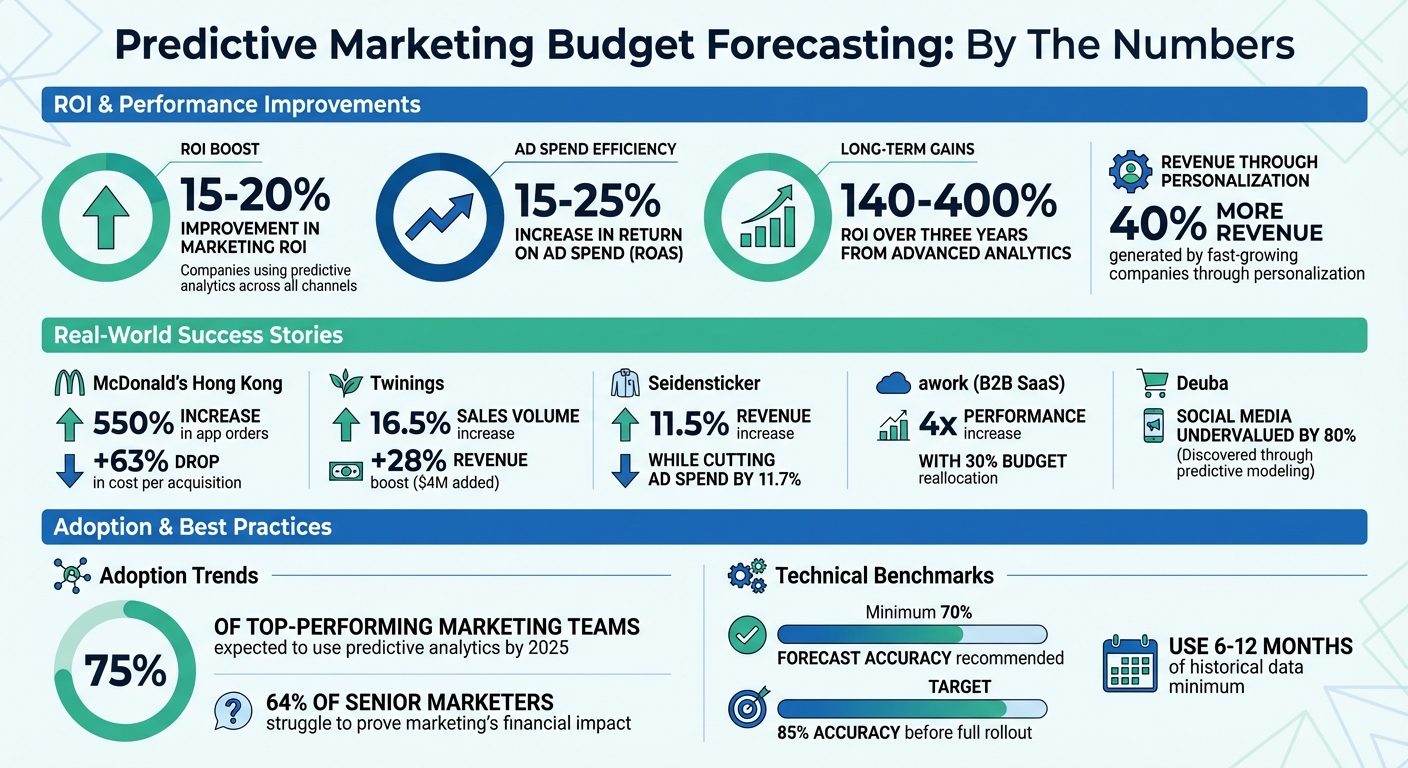
Predictive Marketing Budget Forecasting: Key Statistics and ROI Benefits
You Ask, I Answer: How to Prepare a Marketing Budget
Predictive Modeling Techniques for Budget Forecasting
The choice of predictive modeling technique hinges on your specific forecasting needs and the complexity of your marketing landscape. For example, regression analysis is ideal for understanding the relationship between spending and outcomes, while time series models excel at identifying seasonal trends and patterns over time. Bayesian models, on the other hand, introduce an added layer of uncertainty management, offering a range of possible outcomes instead of a single prediction.
Regression Analysis for Spend Prediction
Regression models are powerful tools for uncovering mathematical relationships between your marketing efforts – like ad spend, promotional timing, or external factors such as weather – and desired outcomes, such as revenue or conversions. Linear regression is straightforward, linking a single input to an output, such as showing how a $10,000 increase in Google Ads spend correlates with revenue growth.
For more complex scenarios, multiple regression analyzes how several variables interact. For instance, it can reveal how a combination of factors like temperature, day of the week, and advertising spend impacts sales simultaneously.
When the relationship between spend and outcomes isn’t linear, polynomial regression steps in. It can highlight diminishing returns, which is crucial for budget planning. For example, sales might grow significantly with spending up to $50,000 per month but plateau beyond that point. Additionally, using lagged predictors – data from previous periods – can enhance forecasting accuracy. For instance, last quarter’s spend can help predict this quarter’s results.
While regression models are excellent for understanding relationships, time series forecasting dives deeper into trends and seasonality.
Time Series Forecasting for Trend Analysis
Time series models are designed to track how data evolves over time, making them perfect for analyzing metrics like daily website traffic, monthly subscriptions, or quarterly revenues. These models break data into three main components: seasonal patterns (e.g., holiday spikes), long-term trends, and residual noise.
Popular approaches like ARIMA models rely on past values and error terms to predict future performance, while exponential smoothing gives more weight to recent data, ensuring predictions are more responsive to current market dynamics.
For marketing budgets, time series forecasting can guide spending adjustments based on anticipated demand. For example, a German hotel brand used SARIMA (Seasonal ARIMA) to predict revenue by channel. This allowed them to strategically shift budgets between organic search and Google Ads, leading to a 20% increase in year-over-year revenue.
Bayesian Models for Probabilistic Budgeting
Bayesian models stand out by offering probabilistic forecasts, providing a range of potential outcomes with associated confidence levels. Bayesian Structural Time Series (BSTS) models are particularly useful for high-stakes budget decisions. They incorporate prior market knowledge and explicitly account for uncertainty.
"Within a BSTS framework, one is able to turn all of the knobs and levers… This offers an added layer of interpretability often missing from more traditional approaches."
This technique enables the creation of scenario-based budgets – such as base, stretch, and contingency plans – each tied to specific confidence levels. Additionally, spike-slab priors help identify which marketing channels or campaigns are most influential, allowing you to focus resources where they’ll have the greatest impact. For organizations dealing with high-risk budget decisions, Bayesian models provide the clarity needed to make informed choices.
Building and Implementing Predictive Budget Models
Start with clear objectives instead of diving straight into complex algorithms. Identify channel-specific KPIs like conversion rates or customer lifetime value that align with your broader goals – whether it’s driving revenue growth, generating leads, or improving cost per acquisition. Companies that use predictive analytics across all channels typically experience a 15–20% boost in marketing ROI. This initial step is crucial for setting up accurate model training and ensuring smooth integration into actionable workflows.
Data Collection and Preparation
Gather your data from CRM systems, ad platforms like Google Ads or Meta, and web analytics tools, and consolidate everything into a centralized data lake. This eliminates the hassle of juggling multiple platforms and provides your model with a comprehensive view of your marketing performance.
Once consolidated, clean the data by removing outliers and resolving inconsistencies. Use at least 6–12 months of historical data for better accuracy. A great example of the impact of clean data comes from McDonald’s Hong Kong. In 2024, they used Google Analytics 4’s predictive audiences to target users "likely to purchase soon." The results were striking: a 550% increase in app orders and a 63% drop in cost per acquisition. Without clean, well-prepared data, achieving such results would be nearly impossible.
Training and Testing Predictive Models
Split your cleaned data into two sets: 70–80% for training and 20–30% for testing. The type of model you choose depends on your goals. For instance, regression models help analyze spend relationships, time series models like ARIMA or Prophet are great for spotting trends, and clustering works well for audience segmentation.
Backtesting is essential to ensure your model’s reliability. By running the model against historical data, you can check if its predictions align with actual outcomes. For example, B2B SaaS company awork reallocated 30% of its marketing budget using mix modeling. The result? A fourfold increase in performance and lower acquisition costs. Tobias Hagenau, Co-founder and CEO of awork, explained:
"We could raise our bids and outbid the competition in the important placements while saving our resources on campaigns that contribute less".
Once your model is validated, the next step is to incorporate these insights into your daily marketing processes.
Integrating Models into Marketing Workflows
Use real-time dashboards to embed forecasts into your decision-making process. Automate data updates – weekly during normal periods and more frequently during high-spend campaigns.
A German ecommerce company, Deuba, combined marketing mix modeling with multi-touch attribution and found that social media was undervalued by 80%. They applied these insights to their Google Ads bidding strategy, resulting in improved ROI across channels. Mark Prediger, Head of Online Shops and Marketing at Deuba, shared:
"Transitioning from a last-click attribution model to a holistic measurement approach… has given us the power to accurately measure the real ROI of every marketing move".
sbb-itb-2ec70df
Overcoming Challenges in Predictive Marketing Forecasting
Predictive models can transform how marketing budgets are forecasted, but they come with their own set of challenges. Issues like poor data quality, resistance from stakeholders, and the complexity of the models themselves can derail even the most promising efforts. Let’s break down how to tackle these obstacles effectively.
Addressing Data Quality Issues
Nothing undermines a predictive model faster than unreliable data. Problems like missing values, inconsistent formats, outliers, and duplicates can skew results and lead to flawed insights. So, how do you avoid this? Automating data validation is a great start. Tools like Great Expectations, Apache Spark, or Python’s Pandas can help enforce rules, such as ensuring sales figures are non-negative or flagging missing entries. Statistical techniques like Z-scores are also invaluable for spotting outliers. When these strategies are in place, the payoff can be enormous; advanced analytics have been shown to deliver a 140–400% ROI over three years.
Ensuring Stakeholder Buy-In
Once your data is in good shape, the next challenge is getting stakeholders on board. Without their trust, even the best model can fall flat. Why is this so important? Consider this: 64% of senior marketers say proving marketing’s financial impact is a major hurdle. To build trust, start by aligning on key financial metrics like cost-per-click, customer acquisition cost, and return on ad spend. Validate these metrics with backtesting against historical data to show that the model works. Tools like interactive scenario planning can also help stakeholders see how different spending levels might impact outcomes. For example, companies that adopt predictive analytics across channels have reported a 15–20% improvement in marketing ROI. Shared dashboards that update in real time can further strengthen confidence by keeping everyone on the same page.
Dealing with Model Interpretability
Even with stakeholder support, complex models can lose credibility if their operations aren’t clear. Transparency is key. One way to build understanding is through "what-if" simulations. For instance, showing how reallocating 10% of the budget from one channel to another impacts results can make the model’s logic more accessible. Visual tools like matrices that map metrics to budget levels can also clarify how diminishing returns work. A real-world example? In 2025, Twinings teamed up with Keen to use a Bayesian-based predictive model. By simulating demand scenarios and optimizing weekly spend, they boosted sales volume by 16.5% and revenue by 28%, adding $4 million to their marketing investment. Joint planning sessions between marketing, finance, and analytics teams can further ensure everyone understands the model’s goals and methods.
Measuring Success and Refining Predictive Models
Once a predictive model is in place, the next step is making sure it performs well over time. Accurate measurement and consistent fine-tuning are essential to keeping the model relevant and effective. Without these, even the most advanced models can lose their edge and start producing unreliable forecasts.
Defining Key Performance Indicators (KPIs)
To evaluate your model, focus on tracking the right metrics. Forecast accuracy should be a top priority – aim for at least 70%, especially when working with unpredictable products or frequent promotions. Instead of relying on standard MAPE, opt for Weighted Mean Absolute Percentage Error (WMAPE). This metric accounts for demand volume, ensuring that errors in high-revenue products are prioritized.
Financial KPIs also play a critical role. Metrics like ROI improvements, budget variance rates, and cost per acquisition (CPA) help determine if the model is driving real business impact. Additionally, keep an eye on bias, measured by Mean Forecast Error, to check if the model consistently over- or under-forecasts. Persistent bias can indicate deeper issues in the model’s logic. For perspective, even a 1% boost in forecasting accuracy can translate to annual savings of $1.43 million to $3.52 million for large companies.
A real-world example: In November 2025, the ecommerce brand Seidensticker leveraged Lifesight‘s predictive optimization tools to achieve an 11.5% revenue increase while simultaneously cutting ad spend by 11.7%. This success came from AI-driven budget planning and real-time financial insights, which allowed for proactive adjustments.
Continuous Model Optimization
Predictive models are not a one-and-done solution – they need ongoing updates. Markets evolve, customer preferences shift, and platform algorithms are constantly changing. Regular backtesting is critical. This involves retraining the model with historical data up to a certain point and then testing it on "unseen" data to evaluate its accuracy. Setting up automated weekly or monthly retraining cycles ensures the model stays aligned with current market conditions.
To detect model drift, schedule quarterly reviews. If you notice a drop in accuracy, it’s time to refresh the model with updated datasets. Another strategy is moving from annual budgeting to monthly rolling forecasts that project 12–18 months ahead. This approach provides better visibility and supports real-time adjustments. Companies that adopt predictive models across all channels often report a 15–20% improvement in marketing ROI. By consistently refining and aligning the model with these metrics, businesses can maintain its effectiveness and adapt budgets with agility.
Conclusion: Driving Growth with Predictive Marketing Budgeting
Predictive budgeting has become a transformative force in marketing, shifting strategies from reactive guesswork to proactive, data-driven decisions. With predictive models, businesses can move beyond analyzing "what happened" to anticipating "what’s likely to happen next". Companies using these tools to allocate budgets across channels report a 15–20% improvement in marketing ROI and a 15–25% increase in Return on Ad Spend (ROAS).
To get started, focus on high-impact areas like lead scoring or churn prevention before expanding into full-scale budget optimization. Break down data silos, validate your models through backtesting, and aim for at least 85% accuracy before rolling out these tools fully.
By 2025, 75% of top-performing marketing teams are expected to use predictive analytics. Fast-growing companies are already leading the way, generating 40% more revenue through personalization powered by these advanced tools compared to their slower-growing competitors.
However, building sophisticated models like Marketing Mix Modeling or Bayesian frameworks can be complex. This is where expert guidance becomes vital. Growth-onomics, for example, specializes in helping businesses implement predictive systems with a focus on measurable growth and performance.
The days of rigid, annual budget planning are fading. Dynamic, flexible budget allocation – adjusted weekly or even daily using real-time market data – is quickly becoming the standard. With marketing budgets often accounting for over 20% of total business spending, accurate forecasting is critical to avoid waste and maximize impact. Embracing predictive budgeting now means using real-time data to optimize spending and stay ahead in today’s fast-changing marketplace.
FAQs
How can predictive models help optimize marketing budgets?
Predictive models rely on historical data – like sales patterns, past campaign outcomes, and customer behavior – to predict which marketing channels are likely to perform best. This approach helps businesses make smarter decisions about where to spend their money, cutting down on unnecessary expenses and boosting ROI.
Growth-onomics takes these insights a step further by using them to fine-tune budget allocation over time. This ensures that resources are consistently directed toward strategies that deliver measurable results and drive business growth.
What key data is needed for accurate marketing budget forecasting?
To create a reliable marketing budget forecast, start by gathering historical data on your marketing expenses and performance. This includes key metrics like clicks, conversions, and revenue. Dive deeper by evaluating channel-specific ROI and cost-per-acquisition (CPA) to determine how well each platform performs. Don’t forget to factor in seasonality trends, market data, and your broader business objectives – whether that’s hitting a specific revenue target or managing customer acquisition costs (CAC).
Using these insights, you can make smarter decisions about where to allocate resources, helping your business grow while getting the most out of your investment.
What obstacles do businesses face when using predictive models for marketing budget forecasting?
Implementing predictive models for marketing budget forecasting comes with its fair share of challenges. For starters, businesses need accurate, clean, and consistent data from sources like sales records, campaign metrics, and customer behavior patterns. Collecting and preparing this data often demands a lot of time and effort. On top of that, predictive models must be regularly updated to keep pace with shifting market conditions and evolving consumer trends, which can drain resources.
There’s also the technical side of things. Building and fine-tuning models, especially those powered by machine learning, can be complex and often requires specialized expertise that many teams might not have. Some models function as "black-box" systems, meaning their predictions are difficult to interpret or explain. This lack of transparency, coupled with stricter privacy regulations, can make compliance an even bigger challenge.
To address these obstacles, Growth-onomics, a performance marketing agency, offers U.S. businesses comprehensive data analytics solutions. They handle everything from data collection and model creation to ongoing monitoring and clear, actionable reporting. With Growth-onomics, businesses can confidently allocate their marketing budgets in dollars ($) while achieving measurable growth and improved ROI.