

Cross-channel marketing connects multiple platforms – email, apps, social media, websites, and stores – into one smooth customer journey. This approach significantly boosts Customer Lifetime Value (CLV) by creating consistent, personalized experiences. Key findings include:
- 91.3% retention rate for brands using cross-channel strategies vs. 29.8% for single-channel.
- Customers engaging across 5+ channels spend 38.4% more per transaction.
- Combining email and SMS increases conversions by 37.2%.
- Campaigns with 6+ touchpoints improve 12-month CLV for new customers by 44.2%.
Cross-channel strategies also reduce churn and build trust through seamless experiences. For example, loyalty programs and real-time data integrations ensure a frictionless journey, boosting both retention and spending. Brands like Amazon and Sephora excel at this, showing the power of unified customer profiles and personalized messaging.
To implement this, businesses should:
- Integrate key channels like email, SMS, and apps.
- Consolidate data into a single platform for a unified view.
- Use AI to predict customer preferences and optimize budgets.
The takeaway? Cross-channel marketing isn’t just about being present everywhere – it’s about connecting everything to increase loyalty and long-term revenue.
Mastering Cross-Channel Marketing For A Seamless Customer Journey
Research Findings on Cross-Channel Marketing and CLV
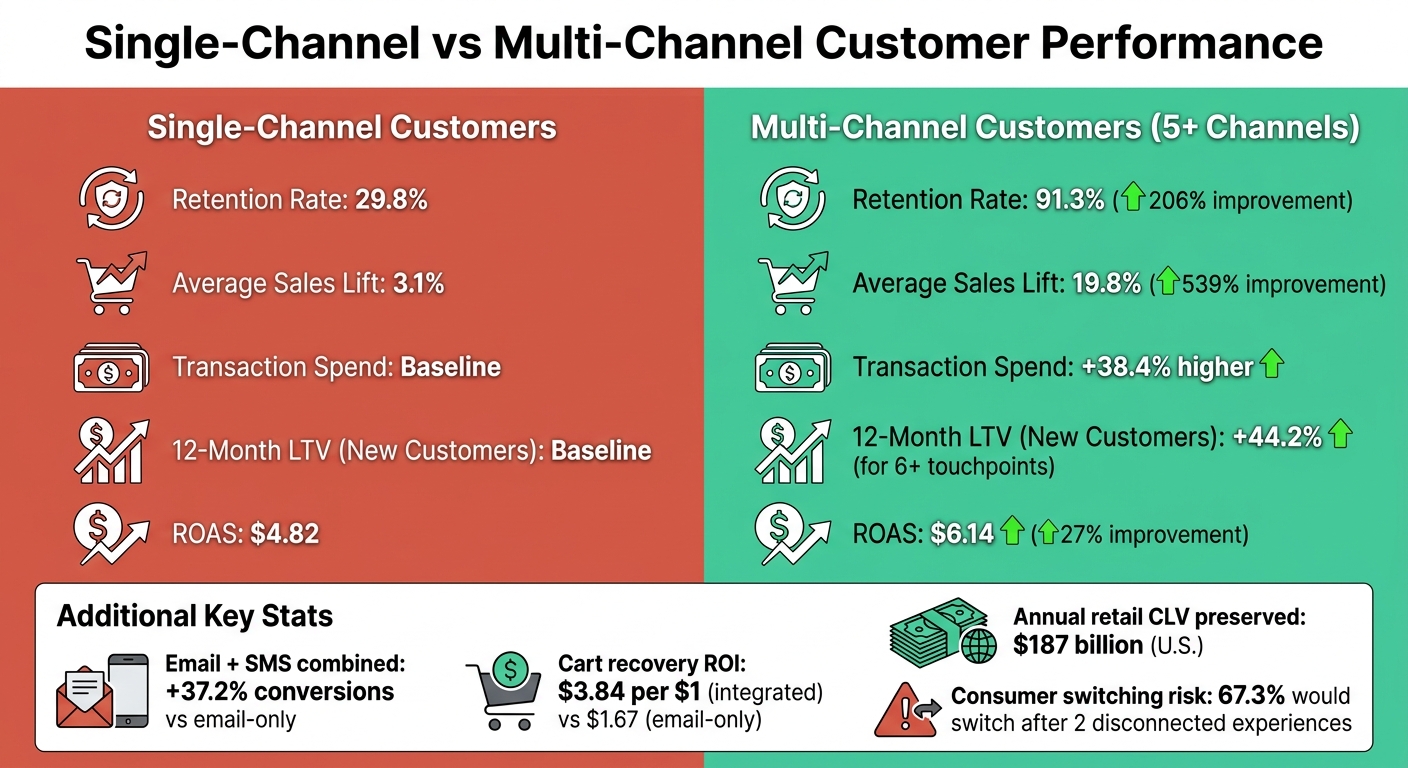
Single-Channel vs Multi-Channel Marketing Performance: CLV Impact Comparison
Multi-Channel Customers Exhibit Higher Lifetime Value
Here’s what the data shows: brands that fully integrate cross-channel strategies see an impressive 91.3% customer retention rate, compared to just 29.8% for brands relying on single-channel approaches.
Customers engaging with a brand across five or more channels spend 38.4% more per transaction than those limited to a single touchpoint. This approach also helps preserve a staggering $187 billion in U.S. retail customer lifetime value annually. When customers can seamlessly transition between platforms – like your app, website, email, and physical store – it not only keeps them loyal but also encourages higher spending over time.
These retention rates create a strong foundation for increasing both purchase frequency and long-term customer loyalty.
Cross-Channel Strategies Increase Purchase Frequency and Retention
Campaigns leveraging five or more coordinated channels deliver an average 19.8% sales lift, compared to just 3.1% for single-channel efforts. The gap is even more striking when it comes to acquiring new customers: brands using six or more acquisition touchpoints see a 44.2% higher 12-month lifetime value for new customers.
Combining email and SMS in triggered campaigns boosts conversions by 37.2% compared to email-only campaigns. For cart recovery, integrated approaches yield $3.84 per $1 spent, while email-only efforts recover just $1.67.
The stakes are high: 67.3% of consumers say they would switch to a competitor after experiencing disconnected messaging twice. By 2026, consumer expectations for consistent cross-channel experiences are expected to leave no room for error.
Single-Channel vs. Multi-Channel Customer Comparison
A side-by-side comparison underscores the benefits of multi-channel strategies over single-channel approaches:
| Metric | Single-Channel Customers | Multi-Channel Customers (5+ Channels) |
|---|---|---|
| Retention Rate | 29.8% | 91.3% |
| Average Sales Lift | 3.1% | 19.8% |
| Transaction Spend | Baseline | +38.4% |
| 12-Month LTV (New) | Baseline | +44.2% (for 6+ touchpoints) |
| ROAS | $4.82 | $6.14 |
Multi-channel advertisers enjoy a $6.14 return on ad spend (ROAS), significantly outpacing the $4.82 ROAS seen with single-channel strategies.
How Cross-Channel Marketing Improves Retention and Loyalty
Reducing Churn with Consistent Experiences
Customer frustration is a major driver of churn, but cross-channel marketing can help prevent it by ensuring smooth transitions between different touchpoints. Think about it: when someone adds items to their cart on a mobile app and later finds them waiting on their desktop, or when loyalty points earned in-store are instantly reflected in an app, it creates a sense of reliability and connection – not just a fleeting emotional reaction.
The numbers back this up. Fully integrated marketing strategies lead to much higher retention rates compared to fragmented, multichannel approaches. On the flip side, 67.3% of consumers are likely to jump ship to a competitor after experiencing disconnected messaging just twice. Disney+ illustrates how seamless cross-channel experiences can work. Its streaming service allows users to pause a show on their TV and pick it up on their mobile device without missing a beat. This feature has helped reduce churn rates by 30–40% among users who engage across multiple devices. Lower churn doesn’t just keep customers around – it also increases their lifetime value by keeping them engaged over time.
Building Trust Through Consistent Branding
Beyond retention, cross-channel marketing fosters trust by delivering consistent experiences. When messaging, pricing, and promotions align across email, social media, in-store visits, and mobile apps, customers feel confident in the brand. In fact, 71% of customers expect seamless interactions across all touchpoints, and meeting this expectation directly improves trust and satisfaction.
Some brands are nailing this approach. Amazon, for example, boasts a 95% year-over-year retention rate among Prime members by ensuring that shopping carts, delivery tracking, and return options work flawlessly across platforms. Sephora’s Beauty Insider program is another standout example. It integrates in-store and digital experiences so that rewards, recommendations, and purchase history follow customers no matter where they shop. The payoff? Customers who engage with Sephora across three or more channels spend 15% more annually, and their lifetime value is double that of single-channel shoppers.
Interestingly, while 80% of B2C leaders believe they’re delivering excellent shopping experiences, fewer than half of their customers agree. Bridging this gap with unified cross-channel branding isn’t just a nice-to-have – it’s essential for turning occasional buyers into loyal advocates.
Using Data for Personalization and CLV Growth
Understanding Customer Journeys with Cross-Channel Data
Cross-channel data helps paint a complete picture of how customers move through their customer journey. Picture this: a shopper browses products on a mobile app during lunch, adds items to their cart on a desktop at work, and finishes the purchase in-store over the weekend. Without unified data, these touchpoints might seem unrelated, leaving brands in the dark about the customer’s true path.
Breaking down data silos is key. By consolidating data from email, SMS, point-of-sale systems, loyalty programs, and customer service into a single Customer Data Platform (CDP), businesses create a "single source of truth". This means every customer interaction – whether it’s chatting with support, opening an email, or scanning a loyalty card – gets added to one unified profile. For example, McConnell’s Fine Ice Creams integrated data from their physical stores, online channels, and ecommerce platforms. This allowed them to send targeted offers for online delivery and track in-store sales back to specific email campaigns.
The result? Brands can deliver context-aware interactions. Instead of treating each touchpoint as separate, they can recognize where a customer is in their journey and adjust their messaging accordingly. Real-time behavior triggers make this possible – for instance, pausing promotional emails if a customer has an unresolved support ticket or sending a follow-up text when an email goes unopened. This approach not only improves customer experience but also boosts CLV by ensuring timely and relevant engagement.
"I fundamentally think that if you’re going to be sending emails and SMS, they have to know what each other are doing."
Jonathan Guez, CTO of Sunrise Brands
How Personalization Drives Engagement and Conversions
With a unified view of customer behavior, brands can fine-tune their approach to deliver personalized experiences that resonate.
Personalization uses data from multiple channels to anticipate customer needs. During the 2023 Black Friday Cyber Monday season, health supplement brand Happy Way segmented customers based on their preferred channels and dietary needs. By sending tailored offers and last-minute SMS reminders, they generated over $350,000 in attributed revenue.
The numbers speak for themselves: cross-channel retargeting can increase conversion rates by up to 300%, and customers tend to spend 37% more when their experience is seamless across channels. Predictive personalization takes this a step further. By leveraging unified customer profiles, brands can run A/B tests that use past engagement patterns and lifetime value to determine which content will resonate most with specific segments. These strategies directly enhance CLV by encouraging repeat purchases and deeper engagement.
Luxury beauty brand Tatcha showcased this during their January 2025 New Year’s event. They amplified promotions across email, SMS, and social media while excluding recent buyers from paid media campaigns to save costs. The result? A 20% increase in ecommerce revenue compared to the previous year.
Building Complete Customer Profiles
Taking personalization further, creating complete customer profiles allows brands to predict behaviors and maintain consistent engagement.
These profiles combine demographic details with behavioral data from every channel. When Zara introduced real-time inventory syncing, enabling online shoppers to check stock availability in physical stores and return online purchases in-store, they saw a 25% boost in conversion rates among customers using multiple channels during a single purchase cycle.
AI-powered tools also play a role in refining this process. By analyzing historical engagement data, brands can predict which channels – like WhatsApp, email, or push notifications – a customer is most likely to engage with. These preferences are updated automatically as behaviors change.
"Channel affinity has really helped us reduce over-messaging and create opportunities to do more brand-building in extensive flows."
Luke Styles, CRM Manager at Lorna Jane
A complete view of the customer enables smarter, more effective interactions. With 77% of omnichannel shoppers using three to four channels to research and buy products and 62% of consumers preferring AI to remember their past purchases rather than re-explaining them to sales associates, comprehensive profiles are no longer optional. They’re a necessity for driving long-term CLV growth.
Improving ROI with Cross-Channel Strategies
When customer profiling and personalization come together, cross-channel strategies can significantly boost ROI.
Improving Marketing Budget Efficiency
Using separate marketing tools often leads to redundant efforts and inflated costs. By consolidating into unified platforms, businesses can reduce tech expenses by up to 18%. This approach also prevents platforms like Meta and Google Ads from competing for the same customers, a problem known as channel cannibalization.
Multi-touch attribution models and flow filters play a key role here. They prevent double-counting and repetitive messaging, allowing brands to allocate budgets with 23% greater efficiency.
AI-driven insights take this a step further by identifying each customer’s preferred communication channel – whether it’s email, SMS, or WhatsApp. This precision reduces over-messaging and ensures you’re connecting with customers where they’re most likely to engage.
Real-Time Adjustments to Marketing Campaigns
Static budgets often lead to missed opportunities. By optimizing the channel mix, businesses can improve ROI by 15%–30% without increasing their spending. The secret lies in focusing on "marginal ROI", which evaluates what the next dollar spent can achieve, rather than relying on outdated "average ROI" metrics. Real-time data is crucial for spotting when one channel is oversaturated and another has untapped potential.
"Most marketing teams allocate budget based on last year’s plan plus or minus a gut feeling – and leave 15-30% ROI improvement on the table."
- KISSmetrics Editorial
Understanding the interconnected nature of channels is also critical. For example, cutting back on display ads might unintentionally reduce branded search traffic because fewer people are exposed to the brand. Real-time monitoring helps marketers catch these cross-channel effects early, before performance suffers.
AI-powered systems are now capable of reallocating budgets automatically. Multi-agent AI workflows designed for marketing mix optimization can improve cross-channel budget allocation by 31% compared to manual methods. Weekly feedback loops between paid media, CRM, and content teams further enhance agility. These teams can quickly shift resources based on a blended Return on Ad Spend (ROAS), ensuring that underperforming channels don’t drain the budget while high-performing ones get the support they need.
This adaptability is especially valuable as customer acquisition costs have risen by 40% over the past two years. Real-time adjustments are no longer optional – they’re essential for sustainable growth.
Customer Journey Mapping for Better Returns
Mapping the customer journey helps brands identify where potential customers drop off, allowing for more effective resource allocation. Segmenting marketing flows by acquisition source and funnel stage can lead to a 51% improvement in email click-through rates. For instance, customers acquired through paid search often behave differently than those from organic social, so tailoring messages to these groups improves conversions and reduces wasted spending.
Growth-onomics excels in integrating customer journey mapping with data analytics to streamline resource allocation. Their services – spanning Customer Journey Mapping, Performance Marketing, and Data Analytics – help businesses focus on high-value touchpoints and eliminate inefficiencies. With companies often juggling an average of seven separate data sources, a unified approach becomes crucial for maximizing ROI.
Conclusion and Key Takeaways
Why Cross-Channel Marketing Matters
Research has made it clear: engaging customers across multiple channels drives better retention, more frequent purchases, and increased revenue. For instance, multi-channel customers have a 30% higher lifetime value and buy 250% more often than those who stick to a single channel. Companies with strong cross-channel strategies retain 89% of their customers, compared to only 33% for weaker strategies.
The financial benefits are equally compelling. Businesses with solid cross-channel engagement report 9.5% annual revenue growth, compared to just 3.4% for single-channel efforts. Campaigns using three or more channels achieve a 287% higher purchase rate, and omnichannel shoppers tend to have an Average Order Value that’s 13% higher. Despite these impressive numbers, only 9% of marketers have fully embraced cross-channel marketing.
These findings highlight the importance of a unified strategy to unlock these benefits.
Next Steps for Implementing Cross-Channel Strategies
To capitalize on these advantages, businesses can take practical steps to adopt cross-channel marketing effectively.
- Begin with three key channels – email, SMS, and push notifications – to lay the groundwork for broader engagement.
- Audit your current tools to identify any data gaps, then consolidate your tech stack into a single platform that ensures seamless communication.
- Leverage data on customer channel preferences to send messages where they’re most likely to respond, avoiding repetitive or irrelevant outreach.
Growth-onomics offers tailored support for businesses navigating this shift. Their expertise in Customer Journey Mapping, What is Performance Marketing?, and Data Analytics helps businesses pinpoint high-impact touchpoints, streamline operations, and create unified customer profiles. These steps are critical for boosting Customer Lifetime Value and achieving a stronger return on investment.
FAQs
What’s the difference between multichannel and cross-channel marketing?
The main distinction lies in how customer interactions are handled. Multichannel marketing relies on separate platforms, such as email and social media, that function independently. This often leads to disjointed customer experiences. On the other hand, cross-channel marketing connects these platforms, creating a smooth and cohesive customer journey. By integrating interactions across channels, this approach enhances customer lifetime value (CLV) and retention, offering better insights and more effective results.
What’s the easiest way to start cross-channel marketing with limited resources?
If you’re working with limited resources, the key to cross-channel marketing is making the most of what you already have. Start by connecting your existing channels to create a seamless customer experience.
Focus on tracking important metrics such as engagement rate, multi-touch attribution, and customer satisfaction. These will help you spot areas that could benefit from improvement.
Use straightforward tools to link platforms like social media, email, and your website. Begin with the channels where you’re already seeing activity and engagement, and then expand step by step. This lets you get more out of your current efforts without needing a big budget.
How do I measure CLV impact across channels without double-counting conversions?
To accurately gauge the impact of CLV without overlapping results, rely on controlled experiments and multi-channel incrementality reporting. These methods help pinpoint each channel’s unique contribution by comparing outcomes with and without specific campaigns in play.
Keep your data centralized to maintain consistency, and prioritize metrics such as incremental ROAS (iROAS). This approach provides a more precise view of how individual channels truly affect CLV.
