


STL, or "Seasonal and Trend decomposition using Loess", is a method for breaking down time series data into three parts: trend, seasonality, and residual noise. This makes it easier to analyze and forecast data like sales, website traffic, or energy usage. Unlike older methods, STL works with any data frequency (daily, weekly, monthly) and adjusts to changing seasonal patterns. It’s also effective at handling outliers, ensuring anomalies don’t distort trends or seasonality.
Key Benefits of STL:
- Clearer Trends: Removes seasonal noise to highlight underlying growth or decline.
- Improved Forecasting: Models each component separately for more accurate predictions.
- Outlier Management: Isolates unusual events, keeping forecasts reliable.
- Flexibility: Works for various industries (retail, energy, finance) and complex patterns like overlapping seasons.
How It Works:
- Loess smoothing separates seasonal patterns and trends iteratively.
- Seasonal and trend "windows" can be adjusted for faster or smoother responses.
- Outliers are confined to the residual component, preserving data integrity.
STL is widely used in marketing analytics, demand forecasting, and anomaly detection. By separating data into its components, businesses can make better decisions, whether it’s planning inventory, optimizing ad spend, or understanding long-term performance trends.
Forecasting Principles & Practice: 3.6 STL decomposition
sbb-itb-2ec70df
How STL Works Compared to Other Decomposition Methods
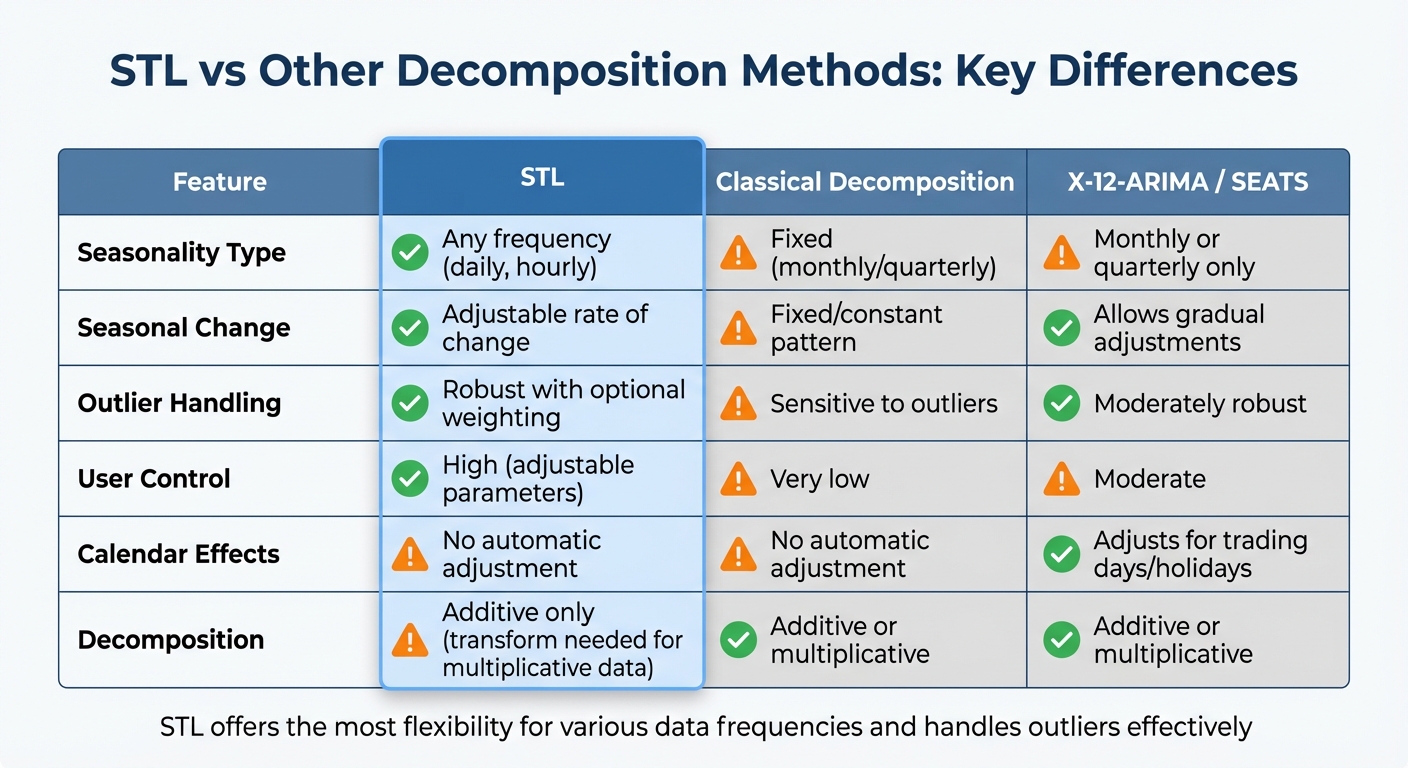
STL vs Classical Decomposition vs X-12-ARIMA: Feature Comparison
Overview of the STL Algorithm
STL breaks down time series data into three components: seasonal, trend, and remainder, using an iterative approach. This process involves two loops: an inner loop fine-tunes the seasonal and trend estimates, while an outer loop calculates robustness weights to minimize the effect of outliers. A few iterations are usually enough for a stable result, though the robust mode may require more passes.
The algorithm smooths seasonal sub-series (like all January values) to identify recurring patterns, then smooths the de-seasonalized data to reveal the trend. This setup allows the seasonal pattern to adapt dynamically over time. Both the seasonal and trend window parameters must be odd integers to ensure symmetry during smoothing. For monthly data, a common default for the trend window is 21 observations.
When working with large datasets, STL uses jump parameters to compute LOESS (a smoothing method) on every n-th observation and interpolates the rest. This dramatically reduces computation time without compromising accuracy. This efficiency is a key advantage over traditional decomposition methods.
Comparison with Classical and X-12-ARIMA Methods
STL offers unmatched flexibility and user control. Unlike X-12-ARIMA and SEATS – which are restricted to monthly or quarterly data – STL can handle data at any frequency, including daily, hourly, or weekly. Classical decomposition assumes a rigid seasonal pattern that repeats identically each year, while STL allows the seasonal component to evolve dynamically, based on user-defined parameters.
| Feature | STL | Classical Decomposition | X-12-ARIMA / SEATS |
|---|---|---|---|
| Seasonality Type | Any frequency (daily, hourly) | Fixed (monthly/quarterly) | Monthly or quarterly only |
| Seasonal Change | Adjustable rate of change | Fixed/constant pattern | Allows gradual adjustments |
| Outlier Handling | Robust with optional weighting | Sensitive to outliers | Moderately robust |
| User Control | High (adjustable parameters) | Very low | Moderate |
| Calendar Effects | No automatic adjustment | No automatic adjustment | Adjusts for trading days/holidays |
| Decomposition | Additive only (transform needed for multiplicative data) | Additive or multiplicative | Additive or multiplicative |
One of STL’s standout features is its ability to handle outliers effectively. For instance, when analyzing EU electrical equipment production from 1995–2016, STL successfully isolated the effects of the 2008 financial crisis within the remainder component. This prevented the crisis’s sharp downturn from distorting the seasonal pattern, preserving forecast reliability. In contrast, classical methods often allow such shocks to influence seasonal estimates, leading to less accurate results.
Research Evidence Supporting STL’s Forecasting Accuracy
Research on STL’s Impact on Forecast Accuracy
A 2014 study analyzing the M3 competition dataset – which includes 3,003 time series – revealed that combining STL decomposition with bootstrap aggregation (bagging) of exponential smoothing (ETS) models significantly reduced forecast errors compared to using ETS models alone.
"Using the MASE, our method [using STL] is significantly better than all the M3 participants on the monthly data." – Christoph Bergmeir, Rob J. Hyndman, and Jose M. Benitez
In a 2024 study, Kong Hoong Lem demonstrated that a hybrid STL-ARIMA approach outperformed SARIMA in terms of MAE, RMSE, and MAPE when applied to CO2 data from Mauna Loa, Hawaii. Similarly, in energy forecasting, Kasun Bandara, Rob J. Hyndman, and Christoph Bergmeir evaluated MSTL (an extension of STL designed for multiple seasonal patterns) using 149 days of hourly electricity consumption data from Victoria, Australia, starting January 1, 2012. MSTL achieved a Trend RMSE of 207.6, which was notably better than TBATS (742.1) and Prophet (243.7). These results highlight STL’s effectiveness across various forecasting challenges.
Common Domains for STL Application
STL’s versatility extends well beyond controlled research settings, proving its value across numerous industries. In retail, finance, energy, and environmental science, STL consistently delivers measurable improvements:
- Retail: A hybrid STL model reduced MSE by 35.9% and MAPE by 21.4%, effectively accounting for promotion, holiday, and weather-driven volatility in fast-moving consumer goods (FMCG).
- Finance: STL effectively manages the high volatility of markets like stocks, commodities, foreign exchange, and cryptocurrencies by isolating multiscale features from noisy data.
- Energy: Utilities use MSTL to forecast electricity demand, especially for interlaced daily and weekly seasonal patterns, delivering precise predictions in complex scenarios.
- Environmental Science: STL is widely applied for forecasting CO2 concentrations and groundwater levels, offering reliable insights for environmental monitoring.
- Traffic: Studies have shown STL-based methods to be robust for real-time, multi-step traffic flow forecasting, making them a reliable choice for dynamic applications.
Why STL Improves Accuracy
STL’s ability to deliver cleaner trend-cycle estimates stems from its use of Loess smoothing, which isolates evolving seasonal patterns. Its robust mode is particularly effective in handling outliers, ensuring that anomalies are confined to the remainder component and do not distort other parts of the decomposition.
"STL has several advantages… it will handle any type of seasonality… the seasonal component is allowed to change over time… and it can be robust to outliers." – Rob J. Hyndman and George Athanasopoulos
When STL Performs Best and Its Limitations
Best Use Cases for STL
STL shines when dealing with complex and shifting seasonal patterns. Unlike methods like SEATS or X-11, which are limited to monthly or quarterly data, STL works seamlessly with various frequencies, making it a go-to option for high-frequency data.
One of STL’s standout features is its robust mode, which uses weighting to isolate outliers in the remainder component. This ensures that both trend and seasonal estimates remain accurate, even in the presence of unexpected anomalies. This makes STL particularly reliable when working with irregular real-world data.
Another area where STL excels is in fine-tuning component smoothing. Smaller window settings allow the model to capture rapid changes, while larger windows provide more stable outputs. This adaptability makes STL suitable for a wide range of scenarios, from highly volatile financial markets to steady retail demand forecasting.
However, these benefits come with certain trade-offs, which are important to understand.
Limitations of STL
While STL offers many advantages, it does have some limitations that can affect its performance in specific situations.
For one, STL does not automatically account for trading day or calendar variations. This can lead to inaccuracies in datasets where these factors are significant, such as economic data that varies with the number of trading days in a month. In such cases, you’ll need to manually adjust for these effects before applying STL.
Another limitation is that STL is inherently designed for additive decomposition. If the seasonal fluctuations in your data are proportional to the trend (indicating a multiplicative relationship), you’ll need to apply a log or Box-Cox transformation before decomposition. Afterward, the results must be back-transformed, adding an extra layer of complexity and potential for misinterpretation.
Parameter sensitivity is another challenge. STL’s effectiveness relies heavily on selecting appropriate trend (t.window) and seasonal (s.window) window sizes. For example, if the trend window is set too rigid, significant events like the 2008 financial crisis might not be accurately reflected in the trend and could instead appear in the remainder component. Finding the right parameters often requires trial and error, along with domain expertise.
| Feature | STL Advantage | STL Limitation |
|---|---|---|
| Seasonality Type | Handles any frequency (daily, weekly, etc.) | Does not automatically adjust for trading day/calendar |
| Flexibility | User-controlled rate of trend/seasonal change | Requires manual tuning for optimal settings |
| Robustness | Resilient to outliers with robust option | Supports only additive decomposition directly |
| Data Length | Works with multiple seasonal patterns | Needs ample data for long-window estimation |
| Complexity | Loess handles non-linear relationships | Computationally intensive for large datasets |
For very large datasets with extensive seasonal periods – like minute-by-minute data with a seasonal period of 1,440 – the computational demands can be substantial. However, using "jump" parameters (such as setting seasonal_jump or trend_jump to 10–20% of the window size) can reduce processing time significantly, often by a factor of 15, without compromising much on accuracy.
Practical Applications for Growth Marketing and Forecasting
Applying STL in Marketing Analytics
STL (Seasonal and Trend decomposition using Loess) offers marketers a powerful way to interpret campaign data by separating authentic growth signals from predictable seasonal patterns. For example, when performing media-mix modeling, using seasonally adjusted data (yₜ – Sₜ) helps isolate the actual impact of advertising spend. This eliminates the confusion caused by recurring seasonal peaks, like higher weekend traffic, allowing you to determine whether a spike in conversions is due to a new creative strategy or just a predictable trend.
The tool’s robust fitting feature is especially useful for handling anomalies like Black Friday sales, viral social media posts, or temporary outages. By treating these one-off events as exceptions, STL ensures long-term trends and seasonal patterns remain intact. For agencies such as Growth-onomics, which specialize in SEO and performance marketing, this precision makes it easier to distinguish between short-term campaign noise and sustained growth.
For high-frequency data, MSTL (Multiple Seasonal-Trend decomposition) provides even deeper insights by capturing overlapping seasonal patterns. A great example is a study of Victoria’s electricity demand from January to May 2012, which revealed how daily peaks shifted from afternoons in summer (due to air conditioning) to evenings in May (driven by heating and lighting). Similarly, marketers can analyze hourly website traffic to uncover both daily engagement cycles and evolving weekly trends.
These insights are not just limited to marketing – they also play a crucial role in improving business forecasting.
Integrating STL into Business Forecasting
STL doesn’t just enhance campaign analysis; it also sharpens overall business forecasting. A common workflow involves breaking down your time series data with STL, forecasting the seasonally adjusted component using methods like ARIMA or ETS, and then reintegrating the seasonal component. This layered approach consistently delivers more accurate forecasts compared to directly working with raw data.
For tasks like budgeting and inventory planning, STL helps pinpoint actual shifts in business performance. For instance, an analysis of EU electrical equipment manufacturing data (January 1995 to May 2016) used STL to separate the economic downturn during the 2008 financial crisis from regular seasonal variations. The trend-cycle component highlighted the true economic impact, while the seasonally adjusted data still contained residual noise that could mislead decision-makers.
Because marketing data often exhibits multiplicative patterns – where growth scales alongside overall levels – applying transformations like log or Box-Cox before using STL ensures more precise decomposition. This is especially helpful when seasonal fluctuations grow in proportion to the data’s overall trend.
Best Practices for Using STL
To get the most out of STL, start by backtesting your forecasts against simpler baseline models, such as Seasonal Naive methods. This step ensures your STL-enhanced forecasts genuinely outperform less complex alternatives.
Customize smoothing windows to suit your specific business needs. Shorter trend and seasonal windows adapt quickly to changes, such as shifts in consumer behavior, while longer windows provide stability for strategic, long-term planning. For example, when analyzing major disruptions like financial crises, using a shorter trend window (e.g., window = 7) prevents critical signals from being lost in the remainder component.
| Marketing KPI | STL Application | Business Benefit |
|---|---|---|
| Order Volume | Separate growth trends from seasonal spikes | Better demand forecasting for inventory planning |
| Website Traffic | Capture daily and weekly cycles with MSTL | Optimize ad scheduling and content publishing times |
| ROAS | Identify true performance vs. seasonal dips | Make smarter budget reallocation decisions |
| Conversion Rates | Remove Friday/weekend effects | Evaluate campaign effectiveness without timing bias |
Conclusion
STL is a powerful tool for breaking down data into seasonal patterns, long-term trends, and random noise, making it a game-changer for improving forecasting accuracy. Unlike older methods, which often worked only with monthly or quarterly data, STL can handle any data frequency – whether it’s hourly website visits or daily sales figures – making it a perfect fit for today’s fast-paced analytics needs.
One of STL’s standout features is its ability to adapt to changing seasonal patterns and tolerate outliers, ensuring forecasts align more closely with actual business performance. As Rob J. Hyndman, a Professor of Statistics at Monash University, explains:
"The seasonal component is allowed to change over time, and the rate of change can be controlled by the user".
This flexibility has proven its worth in real-world applications, including the M3 forecasting competition, where STL-based methods excelled in handling monthly data.
For businesses focused on data-driven strategies, STL turns raw numbers into actionable insights. Whether it’s identifying genuine growth amidst seasonal shifts in conversion rates, predicting inventory needs during uncertain periods, or timing ad spend using MSTL’s ability to handle multiple seasonal cycles, STL delivers results you can rely on.
With its strong track record in both academic research and practical use, STL offers a customizable approach to tackling diverse forecasting challenges. By adjusting smoothing windows, applying the right transformations, and running thorough backtests, businesses can use STL to separate meaningful signals from noise – helping them make smarter decisions in marketing, operations, and financial planning.
FAQs
How does STL manage outliers differently from other decomposition methods?
STL employs a powerful decomposition process designed to handle outliers effectively. By gradually reducing their influence, it ensures that extreme residuals mainly impact the remainder component. This approach prevents outliers from distorting the estimated trend or seasonal patterns.
Traditional methods like SEATS or X-11, on the other hand, treat all data points equally. This can allow outliers to skew both trend and seasonal estimates. By isolating these anomalies, STL delivers more precise and dependable forecasting outcomes.
When is STL more effective than traditional decomposition methods?
STL, which stands for Seasonal-Trend decomposition using Loess, shines when it comes to handling complex or irregular seasonal patterns – situations where traditional methods like additive or multiplicative decomposition often struggle. It’s versatile enough to work with data that spans daily, weekly, monthly, or even multiple overlapping seasonal cycles.
One of STL’s standout strengths is its ability to adapt to changing seasonal patterns. Whether it’s shifting peaks or variations in amplitude, STL can adjust accordingly. Users also have control over how smooth the trend and seasonal components are, making it suitable for both slow, gradual changes and sudden, abrupt shifts. Another key advantage is its built-in resistance to outliers, ensuring that unexpected anomalies or sharp spikes don’t skew the results. This makes STL particularly effective for analyzing noisy or irregular datasets.
Thanks to these capabilities, STL is a go-to choice for improving forecasting accuracy, especially in cases where traditional approaches fall short due to evolving seasonality or extended seasonal cycles.
What challenges does STL face with multiplicative seasonal data?
STL (Seasonal-Trend decomposition using Loess) works best with additive data patterns, but it can struggle with multiplicative seasonal data. To make it compatible, the data often needs to be adjusted using methods like a logarithm or Box-Cox transformation before decomposition. The downside? These adjustments can sometimes introduce bias, making it trickier to interpret the trend and seasonal components clearly.
Another limitation of STL is its inability to automatically handle calendar effects, such as differences in month lengths or the impact of holidays. These irregularities end up in the residual component, which can hurt forecast accuracy for datasets influenced by such factors. To get reliable results, users need to carefully preprocess their data and select appropriate transformations.